LSO play Ravel and Mussorgsky at the Barbican review ***

mussorgsky_repin

London Symphony Orchestra, Gianandrea Noseda, Yefim Bronfman (piano)

Barbican Hall, 3rd June 2018

  • Ravel – Rapsodie Espagnole
  • Beethoven – Piano Concerto No 3
  • Mussorgsky arranged Ravel – Pictures at an Exhibition

It has been a few years since I have heard Pictures at an Exhibition live, and I have thoroughly enjoyed Mr Noseda’s way with Shostakovich and Beethoven recently, so I reasoned now was the time to reacquaint myself. Moreover Mr Bronfman’s account of the PC 4 last year, admittedly under the exacting eye and ear of Mariss Jansons and the Bavarian RSO, was pleasurable enough if not earth-shattering (Bavarian Radio Symphony Orchestra at the Barbican review *****). And I thought it right to risk another chapter in my ongoing love/hate relationship with Ravel.

The Rapsodie espagnole is a pastiche, of sorts, of Spanish music, in contrast to the rather more rooted offerings of the likes of de Falla, Albeniz and Granados, though Ravel is not the only French composer to have been seduced by all that sultry dance. Indeed when this was composed, in 1907, Maurice was immersed in all things Iberian what with his opera L’heure espagnole and the songs of the Vocalise-Etude. And his particular favourite was that familiar habanera rhythm – which turned into, amongst other things, the cha cha cha we now today. Mind you his mum was Spanish and he was born just over the border in the Pyrenees so it was in the genes/memes.

This was Ravel’s breakthrough orchestra piece and actually pretty much his only full force work that didn’t start in another form or from the piano. Whilst it isn’t based on any specific Spanish melodies there is no doubting where you are. Ravel, of course, was the master of musical and emotional coloration. Yet he doesn’t always surprise. When he does, for me mainly in the chamber, piano and piano concerto works, he can dazzle. When he doesn’t, often as not for me in the vocal works, he can be just a bit too diddly to no purpose. Not as diddly as Debussy who mostly really tries my patience, but still a triumph of style over substance.

Overall, given the material, this was reasonably enjoyable though I wouldn’t seek it out. There is a distinct descending four note ostinato motif that recurs through three of the four sections, with the Habanera being the exception. This helps it all hang together. The LSO was on top of the score, of course, but Mr Noseda’s reading felt a little forced, but not unpleasantly so, until the final Feria where the band cut loose.

This spilled over into the Beethoven where the quiet string theme that opens the C minor concerto shuffled into, rather than glided into, the room to set up the extended orchestral intro of the Allegro. Last time round in Beethoven I felt Mr Bronfman’s precise, delicate playing meant he got a bit bullied by the orchestra. I feared a repeat. As it turned out he was given enough room to breathe and the LSO, especially in the woodwind and lower strings, was on top form, with the Largo the standout. I have heard more convincing overall interpretations, and a bit more whoosh in the Rondo, but this was satisfying enough.

Hendrix, Morrison, Cobain, Vicious, Bonham, Curtis, Johnson, Buckley (x2), Cooke, Gaye, Coltrane, Parker, Parsons, Bolan, Tosh, Lynott, Nelson (PR). Some of my musical “heroes’ who died of unnatural causes, often with a fair bit more left to give, But if you want real rock’n’roll, nearly a century before any of these punters were doing their thing, then Modest Mussorgsky is your man. Obviously, like so many of the above, he was a f*cking idiot to waste his talent mashed up on booze, but, having chosen this course, and he did choose it seeking artistic freedom in this “bohemian life”, he got properly stuck in. Which meant he failed to complete vast swathes of work and didn’t get much beyond the piano and a bunch of songs and the completed opera Boris Godunov. He was a rubbish musician barely caring or knowing about structure or texture but boy could he capture a mood. and in BG he basically captures the essence of Russia.

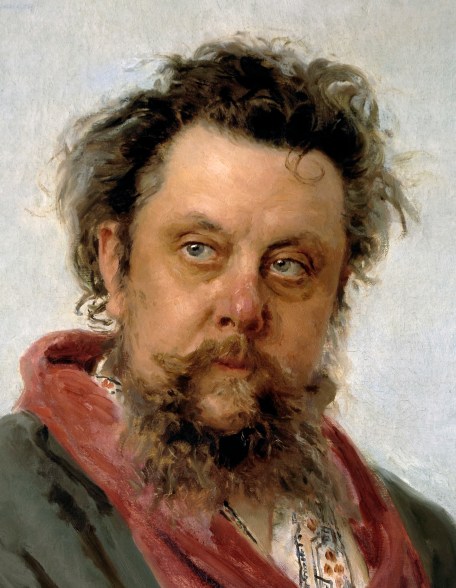
Anyway there he is above in close up, in Repin’s famous portrait from 1881, which appeared in the marvellous Russia and the Arts collection at the National Portrait Gallery a couple of years ago. He looks a bit rough for sure. Worse still when you realise he was just 42 and died a few weeks later.

Easy to see what the colourist Ravel, as many others have done subsequently, was smitten with MM’s big ideas and couldn’t resist the temptation to smooth off the rough edges. The original piano suite of Pictures at an Exhibition was inspired by a posthumous retrospective of the work of artist Victor Hartmann, MMs mate who died aged 39. Mind you MM’s musical images, as you might expect, went way beyond whatever Hartmann envisioned, but the concept of the exhibition, with the repeated Promenade being us the viewer, holds the whole thing together and adds an ironic, detached air to the bombast. On the piano it doesn’t entirely work but in Ravel’s hands something magical emerges. Ravel used Rimsky-Korsakov’s edition of the piano original so a few changes were made but you get the feeling that MM would have been happy with the result even if he may not have known how Ravel got there.

It might all be very familiar but it the right hands, and the LSO and Gianandrea were the right hands, it can still be thrilling. Bydio, Baba-Yage and the Great Gate of Kiev didn’t disappoint. Boom. If you are a classical virgin and want to find a way into live performance there is no better way. You won’t stay there as you move on, and you may end up thinking it is all a bit daft, but the hairs on the back of your neck will still stand on end whenever you return to it.

Rock’n’roll. Sort of.


Beethoven and Shostakovich from the LSO at the Barbican review ****

nosedajpg

London Symphony Orchestra, Gianandrea Noseda, Nikolai Lugansky (piano)

Barbican Hall, 8th April 2018

  • Beethoven – Piano Concerto No 4 in G major, Op 58
  • Shostakovich  – Symphony No 8 in C minor, Op 65

I could be imagining it but the LSO seems to be notching up a gear, from its already high level, each time I hear it. You would never get to hear Shostakovich under Sir Simon Rattle’s baton but here we had one of their two Principal Guest Conductors, in the shape of the inestimable Gianandrea Noseda, tackling DSCH’s mighty gloom-fest No 8, and delivering as good a rendition as you are likely to hear. In recent years, if I wanted to hear convincing performances of DSCH symphonies I would probably look elsewhere, to the LPO and Vladimir Jurowski maybe, though the last time I heard them take on No 8, at the Proms in 2015, it wasn’t perfect.

It is all about nailing that epic first movement. I say movement but let’s be honest it is pretty much a symphony in itself. Weighing in at a few minutes short of half an hour, depending on tempi, it winds up, through marches, to an immense tutti, strings blazing, drums rolling, and most of the woodwind and brass involved, before subsiding back to the immense adagio recapitulation of the second theme, with woodwind solos, that DSCH excelled at and which seem to cross all 11 of Russia’s time zones. And, it the conductor and orchestra aren’t careful to establish the line, it can feel like several hours. The tunes themselves aren’t complicated, the key “fate” motif is laid out right at the start, before the two lyrical themes are developed, and it is the fate motif to which orchestra returns before the fabulous cor anglais solo. Time for the LSO’s Christine Pendrill to shine which she did. Her woodwind colleagues also get there time in the sun in the later movements, notably the picccolo of Patricia Moynihan, the bassoon of Rachel Gough and the bass clarinet of Renaud Guy-Rousseau.

Having come out the other end of this movement. DSCH then slaps you, first with one of his textbook sardonic, militarised marches, and then with a moto perpetuo with screams that reeks of the battlefield, (think planes buzzing overhead) and contains the second of the symphonies massive tutti climaxes. The following slow passacaglia movement reworks the fate motif through brass, strings and, memorably, into the bass, before we get some relief in the concluding C major rondo kicked off by the bassoon solo. Even here though we get a repeat of the howling tutti before bass clarinet takes us to some sort of rest with alternate pizzicato and sustaining high strings (the fate motif inverted). As in the first movement, this final allegretto has plenty of action for snare and bass drums and trumpet calls.

DSCH claimed the symphony was, overall, uplifting and life affirming, pointing to the brighter, dancey, folk rhythms in that finale. He must have been taking the p*ss, as so often, given the extreme violence and suffering which characterises the previous movements. This was written over 10 weeks in 1943. Those punters who were expecting a sequel to the story of patriotic resistance apparently laid out in its predecessor, the Leningrad, were sorely disappointed. The Nazis were on the back foot now in Russia but, in retrospect, Dmitry was never going to big up Stalin and the leadership for saving Mother Russia. Its ambiguities are barely concealed, and, when DSCH was once again pilloried for his pessimism in 1948, it was singled out for special criticism.

Yet, for me, all of these middle symphonies wrestle with the same dilemmas. They are just music, so we must be careful not to get sucked too far into the “what did DSCH really mean” cottage industry, but, if we accept that context had an impact then it seems right to believe, that these symphonies, warts and all, are warnings against the depths to which humanity can sink whatever the ideological backdrop. This is not a symphony to set alongside other C minor tragedy to triumph belters, Beethoven 5, Mahler 2, Bruckner 8, it is too brutal overall and the light at the end of the tunnel isn’t bright enough, even with the ocassional tender passages, but I do think it is DCSH’s best, alongside 5 and 10.

Mr Noseda and the LSO are engaged in recording a DSCH symphony cycle. Not sure if this will form part of it but it would be a fitting contribution, assuming the engineers master the Barbican sound. My benchmark recording, as it so often is, is from the maestro Haitink with the Concertgebouw. This performance matched it.

I am afraid I wasn’t as convinced by Nikolai Lugansky’s rendering of Beethoven Fourth Piano Concerto. Mr Lugansky is highly regarded, seen as sympathetic to the music and unshowy, but he is keen on his tinkly rubato, whereas I like my Beethoven direct and muscular. This was too Romantic and insufficiently Classical if you take my meaning. Noseda and the LSO offered up a perfectly apposite support, especially in the strings, but yielded too much to the piano in the second movement, and especially, concluding in the rondo, so it all went a bit arpeggio crazy. Mr Lugansky encored with some Mendelssohn which didn’t help my mood

Still it’s Beethoven and it wasn’t that annoying. And given the quality of the Shostakovich it was a minor irritant. Gianandrea Noseda and the LSO tackle No 10 next. My favourite. Can’t wait.


Twentieth Century Masters: LSO at the Barbican review ****

orig_59afd6d959fea7-94052844

London Symphony Orchestra, Simon Rattle, Isabelle Faust

Barbican Hall, 14th January 2018

  • Janacek – Overture: From the House of the Dead
  • Elliott Carter – Instances
  • Berg – Violin Concerto
  • Bartok – Concerto for Orchestra

Back to the Barbican for another round with Sir Simon Rattle and the LSO, though this was more familiar ground (for me) compared to the previous outing (Rameau to Mahler: LSO at the Barbican review ***) a few days earlier. And back to my more usual perch. Once again the Hall was pretty much full to the rafters, and, encouragingly, it looked liked a very youthful audience. (Or I am ageing more rapidly than I thought). Anyway, on the subject of age, the thread here was orchestral works written near the end of their lives by these four very different composers. All of which gave a chance for the whole orchestra to shine.

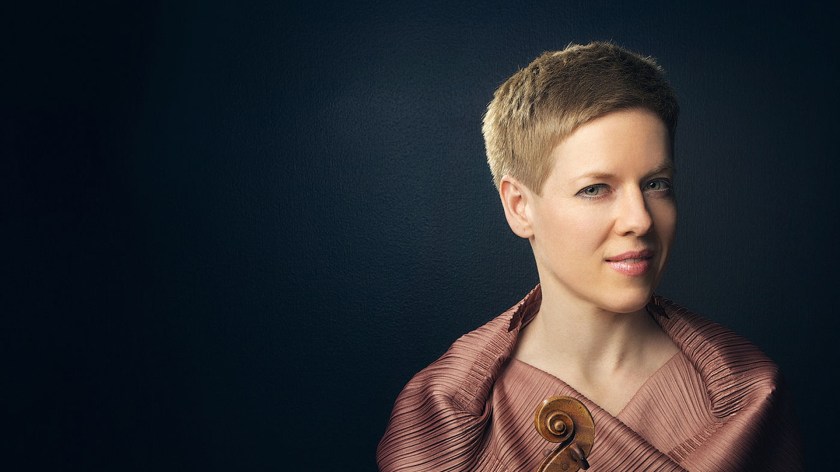
Now the main draw for me here was Isabelle Faust. I think she is probably the best current violinist in the world. Mind you, as is my wont, I have gone all hyperbolic in this claim with little evidence to back this up. So, more exactly, the best violinist I have heard in the past couple of years, based on recordings and her Bach outing last year at the Wigmore Hall (Akademie fur Alte Musik Berlin at the Wigmore Hall review *****).

As it happens I saw a fine rendition of the Berg Violin Concerto performed by another favourite violinist in the elfin form of Patricia Kopatchinskaja last year at the RFH with the LPO under the baton of Vladimir Jurowski. And I recently invested in the benchmark Levine/Mutter recording, (even though I am not entirely convinced by Ms Mutter). Now I am not going to pretend that listening to Berg comes easily to me, but even I can hear that there is a rich depth in his works from the combination of passion, intelligence, serial technique and romanticism, that rewards persistence. I rashly signed up for a performance of Wozzeck at the Frankfurt Oper a couple of years ago in German with German sub-titles (FYI I don’t speak German). Unforgivably I bought the cheapest ticket up in the gods. It is a wonderful auditorium but I could only see half the stage. That was still enough to be transfixed by an outstanding production. But most of all it meant I had no choice but to get lost in the score. Stunning. Add to this the Lulu in 2016 at the ENO directed by William Kentridge, which I confess was beyond me in parts, but was visually spectacular, and I am now well on the road to Bergian conversion. Mind you, what with his long(ish) musical education under Schoenberg, the proscription of his music under the Nazis and his early death, aged 50, after a bizarre insect biting incident, there isn’t too much composition to get your head around.

Now this Violin Concerto isn’t like others in the canon. It’s tricky for sure, and asks a lot of the soloist, but it isn’t showy. Orchestra and soloist have to mesh together. It is pretty much the last piece Berg wrote and is dedicated to the memory of Manon Gropius, the daughter of Alma (Mahler’s widow) and Walter Gropius (Bauhaus founder), who died from polio at 18. Apparently she was a captivating young woman in the manner of her mother.

The two movements are each split into two parts and with the waltz emerging from the material set out in the first movement, and the chorale emerging from the more rhythmic, almost cadenza, in the second movement. This the tempo is reversed in each. I can sort of pick out the established musical structures from within the twelve tone architecture but couldn’t tell you exactly what was going on. Suffice to say this is a dark, brooding, self-absorbed piece for the violinist and Ms Faust seemed to capture this utterly. She seemed lost in music, caught in a trap, to paraphrase Philly’s finest sisters, There are times when the whole edifice becomes just that bit self indulgent but this is where Sir SR’s insistence on picking out the orchestral instrumentation pays dividends. I hadn’t realised how detailed are the parts for harp, clarinet, viola, flute and trumpet were in this piece. I do now.

Which brings me to the Bartok Concerto for Orchestra. Now this is a piece written with the express intention of letting everyone in the band have a solo, like some prog-rock group in its 1970s pomp, It is an obvious, but still inspired, choice to present to an audience in a first season, and, I would hazard a guess, if you are engaged in a bit of musical team-building. I have Rattle’s first, (I think), stab at this when he was a younger at the CBSO, (though the bargain basement Solti/Chicago Symphony Orchestra version tops it). Anyway Sir Simon knows his way around it, and it brilliantly matches his predilection for coloration and deliberation.

I am not going to lie. It blew my socks off. There is just so much to listen to here. The first movement strings and brass, coming out of the undergrowth, with the woodwind, led by a solo oboe, getting their turn in the spotlight. The wonderful second movement scherzo with its contrasting intervals, an eerie disco. Next up an Elegia, exactly as it says, with the strings swirling around and up to be met by bold brass chords and a piccolo sticking its little nose in. The second scherzo quotes, mocks and, ultimately, compliments Shostakovich with tuba and harps getting involved, and the final movement works in classic Bartok folky stuff with a gallop to a rousing chorale at the conclusion.

I reckon we won’t have seen the last of this piece, or of Bartok, from Sir Simon and the LSO and it can probably get even better from here. Hopefully too we will see him rework some of his other C20 repertoire. Some more Stravinsky for sure, but I’d loved to hear his latest takes on Britten’s music for orchestra and, please, some, no all, of the Nielsen symphonies.

Anyway the other two pieces in this concert were tried and trusted composers for Sir Simon, Janacek’s Overture From the House of the Dead didn’t quite get the pulse racing in the way the Bartok did, but still suggested what the LSO is heading towards. (I see the House of the Dead will see a new production at the Royal Opera House in the forthcoming season. That has contemporary relevance written all over it). Sir Simon has always championed Elliott Carter and I can see why. This was another of those short, but inventive, comedy pieces that Carter was turning out in his musically fecund 90s and even into his 100s, but it has a strangely, moving ending.

Can’t wait to see what the Scouse Gandalf will programme with his band for the forthcoming season. Hopefully not too much Mahler, Bruckner, Sibelius please.


Rameau to Mahler: LSO at the Barbican review ***

rattlelsoedit7

London Symphony Orchestra, Simon Rattle, Magdalena Kozena

Barbican Hall, 11th January 2017

  • Schubert – Symphony No 8 Unfinished
  • Mahler – Ruckert Lieder
  • Handel – Three Arias
  • Rameau – Les Boreades Suite

Now I admit I hummed and harred about this particular gig. I am as excited as the next person about the return of Sir SR to London to lead the mighty LSO, but also recognise that, as his musical taste and mine are not entirely congruent, I had better carpe diem where I can. When he does serve up a favourite, chances are it is going to be the dog’s proverbials, to wit the simply stunning triptych of Stravinsky ballets, a highlight of last year (Stravinsky from Rattle and the LSO at the Barbican review *****).

So eventually I took the plunge here, intrigued by the Baroque on offer, recognising that I need to do more work on Schubert and wanting to see whether Sir SR is as nice to his wife, mezzo-soprano Magdalena Kozena, on stage as he is to the LSO and everyone else. The Mahler Ruckert Lieder and the three showy Handel Arias, one from Agrippina and two from Ariodante, certainly meant the missus had to put a shift in, two frocks and an hour in total either side of the interval. The Rameau has been a staple party piece for the Berlin Philharmonic for years, and it seemed interesting to see what the LSO would make of it.

As it turned out this programme also piqued the interest of Mrs TFP, who is rightly suspicious of my Renaissance/Baroque and Contemporary leanings, but who was happy to come along for the ride here. The Germanic quotient was also sufficiently high for her.

So what did I learn. Well …. aaah … I still don’t think I am ever going to embrace Schubert. I assume Sir Simon and the LSO gave this a respectable work-out but it is still just doodling for me, without the rhythmic discipline of Beethoven and with too many strands. Even the finished bits sound unfinished to me. I am really sorry as I know there are a lot of Schubert groupies out there.

Now the Mahler took a bit of time to get going but songs 3,4 and 5 (in Rattle’s sequence) let loose all of that Mahlerian drama and suspense, with the growly stuff at the bottom, the sniff of folk tunes and the aching strings all deployed to great effect. Mrs TFP combed the text scrupulously for mistranslation and therefore snaffled up the stories. I didn’t understand a word of what Ms Kozena was saying and, given it is the usual Romantic, Love/Fate/Man/Artist tripe, (with one about a lime tree apparently), I didn’t really care, but at times the noise was ravishing. Unsurprisingly I guess soloist and band were well matched thanks to Sir SR, though I wonder if Ms Kozena may have topped these renditions in previous performances. No matter. This was concentrated Mahler which for me is a good thing.

On the subject of concentrated musical pleasure, I cannot believe I am the only one who prefers to take his Handel operas from the set lunch, and not the full tasting, menu. The music induces a nice warm glow, for sure, but they can go on a bit. So I thought a triple helping of well chosen arias would hit the spot. These three are undoubtedly showy, particularly the final Dopo notte, but it didn’t feel as if orchestra and soloist were entirely comfortable in parts, and, I was reminded that old George Fred, once his lady singers got up a head of steam, was apt to encourage them further with interminable repeats. Even so it left me grinning from ear to ear.

As did the Rameau suite. So this is apparently one of those all singing, all dancing (literally) extravaganzas that the French Baroque invented. It was Rameau’s last opera tragedie and boy did he chuck the kitchen sink at it judging by this suite. An everyday tale of windy Gods, the orchestral colour is dazzling, with state of the art technology to boot. I absolutely adored it, as did Sir SR and the LSO. Very funky.

So another entertaining evening in the hands of Sir Simon, but also a reminder not to push the boat out too far in terms of repertoire I enjoy.


Stravinsky from Rattle and the LSO at the Barbican review *****

orig_59ae8c22d00135-63398832

London Symphony Orchestra, Sir Simon Rattle

Barbican Hall, 24th September 2017

  • Igor Stravinsky – The Firebird (original ballet)
  • Igor Stravinsky – Petrushka (1947 version)
  • Igor Stravinsky – The Rite of Spring

So here is is. The second coming. Sir Simon Rattle kicks off his tenure at the helm of the LSO. I missed the opening concert of British composers (annoying) and the Damnation of Faust (no interest) but this was always going to be a must see so I booked as soon as it opened.

Now it has been perfectly possible to see Sir Simon in London with the LSO, (for example, a Mahler 6 and the Ligeti Grande Macabre earlier this year), and other bands, (a Haydn Seasons and the late Mozart symphonies both with the OAE stick in the memory), but this was the first opportunity to gauge what will be possible for orchestra and conductor to achieve now they have quality together.

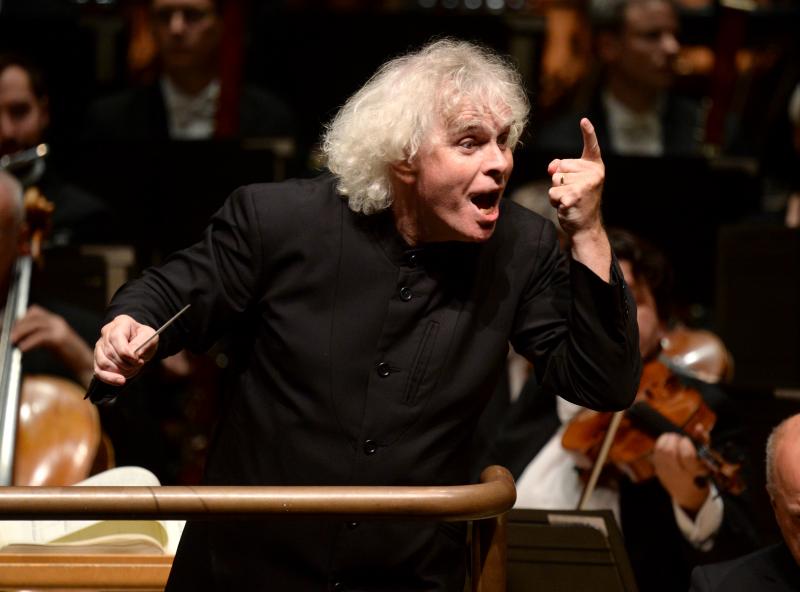
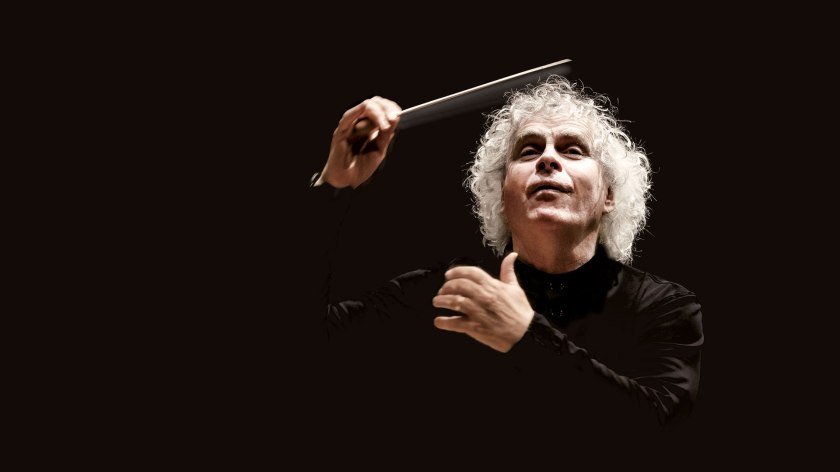
So it was an expectant mood in the hall as the Scouse Gandalf took to the podium (no need for scores – it is all in his head), after a few words with a clearly pleased as punch Lord Mayor. And then all hell broke loose. This was simply breathtaking. For long periods I was sitting stock still (and I am a terrible fidgeter) either open-mouthed in astonishment or grinning to myself like the proverbial cat from Cheshire.

Now I like the boy Stravinsky. And the more I get to grips with his compositions the more pleasure (and intellectual stimulation) I get. But it is hard to beat these three ballet scores.

Sir Simon chose to deliver the complete Firebird ballet. This means there is more of the still late Romantic colouration and chromaticism before we get to the Kashchei mad disco bits which presage The Rite of Spring. This means the debt to mentor Rimsky-Korsakov and the stench of Imperial Russia (give ’em fairy tales instead of food) hangs heavy in the air. Tchaikovsky and the rest of the Five are also on show. As usual Sir Simon was not interested in galloping through the first half of the exotic first tableau, to make sure every ounce of orchestral magic was received and understood by the audience. Which meant that by the time we got to the stunning apotheosis we were begging for release. Oooh. You just knew Igor, after this first lucky break, was going to take this to the next level.

Which is what he did. For Petrushka we got the 1947 streamlining though this is the standard nowadays. Here we start to get the big repeated rhythms and motifs which are what took the world of Western classical music by the scruff of the neck and turned it into a new direction. The late C19 structure is sort of still visible but in a kind of ironic way. The thrust towards Modernism and the age of machines is starting to take over though with rapid changes of direction, repetitions, major keys piled up and loads of banging tunes. And at the centre was the LSO’s own pianist master, Philip Moore.

A well earned break and we got to Sir Simon’s Rite of Spring. What a racket. In a brilliant way. The orchestra throughout was using every available inch of the Barbican stage with 60 odd strings on show and more brass than Yorkshire. And in the giant rhythmic climaxes they all got a look in. My ears were pounding and I was at the back of the circle. Heaven knows what it must have been like for the captives at the front of the stage. I have heard some marvellous Rite of Springs, (in my view, I cannot vouch for the ear of the professional), but this topped the lot. You can see why everyone got so enervated at the first performance in 1913. I was tempted to jump out of my seat at the end of Dance of the Earth and yell “go on my son”.

Now the LSO is top notch. We know that. Best in the world. Maybe. Best in my world. Definitely. But I have never heard them sound like this. Under Valery Gergiev, sometimes with interpretations that seem to be dialled in a couple of hours before a concert, they looked, and sounded, frustrated. Not here. They were having a blast. I have never seen an orchestra looking so happy. Every single section sounded faultless to me bar a couple of overly-enthusiastic brass fanfares. Yet is was the woodwind which stood out. And when the strings where belting out as one, like some giant single instrument, or capturing a pianissimo so quiet time was suspended, it just felt good to be alive.

So all in all a genuinely memorable evening. I cannot wait for the next from this marriage made in musical heaven. Unfortunately a fair slice of Sir Simon’s standard repertoire is not entirely to my taste but there should be enough from the C20 and contemporary commissions and from Classical masters. Indeed in January he will take the LSO back to the Baroque in part (Handel and Rameau) alongside Mahler’s Ruckert Lieder (with the lady wife singing – his, not mine) and Schubert’s Unfinished Symphony. There is also a very attractive C20 programme with Janacek, Carter, Berg’s Violin Concerto, with the marvellous Isabelle Faust, and Bartok’s Concerto for Orchestra. And there is plenty of Mahler, as well as Tippet, Bernstein and Strauss for those attuned to that sort of thing. Bring it on.

London Symphony Orchestra at the Barbican review ****

dd962845a2824add53af118e7be7a9dcdb84a5b710a55991534227558486c096_dowz

Anne-Sophie Mutter, Sir Mark Elder, London Symphony Orchestra

Barbican Hall, 7th May 2017

Modest Mussorgsky, arr. Rimsky-Korsakov – Prelude to Khovanshchina
Tchaikovsky – Violin Concerto in D major Op.35
Shostakovich – Symphony No.15 in A major Op.141

Who’d be a Russian composer eh. Mussorgsky drinks himself to death at 42 (look at the famous Repin portrait to remind you there is no glamour in this form of self destruction) and p*sses away whatever talent he may had have (one powerfully dramatic opera in Boris Godunov). Tchaikovsky may have taken his own life, or fell victim to cholera, at just 53, and seemed by many accounts to have felt compelled to keep his sexuality a private matter. And Shostakovich lived a life of allusion and inference which kept his true feelings about the society he lived and worked in a mystery.

So you’d be surprised if they produced a jolly night out musically. Well then you might have been surprised. Well maybe only a bit, as some of this did sound exactly as you might have expected given these personal demons. Yet in other ways, these pieces seem to me at least quite a long way from the narratives that are routinely get trotted out to explain the work of these three composers.

So with the Khovanshchina Prelude we have the opening to Mussorgsky’s planned grand historical opera exploring the changes in Russia society in the reign of Peter The Great. Unfortunately it never got finished and Rimsky Korsakov had to step in and tszuj it up a bit and smooth it off. I am afraid that for me it is just a bit of a meandering melody with no great interest. The Tchaikovsky concerto is properly blingy with memorable tunes but gets a little less endearing with each hearing I think. The Shostakovich, on the other hand, gets more interesting for me with each hearing. Four movements, usual proportions, biggish orchestra but balanced. But what he then does with this structure is all over the shop. Lots of single instrument lines, loads of obvious and not so obvious musical quotations, exaggeratedly simple tunes and then complex twelve note themes. The parallels with Nielsen’s 6th Symphony are often drawn which makes sense and which I always love. Who knows what he was thinking but it does seem to me to be some sort of encapsulation of all of his output before set against some sort of commentary on all that he had seen in his life. Anyway its top notch.

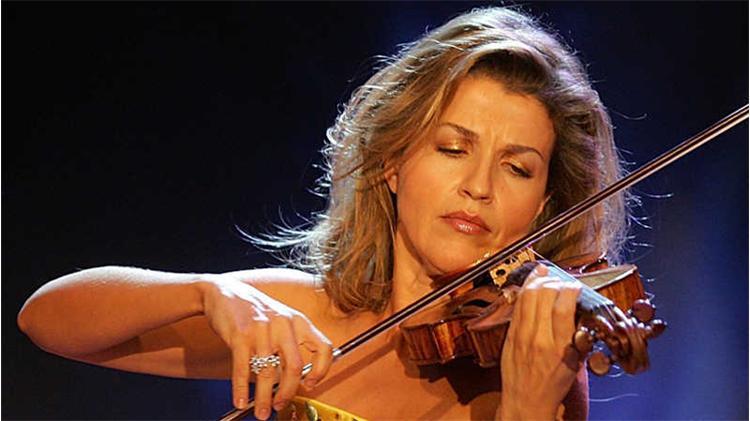
So the Shostakovich wqs the main reason for going to this concert (it is the programme that largely drives my choice now that I have a firm handle on the boundaries of what works for me like in the classical music world). However I am also keen to hear as many of the great performers and conductors and this was a chance to knock a couple off the list. I have to say Anne-Sophie Mutter must be the best violinist technically I have ever heard but this almost felt too perfect and furiously methodical. Still I will remember this performance, especially when she turned to the LSO to implore them punp it up, even if I am not sure I really enjoyed it. For the Shostakovich though I can see why Sir Mark Elder is held in such high regard.

So all in all a very fine programme and I will add Sir Mark Elder to the list of must see conductors (when they have the right pieces) which includes Rattle, Haitink, Jurowski, Jansons, Salonen and Chailly.