
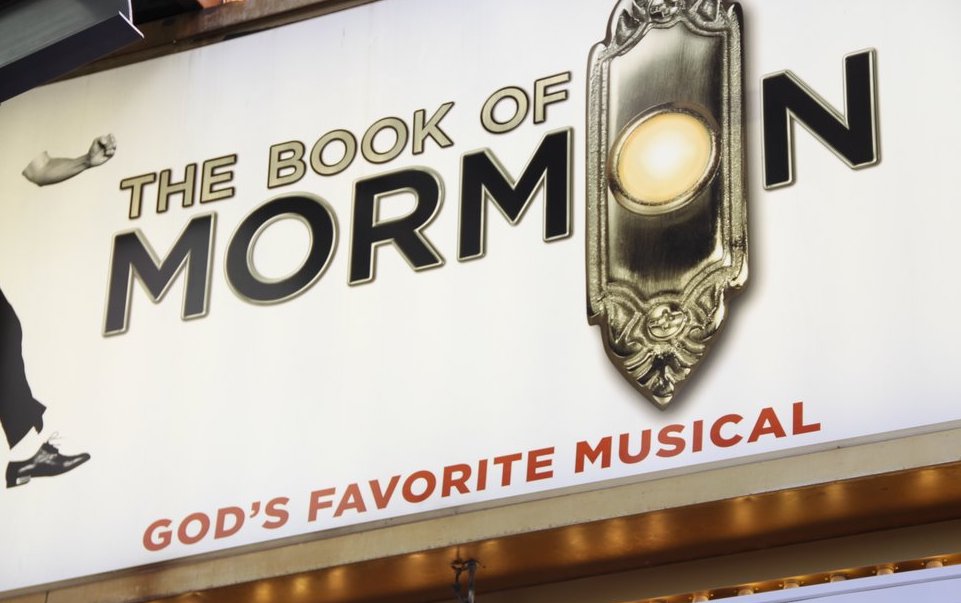
The Book of Mormon
Prince of Wales Theatre, 20th April 2019
Better late than never. Six years after it opens the Tourist finally gets to see The Book of Mormon. As all Tourists should. Thanks to LS and LGN.
Now the previous musical theatre adventures with the two of them have not been unalloyed successes. The Lion King visit predates this blog. Just as well as there would be no review for the simple reason that I don’t do reviews of stuff which is awful. Seems unfair. But it was. Sorry. Les Miserables was better, though not as good as I remember first time around, reflecting increasing age and pretentiousness on my part. Though I also think my misgivings may actually in part reflect the source material. Victor Hugo’s story is just too melodramatic and too chock full of coincidence for me to swallow. This was clear in Andrew Davies’s recent TV adaptation despite it being crammed with cracking acting talent. Mr Davies has penned many of the best things I have seen on the telly. House of Cards (UK not US), Middlemarch, Vanity Fair, Daniel Deronda, Tipping the Velvet, Bleak House. His War and Peace also put in a strong showing, though maybe didn’t quite encompass the full scope of the novel. For that you probably need the full weight of the Soviet authorities behind you. On that note I see that the mid 196os four part adaptation by Sergei Bondarchuk has been recently restored and is about to be released on DVD. Can’t wait. Anyway the idiosyncracies of Mr Davies’s approach, focusing on key episodes and key character traits, which has worked so well in the past, didn’t quite cut it for me in Les Mis. But I was also painfully aware of just how contrived the story is. Which probably is the major reason for my resistance to the musical.
The other problem I have with popular musicals is that they are, er, popular. If anyone says “ooh you like theatre, they you must see this” and proceeds to recommend a West End musical, then the snob in me is guaranteed to dismiss their opinion. This is not because they are likely wrong. It is because I am a w*nker. But, in my defence, as with The Book of Mormon, where numerous people, whose opinion on all other matters I value very highly, have implored me to see it, I will eventually back down. As with TBOM.
(So on that basis, and having made a rash promise to LS, if you are prepared to wait a few years, eventually I will gush forth on Hamilton, most likely with a grudging admission that it is very good, though still not in the same league as Ben Jonson, Brecht, Edward Albee, Caryl Churchill, David Harrower, Ella Hickson or whichever “serious” playwright I am obsessed with at the time and wish to show off about).
Now the first thing I would say about TBOM is … what a very nice theatre the Prince of Wales is. The Tourist detests most West End theatres. I hate most late Victorian/Edwardian neo-classical architecture, (though I can get my head around Frank Matcham’s buildings), facilities are usually dreadful, seats cramped, sight-lines awful and sound poor. The Prince of Wales’s jaunty Art Deco vibe, dating from 1937, and expertly tarted up in 2004, is a delight. We were up in the Circle, the Tourist being a cheapskate, though to be fair even the best seats in the house here are not outrageously priced given the entertainment. Whilst the Circle may be pitched at an unnervingly steep angle, and the seats are ram-rod upright, this does mean the view is perfect, and, with the cast miked up to the eyeballs, even the hard of hearing Tourist could hear every word. Just a shame I’ll probably never go back as this will probably run for many more years until replaced by whatever the musical magpie Andrew Lloyd Webber can cobble together for his parting swan song musical.
So the Tourist, pleased with the accommodation, was open to persuasion on the entertainment. For the first ten/fifteen minutes or so however he was anything but. For that is how long it took him to adjust to the tone of the satire and depth of musical parody. Oh no, was it just going to be a bunch of crude, scattergun jokes that mocked the US and religion (permissible for us liberal, metropolitan elite smart-arses), but in doing so was needlessly and uncomfortably offensive about Africa (most definitely not permissible)? And was this childish music all there was? It didn’t take long though to realise that is much cleverer, and, despite surface appearances, much subtler than that. TBOM makes some telling points about the idiocy of Mormonism, and by implication, all religious dogma, but not in a snarky way. The irony in the portrayal of Uganda and its people is rapidly revealed; this is taking the p*ss out of the way we, Lion King I am looking at you, see Africa.
Every trope of musical theatre is trotted out but in an utterly disarming way. The songs are not so bad that they are good. They are so accurate in the styles that they are undercutting that they are good. And, on occasion, actually just good in themselves. The whole thing is suffused with a sense of knowing fun such that, by the end, it doesn’t actually feel like satire anymore, in fact the story and characters take over.
I hated South Park, (another reason for trepidation going into The Book of Mormon), but loved Team America and now loved this. So I guess I have to hand it to the Trey Parker and Matt Stone combo. They are far smarter than I thought. Mind you, based on the brilliance of the musical pastiche, (the whole history of comic opera and theatre seems to be be lovingly teasing somebody else), Robert Lopez might be the main man to thank. Maybe I need to see his other hit, Avenue Q. An extraordinary admission for a man whose idea of theatrical heaven would be Brecht in German in a car park.
There are about a billion people involved in creating The Book of Mormon named in the programme, (in fact, for once, I wish I hadn’t bothered to buy one since a list is about all it is), so I will just single out the cheesy choreography, (and original direction with Trey Parker), of Casey Nicholaw and the performances of Tom Xander as the hapless hero Elder Cunningham, Leanne Robinson as (correctly named) Nabulughi and, especially, Steven Webb, who has got stage sparkle and knows it, as Elder McKinley.
So there you have it. A show that mocks its subject, its characters, its genre, its audience and itself. But also loves all of them. And is very, very funny, (unless you are a blue rinse conservative or grim class/identity warrior), very entertaining, musically diverse and even, surprisingly, uplifting. Though maybe not in Spooky Mormon Hell Dream, my particular song highlight. I see from the original 2013 reviews that all the papers bar, predictably, the Daily Heil, loved it. That should have been the only recommendation I needed.
Don’t be a dick like me and make sure, if you haven’t seen it, that you add it to the bucket list.
 At Home He Feels Like A Tourist