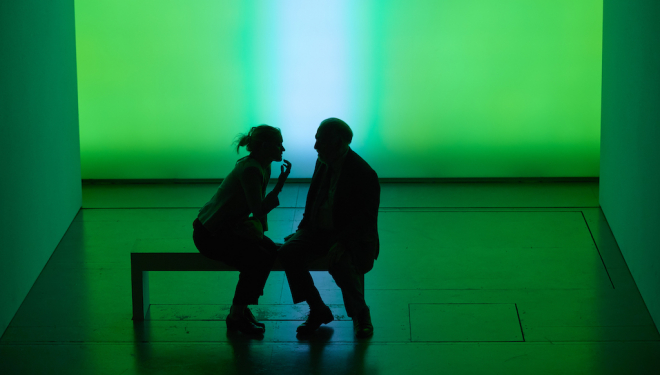
Heisenberg: The Uncertainty Principle
Wyndham’s Theatre, 9th November 2017
Everyone’s at it. The “science” play. Science, whether directly through using theory to inform plot, or indirectly, often through the impact of ecological or other catastrophe, has underpinned many of the best new plays I have seen in the last couple of years. Steff Smiths’s Human Animals, Nick Payne’s Constellations and Elegy, The Forbidden Zone from Schaubuhne Berlin, Caryl Churchill’s Escaped Alone, Lucy Kirkwood’s The Children and Mosquitoes and Christopher Shinn’s Against all have a healthy dose of science in the mix.
Mind you this is nothing new. The brainy playwrights have been at it for decades. Think of Stoppard’s The Hard Problem, even Brecht’s Life of Galileo, the mighty Caryl Churchill’s A Number and Love and Information. Lucy Prebble’s The Effect, Timberlake Wertenbaker’s After Darwin. Indeed Michael Frayn in Copenhagen even took Werner Heisenberg himself as the subject for his play. Nor is it really surprising given the importance of mathematics and physics to our lives. After all it is the role of theatre to comment on, engage with and maybe even influence the big ideas that underpin our world. But it does take a fierce intellect to make this sciencey stuff work.
It was probably only a matter of time before the prolific, eclectic and clever Simon Stephens came up with his own variation. Like Lucy Kirkwood in Mosquitoes he takes a big idea from theoretical physics to create a metaphor for the actions of his characters, though I am not sure he is as successful. Heisenberg’s Uncertainty Principle states that if we measure the position of a particle with ever greater precision, then at some point we have to accept a correspondingly increasing imprecision in our measurement of the particle’s momentum. (Thank you Wiki and the programme – I would be lost without you). When we look at the little stuff, like electrons, its behaviour sometimes emulates a particle bouncing around but sometimes it is like a wave. Apparently “vagueness” is built into nature at the quantum scale. Yet we humans are always deluding ourselves that we have control and that there is order around us. We live at a larger scale than the quantum so see the physical world obey laws and we can trust the effect of statistical averaging.
Allied to the Uncertainty Principle is the idea of the observer effect. The act of observing will influence the phenomenon being observed. At the quantum scale for us to “see” and electron, a photon apparently must interact with it, thus changing the path of the electron. You can see why this concept might appeal to the inventive playwright.
(I will refrain from opening up to the idea that some neuroscience even suggests our concept of “free will” is an illusion. “Free won’t” maybe, but the electrical activity in or brains that prompts an action seems to come before our “conscious” realisation of the intended action. Get your head round that).
Anyway this randomness is the idea Mr Stephens builds into his play. Unpredictability is built into our lives. When forty something garrulous, and dissatisfied, American expat Georgie Burns (Anne-Marie Duff) randomly kisses, on the back of the neck, mid seventies lonely butcher Alex Priest (Kenneth Cranham) on a bench in St Pancras station, no-one, least of all them, could have predicted where this would lead. As it happens it leads to a beautifully observed affair which brings happiness and lashings of extra life to both.
Now I guess that, at the end of the day, you might be able to take any other boy meets girl (or boy meets boy, or girl meets girl, or other feasible combinations) stage double hander and overlay the same idea. Nick Payne’s Constellations covered similar territory albeit with a very different formal structure. Indeed if you jettisoned old Heisenberg and just took the play on its own merits you wouldn’t lose much. You would ask yourself why would Georgie ever approach Alex in the first place, but might soon be persuaded as to why, and indeed would be offered some alternative explanations. The question of the age gap would loom large but fairly soon be dismissed, as it should be. Some of the twists in the romance might seem a little contrived but then you could say the same about all romances, real or imagined.
That the play works independent of its big ideas is down to the performances, and to a lesser extent, the sure direction of Marianne Elliot, the much praised set of Bunny Christie and the lighting of Paule Constable. In Anne-Marie Duff and Kenneth Cranham we have here two actors at the top of their game. In fact they are so at the top of their game that they are both banging in hat-tricks on a weekly basis like the love-child of Harry Kane and Cristiano Ronaldo. Ms Duff is always better than the play she leads, even when the play itself is perfect. Saint Joan, Cause Celebre, Strange Interlude, Husbands and Sons, Oil, the unfairly maligned Common. In her every major London stage role in the last few years she has, to overwork the sporting metaphors, banged it out the park. Of course, there may be some cause and effect here, as I will see everything she stars in. Even so, for my money, she is on a par with the theatrical dames of the prior generation. I am literally wetting myself with excitement at next year’s NT Macbeth with her and Rory Kinnear.
Now I was not as impressed as the smart money with Florian Zeller’s The Father thinking it a bit too tricksy, (mind you I had an uncomfy perch on the night of performance so my view might, literally, have been guided by arse), but there was no doubting Mr Cranham’s sterling performance. Here his Alex starts off, unsurprisingly, a little discombobulated by Georgie’s approaches. As the relationship unfolds, and he opens up, we see the joy fill first his face and, eventually, his whole body. Ms Duff similarly is as skilled in bringing Georgie to life through her movement as much as her words. Together their timing is perfect with the interplay of lines, and pauses, perfectly modulated. As Alex explains, when talking about his love of music, it is all about “the space between the notes”. They get it.
My guess is that, in lesser hands, this might all be far less effective. Simon Stephens is a wise man I think because he seems to know how important is the rest of the collaborative eco-system. Whether this be the writers whose works he has adapted (Chekhov on multiple occasions, Mark Haddon for The Curious Incident of the Dog in the Night-Time. Bizet for Carmen Disruption) or directors (Marianne Elliot, here and many times before, Carrie Cracknell, Katie Mitchell and, successfully, the erratic Ivo van Hove).
More importantly he is a very wise man because, as he says in the programme, “I think I only write plays because I’ve never been in The Fall”. There are those of us who recognise that the most important artist in the world is alive, well (hopefully) and using his free over 60s bus pass in Prestwich, and those of you who don’t.


 At Home He Feels Like A Tourist