How difficult can it be to get to Kilburn? Very it would seem if you are the Tourist, this being the second time this year that he has missed the start of a matinee performance, (and having cut it perilously fine on another occasion). Message to self. Stop twatting about with the Overground and buses to get here and stick to the Jubilee.
Anyway it was a somewhat frustrating idea to watch the first scene of Wife on the tiny black and white stage telly, however accommodating the ever friendly front of house. Aussie Samuel Adamson’s latest play, (you may know him from The Light Princess musical at the NT of his Chekhov/Ibsen adaptations), is an intertwining affair which examines the relationships of four couples from 1959 to an imagined 2049. Ibsen is the stepping off point. Specially A Doll’s House, (there is a lot of Doll’s House inspiration coming up, see the Lyric Hammersmith, the Young Vic and International Theater Amsterdam).
After that scene and the infamous door slam, Wife opens with stiff-necked Robert (Joshua James) properly wound up after the performance, which he sees as an attack on the sanctity of marriage. His wife Daisy (Karen Fishwick), who dragged him along, doesn’t agree. She is in love with Nora the character and yearns for a similar freedom. Things ratchet up when we find out she is also in love with the actress, Suzannah (Sirine Saba) who plays Nora in the production. This is the scene I missed “live” but it was still plainly a compelling set up even if I couldn’t completely follow the subsequent ding-dong exchange of ideas and feelings between these three characters .
Next up 1988 and a couple of young gay men, with something of a class difference, the posh, volatile Ivar, (Joshua James again, named after one of Nora’s children), railing against the straight world, Thatcher and Section 28 and the younger, not-yet-out Eric (Calam Lynch) . They have retired to the pub after a Norwegian language version of the Doll’s House, and, after some exquisite verbal jousting, are joined by another Suzannah. On to 2019 and Clare (Karen Fishwick again) and Finn (the versatile Joshua James) who are at the Kiln Theatre bar (!) waiting for ….. well not the Suzannah who breezes in from the avowedly queer production of A Doll’s House being staged but Ivar, now 58 (Richard Cant, who also plays Peter in the first Doll’s House and the pub landlord in Scene 2), now bruised by life, and, after a while, his younger husband, bitchy actor Cas (Calam Lynch again). Clare and Ivar, as you pretty quickly surmise are connected.
And, in a final meta flourish, the finale is set in 2042, with an extract from a naturalistic play featuring Daisy, Robert, Suzannah and Marjorie (Pamela Hardman), a dresser. Now the whole point of this journey through time and coupledom is to show we are no closing to reconciling the struggle between the need to explore individual freedom, and the desire for equality, in domestic relationships, than Ibsen and his characters were in 1879.
In other hands this have could have become more than a little tricksy or worthy or muddled, but Mr Adamson pulls it off largely through the quality of his dialogue, they are some terrific lines and witty observations, and the way in which the cast it self has to shift pretty radically between the characters, even those that are linked by family ties, notably Joshua James (who has a knack of standing out in smaller roles in previous productions that the Tourist has enjoyed), Karen Fishwick (following her RSC stint, a fine Juliet, and Our Ladies from NT Scotland) and Calam Lynch (whose Claudio in the Rose Kingston’s Much Ado attracted disproportionate attention from LD, and not just for his acting talent). All three young actors served up really fine performances.
Of course it helped that Kiln AD Indhu Rubasingham took the chair herself lending customary energy to the production and papering over the cracks when words and actions pushed a little towards the artificial: these people don’t really do reflective silences. Richard Kent probably had more fun designing the costumes that the somewhat unremarkable set, as did Alexander Caplen with his sound contribution and Guy Hoare with lighting.
The proper reviews were, rightly, pretty positive overall. I have a very strong feeling that this will not be the last we see of this play.If so the Tourist will make damm sure he turns up on time.
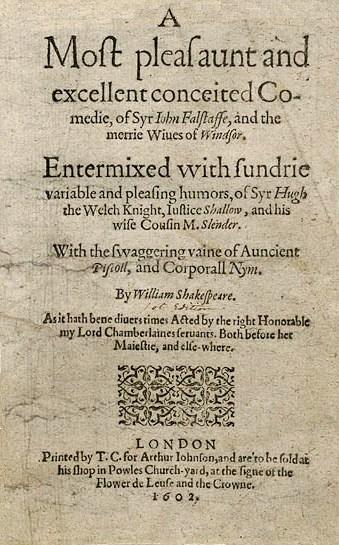
Confession. This was the first time I had ever seen a production of The Merry Wives of Windsor. The Tourist can’t remember there being an opportunity, RSC or otherwise, in those few periods of his intensive theatre-going in the past, and I don’t think there was a production of sufficient quality over the more fallow years to drag him away from the reality of life, work, kids, drink and the like.
Also, I have to admit, TMWOW has always sounded a bit limp, with the Shakespeare industry being a bit sniffy about its worth, dubbing it “the first sit-com”, compared to the other comedies, Twelfth Night, Dream, Much Ado, As You Like It, Errors, Shrew ….. in fact only The Two Noble Kinsmen of the “pure” comedies seems to get a worse rap. (Well maybe The Taming of the Shrew with its impossible to mitigate misogyny without some dubious directorial device). The other criticism seems to centre on the disappointment of taking one of WS’s most “rounded” characters, analytically as well as literally, out of the history plays and plonking him into a class-based farce as the butt of the comedy.
Well just as Barrie Rutter made a case, albeit not entirely convincing, for WS’s (with John Fletcher) last contractural obligation with his Two Noble Kinsmen at the Globe, so director Fiona Laird has served up a peach for the RSC, (though it is just about to end its run at the Barbican). All I can say is that if TMWOW is normally this funny then all those naysayers who are supposed to know their onions when it comes to the Bard need their heads examined.
If it isn’t normally this funny then Ms Laird is to be further congratulated for making it so to a contemporary audience. Shakespeare’s humour comes from plot – usually will they/won’t they romances and unlikely assignations, from – word-play – badinage, punning and bawdiness – and from physical comedy – which, obviously, is not something made explicit in a text. To make a modern audience laugh it usually makes sense to trust Will and let the plot do what it will, play down the anachronistic, and not always easy to follow, wordery and massively ramp up the caricature, mannerism and visual gags. Which is exactly what this production does. With plenty of new interpolations.
If the audience reaction at the performance the Tourist attended was anything to go by, and it seems this has been supported by critics, professional and amateur alike, this definitively worked. I laughed. A lot. In fact as much as I can ever remember for a Shakespeare comedy. It is not as all round satisfying as the best Much Ado or Twelfth Night production but it was still a revelation.
The plot is contrived. And daft. No question. One theory alleges that Will only had 14 days to come up with it after the Queen requested an entertainment for the Order of the Garter festival in 1597 to feature her favourite of his comic creations, Sir John Falstaff. Now, as I sure you all know, Falstaff is way more than just a comic buffoon, as we see in Henry IV Parts I and II, and as Mistress Quickly explains in her eulogy in Henry V. He may be vain, boastful, corrupt, cowardly, a drunk and petty criminal, but he is charismatic and he embraces life and we, and Prince Hal, therefore love him despite his faults. And he is, of course, fat and as everyone knows us fat people, with our seeming inability to control our appetites, and our apparent physical limitations, are just funny.
Humour invariably validates superiority. It takes what the group or society has deemed as unsettling, threatening or just different and turns it into something safe and tolerable. Falstaff, because the genius Shakespeare created him, is doubly funny because he is both the object of our laughter and also, because of his wit and intelligence, the source. Tricky business humour. I am sure that there are plenty of people who would be happy to make a joke at my expense because I am fat. In the same way it would probably make me happy to make a joke at their expense because they are stupid. Like I say tricky business.
Anyway I suspect big Will didn’t waste too much time mulling over the psychology of humour and just got on with the task, knowing which way the Elizabethan bread of patronage was buttered. Which explains the oft observed “lack of subtlety” in the plot and character. Yet, as all students of the situation-comedy know, the best characters in the genre have one, or more, personality traits amply exaggerated. And the best sit-com plots begin with a plausible set-up that gets incrementally ever more ridiculous. Which, give or take, is what happens in TMWOFW.
Falstaff is on his uppers. He pitches up in Windsor, or, in this production a place that feels suspiciously like Chigwell. He resolves to woo a couple of wealthy married women, Mistress Alice Ford and Mistress Margaret Page. He commands his servants, Pistol and Nym, to deliver the ladies identical love letters. They refuse and tell the ladies’s husbands. Page (Paul Dodds) isn’t too bothered but Ford is the jealous type, and he is introduced to Falstaff by the Host(ess) of the Garter Inn masquerading as a Master Brook in order to unveil Falstaff’s plans. Meanwhile, (yep there is always a meanwhile or two in these plots), three other chaps are trying to woo the Ford’s daughter, Anne; absurd French doctor Caius, asinine youth Master Abraham Slender, cousin (here nephew) to Justice Robert Shallow and young Fenton (Luke Newberry), a gentleman now bereft of his fortune.
Cue confusions, set-ups and comic revenges. By the three suitors on the Host(ess), by the two Mistresses on Falstaff, by “Brook” on Falstaff, by Ford on his wife, by everyone on Falstaff, and by Page and his wife on Slender and Caius, and by Anne and Fenton on the parents. It all ends happily though.
These farcical set pieces, replete with disguise and concealment, offer plenty of opportunity for clowning, which the cast, directed by Spymonkey specialist Toby Park, relish and have perfected over the run in Stratford and now London. David Troughton is a brilliant Falstaff, decked out in “fat suit” and priapic codpiece, and booming out his perfectly timed lines. Rebecca Lacey and Beth Cordingley are sensational as the conspiratorial and true friends, Mistresses Page and Ford, with exaggerated TOWIE accents and hamming up their humiliations of Falstaff, both in the laundry basket scene, here a wheelie-bin, and in the Woman of (now) Brentwood scene. Vince Leigh, who I remember pulled off a similar trick in Propellor’s all -male Taming of a Shrew as Sly/Petruchio, manages to make Ford’s jealousy palpable, and not a little pungent, but still amusing, and even gracious, when his suspicions prove unfounded. It is possible to believe that he and Beth Cordingley could be a couple who care beneath the mutual scorn.
Tim Samuels and Tom Padley make a fine double act as Shallow and Slender. All the servants, Ishia Bennison as Mistress Quickly, here housekeeper to Caius, Steve Basaula as his man Rugby, Nima Taleghani as Falstaff’s pageboy and John Macaulay as Simple, offer wry indulgence to the whims of their “betters”. Charlotte Josephine, Afolabi Alil and Josh Finan are also able to inject at least some of the personalities of Bardolph, Pistol and Nym, though these are more developed in the history plays. TMWOW is, at its heart, a satire on the pretensions and affectations of the “middling” class, their preoccupations with wealth, marriage prospects and position in society. Aristocracy is conspicuous by its absence, other than Falstaff and his young doppelgänger the spendthrift Fenton, though Shakespeare chucks in enough references which gently mock his Court audience, and the servants are generally enablers rather than protagonists. This then is obviously immediately recognisable territory for the modern audience, “we are all middle class now”, made more so here by the Essex milieu.
The comedy also takes a swipe at that staple of “English” comedy, foreigners, and specifically their funny accents. No obviously progressive way to do this so best wade right in. David Acton does exactly that with loquacious Welsh parson Sir Hugh Evans, another from the Shakespeare school of Welsh windbags, but Jonathan Cullen goes even further with Dr Caius, offering a Gallic strangling of the English language which goes well beyond the simply Clouseau-esque. A couple of deft retouches create some priceless, and filthy, moments, one of which I fear I might have made up in my own dirty mind as no-one else seemed to laugh. I particularly enjoyed the addition of the East Europeans who come to remove the wheelie-bin, who are snootily looked down on by the assembled throng whilst they, it transpires, are chatting about the scene’s resemblance to Proust.
The final theme of TMWOW seems to me to lie in the power executed by the women. By casting Katy Brittain as the Hostess of the Garter pub she too, along with the Mistresses, Anne, (another fine performance from Karen Fishwick to set alongside her Juliet in this season), and Mistress Quickly, run rings around the lads. They get their own way, and get revenge on the sexual predators, not through compromise, simpering or abasement but through their own agency, and they have a right laugh in the process. Switching the denouement to the town square, rather than Windsor Great Park, with Elizabeth’s statue towering over it, may slightly invalidate Falstaff’s Herne the Hunter garb, though Epping Forest isn’t too far away I’ll warrant, but it does, finally, leave the women on top. I wonder if Liz I herself would might been pleased with this ending.
Lez Brotherston’s set, turning seamlessly to reveal the skeletal interiors and exteriors of the half-timbered houses, is as ingenious as his hybridised costumes, which mix modern and Elizabethan fashions. There is plenty of blingey accessories on show, particular favourites for the Tourist were the blow-up flamingos, Mistress Page’s all in one cerise pink throne and foot-bath, Anne’s fluffy pooch, the f*ck-off massive gas barbecue, the remote-control golf cart and the white leather bar stools. Caroline Burrell has recreated Tim Mitchell’s lighting design particularly effective when the houses turn neon. Gregory Clarke’s sound design didn’t intrude and Fiona Laird’s own composition completed the jolly mood.
OK so there are a couple of occasions when my snob-o-meter vibrated. The Bread of Heaven chorus and the Dick Emery reference might have been steps too far but that is my problem not Ms Laird’s and the RSC’s. Overall this is a cracker of a show, very funny, easily digested and with a few points to prove. Carry On.
You can stay right next to Juliet’s balcony in Verona. Le Suite de Giulietta. The Tourist, SO, BD and LD can vouch for the lovely decor, the sizeable rooms and the delicious breakfast. The courtyard is closed at night so it is very tranquil and, in the day, it is quite fun watching the crowds do a double take when you exit from the hotel. And Verona itself is a very fine city.
Now I am not a berk. I know it was a window not a balcony. And that this is a story which Will S nicked from William Painter via Arthur Brooke via numerous Italian medieval raconteurs, including Dante, and then all the way back to Ovid and Xenophon. But even this cranky curmudgeon can get swept along by the definitive tale of young love dashed. Though Shakespeare being Shakespeare there is a lot more too it than that, what with the examination of gang violence, pointless vendettas, family loyalty, sexual freedom the curious nature of Mercutio, the expanding eloquence of Romeo, the precocity of Juliet (she’s supposed to be coming up to 14 remember), the constancy of Benvolio, the comic good-naturedness of the Nurse and the misguided and hare-brained intervention of Friar Laurence.
It’s easy to see why R&J is so popular and has been presented in so many ways. The denouement with our two dead teens is always, or should be, a tearjerker, even as we know the outcome, the idiocy of Friar John – all you had to do was deliver a letter, how hard is that numbnut – is always a reason to shake your fist, the reconciliation of the families, (even as you know it won’t last), always stirs, there are some good, often dirty, jokes and some fine, sweet verse.
It can endure a lot of textual and/or directorial abuse, (though it is hard to fathom the happy endings of previous centuries), and, even with the sub-plots is a breeze to follow, even without the Friar’s helpful “brief” summary at the end. What it doesn’t like though, in my book, is less than clear delivery of the verse. You need to hear the clever way WS matches language and form to character, you should clock the sonnets, you ought to grasp the filter of metaphor and religion through the language of love, and hate, you should be left to decide for yourself whether the narrative is driven by “fate”, by “chance” or by character “flaws” or “humours” and you need time to ponder on Shakespeare’s preoccupation with, well, time.
In this respect I wasn’t entirely convinced by director Erica Whyman’s gung-ho interpretation. The youthful cast, in the relevant roles, certainly brings to the fore the recklessness of their behaviours, their strutting self-absorption, their need for peer validation, and the brings out the parallels to contemporary knife crime. Bally Gill’s impetuous, swaggering yet still sensitive, Romeo and Karen Fishwick’s animated, “mature beyond her years”, Juliet could live in any city near you right now. They certainly have the chemistry. Charlotte Josephine brings a whole new dimension to Mercutio’s complexity, his/her relationship with Romeo and exaggerated masculinity. To me there was almost a rap like quality to Mercutio’s wilder flights of linguistic fancy. Josh Finan’s Benvolio offered counsel to Romeo which maybe also sprung from a deeper admiration. The gender fluidity in the Houses of Montague and Capulet also extended to Donna Banya’s timid Gregory.
In the adult roles casting Beth Cordingley as Escalus pays off especially when she spits out “you men, you beasts” and Michael Hodgson is a severe Daddy Capulet who pushes his daughter into disobedience. Ishia Bennison’s Nurse also delivers, offering up her deceptively “simple” verse complete with funny accent. Andrew French’s Friar L relished every syllable. Tom Piper’s set, with oxidised cube, doesn’t really add much, then nor does it detract, (well maybe a bit at the end), and Ayse Tashkiran’s movement seems more in tune with Erica Whyman’s vision than some of the other creatives. As well as time, Will S bangs on about light and dark, night and day, sun and moon/stars, incessantly through the play, and the whole tone lurches to the minor post Mercutio’s slaying by Tybalt, but this contrast didn’t fully emerge. Sophie Cotton’s score similarly veered towards the murky.
Overall then, in trying to explore the “tragedy of youth” and the intricacy of passion in a fresh and recognisably modern setting, to get to the root of “feelings”, the words sometimes ended up grating. The chopping of text wasn’t always helpful. And the delivery was uneven. I want to believe that this unlikely chain of events really could happen, to see the “if-onlys” as exactly that, and not to watch some swooning melodrama, but I also want to hear and digest exactly what everyone is saying. So big picture, this works, in some of the details, it is a little less cogent.



 At Home He Feels Like A Tourist