
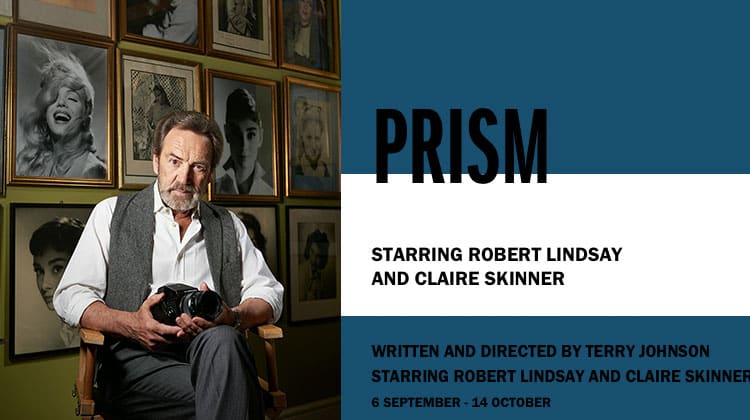
Prism
Hampstead Theatre, 14th September 2017
Full disclosure. I love Terry Johnson’s plays. The marrying of “high” and “popular” culture themes and structures, the mix of humour and, as he calls it “brainy stuff, the abrupt lurches in tone: all this works for me. I have many more plays to get through (here’s hoping for some revivals) but favourites so far are Insignificance, which explores the nature of fame by throwing together Marilyn Monroe (of which more later), Einstein, Je DiMaggio and McCarthy (and is coming up shortly at the Arcola), Hysteria which pits Freud and Dali in a farcical set-up and Dead Funny which pulls apart the nature of comedy. So this is not likely to be an unbiased review. And it isn’t. I thoroughly enjoyed Prism with just a couple of tiny misgivings.
This is Mr Johnson’s first full length play in a decade or so though he keeps busy directing and writing for television and film. So for me this was something of an event. The idea for the play came from Robert Lindsay who is also a rareish sighting on the stage nowadays, which is a shame as he is a great actor in my book. Prism is based on the life of Jack Cardiff (1914-2009) about whom, I cheerfully admit, I knew nothing before this evening, though I was aware of his work. For Cardiff, who won a couple of Oscars, was the cinematographer behind such classic films as Powell and Pressburger’s Life and Death of Colonel Blimp, A Matter of Life and Death, Black Narcissus and The Red Shoes and John Huston’s The African Queen, of which more below. There were many others over his six decade career, as well as some directing assignments. By all accounts Mr Cardiff revolutionised the art of cinematography and he mixed with all the Hollywood greats. He was also something of a “ladies man” as my gran would say, and a fine looking fellow in the mould I think of a young Michael Caine.
If you are familiar with the films I name-checked above, as I am sure you are, you will know that the way these films are lit is jaw-droppingly impressive. Light, and the way we see things, is sort of the point of this play. And the golden age of Hollywood film has served Terry Johnson well as context before with the plays Insignificance and Hitchcock Blonde.
We first meet Jack Cardiff with his son Mason (Barnaby Kay), who has fashioned a studio of sorts out of a garage for his Dad to write his memoirs. This studio has one of his cameras (minus its vital prism thanks to Mason past carelessness) as well as photos of Hollywood leading ladies and Mr Cardiff’s own capable reproductions of Old Masters, such as Vermeer, Rembrandt, Renoir and Van Gogh, who captured light in paint before the photographic age and inspired our Jack.
Mr Cardiff is sliding into dementia, which provides the backdrop for much of the first act gentle humour here, so needs the help of a carer Lucy (Rebecca Night), who is also tasked with keeping the memoir on track. We also meet Jack’s second wife, Nicola (Claire Skinner) who was his assistant so is somewhat younger than Jack and is finding his decline difficult to cope with.
There is more than meets the eye here, quite literally. In a smart second act coup de theatre we shift to the location set for the filming of The African Queen with Barnaby Kay now playing Humphrey Bogart and Rebecca Night playing Lauren Bacall. And Claire Skinner metamorphoses into Katherine Hepburn. Now I go weak at the knees at the very though of Katherine Hepburn so, again, may not be the best judge of Ms Skinner’s performance but I was captivated. The flirting scene between Cardiff and Hepburn is terrific as are the references to the much reported hardships the cast had to undergo in the filming.
Mr Johnson also pulls another cracker from his bag marked “theatrical devices” with a scene involving Jack lighting Marilyn Monroe (Rebecca Night) followed by a fracas with Arthur Miller (Barnaby Kay). But this is an exact repetition of an earlier scene where Jack is explaining his work to carer Lucy. The doubling and trebling of roles here is a key element of the structure of the play as we probe Jack’s fading memory.
We learn about Jack Cardiff’s life, with Terry Johnson working his usual magic by stretching and shifting real events, the nature of light and ways of seeing in art and film, and the nature of memory. Lovely, very funny, insightful dialogue, the usual big ideas refashioned in comedy drama with real narrative and momentum and a more poignant, valedictory note (I won’t spoil the ending) than in previous Terry Johnson plays.
As usual Mr Johnson directs his own work, (some very interesting insights in the programme about this process), which means what he wrote and intended is what you see and hear. Tim Shortfall’s set is clever but not clever, clever and the performances are excellent. Minor quibbles are the slight lack of momentum through the middle of Act 1 as the “real” characters are mapped out, with Mr Cardiff’s dementia milked for laughs a little bit liberally, and the slicing in of Lucy’s tough background and circumstances, I didn’t see the point of this other than to lurch us from laughing to sadness in an instant which is a bit of a trait from this playwright.
So, as you can see, I really enjoyed and admired this, but like I say, I am a sucker for Terry Johnson’s plays. My guess, judging from the audience reaction, is that the overall reception may be a little more muted. But this seems to have been the fate of Terry Johnson’s work from the start. Some people rave, some people shrug their shoulders. What I would say is that even if you are not familiar with his work, if you have any interest in the subject, in film, like the cast or just want a funny, interesting night out then don’t hesitate.
 At Home He Feels Like A Tourist