Small Island at the National Theatre review *****

Small Island

National Theatre Olivier

If you know Andrea Levy’s Small Island either from the original 2004 book, (not me I confess), or the 2009 Two part BBC adaptation with script from Sarah Williams and Paula Milne and starring the inimitable Ruth Wilson and Naomie Harris then you will know roughly what to expect from Helen Edmundson’s adaptation directed by NT head honcho Rufus Norris. This is an epic social history, set in post-WWII Jamaica and London, and centred on the lives of two ordinary couples, or more specifically two, extraordinary, women, Hortense and Queenie.

It is a brilliant story, brilliantly told, but, even with the NT’s formidable financial and creative resources to hand, it was still an ambitious ask to bring it to life on the stage. Now I reckon Rufus Norris has been unfairly pilloried in some quarters during his stewardship at the NT. Not all the new commissions have come off but there have been some absolute belters as well. Keeping the progressive and conservative stakeholder congregations onside at the NT would test the patience of a saint, especially in these interesting times, and I reckon RN has had a pretty good stab at it. And a couple of the projects where he has taken the director’s helm himself, Everyman and Mosquitos, were superb. Yet for me he is at his best when pulling together multiple narratives and kaleidoscopic forms; as long as the writing on which any work is created is up to snuff and the stories he helps tell make an immediate emotional connection. London Road, Behind the Beautiful Forevers, The Amen Corner, Feast, (both of which I missed), Festen and, I gather his takes on Cabaret, all fit that bill. So I was pretty sure this would work and fill the Oliver stage with technicolour life again.

And it does. Superbly. We first meet Hortense (Leah Harvey) in the Jamaican school she teaches in alongside glamorous American Mrs Ryder (Amy Forrest). A hurricane is coming. Michael (CJ Beckford), the rebellious son of Mr Philip (Trevor Laird) and Miss Ma (Jacqueline Boatswain), who are also Hortense’s, very strict, stand-in parents, (she is the illegitimate daughter of Mr Philip’s affluent white cousin). arrives. Hortense loves Michael but he has eyes only for Mrs Ryder. Cue a brilliant set piece prologue, bravura lighting (Paul Anderson), sound (Ian Dickinson) and, especially, projection design from Jon Driscoll, taking us through the storm, interspersed with Michael and Hortense’s childhood, (not sure who played little M and H but blimey they are brave), and an explosive argument at the dinner table. In this Tempest-ian prologue it soon becomes clear we are in for an aural and visual treat thanks to these creatives in tandem with the sedulous stage and costume design of Katrina Lindsay, music of Benjamin Kwasi Burrell and movement of Coral Messam. Heaven knows how many hours they all put in but not was worth it.

This is worth the ticket price alone. Especially if, like the Tourist, you only pay £15. The proper reviews have come in and they are excellent. If Billers at the Guardian and DC at the Telegraph both say 5 stars then you would be a t*t to miss it. There are plenty of tickets left towards the end of the run from which to take your pick. With acting of this level and stories with this much passion I would happily have paid £75 for centre front stalls but trust me, with stagecraft of this quality and scale you’ll be fine in the cheap seats as well.

Now the characters do take a little time to fully come to life. The setting does dwarf the actors a little in the prologue and, in the preview I attended, the delivery of the dialogue initially lacked a bit of fizz. But when we move to England, the “mother country”, to meet Queenie (Aisling Loftus) and her awkward, repressed suitor, bank clerk Bernard (Andrew Rothney), and then track the progress of Gilbert (Gershwyn Eustache Jnr), during the war as an airman and then when he returns after the war, with Hortense who has married him to realise here dream of escape, things really begin to crank up.

Andrea Levy’s story, replayed deftly by Helen Edmundson, is built on memorable episodes which together create an irresistible momentum topped, at the end of the first, long, half by the arrival of the Empire Windrush, and then in the shorter, more constrained second half, set in 1948, by the return of Bernard and the momentous decision which finally binds the two couples. Queenie’s date with Bernard in the cinema, her first encounter with Michael’s irresistible charm after he too arrives in GB to fight for Empire, Hortense mistaking Gilbert for Michael on first meeting, the ill-fated fight in Yorkshire, Hortense’s desperate betrayal of best friend Celia (Shiloh Coke). Queenie’s tender care for her traumatised father-in-law Arthur (David Fielder), the overt racism Gilbert and Hortense encounter, as postie and would-be teacher, (audience visibly outraged), and from Bernard after he returns. And many more. Each scene is expertly navigated and beautifully mounted.

Small Island is, of course, primarily about race and prejudice, and the journey that the protagonists take, both geographical and emotional. It reflects Andrea Levy’s own, mixed race heritage, and the legacy of Empire. In this adaptation though, and maybe just because of the brilliance of Leah Harvey as the proud, uptight, determined Hortense and Aisling Loftus as the openhearted, optimistic but tough Queenie, I was particularly drawn to the compromises the women had to make to carve out any sort of meaningful life for themselves. All the main characters have dreams that, in order to be realised need to confront unpalatable realities, but the two women, in their own, intertwined, ways have so much more to overcome. This, ultimately, is what makes them so sympathetic and the story itself so warm, uplifting and, dare I say, inspirational.

Without the somewhat syrupy narration, and with the exuberant, (even in some of the darker passages), innovation which was required to bring each scene to life, this stage version is more moving and satisfying than the TV version. It is around three hours, even without the interval, but it never feels like it and, though I can’t be sure not having read the book, it seems to offer a more than faithful distillation of Ms Levy’s intention. Unfortunately she passed away in February before the play opened so we can’t be sure but she was apparently fully signed up to director and adaptor’s vision . The programme contains an extract from her 2014 essay “Back To My Own Country”. Everyone should read it.

“We are here because you were there.” I was particularly struck by this quote from Ambalavaner Sivanandan, prime mover in the Institute of Race Relations, highlighted in the programme notes from Leah Cowan. Remember everyone who came to Britain from Jamaica and elsewhere was a British citizen. Same rights as my grandad. Who just happened to be, I knew even as a child brought up in an entirely white monoculture, an ugly, visceral racist. He’s long gone. Yet it seems the open abuse he habitually lobbed at his black neighbours still hasn’t.

Small Island with bowl you over as a piece of theatre, make you laugh and maybe even cry, but it should also make you think long and hard about our shared history. Do go.

(As an aside can I beg Naomie Harris, Hortense in the TV adaptation, to return to the London stage. You will know her from her film roles as Eve Moneypenny in the last few Bonds or Moonlight, amongst others. I think the last time she was in the theatre was in Danny Boyle’s amazing sounding Frankenstein which I never got to see. Come to think of it it would be good to see Mr Boyle’s boundless imagination let loose again on the Olivier stage. He would fill it I am sure. As for Ruth Wilson, Queenie in the TV Small Island, anyone who saw her magic in Ivo van Hove/Patrick Marber’s Hedda Gabler will be counting the days to her UK stage return).

The best theatre coming up in London

It’s been a little while since the Tourist set out his favourite theatre opportunities either on now (in the case of Nine Night), or coming up over the year in London. Nothing too obscure or fringe-y here. Tried and trusted in terms of writer, director, cast and/or venue.

The first ten plays are written by, are about, or have creative teams led by women. We’re getting there.

Top Girls – National Theatre Lyttleton. The English speaking world’s greatest living playwright Caryl Churchill and one of her best ever plays. Still relevant, with its profound feminist critique, near 40 years after it was written. Audacious beginning with the dinner party scene and then the force of nature Marlene takes over.

Small Island- National Theatre Olivier. An adaptation by Helen Edmundson of Andrea Levy’s brilliant novel about race (the Windrush generation) and class in post war Britain. A cast of 40 count ’em directed by Rufus Norris (this should play to his strengths after a couple of duffers).

ANNA – National Theatre Dorfman. The bugger is already sold out but more seats promised. Ella Hickson, who is probably our most talented young playwright, and the Ringham brothers, sound maestros, combine in a tale set in East Berlin in 1968 which the audience will hear through headphones. Think Stasiland and Lives of Others.

Medea – Barbican Theatre. Euripides’s greatest tale of female revenge with Europe’s finest actress, Marieke Heebink, in a production by Europe’s greatest theatre company International Theater Amsterdam (was Toneelgroep) directed by Simon Stone. Don’t let the Dutch (with English sur-titles) put you off.

Three Sisters – Almeida Theatre. Chekhov. New adaptation. Cast not fully announced but Patsy Ferran and Pearl Chanda is a great start and directed by Rebecca Frecknall who garnered deserved praise for her Summer and Smoke by Tennessee Williams. Usual Chekhov tragic-comic ennui. A few tickets left.

Sweat – Gielgud Theatre. Transferring after the sell-out run at the Donmar. Lynn Nottage’s conscientiously researched drama about blue collar America is the best play I have seen this year and one of the best in in the last 5 years. Nothing tricksy here just really powerful theatre.

Blood Wedding – Young Vic. Lorca’s not quite the happiest day of their lives directed by Yael Farber (this should suit her style). The last time the Young Vic did Lorca it was an overwhelming Yerma.

A German Life – Bridge Theatre. Dame Maggie Smith. That’s all you need to know. (Playing Brunhild Pomsel who was Goebbels’ secretary in a new play by Christopher Hampton who did Les Liasions Dangereuses and translates French plays).

The Phlebotomist – Hampstead Theatre. Blood of a different kind.. I saw this last year in Hampstead Downstairs. Now a run in the bigger space for Ella Road’s debut near term dystopic relationship play with Jade Anouka tremendous in the lead.

Nine Night – Trafalgar Studios. Only a few days left and only a few expensive tickets left but Natasha Gordon’s debut play about Jamaican and British identity is a cracker.

Death of a Salesman – Young Vic. Arthur Miller’s greatest play and therefore one of the greatest ever with an amazing cast directed by Marianne Elliott and Miranda Cromwell. This is near sold out but book now otherwise you will be paying twice the price in the West End for half the view as this is bound to be one of the best productions of the year and is bound to transfer. Willy Loman is maybe the greatest male part ever written for the stage.

The Lehman Trilogy – Piccadilly Theatre. I told you to see it at the NT and you ignored me. Do not make the same mistake twice.

Cyprus Avenue – Royal Court Theatre. Probably pointless putting this in as it is pretty much sold out but I missed David Ireland’s sharp satire of Irish republicanism and am not about to repeat that error.

Bitter Wheat – Garrick Theatre. World premiere of new play by David Mamet about Weinstein with John Malkovich in the lead, Woo hoo.

Rosmersholm – Duke of York’s Theatre. Hayley Attwell and Tom Burke in the “greatest ever Ibsen play” which rarely gets an outing. Expect usual Ibsen misery tropes. Directed by Ian Rickson and adapted by Duncan MacMillan, marks of quality.

The Night of the Iguana – Noel Coward Theatre. Talking of less often performed classics by the greats here is a Tennessee Williams with Clive Owen putting in a rare appearance along with Lia Williams, directed by James MacDonald.

The Favourite film review *****

The Favourite, 3rd January 2019

The more theatre I see, the more I am turning into an insufferably superior luvvie. “A play will always trump a film because it is organic, dynamic, viewed from multiple perspectives, energised by audience complicity, palpable, alive, more daring in terms of form and structure” and much other such guff.

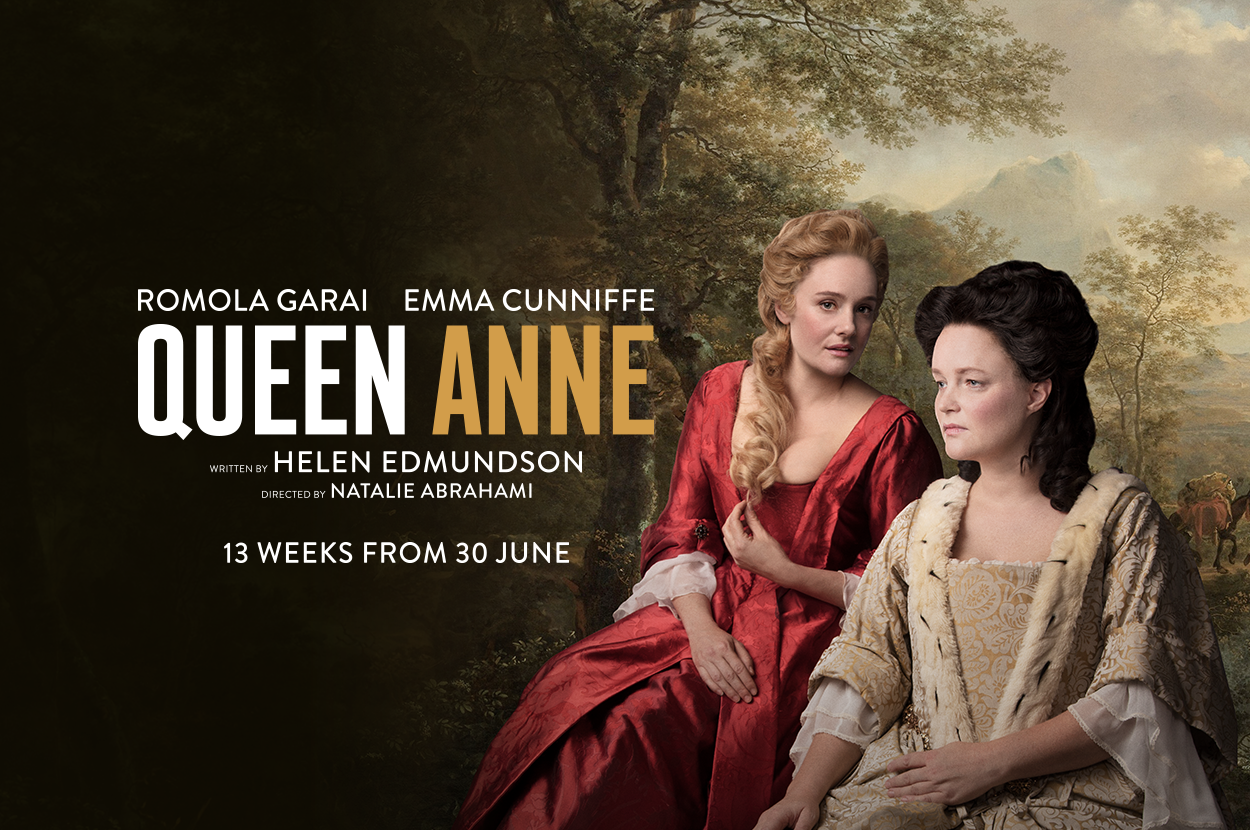
However sometimes I have to accept that the cinematic trumps the theatrical and that is definitely the case for The Favourite. For only a couple of years earlier, writer Helen Edmundson, director Natalie Abrahami, the massed ranks of RSC creatives and a cast led by Romola Garai and Emma Cunniffe served up Queen Anne, a play that, like The Favourite, dramatises the relationship between Anne, Sarah Churchill and interloper Abigail Hill. Except that the play offered a much broader sweep of history, Anne’s accession, the War of the Spanish Succession in Europe between the Grand Alliance and the Spanish and French Catholic monarchies, the rise of the Duke of Marlborough, Sarah’s husband, as well as Lord Godolphin and Anne’s political interventions. It also focusses on the birth of the free press in England at the turn of the C18 and, specifically, the spread of satirical publications. All this in addition to the personal troika.

In contrast The Favourite, whilst referencing the political manoeuvrings between protectionist Whig and free-trade Tory, and the impact of the growing tax burden to finance the war on landowners, is firmly focussed on the relationship between the three principal women. Mark Gatiss gets a look in as Marlborough (Winston Churchill’s ancestor) but not much opportunity to show off. Same goes for James Smith as Godolphin. Both were Tories but they became ever more reliant on Junto Whigs to finance the war.

(As an side I personally continue to sh*t myself about the long term, and increasingly short term, effect of debt on this country. As it happens public debt to GDP ballooned in the years after William III first went cap in hand to the City spivs with the idea of issuing Government bonds. At the peak of the War of Spanish Succession it approached 200%. War tends to do that. Anyway now good old Blighty runs at around 90%, not too far away from our major developed economy neighbours. But when you add in private debt it gets closer to 300% of GDP. There are a bunch of countries with “higher” levels but this reflects their tax friendly approach to issuers of corporate debt. Our debt is built on the backs of consumers.

So for those Brits who now purport to prize “sovereignty at any price” I would venture we are already in more of a pickle than all the Euro economies you take a pop at. But that is not all. Our current account deficit currently runs at 5% or so. Comparable with the likes of Turkey and Argentina. This has to be financed by foreign investors, “the kindness of strangers” as the Governor of the BoE would have it. Who knows what might happen in the next few weeks and months but if we balls this up, sterling depreciation, imported inflation, capital flight and sale of assets is guaranteed. And there may be f*ck all the BoE and Government can do to protect us. Forget about your ten quid for a visa, roaming charges, lorry queues or medicine stockpiling. That’ll be the least of your worries).

Oops I’ve done it again. Back to the script. So Anne, a natural Tory, became increasingly less enamoured of the Junto dominated government, especially when she fell out with Sarah, and the non-Junto Whigs started to break bread with the Tories led by Robert Harley. Cue the terrific Nicholas Hoult for it is he that plays Harley, sumptuously powdered and bewigged, but still brutally Machiavellian. He intrigues with the ambitious Abigail, eventually marrying her to his ally Masham (a virile Joe Alwyn), with the Queen’s approval. Harley wins the political battle, last straw for Sarah, but the Whigs win the battle after Anne’s death when the Hanoverian line is established, the Jacobites are defeated and the Whig supremacy is ushered in. The new money trounces the old.

Anyway I suspect that once the mercurial director Yorgos Lanthimos, in 2009, got his mitts on Deborah Davies’s original script, first written twenty odd years ago, it was always likely that the political context was going to be downplayed. Mr Lanthimos went on to garner deserved critical acclaim for Dogtooth (my favourite of his until, er, this Favourite), The Lobster and The Killing of a Sacred Deer. For those that don’t know, these are not your run of the mill Hollywood blockbusters. So, in many ways, The Favourite it surprisingly in its near naturalism. It is beautifully shot courtesy of cinematographer Robbie Ryan, the costumes (Sandy Powell) and set decoration (Alice Felton) are, as you might expect, exceptional and the locations, mostly Hatfield House, also Hampton Court Palace and the Bodleian’s Divinity School, are all stunners. The soundtrack, without exception, is divine, though amongst all the Purcell, Handel, Vivaldi and Back (WF as well as JS) make sure to listen out for Anna Meredith’s rasping contribution from her string quartet Songs for the M8.

So it looks and sounds wonderful. A period drama with a twist of Peter Greenaway’s Draughtsman Contract. But it is the relationship between the three women that is Mr Lanthimos’s concern and, with a little embellishment and ornamentation, he constructs a drama that the Tourist thinks sheds more light on the workings of power than any dry “historically accurate” portrayal could do. It is a drama, so “historical accuracy” for all the pedants out there is meaningless in this context, and, in any event, history is simply what is left and what is found, and it always changing. I suspect what really winds these punters up is the functional lesbian love triangle but, without that there would be no drama. The power games between the three women seem to echo, and directly, influence the power games between politicians and Crown and State.

Queen Anne, (we never see husband George who was an arse by all accounts), famously lost all 17 of her children and left no heir, hence the invitation to the Germans, 26 years after the invitation to the Dutch. Protestant royal kids eh, never there when you need them. This, unsurprisingly, leaves her sad, needy, physically incapacitated and isolated. Hence her bunnies. And her cake. She has a friend from childhood, Sarah Churchill, but these two chums are beyond dysfunctional. Having opened the door to her, she, Sarah, is in turn is manipulated by impecunious upstart cousin Abigail Hill, who then steps in to manipulate the Queen, literally and emotionally. Except that she, the Queen, whilst vulnerable is also capable of manipulating both, and ultimately pulls rank.

There are external scenes, in the palace gardens, on horseback, to Parliament, but most of the action takes place indoors and specifically in the Queen’s bedchamber and the corridor outside. Genius. Adds to the damaging intensity and claustrophobia of the relationships. As does the roving camera. And the predominantly wide-lens shots. The dialogue is dynamic and contemporary, the humour broad and often incongruous, the tone ambivalent. Your sympathies will constantly oscillate between the characters.

It is probably a comedy, but not one of those “dark” or “black” comedies where you don’t laugh. There are hints of Restoration romp and barbed bitch-fest a la Les Liaisons Dangereuses but then the idiom is right here, right now. It might be a tragedy but who is the heroine? Historical drama? But no-one normally speaks or moves like this in the bog-standard drama. The Madness of King George filtered through an absurdist lens. Maybe, but then it isn’t that absurd. Parallels with the arch Whit Stillman’s Love and Friendship, or the recent ITV Vanity Fair. Yes, but with more filth and camp. Could another director have taken the scrip and budget and churned out a more than passable film. For sure but it wouldn’t be half as much fun or half as original.

All of this reflects Yorgos Lanthimos’s off-kilter, deadpan style but it was never going to work without the three leads stepping up and, crikey, they do. In any other filmic context Emma Stone’s opportunist Abigail would take your breath away. Then along comes Rachel Weisz’s cruel to be kind, then to be cruel, and then back again, Sarah. And then, in probably the least surprising acting triumph of all time, Olivia Colman comes along and chews them up with her Queen Anne. The way all three bring out the conflicts implicit, and explicit, in their relationships is, frankly delicious, but OC takes it to another level.

I have already intimated that IHMO the present shower of Parliamentary sh*te might as well be dissolved to be replaced by a matriarchy comprised of acting Dames. Judi Dench as PM, Maggie Smith as Chancellor, Helen Mirren as Foreign Secretary, Eileen Atkins as Home Secretary, Joan Plowright as Education Secretary, Patricia Routledge at Health, Harriet Walter Justice, Kristin Scott Thomas International Development, Julie Walters Work and Pensions. You get the idea.

Culture Secretary I hear you cry. Easy. Sarah Caroline Olivia Colman. Only a matter of time before she is be-Damed. And surely she could cheer us all up. Telly, film or, too rare, on stage (she was close enough to touch in Mosquitoes), how she manages to get so deep into the emotional core of the characters she has played, even in relatively “lightweight” roles, is astounding. Anyway she now seems to have cornered the market in screen Queens, as it were, and here she is simply magnificent. Whether vomiting up blue cheese, petulantly cutting short a recital, stroking her rabbits (no euphemism), freezing in Parliament, linguistically weaponising cunnilingus (yep that’s what I meant), weeping for her lost child, ecstatically responding to Abigail’s poultice (again no euphemism) or bullying some poor footman, she always convinces, even as we snigger.

I see The Favourite, and Olivia Colman, Emma Stone and Rachel Weisz, are all over t’internet as Oscar candidates. I haven’t seen many of the other films habitually mentioned bar Blackkklansman and Black Panther (note to self: get on to that Roma caper asap). I doubt they will get far. But just maybe Olivia Colman can do the business and the whole world can see how perfect she is. That would be nice.

Queen Anne at the Theatre Royal Haymarket review ***

aa_qa_home

Queen Anne

Theatre Royal Haymarket, 3rd August 2017

Tricky customers history plays. How to introduce the characters and explain events without slackening the dramatic pace. It’s OK if your Will Shakespeare. He wrote the history. Or at least someone before him wrote something, which he then purloined and turned it into a great work of art with those words, oh those beautiful words. And ever since people have half-believed his stories were based on solid facts. Mind you historical “facts” are a slippery business anyway. Always shaped by the narrator. I’m with the master of wry Alan Bennett: “History is just one f*cking thing after another”. A quote he stole in any event from a distinguished academic, though no-one seems sure which prof. said it first. See what I mean.

Anyway the writer of Queen Anne, Helen Edmundson opts for the direct approach to exposition with characters bluntly announcing their identity and, when necessary, the unfolding key events. This ensures that we the audience can follow the action without the need for intensive background reading but it does mean the first third of the play feels a little disjointed. However once the dramatis personae are established and the various themes laid out we then get a fine story simply told under the direction of Natalie Abrahami.

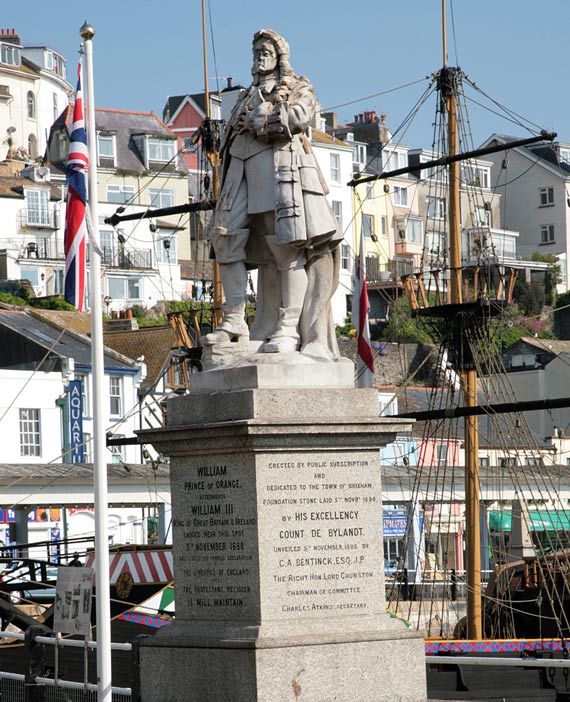
The focus of the play is the relationship between Queen Anne (Emma Cunniffe) and Sarah Churchill, Duchess of Marlborough (Romola Garai). Anne accedes to the throne on the death of her childless brother in law William III (played in barking king mode by Dave Fishley). You know he was the Dutch fella we invited over with wife Mary to keep the Catholics off the throne. He landed at Brixham, also famous as the birthplace of the Tourist. Hurrah. Here he is. Unusually without a seagull crapping on his head.

william-of-orange

Anyway Anne is a Stuart but the right sort as a Protestant. She is also childless despite seventeen pregnancies, a very sorry state of affairs. Her husband, Prince George of Denmark (Hywel Morgan) is a full on booby. Anne is, initially at least, physically and temperamentally, not really up to the job, so her childhood friend Lady Sarah and her circle of Whigs do their best to manipulate her to their own ends. Our Lady Sarah just happens to be the wife of John Churchill, whose rise to become leader of the Protestant forces across Europe in the War of the Spanish Succession against mighty France and Spain, (after a few false starts), brings recognition, wealth and prestige. This was a turbulent time in English (and with the Act of Union in 1707, British) politics and the play does an excellent job in drawing this out, as Anne seeks to make her mark and shifts allegiances towards the Tories led by Speaker Robert Harley (very well played by James Garnon). This was the era when Britain moved into the first division of European powers (though war proved an expensive business) as the Catholic powers were faced down and as capital was accumulated largely on the back of the slave trade (yes all you proud Brexiteers, these are the foundations your glorious country is built upon).

The tempestuous Lady Sarah gets the hump as her influence on Anne dissipates and gets properly jealous of Abigail Hill (played by Beth Park) another scheming ingenue who comes from nothing to become the Queen’s new bosom buddy. Sarah leaks some salacious correspondence but this backfires and she, her husband and her circle are debilitated (though the family has seemed to rub along ever since down the centuries – go see Bleinhem Palace is you don’t believe me).

These events are interspersed with some entertaining song and dance routines. This was after all the period which saw the rise of the popular press, in the form of pamphlets, and the emergence of political satire. The great British public, OK the emergent newly rich grasping oligarch Whigs (land alone no longer being the route to power), had put the monarchy back in its box and weren’t above any ruse to slap down the Tories, high Church and sniff out any whiff of Jacobitism.

So a fascinating time, an important monarch who ruled at a pivotal period in England’s history, and a well realised portrait of an intense relationship. Emma Cunniffe and Romola Garai both give very credible performances as Anne and Sarah and there is real passion in parts of the second half. But this is no Mary Stuart and there were times when I was hoping for a few more twists and turns. On the other hand if this is the sort of thing that floats your boat, and on balance I would say it should, then I see there are plenty of tickets left at very attractive prices, so give it a whirl.