
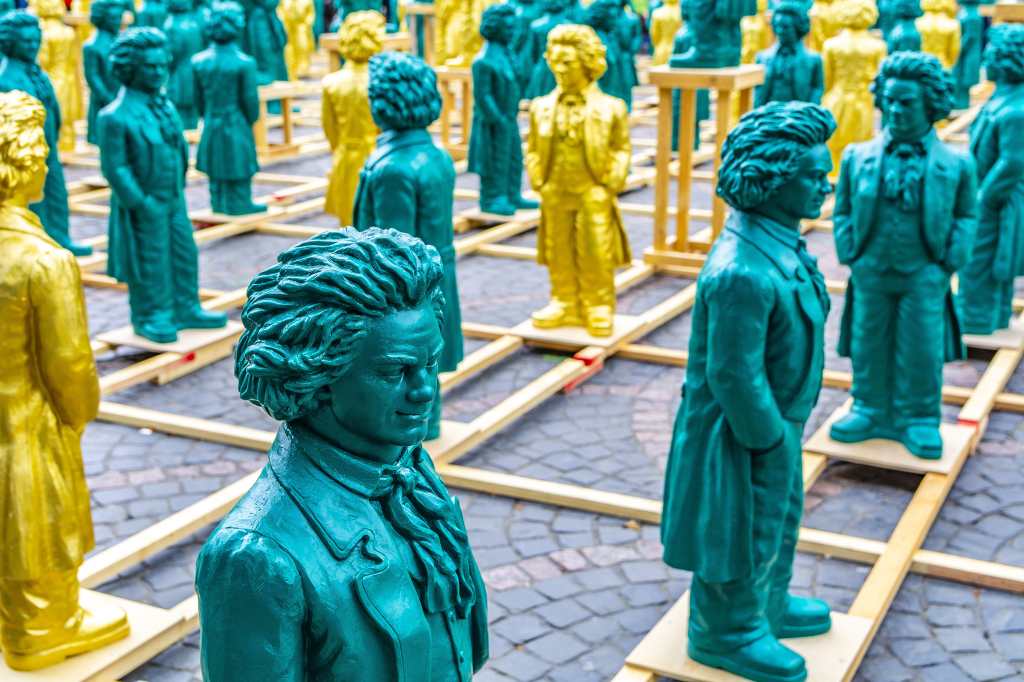
Beethoven Weekender at the Barbican review

Beethoven Weekender

“This could be the closest thing to heaven …. “. No not the Tears for Fears dirge from 2004 but one of the many fine singles from the vastly under-rated, and alas short-lived, Kane Gang from 1984. The KG, along with the magnificent Prefab Sprout, and the rather less remembered and post-punky Daintees, at least in my mind, were the apogee of the early 80s British pop/blue eyed soul bands hailing from the North East’s Kitchenware Records in the 1980s. Rich melodies, lush production, and often orchestration, skilled song-writing.. What has this got to do with Beethoven I hear you cry. Well nothing actually. It is just this was the song that popped into my head as I enjoyed a fine fry up for lunch courtesy of Fast Break on Day 1 of the Barbican Beethoven Weekender in early February. Plainly I was in a good mood.

Obviously the celebration of the 250th year since Beethoven’s birth has now been put on hold during these troubled times. (The Tourist had intended to take in Bonn on his Spring train break). Once again I apologise for rabbiting on about a classical music gig from many weeks ago when there is so much more of import going on around us. However I was able to attend a smattering of Beethoven programmes prior to the lockdown taking effect but frankly nothing came close to this offering from the Barbican. All the symphonies, courtesy of some of the UK’s finest orchestras based outside London, interspersed with other, well thought through and informative contributions featuring bits and pieces of LvB’s piano, quartet and violin chamber works, alongside some other, moreorless quirky, responses made up this excellent Festival. And all for just £45. That’s right. The greatest music ever written, (in the Western art canon at least), spread over two full days with change from a bullseye.

I was very taken with the exhibits, ear trumpets, the great man’s violin, the Warhol print, drawn from the Beethoven Haus collection in Bonn, with the Beethoven Bites contributions from various young composers and performers, many drawn from the ranks of the Guildhall School, and Matthew Herbert’s deconstruction/ reconstruction of the Ninth, especially Together, which takes 30 or so recordings of the third movement and plays them simultaneously to the same time frame. This shows how performance can differ, not just in tempo, but also in tuning, pitch, recording technique, dynamics.

Christopher Park’s readings of various of the Bagatelles at St Luke’s Old Street was surprisingly involving, despite the always interesting interruptions by Gerald McBurney reading eye witness accounts of LvB’s playing (and scheming). Daniel Sepec is the only musician (I think) entrusted with playing Beethoven’s own fiddle, and he was joined in Milton Court by Tobias Schabenberger (fortepiano), Taj Murray (violin) and Silke Avenhaus (piano) for extracts from early violin sonatas and the Kreutzer. The Beeb’s Sara Mohr-Pietsch paid tribute to George Bridgewater, the Afro-European musician who inspired LvB’s greatest sonata and was its original dedicatee. And the marvellous Carducci Quartet, in the Pit, were joined by uber-luvvie Simon Callow for intense extracts from various string quartets interspersed with letters from LvB, to family, to collaborators, and, of course, his Immortal Beloved. Now Mr Callow is rightly renowned for his ability to put us through the emotional wringer, but, from my perch very close to him, I can confirm the old boy shed a real tear or two. Terrific.

Still it’s the Symphonies that put the meat on the bones of this celebration and I can report that we were treated to performances of the highest quality, all brought together with enthusiastic wisdom from uber Beethoven fan-boy John Suchet. I won’t babble on about the works themselves or the detail of the performances. All I can say is that I need to get out, of London, more. Although, based on the stunning interpretation of the Fifth and Sixth from Vasily Petrenko and the Royal Liverpool Philharmonic *****, Liverpool’s (and Oslo’s) loss will be London’s gain when the young(ish) Russian comes permanently to the Royal Philharmonic. I expected much and wasn’t disappointed. If there is a better way to spend a Saturday morning then you had better tell me.

Lars Vogt and the Royal Northern Sinfonia **** (finally there is a connection with Newcastle) put everything and more into the Seventh and Eighth, and jst about edged Mirga Gražinytė-Tyla and the City of Birmingham Orchestra’s **** more thoughtful takes on the Second and Fourth. But this may reflect my preference for Seven and Eight in the pecking order. The programme notes certainly don’t imply that Ms Gražinytė-Tyla thought that she was in any way getting the short straw with Two and Four and the performances were testament to this. I think I am right in saying that she has shaken off you know what. A good reason to explore some of the good stuff the CBSO has posted up to take us through the coming weeks/months, including the documentary about their gifted musical director prodigy.

In fact the riches that the world’s orchestras have offered up in the past few weeks have to be seen and heard to be believed. The Concertgebouw probably takes the biscuit, I have started working my way through the Ivan Fischer Beethoven cycle, but take a look too at the offers from the Berlin Philharmonie, the LSO, the LPO, Wigmore Hall, the BRSO and, my favourite so far, the Monteverdi Orchestra and Choir. And, at this rate, no one will ever enter an opera house again. Just kidding but there is a lot to see for free right now. Though not for free as all us privileged types should be financially supporting our cultural institutions right now, as well, of course as those in the front line, and less fortunate than ourselves.

Anyway Kirill Karabits and the Bournemouth Symphony Orchestra *** were quite able to match the RCO in their performance of the Eroica, which got a little muddled in the development of the opening Allegro con brio and in some of the variations in the Finale, though their interpretation of the First more than passed muster. I have to say though that the least convincing interpretation in the cycle was the closing Ninth from the Halle Orchestra under Sir Mark Elder ***. Sopranos Elizabeth Watts and Sarah Castle were bulldozed a little, the balance between orchestra and chorus didn’t feel right and the tempi overall were too measured for me especially in the slow movement. Still it’s the Choral, it capped an amazing couple of days and I still went home happily humming the Ode to Joy.

Something to hang on to until this is all over.

PS. The programme notes to accompany the Weekender are excellent BTW. To the point essays on Beethoven’s various disappointments in life (family, love and deafness), his idealist politics, his cultural impact and some wham bam notes on the symphonies.
Hungariana: Casals Quartet and Tamara Stefanovich at Milton Court review ****

Casals Quartet, Tamara Stefanovich (piano), Gerald McBurney (creative director), Amelia Kosminsky (video designer)

Hungaria, Milton Court Concert Hall, and 3rd February 2019

Gyorgy Kurtag

  • Six moments musicaux Op 44
  • Jatekok excerpts

Bela Bartok

  • 14 Bagatelles Op 6
  • String Quartet No 3
  • Three Burlesques Op 8c

Gyorgy Ligeti

  • Etudes excerpts
  • Musica ricercata VI-XI
  • String Quartet No 1 Metamorphoses nocturnes

One day. Three concerts. Showcasing the chamber music of the three most renowned Hungarian composers of the C20 (OK, well maybe that is a little harsh on Zoltan Kodaly). In fact, outside of some chap by the name of Franz Lizst, probably the three most famous Hungarian composers of all time. Except that European history being what it is all three of them were actually born in Romania, in its various incarnations. But their shared musical heritage, rooted to various degrees in folk music, is defiantly and definitely Hungarian. To perform the music, a Spanish quartet, albeit one with great affinity with the repertoire, and a Serbian pianist, though again one with proven expertise in all three composers.

A confession. I missed the first concert. Late-ish flight back the previous evening (Bologna since you ask – not humble-bragging but the Tourist highly recommends La Dotta/Grassa/Rossa, as well as nearby Ferrara and Ravenna. Be thankful he hasn’t the energy to start blogging on these trips or the vanity to Instagram). Anyway a bit tired to get to the Barbican by 11am so the first 5 parts of Ligeti’s Musica ricercata were missed, as were various excerpts from Kurtag’s Jatekok piano works, his 12 Microludes and Bartok’s String Quartet no 1. Most annoying (to miss) in retrospect were the Microludes, 12 tiny string quartet pieces in homage to Kurtag’s mate Mihaly Andras. Still, no worries, as, on the strength of Six moments musicaux, which was Kurtag’s fourth string quartet, I have a CD of his entire output for the form winging its way to me.

For I was very taken with Six moments musicaux, a title lifted from Schubert (and Rachmaninov). Written in 2005 the, er, six short pieces differ in character both between, and within, themselves. All are, as is characteristic with GK, very short. The first, Invocatio has loud, hard rhythms, an announcement, encasing a pianissimo melody and a chorale. Footfalls is a slow, broken waltz, the title taken from a late Beckett play. Then a Capriccio, a duel with obstinate lines and then a memoriam, a sort of passacaglia dedicated to Hungarian pianist George Sebak. This, like the finale, was based on two of the Jatekok piano pieces. The finale, titled Les Adieux, tilts at Beethoven but is subtitled in the manner of Janacek and is a lament of sorts. The penultimate is a “study in harmonics” based on birdsong a la Messaien.

George Kurtag was notoriously slow to get in to his compositional stride, writing just 9 small-scale works in the 1960s and early 1970s. In 1973 though he was commissioned to write some children’s piano pieces, which became the first 4 volumes of Jatokek (“Games”), and since then he hasn’t stopped, and there are now several hundred of these piano pieces alongside all his other work. All tiny, for solo or duo piano, their titles range across ideas, emotions, images, dedications, gestures, and together these fragments encompass the range of his musical imagination. If I am honest, even with the love and care lavished on them by Tamara Stefanovich, the combined effect was a bit stupefying, not in a bad way, just that, in the absence of titles or breaks, it was tricky to keep up. I will need to revisit.

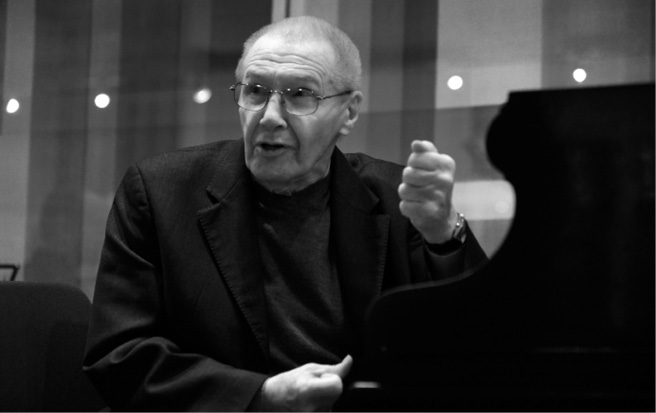
Indeed I will need to explore all of GK’s oeuvre. The idea of reducing music to fragments appeals (Flowers We Are, Mere Flowers, from the eighth volume of Jatokek, is just 7 notes long), but, based on these pieces, this is music with emotional heft despite its brevity, and not just an academic exercise. GK (pictured above) is an expert teacher, especially in chamber music, and the echoes of his own favourites, Bach, Beethoven, Schubert, Schumann, Webern and, of course, Bartok are easy to pick out. Of course it helps that GK adores the music of his friend and mentor Gyorgy Ligeti, who similarly, though I would contend, at a somewhat more elevated level, was to take the language and structure of music and turn it into something truly astounding. GK is still with us, now 93, though he was a little frail to attend the premiere of his opera, Fin de partie at La Scala last November, which is based on Beckett’s Endgame (which Ligeti first introduced him to).

In these two concerts we were treated to Tamara Stefanovich’s rendition of a handful of the Etudes (2, 8, 11, 3, 5, 15 and 10) and the second half of the Musica ricercata. The Etudes proved a fertile laboratory for Ligeti’s genius, mixing his early affinity for Hungarian folk sounds, (following in the footsteps of Bartok), his love of Debussy’s re-invention of piano music and purpose, his experiments with fractal patterns, his investigation of non-Western tonality and his fascination with Conlon Nancarrow’s complex cross-rhythms. Most of the etudes involve some, albeit very different variation on each hand playing at different speeds. If you have never heard, or claim never to want to hear, any “modern” classic music listen to the Etudes. You will change your mind. Guaranteed.

TS is a powerful advocate for the work, maybe not quite as powerful as her friend and collaborator, Pierre-Laurent Aimard, who performed the Etudes in their entirety last year at the QEH Ligeti weekender, but brings more Debussyian grace. Musica ricercata is more rule-based composition, not serialist, but a suite intended to progress from just two notes to a full-blown High Baroque fugue. It was written in the early 1950’s in Budapest, where it could not be played given the Soviet musical mindset, and, when GL moved to the West he saw it as too simple, until 1969 when the adventure of Boulez and Stockhausen was no longer de rigeur. I am still listening and learning, (some helpful programme notes here courtesy of Paul Griffiths), so can’t explain the music musically as it were, but, like the Etudes I know I like it. A few more years and I might even understand these works.

The highlight of the day though was Ligeti’s First String Quartet however, “Metamorphoses nocturnes”. The Ligeti quartets are putting ever more frequent appearances in the quartet repertoire and the Casals turned in an excellent rendition, near matching the Arditti recording I have. GL took this early piece with him when he left Hungary in 1956 after the Soviet crackdown, and it was premiered in Vienna in 1958. However, like the Musica ricercata, it was deemed a little too “prehistoric” in Ligeti’s words, to warrant dispersion, until its first recording in the 1970s. By then the world was ripe for the interplay of the folk rhythms and trademark Ligetian polyphony, colours and enquiry. The eight sections generate a variety of moods, atmospheric, macabre, dance, humour, with a motif, G-A-G sharp-A sharp, threaded throughout. It is brilliant.

What to do with Bela Bartok? It seems that every time I hear a performance of Bartok’s work, whether orchestral, chamber or solo, (or choral as with Cantata profana performed recently by the LSO, alongside Ligeti’s Lontano), that gets the juices flowing, it is immediately followed by a performance that perplexes. Here the String Quartet No 3, which to be fair I have heard a few times before courtesy of the Emerson recording, challenged and fascinated, whereas the piano pieces, the 14 Bagatelles and Three Burlesques just confused me. Oh well, I guess I just keep trying.

Now sometimes these “immersive” days can feel a bit cobbled together. Not here though as creative director Gerard McBurney introduced each piece with appropriate extracts from the writings of the composers themselves, reinforcing the links between them and their homeland, and the words of contemporary poets, such as Endre Ady and Attila Joszef, in Hungarian as well as translated. Moreover the video backdrop created by Amelia Kosminsky, a mature final year student at the Guildhall, was stunning. She had discovered a treasure trove of amateur monochrome photographs from Hungary throughout the C20, the Fortepan archive, which she combined superbly to match music and text. If I am honest sometimes these designs can just be bloody distracting. Not here though.