Aurora Principal Players, Iestyn Davies (countertenor), Sally Pryce (harp), John Reid (piano), Nico Muhly
Kings Place, 23rd November 2018
Satie – Gymnopédie No. 3
Thomas Adès – The Lover in Winter
Nico Muhly – Clear Music
Debussy – Danse Sacrée et Danse profane
Brahms – Gestillte Sehnsucht
Nico Muhly – Old Bones (world premiere of ensemble version),
Nico Muhly – Motion
Thomas Adès – The Four Quarters
Dowland (arr. Nico Muhly) – Time Stands Still (world premiere)
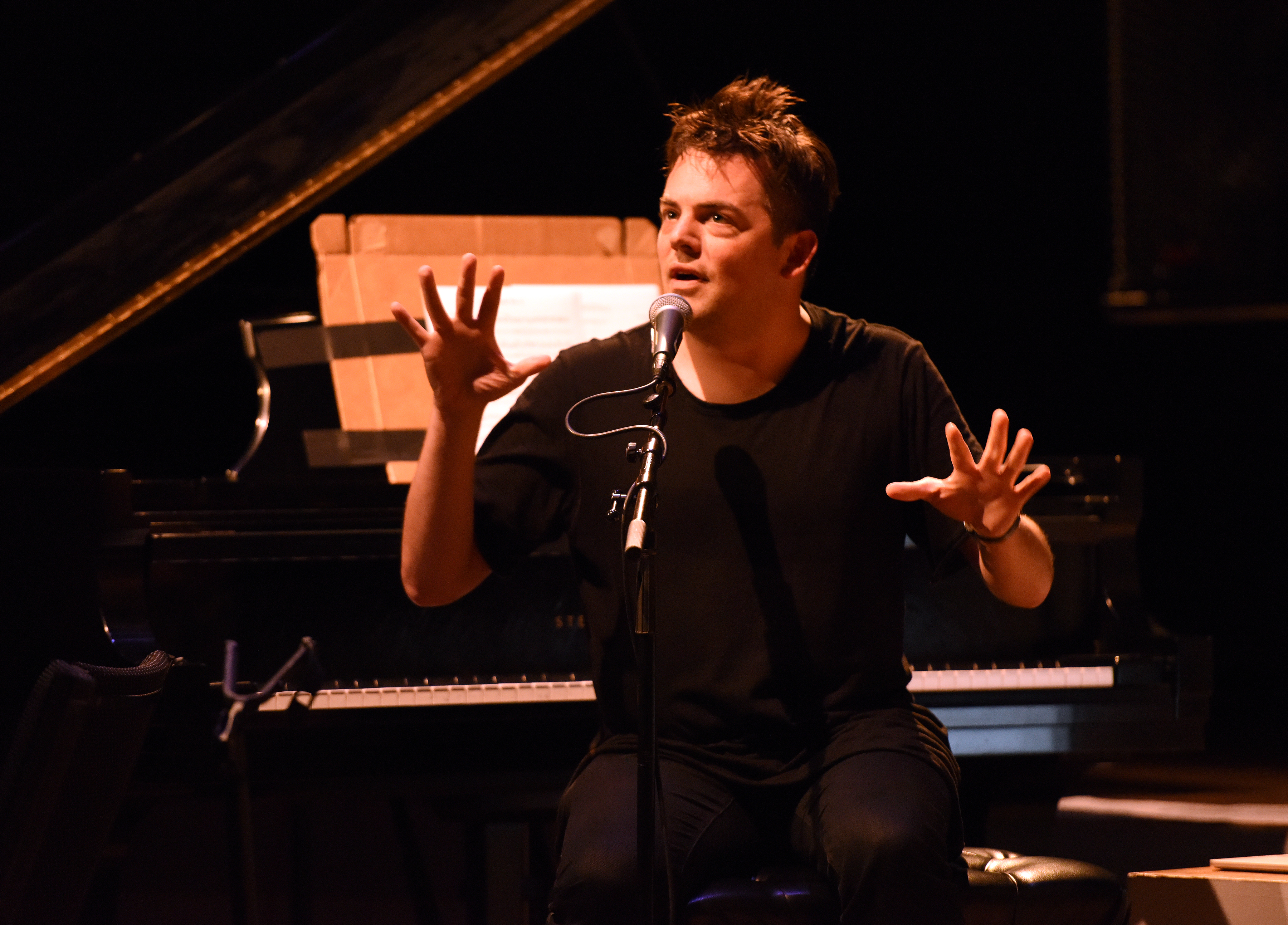
A full house, moreorless, for a diverse programme of chamber music and songs anchored by (relatively) well known works from Thomas Ades and Nico Muhly, whose effervescent presence also graced the evening as performer, conductor and even compere. Oh and did I mention he “curated” the event. The evening was part of the year long Kings Place Time Unwrapped season now coming to an end with the pieces ostensibly linked through their meditation on, er, time and music from an earlier age.
The musical backbone was provided by the graceful pianism of John Reid, with strings and clarinet from Aurora principal players, Alex Wood, Jamie Campbell, Helene Clement, Sebastian van Kuijk and Peter Sparks. Against this a number of the pieces showcased the unusual harmonies of the harp (Sally Price whose playing was certainly not backward in coming forward), celesta (John Reid again) and the ethereal countertenor of Iestyn Davies
There was a world premiere of a new chamber version of Old Bones, a song cycle about the rediscovery of the body of Richard III in a Leicester car park in 2012, (an event which also formed the opening sequence for the Almeida Theatre production of Shakespeare’s play with Ralph Fiennes in the lead). The arioso of Iestyn Davies was originally accompanied only by a lute, which can be discerned in the fragments of poems about Sir Rhys ap Tomas, the alleged killer of the king, which follows the news commentary intro. The momentum builds into a processional as the text, from Philippa Langley of the Richard III society, eloquently connects the infamous monarch to today.
Muhly’s Motion for string quartet, clarinet and piano takes as its starting point a verse anthem from Orlando Gibbons, See, see the Word, and applies his trademark post-minimalism energy to Gibbons’s complex vocal counterpoint .
In contrast Clear Music is based on just a fragment of a John Taverner motet. Mater Christi Sanctissima, and is scored for cello. harp and celesta with the latter gifted an inventive solo part for an instrument normally reserved for adding orchestral colour. The texture doesn’t change and the piece is locked in a pretty high register, even in the cello line, but, as usual with Mr Muhly, he creates an engaging piece that doesn’t come anywhere outstaying its welcome.
Thomas Ades’s Four Quarters from 2010 is a string quartet which takes as it subject the ebb and flow of time, in common with the TS Eliot Four Quartets, poems from which it surely drew inspiration. As usual Ades serves up all sorts of striking sounds, a wide dynamic range rhythmic complexity, beginning with the eerie babble of Nightfall, followed by Morning Dew evoked through pizzicato, the steady pulses of Days and the astounding harmonic complexity of the last movement, the Twenty Fifth Hour, which is measured in an unusual 25/16 time.
The evening’s outstanding piece of me though was The Lover in Winter, written when Ades was only 18. It is made up of 4 very short songs, in Latin drawn from an anonymous text. It has a bleak, brittle, chilly feel, just chiming piano chords and Iestyn Davies’s exquisite countertenor, though the last song fails up the passion. Melismatic with candid word-painting.
Mr Davies was also superb in Time Stands Still, a Dowland song which Nico Muhly has re-arranged. The melody is defined by the singer, based on an anonymous love song, with the whole band coming together to provide complementary but recognisably contemporary harmonies.
The programme kicked off with John Reid in Satie’s ubiquitous piano waltz Gymnopedie 3, blink and you’d miss it, as well as a helping of (to me) an unremarkable Brahms song and Debussy’s showcase for the harp with its “medieval” first part and bouncy Spanish inflected second “profane” part. At the end we were treated to Messrs Muhly and Davies presenting an aria from Marnie, which has just finished at the Met, and which I bloody loved at the ENO.
For someone who I gather lives in NYC, Nico Muhly seems to spend a lot of time in London. No surprise that to the Tourist. Indeed he will be back at Kings Place on New Years Eve with the Aurora Orchestra. I can think of worst places to be. Mind you I do have a better offer for once.
Shostakovich – String Quartet No 8 in C minor, Op 110
Beethoven – String Quartet No 7 in F major, Op 59 No 1, “Razumovsky”
You still see some venerable rock (and pop) bands unwisely soldiering on in their 60’s and even 70’s, sometimes with only one original member still in the line-up. Outside of disposable pop the creative force/s, the composer/s if you will, in contemporary popular music are invariably also the performer/s. Not so generally in classical art music, though that isn’t to say that many canonical composers weren’t, or aren’t, also adept performers. Just that composition and performance are more often separated, and that performance is often as important to composition in terms of audience enjoyment or appreciation.
So when rock musicians die, so does the band, if it has managed to get that far without breaking up due to musical differences, substance abuse or fist-fights, in the established rock’n’roll manner. Leaving the audience with a ropey tribute band and recordings to keep the tunes alive.
In the classical world though, with its much longer back catalogue, legacy is the name of the game. And not just in composition. Performers live on. Not just in recordings but also in the name, and sound, of the band. Easy enough to envisage in the context of the orchestra with its link to place and with a constant turnover of personnel. The Royal Danish Orchestra in Copenhagen can trace its lineage back to a bunch of regal trumpeters from 1448 (!), the venerable and still very highly regarded Leipzig Gewandhausorchester to 1743.
The idea that string quartets outlive their members might be a little trickier to get your loaf around though. Yet this is how it works. Members may come and go but the best quartets stick together for life, such is the dedication of performers to their art, and, when one of the four can no longer perform, pearly gates or otherwise, a replacement is drafted in. But this cannot be any old violinist, viola player or cellist. For the sound of a top notch string quartet, is a very particular thing, and continuity, as well as chemistry, needs to be guaranteed.
Now as is normally the case with the development of classical music, form followed technology and demand in bringing the string quartet to the fore. Once modern instruments had been perfected in the C18, notably the viola, (which is tuned a perfect fifth below the violin and an octave above the cello), and with enough patrons who liked the string quartet groove to pay up, composers were all set. As with so much else in classical music it was Papa Haydn who set the ball rolling in the 1750s. His massive output for the ensemble (68 named, 77 or so in total) is still amongst the best ever written IMHO.
The string quartet, in the opinion of the Tourist, is about as “pure” as classical art music gets. Not easy to get right; any paucity of imagination is ruthlessly exposed. Four parts is enough to fashion an argument but not enough to take the foot off the intellectual or aesthetic gas. Plenty of opportunity to vary pitch but only the colour and texture of strings at the composer’s disposal. All of which might explain why not every big name has embraced the genre and why even those that have sometimes don’t always get beyond one effort or a brace.
After Haydn, Mozart obviously churned out a fair few, 23 I think, though they are not all up to snuff. Still as ever with Wolfgang when he nails it he nails it. Then Beethoven with his 16 (and the Grosse Fuge) which, as with the symphonies and piano concertos, have never been bettered. Schubert also walked the talk with his 15 and a few assorted bits and bobs. (Note to Tourist: more work to do on these).
As the fashion for showy-off, Romantic, bullsh*tty bombast gained traction in the C19 so the string quartet took a back seat, but returned with a bang in the C20. For the Tourist’s money the best of the bunch since 1900’ish are Janacek’s pair, Nielsen’s 6, Ravel and, (in a rare thumbs up from me), Debussy’s single shots, Stravinsky’s various musings, and, best of all, Britten’s haunting treble, Bartok’s virtuoso 6 and Shostakovich’s acutely personal 15. Oh and Glass’s 7 (and counting), Reich’s Different Trains, Crumb’s Black Angels, Nyman’s 5, Ligeti’s 2 and Xenakis’s 4. You might have some others to add. Tell me.
The Emerson String Quartet was formed in 1976, and still has two of its founder members in violinists Eugene Drucker and Philip Setzer, alongside the viola of Lawrence Dutton, with cellist Paul Watkins the last in, having joined in 2013. I have recordings of their arrangement of The Art of Fugue and their renowned Bartok cycle. The Bartok is superbly recorded and is very, very precise and very, very intense. This is what they are famous for. Exact and technically brilliant interpretations. Which maybe lack a little emotion. That tends to be my preference but I can understand why others may take a different line (and there are occasions when I would agree).
Anyway this is what the Emersons are famed for. And this is exactly what they delivered at Milton Court. Britten’s Quartet No 3 was pretty much the last thing he composed appearing in the year he died, 1976. With its call-back to the music of his last opera, Death in Venice, in the final passacaglia, and the recitative quotes that precede it, it really is immensely moving. BB was very ill at this time, only able to work in short bursts following a heart bypass operation, and this seems to be reflected in the four condensed movements which precede the final “La Serenissima”. The opening “Duets”, in sonata form, is also haunting and, by virtue of its various permutations of the quartet personnel, as sparse as its title suggests, even when the duets are accompanied. The Ostinato second movement, like the Burlesque fourth movement, is very short, and taken at a fair lick even where it is played pizzicato. The parodic Burlesque could have come from the pen of Shostakovich in one of his more caustic moments, with its weird central spiccato passage. The central Solo is marked very calm with the first violin line, heading higher and higher, seemingly lifted from the mists, and mystery, of Curlew River. Or maybe Aldeburgh Beach, Or Snape. Anyway as with the rise and fall of the Passacaglia it sounds like BB was set to go home. Blub blub.
The Emersons certainly got the measure of BB’s still extraordinary imagination and technique. But it felt a little less haunting than the recording I have from the Endellion Quartet. This was even more true in the Shostakovich. The Eighth was written when DSCH was in a very dark place, contemplating suicide. He went on in his final quartet, 15, to offer up a genuine personal elegy but this comes pretty close. He was supposed to be written a score to accompany a documentary about the bombing of Dresden but, after just a few days, he came up with this, “an ideologically deficient quartet nobody needs”. It was 1960 but DSCH still wasn’t “free” now being forced to join the Party. It has his trademark initial motif in the opening of the Largo on the cello, which is developed, before the main theme from his First Symphony pops up, before this in turn gives way to a repeated rocking motif.
This rocking motif is then pumped up and speeded up to form the basis for the second movement scherzo. This is, even by Dmitry’s high standards, pretty scary stuff. The DSCH motif also crops up again, in contrasting tempi, As it does in the middle movement Allegretto, here transformed into a Waltz which then proceeds to quote his First Cello Concerto. A violin solo links to the first of the final two slow movements. This contains the tune to a Russian song about the victims of fascism, to whom DSCH eventually dedicated the quartet, but which might be aimed at totalitarianism more generally. The final Largo comes full circle with a return to the rocking motif.
The quartet is taken unbroken and with these powerful and dramatic ideas, and stirring emotion, it is easy to see why it is Shostakovich’s most famous and oft-performed quartet. It would be hard to imagine a more expertly crafted and sharp interpretation, these chaps leave nothing to chance, but, as I discovered a couple of weeks later, courtesy of the Brodsky Quartet, it is possible to wring a fair bit more gut-wrenching angst out of the piece. I have recordings by the Borodin Quartet, now in its eighth decade, constantly refreshed by the best of the Moscow Conservatoire, and the original dedicatees for most of DSCH’s quartets, and the English Fitzwilliam Quartet (founded in 1968) who also worked with the composer and were the first to record a complete cycle.
As it turned out it was the Beethoven first Razumovsky which actually showed the Emersons at their very best. Count Razumovsky was an important Russian aristo and diplomat in Naples and then Vienna but his name has gone down in posterity for the three quartets he commissioned from Beethoven in 1806. All are magnificent but the first might just be the best of the bunch. This is altogether jollier music than the two pieces that preceded it, with its intriguing dissonance and implied repeat in the first movement, the rapid passing of the baton from one player to another, underpinned by the one note cello motif in the Allegretto second, the tragic F minor Adagio and then the ebullient finale with its bouncy Russian theme, (as in the other two Razumovsky pieces). The drilled-to-perfection understanding of the Emersons, and the more upbeat tone of the Beethoven was, for me, at least more satisfying.
That is not to say that overall I took very great pleasure in listening to this famous quartet. They are up there with the very best of their peers, some of which I have already mentioned. When it comes to Beethoven I think the Takacs Quartet (founded 1975) might have the edge of those I have heard live, though the Belcea Quartet (1994), who might just be my favourite string band, run them close. As for recordings of the Beethoven quartets have a sniff around the Alban Berg, Quartetto Italiano (for the middle quartets) and unparalleled Vegh (for the mighty last four).
While I am at it, should anyone care, add the Hagen Quartet (1981) to the bucket list when it comes to Mozart, the Quatuor Mosaiques (1987, HIP specialists) for Papa Haydn and the Kronos Quartet (1973), on the rare occasions they leave the US, in contemporary repertoire.
London Philharmonic Orchestra, Vladimir Jurowski, Leif Ove Andsnes (piano)
Royal Festival Hall, 18th April 2018
Stravinsky – Symphony in C,
Stravinsky – Tango arr. for orchestra
Debussy – Fantaisie for piano and orchestra
Shostakovich – Symphony No 6 in B minor, Op 54
I am pretty confident that no-one reads the reviews of classical music concerts posted here, not should they, since I know so very little about the music I hear, and what I do learn is ruthlessly plagiarised. But if you do stumble across this “content” by accident it really helps if you like Igor Stravinsky and Dmitry Shostakovich. A combination of my taste and that of those responsible for programming in the finest London venues means there is a lot of these two fellas on show here. More than I had realised.
This was another instalment of the Stravinsky Changing Faces festival at the South Bank, this time from the LPO under Vladimir Jurowski’s baton rather than one of their guest conductors.
Before I get to this a shout out for the free concert in the Hall just before this from members of the LPO Foyle Future First programme. This has been created to nurture talented young musicians who aspire to a career in the orchestra. They kicked off with a bouncy rendition of Stravinsky’s “Dumbarton Oaks” Concerto, then tackled some short pieces by Elliott Carter, Luciano Berio, Edison Denisov as well as Stravinsky’s own Epitaphium, a commemoration piece for flute, clarinet and harp, which acted as the inspiration for the other pieces which, in their turn, commemorate IS. The last piece was the more substantial Furst Igor, Strawinsky by Mauricio Kagel, drawn from Borodin’s opera Prince Igor and showcasing the dramatic singing talents of young bass Timothy Edlin, and some startling percussion effects.
I chanced upon this concert. On the basis of this I will endeavour to seek out any future offerings as should you if you are in the vicinity.
On to the main event. The Symphony in C was first performed in 1940 in Chicago conducted by IS himself. The first two movements, a Haydnesque shuffle with prominent oboe, here taken briskly, and a concertante with strings sandwiched by woodwind, were written in Paris, at the same tine as IS lost his daughter, first wife and mother. No grief on show though in this effervescent neo-classicism. The last two movements were composed after IS had moved to the US and comprise a scherzo with nods to IS’s early works and a slower conclusion focussed on woodwind. The trumpet of, I think, principal Paul Berniston, also got a good workout. Like everything Stravinsky wrote, the more times you listen to it the more you are astounded by how easy it all seemed to come to him, whatever form or style he was writing in, and however “academic” the music. This IMHO is about the best Neo-classical piece ever written.
The proceeding tango for chamber orchestra was originally a piano piece, as revealed by Leif Ove Andsnes later on in his encore. Even the stuff IS churned out for money, like this, is captivating, with strings, guitar, woodwinds and more brass than you might expect. Mr Andsnes is a confident fellow, I’ve heard him play a couple of times before, and have enjoyed his interpretations of Beethoven, the Nordics and Chopin, without being utterly convinced, I regard Debussy as a bit of an occupational hazard, as it often, as here, crops up in the programmes that appeal to me. All that swirling impressionism and general diddling about doesn’t really do it for me I am afraid. The piano being the chief instrumental purveyor of the diddling about tendency for composers so inclined, I wasn’t looking forward to this.
Once again my idiotic prejudices were confounded. The Fantaisie was written in 1890 as part of a prize young Claude secured but only the first movement was performed, leading CD to huffily withdraw it. Every time it was scheduled for performance thereafter, after revisions, he missed his deadlines, so that the original published score only appeared in 1919. The revisions were finally published in 1968. Leif OA has made a signature dish from this later version which is what we heard here. The first movement introduces the theme which turns up in the final allegro, there is a bit of the “exploratory” stuff which worries me but it settles into a tune by the end. The slow movement is grandly Romantic and in F sharp major. I shouldn’t like this but I did. Maybe I have a thing for this key. This moves into the the quicker, colourful finale which is underpinned by a repeated bass figure, and that, dear reader, is why I liked it. Probably because it doesn’t sound much like Debussy.
I don’t know how much rehearsal the orchestra got with the soloists. I am guessing it was limited since the programme implied we were getting the original 1919 version suggesting a bit of miscommunication. It didn’t matter. The more I hear the LPO with VJ at the helm the more I admire their unruffled ability to support, but never, overwhelm the soloist.
There is nothing diddly about Shostakovich’s 6th. After getting back in the Politburo’s good books with the 5th he went and upset the apple cart again with this bizarrely “unbalanced” though not “formalistic” symphony. 18 minutes or so of B minor largo slow movement with one of those never ending intros followed by a funeral march second theme, which is then repeated, but in a very subdued, passive way with solo flute from Juliette Bausor, ending with the briefest of recapitulation of the first themes. Then a scherzo, with trio accent, and strident climax, straight out of the DSCH copybook and a closing rondo, with contrasting waltz, that only needs a few clowns to gallop on stage to be complete and even has the enigmatic William Tell Overture which punctuates his last Symphony No 15. No fourth movement, all done in half an hour, audience always a bit taken aback, then relieved that it’s all over. And that’s the contingent, here thankfully large, who love this stuff. The best parties don’t go on too long. Who knows what it all means.
There is a lot of opportunity for pianissimo in the first movement, with most of the orchestra resting most of the time, and VJ and the LPO were keen to show what they could do. The extended second theme of the Largo was as close to eerie Shostakovichian, chair-pinning, perfection as you could ever want to hear, and the closing presto faultless. Bish, bosh. It might still be on I Player if you’re interested.


 At Home He Feels Like A Tourist