
Wife at the Kiln Theatre review ****

Wife

Kiln Theatre, 3rd July 2019

How difficult can it be to get to Kilburn? Very it would seem if you are the Tourist, this being the second time this year that he has missed the start of a matinee performance, (and having cut it perilously fine on another occasion). Message to self. Stop twatting about with the Overground and buses to get here and stick to the Jubilee.

Anyway it was a somewhat frustrating idea to watch the first scene of Wife on the tiny black and white stage telly, however accommodating the ever friendly front of house. Aussie Samuel Adamson’s latest play, (you may know him from The Light Princess musical at the NT of his Chekhov/Ibsen adaptations), is an intertwining affair which examines the relationships of four couples from 1959 to an imagined 2049. Ibsen is the stepping off point. Specially A Doll’s House, (there is a lot of Doll’s House inspiration coming up, see the Lyric Hammersmith, the Young Vic and International Theater Amsterdam).

After that scene and the infamous door slam, Wife opens with stiff-necked Robert (Joshua James) properly wound up after the performance, which he sees as an attack on the sanctity of marriage. His wife Daisy (Karen Fishwick), who dragged him along, doesn’t agree. She is in love with Nora the character and yearns for a similar freedom. Things ratchet up when we find out she is also in love with the actress, Suzannah (Sirine Saba) who plays Nora in the production. This is the scene I missed “live” but it was still plainly a compelling set up even if I couldn’t completely follow the subsequent ding-dong exchange of ideas and feelings between these three characters .

Next up 1988 and a couple of young gay men, with something of a class difference, the posh, volatile Ivar, (Joshua James again, named after one of Nora’s children), railing against the straight world, Thatcher and Section 28 and the younger, not-yet-out Eric (Calam Lynch) . They have retired to the pub after a Norwegian language version of the Doll’s House, and, after some exquisite verbal jousting, are joined by another Suzannah. On to 2019 and Clare (Karen Fishwick again) and Finn (the versatile Joshua James) who are at the Kiln Theatre bar (!) waiting for ….. well not the Suzannah who breezes in from the avowedly queer production of A Doll’s House being staged but Ivar, now 58 (Richard Cant, who also plays Peter in the first Doll’s House and the pub landlord in Scene 2), now bruised by life, and, after a while, his younger husband, bitchy actor Cas (Calam Lynch again). Clare and Ivar, as you pretty quickly surmise are connected.

And, in a final meta flourish, the finale is set in 2042, with an extract from a naturalistic play featuring Daisy, Robert, Suzannah and Marjorie (Pamela Hardman), a dresser. Now the whole point of this journey through time and coupledom is to show we are no closing to reconciling the struggle between the need to explore individual freedom, and the desire for equality, in domestic relationships, than Ibsen and his characters were in 1879.

In other hands this have could have become more than a little tricksy or worthy or muddled, but Mr Adamson pulls it off largely through the quality of his dialogue, they are some terrific lines and witty observations, and the way in which the cast it self has to shift pretty radically between the characters, even those that are linked by family ties, notably Joshua James (who has a knack of standing out in smaller roles in previous productions that the Tourist has enjoyed), Karen Fishwick (following her RSC stint, a fine Juliet, and Our Ladies from NT Scotland) and Calam Lynch (whose Claudio in the Rose Kingston’s Much Ado attracted disproportionate attention from LD, and not just for his acting talent). All three young actors served up really fine performances.

Of course it helped that Kiln AD Indhu Rubasingham took the chair herself lending customary energy to the production and papering over the cracks when words and actions pushed a little towards the artificial: these people don’t really do reflective silences. Richard Kent probably had more fun designing the costumes that the somewhat unremarkable set, as did Alexander Caplen with his sound contribution and Guy Hoare with lighting.

The proper reviews were, rightly, pretty positive overall. I have a very strong feeling that this will not be the last we see of this play.If so the Tourist will make damm sure he turns up on time.
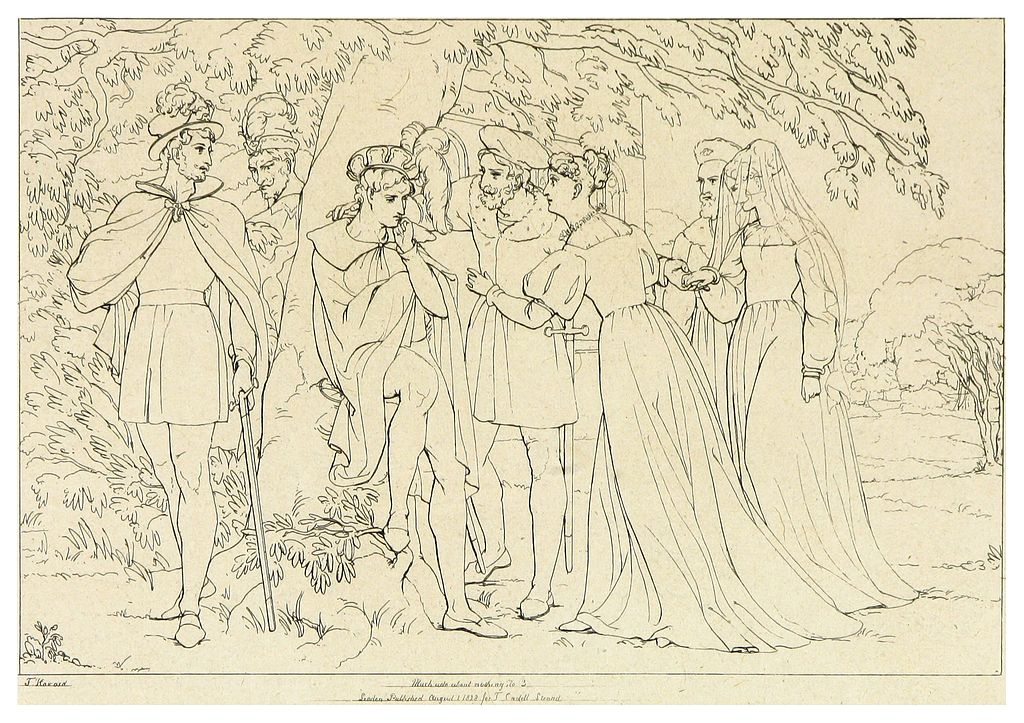
Much Ado About Nothing at the Rose Kingston review ****

1024px-howard281828-3329_shakspeare2c_much_ado_about_nothing_vol12c_p219

Much Ado About Nothing

Rose Theatre Kingston, 20th April 2018

Come on fellow residents of the Royal Borough of Kingston and London Borough of Richmond – both upon Thames. Get your collective arses over to the Rose Theatre to see this new version of Much Ado About Nothing, celebrating the 10th anniversary of your local theatre. There are plenty of tickets left for the last handful of performances. It is not perfect but when it is funny, it is very funny, the setting is intriguing, there are a handful of strong performances, including the star turn Mel Giedroyc, and, in John Hopkins’s Benedick, there is Shakespearean comic acting to rival the very best.

Now I will admit that the main draw for BD, LD, myself, and latterly MS, was Ms Giedroyc herself. Obviously she is a national treasure and we have collectively seen her memorably translate her inimitable style, arch covers it, to the reading of Agatha Christie. Play, proximity and support for the local theatre was enough justification for me, but LD especially needed the hook of her off the telly. LD is probably a bellwether teen, suspicious of Shakespeare, unless forced to consume at school, and then normally pleasantly surprised when Dad mugs her into coming along, usually through vague subterfuge. And she thoroughly enjoyed this. It doesn’t mean a trip to an uncut Lear is just round the corner. Just saying that if it is good enough to entertain her it is good enough to entertain anyone who might be dubious about the Bard.

Moreover, this production, jointly staged with Granville and Parnham and Antic Face, rattles through the action so that we are all done and dusted in under 150 minutes inc. interval. That’s including a several minute intro as we are, just so we know, introduced to the resort hotel in a set shrewdly realised by Naomi Dawson. This is modern day Sicily and Leonato’s estate is now a luxury spa to which Peter Guinness’s suitably intimidating mafioso Don Pedro and crew have retired for a bit of rest, relaxation and intimidation. Suffice to say it looked nothing like the bucolic MAAN in the drawing above.

Director Simon Dormandy’s ideas do, fitfully, generate some insight, notably in the way that Kate Lamb’s Hero and Calam Lynch’s Claudio are so precipitously thrust together, in the fancy dress party which permits the romantic plotting, in the wedding scenes and, especially, in Hero’s fake funeral. Here the juxtaposition of modern sophistication with older, deeper, paternalistic traditions is most striking. We love Sicily, (well I do especially), but Sicilians are a wary bunch, unsurprising given colonisations by Phoenicians, Greeks, Romans, Vandals, Ostrogoths, Byzantines, Muslims, Vikings, Normans, Germans, French, Spanish, Italians, Mafia and Tourists. Mind you that is what is makes it endlessly fascinating to the outsider.

On the other hand there are times when the hotel set is a limitation, most notably for the Watch, though frankly that never works, even with Stewart Wright doing his very best as Dogberry. And, let’s face it, most people see MAAN for the comedy, specifically Beatrice and Benedick sparring. Mel, as customer services manager for the hotel and Mr Hopkins, as an unlikely consigliere to Don Pedro, deliver. Ms Giedroyc, is funny, we know that, and exactly the right sort of funny, and doesn’t hold back from mugging to the audience. When she needs to show Beatrice’s independence, and specifically her revulsion at the patriarchal conceits around her, she also shows she can seriously act. John Hopkins however is a cut above, the physical humour matches his brilliant delivery of the text. Their early disdain for each other is done snappily enough, with some evidence of their back story, but it is when they get serious about each other that they hit the heights. Mel’s immediate retort of “kill him” when asked by Mr Hopkins what Benedick could do for Beatrice to right the wrong Claudio has inflicted on Hero, got the laugh, but the audience was palpably nervous. It is their respective eavesdropping scenes which still the show: pure farce, but why not if it makes us happy.

We were taken with young Calum Lynch as Claudio on his professional debut, especially LD, and especially when his top came off. There was a harsh streak in him, where required, to balance the skittish wooing. Kate Lamb presented an initially diffident Hero but bristled wth anger as her reputation was impugned. Peter Bray, rather disconcertingly played Don John as a somewhat dim East London thug; in contrast his Clerk was more Home Counties solicitor. David Rintoul as Leonato, now hotel manager, was alternately brutal and oleaginous. Fine support elsewhere includes Nicholas Prassad as Borachio and Victoria Hamnett as Margaret conjuring up a saucy scene involving Hero’s wedding dress that provides a not unreasonable explanation for the mistaken identity window scene which leads to Hero’s “disgrace”.

There have been, and will be, sharper, richer versions of MAAN, Christopher Luscombe’s recent RSC production for example, but if you want some straightforward easy on the ear and eye Shakespeare comedy, Kingston, for the rest of this week, is the place to be.