Macbeth at the National Theatre review ***

background-1130431_1280

Macbeth

National Theatre Olivier, 14th April 2018

Life’s but a walking shadow, a poor player
That struts and frets his hour upon the stage
And then is heard no more

This was frustrating. No way of hiding it. It promised so much. A Macbeth. With Rory Kinnear and Anne-Marie Duff, both of whom, when furnished with optimal texts, directing and designs, are as good as it gets. Since we know the text cannot be at fault, though Macbeth productions do have a habit of disappointing, then we have to look to design and direction. It really pains me to say this, since I don’t think Rufus Norris’s stewardship of the NT is anything like as disappointing as some would have you believe, but here, as director, the ideas just don’t really work.

Most of the proper reviews have alighted on the cul de sac that is the design of Rae Smith. Now Ms Smith is a rare talent. I offer you St George and the Dragon, Girl From the North Country, This House, The Goat, or Who is Sylvia, and, of course, War Horse in support of that contention, and that’s just what I know. Here though we have a backdrop of black plastic sheeting strips, like an explosion in a bin bag factory, which seems a very tentative way to solve the challenge offered by the Olivier stage. A steep ramp initially takes centre stage though this gets shunted to one side for most of the proceedings leaving a pair of ramshackle sheds to do most of the visual heavy lifting. It is pretty dark, though with harsh accents, courtesy of James Farncombe’s lighting design, and Dunsinane here put me in mind of nothing more than a camp of homeless people under some arches. There are some poles on which the witches have some fun later on, and which provide a foil to some back to front, shrunken head shenanigans, but generally this is not an insightful concept.

Nothing wrong with the idea, just maybe not in Macbeth, for, as the critics have indicated, this foul is foul visual starting point gives little room for the plot to develop. What exactly is it that Macbeth and the Lady are prepared to commit murder for? Untrammelled ambition and the pursuit of power over this rabble hardly seems worth it. Macbeth is dark, for sure, and gloomy certainly worked for the benchmark RSC Nunn/McKellen/Dench production from 1976, with its minimalist circle. This left everything to our imagination: in this latest NT production we are steered too aggressively towards a composite post apocalyptic dystopia and never get out.

The hackneyed Jarmanesque vision extends to Moritz Junge’s costumes. Back in the day, when the Tourist was a devoted Bunnymen fan, and camouflage gear and ripped jeans were de rigeur, he dressed like this. The witches are properly bonkers, weird sisters indeed, but their aesthetic is similarly post-punkish. This means the supernatural world is firmly tethered to the “real” world, which may respect contemporary Jacobean reality, (remember James I was an “expert” on witchcraft), but doesn’t help when it comes to ratcheting up the atmospherics. The visual brutality smothers the action as well with plenty of stage blood and fake beheadings. Personally I don’t have a problem with the visceral approach to Shakespearean violence but think it is better employed against a more minimalist design or potboilers like Titus Andronicus.

Vaulting ambition, which o’erleaps itself,
And falls on th’other

The design distractions marred Paul Arditti’s soundscapes and Orlando Gough’s composition. As with the lighting, in isolation, this might have worked, but taken together with the look of the production, it was all just a bit too much. This left the cast with just too much to do to draw us into Shakespeare’s sinewy text, so fraught with development and repetition. Every word counts with Macbeth, even more so than the other tragedies, if the couple’s psychological horrors are to be fully realised. There were occasions when the bleak poetry captivated. Rory Kinnear and, especially here, Anne-Marie Duff are both too good as actors not to convince in many key scenes; when they plot the murder, in the immediate aftermath (a real sense of panic here), the Lady’s sleepwalking madness, her “unsex me here” soliloquy, Macbeth realising he has misinterpreted the prophecy.

Yet other scenes are less compelling, Macbeth’s “tomorrow” soliloquy, Banquo’s ghost, (drunken zombie and Lidl barbecue is not a winning formula), and the shock-horror apparitions. Mr Kinnear once again lays on the blokish estuarine, which worked so well for Iago, but which here gets distracting. I think he is an actor who shrinks just a little when the production has flaws, his Macheath on this stage and, as good as he was, his K in the Young Vic Trial, both revealed hesitations. It felt like that here at times. It is a shame as I think that in another Macbeth, shorn of all this overtly macho militarism, RK and AMD’s ability to show the couple’s brittle dissolution could have worked. The religiosity of the text, the childlessness, the notion of “evil” the inability to act, all get lost here.

Patrick O’Kane offered up a Macduff who contains his grief on hearing of the murders, which worked well, and Amaka Okafor impressed as a dignified Lady Macduff. Stephen Boxer, as is his wont, was perhaps a little too fruity as Duncan in this grimy world. On the other hand he has the measure of the language in contrast to Kevin Harvey’s Banquo and Parth Thakerar’s Malcolm who both chomped a bit at their lines. Trevor Fox’s comic Porter had plenty of stage time, though I am not entirely sure what point was being made by this, his warnings on “equivocations” were lost, and his look bore an uncanny resemblance to Bruce Spence’s Gyro Captain from Mad Max, though this may been my unconscious reaction to the look of the play.

Mr Norris has made some cuts to the text, (notably for Malcolm and Macduff in England) excised Duncan’s other son Donalban, and asked his cast to err too much on the side of dramatic caution. In a production which prized the visual over the textural, Birnam Wood, the battle scenes, the apparitions, the witches truncated first appearance, all were underwhelming. A weird paradox indeed that a production that set out to impress the eye, in a played seeped in the supernatural, conjured so few memorable images to highlight text and action.

This may well work better in some of the smaller spaces which the production will tour at the end of this year and beginning of next. Macbeth is a play where proximity to the actors helps. That is maybe why the film versions, and I include the film of the 1976 RSC production, as well as the 2015 Justin Kurzel version, Polanski’s classic and Kurosawa’s Theatre of Blood, work so well: close-ups allow us to see deep inside the characters, in a way that this production, with this set in the Oliver space, could not emulate. The lo-fi design, redolent of theatres with much less money to play with, may come into its own. Despite my comments and the rather sharp reviews, this is still well worth seeing. It is Macbeth after all.

There is an essay in the programme which takes us through the many ways Macbeth has been adapted through the centuries. It references the classic Ninagawa production which shows that a robust, definitive vision can work for Macbeth (Ninagawa’s Macbeth at the Barbican Theatre review ****). But it also, just maybe in retropsect, reads as a bit of an apology.

Something wicked this way comes.


Heisenberg: The Uncertainty Principle at Wyndham’s Theatre review ****

cw-20768-medium

Heisenberg: The Uncertainty Principle

Wyndham’s Theatre, 9th November 2017

Everyone’s at it. The “science” play. Science, whether directly through using theory to inform plot, or indirectly, often through the impact of ecological or other catastrophe, has underpinned many of the best new plays I have seen in the last couple of years. Steff Smiths’s Human Animals, Nick Payne’s Constellations and Elegy, The Forbidden Zone from Schaubuhne Berlin, Caryl Churchill’s Escaped Alone, Lucy Kirkwood’s The Children and Mosquitoes and Christopher Shinn’s Against all have a healthy dose of science in the mix.

Mind you this is nothing new. The brainy playwrights have been at it for decades. Think of Stoppard’s The Hard Problem, even Brecht’s Life of Galileo, the mighty Caryl Churchill’s A Number and Love and Information. Lucy Prebble’s The Effect, Timberlake Wertenbaker’s After Darwin. Indeed Michael Frayn in Copenhagen even took Werner Heisenberg himself as the subject for his play. Nor is it really surprising given the importance of mathematics and physics to our lives. After all it is the role of theatre to comment on, engage with and maybe even influence the big ideas that underpin our world. But it does take a fierce intellect to make this sciencey stuff work.

It was probably only a matter of time before the prolific, eclectic and clever Simon Stephens came up with his own variation. Like Lucy Kirkwood in Mosquitoes he takes a big idea from theoretical physics to create a metaphor for the actions of his characters, though I am not sure he is as successful. Heisenberg’s Uncertainty Principle states that if we measure the position of a particle with ever greater precision, then at some point we have to accept a correspondingly increasing imprecision in our measurement of the particle’s momentum. (Thank you Wiki and the programme – I would be lost without you). When we look at the little stuff, like electrons, its behaviour sometimes emulates a particle bouncing around but sometimes it is like a wave. Apparently “vagueness” is built into nature at the quantum scale. Yet we humans are always deluding ourselves that we have control and that there is order around us. We live at a larger scale than the quantum so see the physical world obey laws and we can trust the effect of statistical averaging.

Allied to the Uncertainty Principle is the idea of the observer effect. The act of observing will influence the phenomenon being observed. At the quantum scale for us to “see” and electron, a photon apparently must interact with it, thus changing the path of the electron. You can see why this concept might appeal to the inventive playwright. 

(I will refrain from opening up to the idea that some neuroscience even suggests our concept of “free will” is an illusion. “Free won’t” maybe, but the electrical activity in or brains that prompts an action seems to come before our “conscious” realisation of the intended action. Get your head round that). 

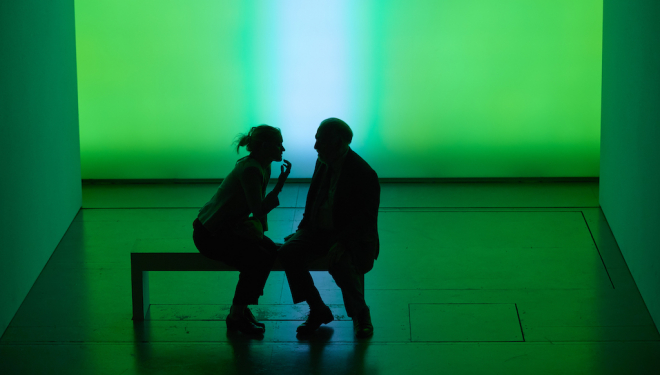
Anyway this randomness is the idea Mr Stephens builds into his play. Unpredictability is built into our lives. When forty something garrulous, and dissatisfied, American expat Georgie Burns (Anne-Marie Duff) randomly kisses, on the back of the neck, mid seventies lonely butcher Alex Priest (Kenneth Cranham) on a bench in St Pancras station, no-one, least of all them, could have predicted where this would lead. As it happens it leads to a beautifully observed affair which brings happiness and lashings of extra life to both

Now I guess that, at the end of the day, you might be able to take any other boy meets girl (or boy meets boy, or girl meets girl, or other feasible combinations) stage double hander and overlay the same idea. Nick Payne’s Constellations covered similar territory albeit with a very different formal structure. Indeed if you jettisoned old Heisenberg and just took the play on its own merits you wouldn’t lose much. You would ask yourself why would Georgie ever approach Alex in the first place, but might soon be persuaded as to why, and indeed would be offered some alternative explanations. The question of the age gap would loom large but fairly soon be dismissed, as it should be. Some of the twists in the romance might seem a little contrived but then you could say the same about all romances, real or imagined.

That the play works independent of its big ideas is down to the performances, and to a lesser extent, the sure direction of Marianne Elliot, the much praised set of Bunny Christie and the lighting of Paule Constable. In Anne-Marie Duff and Kenneth Cranham we have here two actors at the top of their game. In fact they are so at the top of their game that they are both banging in hat-tricks on a weekly basis like the love-child of Harry Kane and Cristiano Ronaldo. Ms Duff is always better than the play she leads, even when the play itself is perfect. Saint Joan, Cause Celebre, Strange Interlude, Husbands and Sons, Oil, the unfairly maligned Common. In her every major London stage role in the last few years she has, to overwork the sporting metaphors, banged it out the park. Of course, there may be some cause and effect here, as I will see everything she stars in. Even so, for my money, she is on a par with the theatrical dames of the prior generation. I am literally wetting myself with excitement at next year’s NT Macbeth with her and Rory Kinnear.

Now I was not as impressed as the smart money with Florian Zeller’s The Father thinking it a bit too tricksy, (mind you I had an uncomfy perch on the night of performance so my view might, literally, have been guided by arse), but there was no doubting Mr Cranham’s sterling performance. Here his Alex starts off, unsurprisingly, a little discombobulated by Georgie’s approaches. As the relationship unfolds, and he opens up, we see the joy fill first his face and, eventually, his whole body. Ms Duff similarly is as skilled in bringing Georgie to life through her movement as much as her words. Together their timing is perfect with the interplay of lines, and pauses, perfectly modulated. As Alex explains, when talking about his love of music, it is all about “the space between the notes”. They get it.

My guess is that, in lesser hands, this might all be far less effective. Simon Stephens is a wise man I think because he seems to know how important is the rest of the collaborative eco-system. Whether this be the writers whose works he has adapted (Chekhov on multiple occasions, Mark Haddon for The Curious Incident of the Dog in the Night-Time. Bizet for Carmen Disruption) or directors (Marianne Elliot, here and many times before, Carrie Cracknell, Katie Mitchell and, successfully, the erratic Ivo van Hove).

More importantly he is a very wise man because, as he says in the programme, “I think I only write plays because I’ve never been in The Fall”. There are those of us who recognise that the most important artist in the world is alive, well (hopefully) and using his free over 60s bus pass in Prestwich, and those of you who don’t.

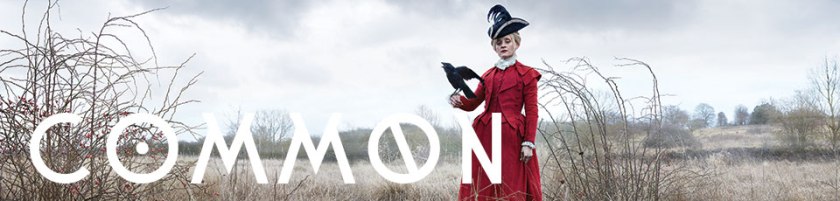
Common at the National Theatre review ***

common_960x230_tcm618-162513

Common

National Theatre, 28th June 2017

Is it possible to feel sorry for a play? Common has had some pretty poor reviews from the criterati and the public alike and there are tons of tickets left for the month or so left on the run.

Well I can’t pretend it isn’t without some pretty deep flaws but I didn’t think it was as bad as some have painted. As usual the Tourist has come late to the run. I gather it has been subject to some judicious cuts and it might be that the cast has become more attuned to playwright DC Moore’s curious and fruity language. It is a bit bonkers and a long way from what I had expected but I have seen much worse.

Our heroine Mary, played by Anne-Marie Duff who proves once again she is incapable of a having an off day at work, returns to her unspecified “home” after a spell in the den of iniquity that is London. Why she returns is never made clear. She might be seeking to exact revenge on her “brother” King (John Dagleish), she might be returning to her love, and “sister” Laura (a spirited Cush Jumbo), she might be seeking to help the ‘”villagers” succumb to the pernicious consequences of land enclosure. She has run ins with a bunch of Irish labourers, with the “Lord” (a perfectly cast though somewhat reticent Tim McMullan) and the Lord’s henchman Heron (Trevor Fox in full on Geordie) and with assorted villagers including the naive Eggy Tom (a touching Lois Chimimba). She, Mary, dies, is resurrected and then wreaks various revenges. Is she a con-woman, a seer, a harbinger? Who knows.

The programme some excellent essays. One is on the impact of enclosure on rural England from the late Medieval period, through the Tudors and, most aggressively, in the last C18 and early C19, when Common is set (1809). Capital has been screwing over labour, in more or less brutal ways, from the off and there is hardly anything more vital for theatre to examine. Another essay is on the importance of magic and spirits in the everyday existence of the “common people” alongside established religion and in the absence of universal education. These are interesting and important themes that the play seeks to explore. However, the slipperiness of the plot, and the focus on how the characters sound and look, serves to obscure these themes in my view.

DC Moore’s text in parts is written in a mangled, “rustic” English (think Yoda as a Wurzel) with plenty of profanity. Most of the criterati don’t seem to get on with this at all. I did. It takes a bit of getting used to but I think this, together with the lighting (Paula Constable deserves a special mention), the sound, the costumes, the set (though once again the Olivier stage offered too much space to the production) and the appropriate music written by Stephen Warbeck, all served to create an atmosphere which I think worked to the play’s advantage. And, as I have indicated, the performances, in large part, gave as good as they got with the material on offer.

The faults then for me largely lie in the meandering plot and the absence of an overarching narrative. This was not some non naturalistic, surreal or absurdist theatre. There was a story and there were ideas; they simply didn’t coalesce. I think Jeremy Herrin, the director, and the Headlong production team, who can normally be relied upon to manufacture a “hit”, probably know Common is a way off what they all hoped to create, but I for one would still applaud their bravery in trying to make this work.

So overall then I don’t think this is quite the turkey that some have painted it as. Yes it does fall down on many counts but it is also, in my view, interesting in other ways. You have been warned but if your expectations have been set low you might be pleasantly surprised if you do splurge all of £15 on one of the remaining performances.

And I wouldn’t mind betting that one day, after a re-write and a re-think, it comes back and is heralded as a misunderstood classic. Mind you it won’t be at the National I suspect.