A Very, Very, Very Dark Matter
Bridge Theatre, 13th October 2018
OK then. All of you fans of densely-plotted, cerebral, potty-mouthed, fairy-tale, political, splatter, revenge, comedy fantasies. Your ship has come in.
I have a strong feeling that Martin McDonagh’s new play at the Bridge will, in years to come, form the basis for many a Theatre and Drama Studies students’ dissertation. Let’s just say he doesn’t hold back here. All of his tics, tropes and obsessions are on show: moral instability, savage humour, verbal aggression, twisted irony, brutal violence, calculated abuse, punishment, justice and revenge, inversions, post-modernist borrowings, self-reverence, complex allusion, high and low art juxtapositions, exaggerations, call-backs, call-forwards and protean plot twists.
In a word: meta.
Once again he is pushing the audience, deliberately transgressive, a kind of theatrical meta-regression to keep us on our toes, but this time, unlike the best of his work, it doesn’t quite hang together on first viewing. The rhythm of the language is less immediately persuasive, less precise, (even allowing for a few timing issues at this early performance). It cannot be missed mind you, and it may be that the production will tighten up through the run, but overall I found it a little less convincing than Hangmen or The Lieutenant of Inishmore, or Three Billboards … or In Bruges. In these the intricate plotting and more naturalistic settings make for a more satisfying whole. On the other hand AVVVDM might turn out to have more intellectual depth: I am simply not clever enough to take it all in on one viewing. Probably closest to Seven Psychopaths for you students of MM, a film even he described as maybe a bit too meta, but one which I think gets better on repeated viewing.
AVVVDM is drawn from Mr McDonagh’s 1995 play The Pillowman, which was first performed in 2003 at the NT and also starred Jim Broadbent, (who plays Hans Christian Anderson in AVVVDM), as cop Tupolski, alongside David Tennant, Nigel Lindsay and Adam Godley. In this play a writer, living in an unspecified totalitarian theocracy, is accused of murders which mimic the plots of his own fairy tales. It is a bit Gothic, it captures the power of literature, there’s some Kafka going on, the ethical dilemma is fascinating if a little forced, of course there is violent imagery and of course there is humour.Like all of McDonagh’s plays The Pillowman’s morality is slippery, though not really ambiguous; it is normally pretty clear what he is saying, just that its compass is oscillating so rapidly between perspectives of right and wrong that we in turn start to lose our bearings.
Once again it he world of “fairy tales” that forms the starting point for AVVVDM. In fact the “plot” looks to be drawn from The Shakespeare Room, which Michal, Katurian’s damaged brother, references in The Pillowman. In this story it turns out that Shakespeare’s plays were written by a pygmy woman he kept in a box. MM has described in the past, reiterated in the programme here, how he made up fairy tales in his teens for his older brother John. One of these formed the basis for another of Katurian’s stories in The Pillowman, The Tale of the Town on the River, which tells how the Pied Piper “saved” one of the children by chopping off his toes. And so fairy tales get darker and darker with the telling.
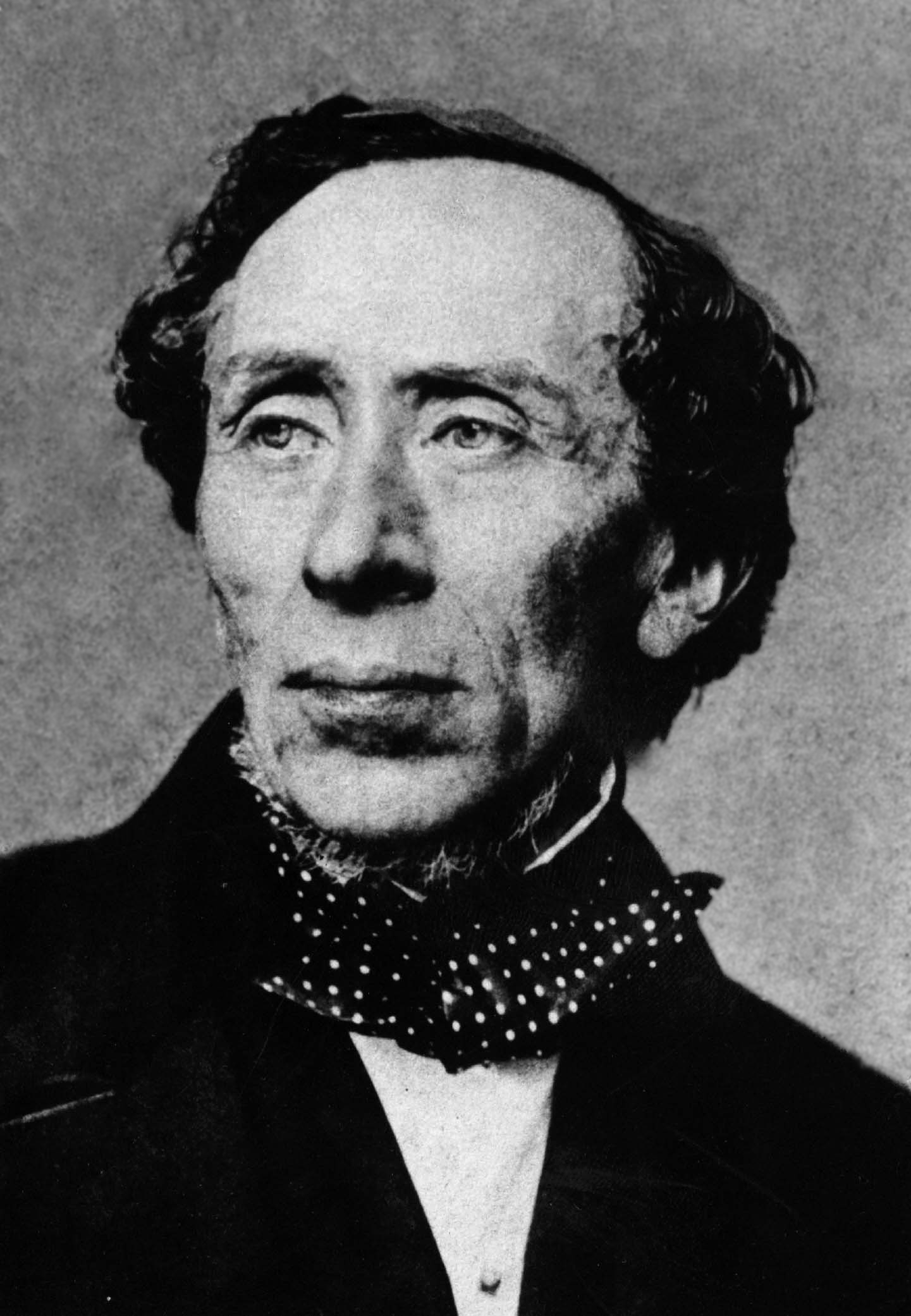
AVVVDM kicks off with Hans Christian Andersen giving a contrived recital of The Little Mermaid. Now it turns out that the real HCA was an awkward character, abused at school, with unrequited longings for men and women but likely celibate. One of the objects of his affections, Edvard Collin (Lee Knight), is in the crowd in this opening scene. And, incongruously, also there, well there in HCA’s mind, cue the scary music, are a couple of blood encrusted, walking and talking, corpses, Barry (Graeme Hawley) and Dirk (Ryan Pope), sporting fine moustaches. Well this is a fairy tale after all. Cut to the attic of HCA’s townhouse where, surprise, surprise, we discover that he has a secret, namely a Congolese pygmy, Marjory, in a box, who is writing his stories.
All this is accompanied by a gravelly narration from none other than Tom Waits. From here MM weaves together the genocide in the Congo Free State in the late C19 with the real life friendship of Charles Dickens (Phil Daniels) and HCA, which unravelled when HCA overstayed his welcome on a visit in 1857. I’ll stop there. Let’s just say the plot plays fast and loose with fact, fiction and time.
I guess MM’s main thrust is to contrast the near unbelievable horror of King Leopold II’s direct, private rule of the Congo from 1885 to 1908, where maybe ten million died, and which scarred the country through Belgian colonial rule, and post independence, with the pygmy population suffering most, (as it still does today), with the maudlin tales of innocence and virtue standing fast against corrupting forces of both HCA and Dickens. It is hard to avoid the stories told by the latter, they permeate Western culture: the barbarous reality of the former though, a couple of decades later, and far worse than anything imagined in fiction, is still barely known by many, including me until now.
The fact that MM tells this story in the form of a comedy, in an expletive-ridden contemporary vernacular, is only to be expected from MM. Casting Jim Broadbent and Phil Daniels, who are, by virtue of career and demeanour, are distinctively Dickensian, is surely no accident. After all a new MM script will pretty much guarantee any actor from his roster of favourites will sign up, sight unseen. Both went all out for laughs, many of which were at the broad end of the subtlety scale. Emily Berrington, as she so often does, near steals the scenes she is in as the earthy Mrs Catherine Dickens. I loved the sweary kids as well. Paul Bradley, as the inexplicit Press Man, also turned in his customarily fine performance.
However the play would not be possible without the formidable Johnetta Eula’Mae Ackles as Marjory, (and later Ogechi, you’ll see). From the moment she emerged from the box, suspended from the ceiling in Anna Fleischle’s amazing set, I couldn’t take my eyes off her. This was BUD, and KCK’s, first exposure to the wonderful and frightening world of Martin McDonagh. The SO was converted at Hangmen. When we emerged, not a little bewildered, after the 90 minutes, we debated the play long into the night. OK then maybe not long into the night, but certainly as long as it took to have a drink, some rarebit (highly recommended) and some madeleines, in the excellent Bridge foyer. Anyway BUD, being the analytical sort of chap he is, couldn’t get over the fact that the play could only exist with Johnetta Eula’Mae Ackles in the role. Surely it must have been written for her?
I agree. But not for the obvious reasons of appearance. Simply because she is an outstanding actor. Sardonic, bitter, vengeful, powerful yet also vulnerable, compassionate and forlorn. Don’t get me wrong she delivers plenty of killer (literally) comic lines but she also carries the entire weight of the emotional and political substance of the play on her shoulders. This is her professional debut. Extraordinary.
Now director Matthew Dunster, and Anna Fleischle, have previous with Martin McDonagh, having brought the Royal Court production of Hangmen into being. (Mr Dunster also has form with HCA, directing the Pet Shop Boys’ ballet adaptation of his story The Most Incredible Thing. Messrs Tennant and Lowe know a thing or two about stagecraft challenges but they are not a patch on MM).
Even so I suspect director and designer, and the rest of the creative team, James Maloney (music), Philip Gladwell (lighting), George Dennis (sound), Chris Fisher (illusions), Finn Ross (video) and Susanna Peretz (wigs and prosthetics), must have rolled their collective eyes at their first meeting. How were they going to make this leap of mischievous imagination from page to stage? Impressively, as it turns out.
So you see the thing with MM is there is just so much there. So many echoes yet uniquely his own voice. Scorsese, Malick, Pinter, Tarantino, Synge, Le Fanu, Mamet, Beckett, Borges, punk. Insert your own thoughts here. I for one really what to believe he likes The Fall.
A master story-teller. With maybe, in this case, not quite a master story. It might annoy you. It might frustrate you. It might provoke you. It might overwhelm you with “WTF” moments. It should make you laugh, (assuming you know a little of what you are letting yourself in for). It will certainly make you think. And you definitely won’t forget it in a hurry.


 At Home He Feels Like A Tourist