
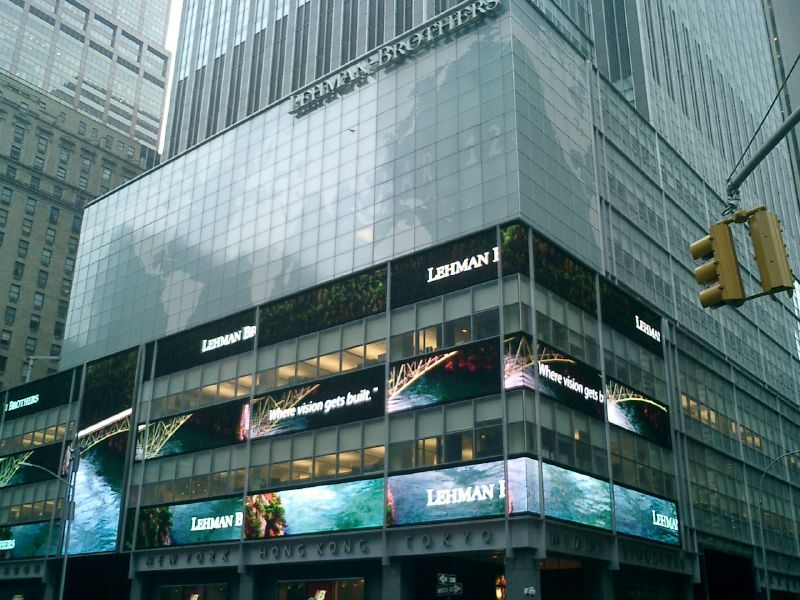
The Lehman Trilogy at the National Theatre review *****

114319196_445326e2cb_o

The Lehman Trilogy

National Theatre Lyttleton, 18th September 2018

So I gather this staging of Stefano Massimi’s play The Lehman Trilogy is a very different take from that lauded across Europe after its premiere in 2015 in Italy. No cast of thousands here. Just three amazing actors in Simon Russell Beale, Ben Miles and Adam Godley, and a minimalist set bearing all the usual hallmarks, (revolving glass cube, neon lights, monochrome, simple props to be shuffled around by the cast), of its designer Es Devlin, with symbiotic and effective video panoramas courtesy of Luke Halls, and thrilling sound and lighting design from Nick Powell and Jon Clark . All this from a director Sam Mendes, who is normally master of the maximalist, last seen in The Ferryman.

Of course no matter how good the production it all starts with the text. Here the Deputy Artistic Director of the NT, and dramaturg maestro, Ben Power has condensed the original play into the sprightliest 3 hours (ex intervals) imaginable. Of course there is a history lesson, but Mr Power, I assume reflecting the Italian original, draws out the themes and repeated motifs, and the key characters, the original three brothers, Henry, Emmanuel and Mayer, and the next generations, Herbert, Philip and then scion Bobbie. The final chapters, as the family cedes control to “outsiders”, and the collapse presided over by the hubristic bully Richard Fuld is, as many others have observed, a bit of a rush, but I don’t think that really matters. This is a story of the founding roots, expansion and degradation of American capitalism and, specifically, how a family of Bavarian Jewish emigres went from a farm supplies shop in Montgomery, Alabama to become one of the most powerful global financial dynasties ever seen. Lehman Bros is fascinating, yes because it is no longer there, but also because it was, to all intents and purposes, the first of its kind.

Our generation knows the importance of these institutions thanks to the crisis of 2008, still impacting the global economy a decade later. Lehman Bros, on that fateful 15th September, was the sacrifice made pour encourager les autres. The biggest bankruptcy in US history, (though the US, European and Japanese “franchises” largely ended up with Barclays and Nomura), Lehmmn was the catalyst for the intervention which we all all still paying for with, at root, the “wrong” cost of capital. The play though resolutely shows that cyclical crises are endemic to financial capitalism, and not just in the events of the 1929 Wall Street Crash. 1857 and 1873 also get a look in. The mis-pricing of complex risk is built into the system. It won’t go away.

We start at the end though with the iconic boxes, which staff used to carry out belongings after Chapter 11 was declared, piled up on the modern office set. These boxes in various configurations, with a few chairs, tables, a spot of graffiti and our imaginations, go on to signify the humble one room shop, the expansion into cotton-broking, the office in New York set up in 1860, the homes of the great and good in the story, particularly the families the three brothers marry in to, a synagogue, the boardrooms and trading floors of the palaces of the post WW II years.

And all the supporting characters, wives, children, business associates, rabbis, friends, even a tightrope-artiste, all are played by our three actors. Throughout they wear the formal frock coat attire from the mid C19. So all these “extras” are conjured up with accent, movement, stance, attitude. Now Simon Russell Beale relishes this sort of caper but Adam Godley near matched him, especially when it came to squeezing humour out of his impersonations. All three of these actors have been at the top of their game for years. Whether on stage, large or small screen, it is a fair bet that they will steal the show in whatever they appear in. To have them all together was revelatory. This is an abstracted story. With a narrative arc of this scale, across this much time and space, intricately juxtaposing the familial with the social, political and economic, it couldn’t be anything else. So everything we see, hear and learn is formed from the basic building blocks of acting and direction. Yet it is so, so rich, symphonic if you will. Look out for the recurring nightmare scenes. Just one example. Simply stunning.

Oh and there was one other genius involved. Candida Caldicot. The soundtrack to this odyssey conjured up live with one piano.

With this story, this cast, this director, this text and this creative team this was always likely to be a winner. No surprise it was an early sell out. This play in this adaptation will re-appear. No question. Whether you get acting of this quality again I am not so sure.

 

Blackkklansman film review ****

3508865199_c3c5f53dbb_o

Blackkklansman, 30th August 2018

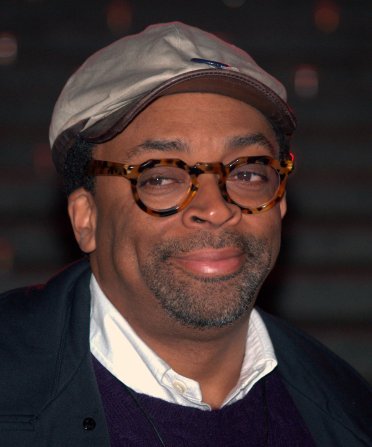
Spike Lee is 61 years old. This photo is a few years old but there is still a twinkle in his eye if you ask me. That twinkle, the eye for mischief, has been in his films from the start. Now I can’t pretend that I have followed his career, after the initial breakthrough in the mid 1980s with She’s Gotta Have It, Do The Right Thing and Malcolm X, but every time I have seen one of his films I have been thoroughly entertained, educated and provoked and made a mental note to see more of his work and revisit the early films. I have failed in this.

However I thoroughly enjoyed Chi-Raq a couple of years ago, with its more than a passing nod to Lysistrata, though the remake of Park Chan-wook’s Oldboy was disappointing, and can add to the acclaim for Blackkklansmen. It is, to its core, a Spike Lee film, the examination of race in the US and the African American experience, the humour, the exaggerated characters, the mixing of fact and fiction, the incorporation of documentary footage, the title sequences, the slick technique, the music, the dolly shots, all in the service of a captivating and extraordinary true-ish story of a black cop in 1970s Colorado Springs who, with the help of a white colleague, penetrates the Ku Klax Klan as they plan a terrorist atrocity.

Mr Lee is a proselytising political film-maker who can, at his best, appear not to be. (I am not talking here about his specifically documentary films such as 4 Little Girls and When the Levees Broke). Political films can, perforce, be a dour watch. Especially if they are about the “business’ of politics, political history, made by directors with an avowedly political agenda or focus on big, global issues, the stuff of international relations. Getting bums on seats with this sort of stuff is not easy. Me Lee here though has managed to incorporate the elements of a thriller, the one sure-fire way to secure an audience for the political, with elements of personal and identity politics in the relationships between the key male characters and the main protagonist, Ron Stallworth, and impassioned student activist girlfriend, Patrice. Best of all the satirical mocking of the KKK and its leader David Duke repeatedly hits the target without diminishing the ugliness of their hate. Remember the criminal fascist Duke is still peddling his sh*te and people are still being emboldened by it.

The period setting is superbly realised. The cast is outstanding. John David Washington’s bone-dry Ron is confident enough to face down face down racist colleagues after joining the force and to persuade boss Chief Bridges (Robert John Burke) to back his plan to infiltrate the KKK. The ever laconic Adam Driver is the perfect foil as Flip Zimmerman, who is sent in undercover to join the KKK cell. We see the political horizons of both expand; Ron after he is sent to monitor a Black rally at the local university, (where Corey Hawkins plays Kwame Ture in a stunning scene), where he meets Laura Harrier’s Patrice, and Flip, as the Jewish heritage he had abandoned is unmasked by the KKK and, specifically, the comically evil Walter (Ryan Eggold). Topher Grace is the spitting image of the young David Duke and brilliantly captures the rhetorical articulacy allied to an idiotic world view. There are some fine cameos on show  from Paul Walter Hauser, following on from his scene stealing performance in I Tonya, from Finnish actor Jaasper Paakkonen as Felix Kendrickson, the leader of the local Klan cell, and from Ashlie Atkinson as his wife Connie, who spews out shocking unthinking vitriol but still ends up as an unwitting victim.

Scene after scene hits home and somehow Spike Lee knits effortlessly knits this all together. Harry Belafonte is immensely moving as Jerome Turner in a scene where he describes the violence meted out to African-Americans in past generations. The Klan meting which ends in a screening of the outrageous DW Griffith’s film Birth of a Nation is properly shocking as is Alec Baldwin playing white supremacist Dr Kennebrew Beauregard. The ending is proper edge of the seat stuff. As if that wasn’t enough Lee leaves us with actual news footage from the Charlottesville rally in 2017. No equivocation here in contrast to some in the US. You will leave the cinema with no doubt what is right and what is wrong.

Blackkklansmen won a price at the Cannes Film Festival. I regret I am not up on these sort of things and have no idea what it was up against, but I am sure the jury here got it right. Mr Lee has packed so much into this film, plot, character, message, tone, spectacle, and the just over 2 hours flies by. Unmissable.

America’s Cool Modernism at the Ashmolean Museum review ****

5843121737_7c5264a2a6_o

America’s Cool Modernism: O’Keefe to Hopper

Ashmolean Museum, 26th June 2018

Those clever people at the Ashmolean in Oxford have come up with another fine exhibition to rank alongside last year’s survey of Modernism in France Creating Modernism in France at the Ashmolean Museum review ****). There are plenty of paintings, and photographs, on show here that you would be hard pressed to see without hopping over to the US, as there is b*gger all from this period in public collections here, and the theme, the “cool” in American art in the first half of the C20 is both aesthetically and intellectually interesting. An excellent counterweight to the recent surveys of Abstract Expressionism and American art in the 1930s which came to the Royal Academy as well as the Tate Modern exhibition of Black American art from the 1960s onwards.

There isn’t a great deal of pure abstraction here in contrast to what was going on, in large part, in Europe at the time. Most of the artists on show keep at least one foot, and often more, in the figurative camp. Indeed escaping the influence of those swanky French seems to be part of what many of these artists set out to achieve. There are some early experiments in abstraction in the first room but they are not really up to much. Landscapes and cityscapes predominate. This is not art rich in portraiture: indeed one of the defining features of the survey is the absence of the human figure. The artists here are generally fixated on the rise of modern, urban America: capital accumulation, the factories, the infrastructure, the cities, the technology. Lines are hard, sharp and exact, the natural light is sharp. Twilight and artificial light get a good look in. In the best of the work on there is a weird sense of alienation and stillness. A very detached eye. The rapid social and economic transformation seems to have unsettled some of these artist folk. The rural does get an outing, but this is agriculture as industry, and not the wide, open spaces of American myth. There are a fair few barns.

The paint colours are “cool”, washed out, not vibrant in the way that European art was preoccupied with at that time. Forms are precisely rendered. There is a fair bit of “flatness” on show. The influence of the exact, “abstract” and architectural photography of the likes of Paul Strand, Berenice Abbott and, a new name for me, Imogen Cunningham is exemplified. There are a lot of buildings.

The core of the exhibition is the “precisionist’ art of Charles Demuth and Charles Sheeler but the curators have also succeeded in drawing a line back to the more naive, and near abstraction, of Arthur Dove, Helen Torr and early Georgia O’Keefe (Black Abstraction from 1927 is the stand out), which catch the eye in the first room, as well as forward to the uneasy genius of Edward Hopper. The exhibition ends with three blockbusters from said Mr Hopper, which, for me, are the best things here by far, but I still thoroughly enjoyed the ride up to this specific thrill.

So what were the biggest surprises beyond those artists I had some familiarity with? The three eerie townscapes from George Ault, New York Night No 2, View From Brooklyn and Hoboken Factory. It seems Ault trained in London, good man, saw three of his four siblings commit suicide, fell out wth his precisionist chums and was an alcoholic. Perhaps this explains his penchant for the twilight world.

His work is certainly a lot darker that Demuth. He is the one who liked text in his paintings of cities, indeed his must famous work is the iconic I Saw The Figure 5 In Gold which title about sums up the subject. Sheeler, who was an amazing draughtsman and nearly as good a photographer as he was painter, is probably the epitome of the “cool” aesthetic that the curators have tried, and succeeded, in showcasing. I was most taken with Demuth’s Welcome to Our City which I assume depicts his native Lancaster, Pennyslvania to whence he returned from New York due to ill health, and away from the circle of artists around Alfred Steiglitz. Sheeler’s Bucks County Barn (shown above) is almost hyper-real in its detail, barely distinguishable from his photographs of the same subjects on first glance, but as you look more closely a triumph of oil on canvas.

The two paintings from a precisionist follower, Canadian Ralston Crawford, Buffalo Grain Elevators, and Smith Silo Exton, take the inspiration of Sheeler’s rural buildings but lend it a more abstracted geometric construction. Great stuff.

There are also a pair of oil paintings from Joseph Stella, Telegraph Poles with Buildings and Metropolitan Port which show his association with the precisionists but also his early exposure to the Italian futurists. The handling of the paint here is a lot freer, there is almost a “smoky” quality, which I was much taken with.

Outside of these paintings I was also drawn to the carefully chosen lithographs on display. Louis Lozowick presents dynamic perspectives in drawings of Minneapolis and New York, there is a superior looking barn from the extravagantly named Benton Murdoch Spruance as well as a couple of fine examples from Sheeler again. Now I am not sure Grant Wood could reasonably be seen as central to the concerns of many of the other artists on show here. A regionalist, focussed on the rural, master of the “American Scene”, I don’t think he was big into for city or industrial subjects. He certainly has the air of detachment that others exhibit here though, albeit with a much heftier dose of irony and/or nostalgia, you are never quite sure. Anyway there are three of his tremendous lithographs in the exhibition, one of haystacks covered in snow, another of MidWest fields, and one of a barn and American Gothic style house. There are Durer-like in their detail and execution.

There is also Martin Lewis’s iconic drawing Which Way? with a car seemingly lost in a snowstorm. Lewis was born in Australia and came to the US to work as a commercial illustrator, a profession that  many of the greats of US art in the C20 took up to keep the wolf from the door, and which underpins the American take on modernism when compared to their rather more esoteric European peers. He found great success in drypoints, a technique he mastered on a visit to Japan, but his fame quickly faded. I think I have seen this image before but I can’t for the life of me remember where. I guessed it might have been used in connection with David Hare’s adaptation of George Simenon’s The Red Barn at the National Theatre directed by Robert Icke (a qualified success), but that image was actually another drypoint image of a barn in the snow by an artist I can’t identify. It seems that the  barn, in whatever weather, is the greatest staple of American art since the founding of the nation. There must be tons of academic papers on this.

Anyway Lewis’s drawing is not a barn but it is a perfectly wrought rendition of artificial light, here the car headlights against the snow, against the dark night. And it is probably a metaphor for the country itself, given this created in 1932, just as the US was emerging from the very worst of the Great Depression.

Now it turns out Lewis was a mate of Ed Hopper. who also has four etchings on show here, all of which show that his mastery of line. shadow and viewpoint wasn’t confined to painting. They would be worth the entry fee alone but, as I said above, there are also three oils to savour, which I think are on show in the UK for the first time. It is hard to believe that his big breakthrough didn’t come until the early 1930’s, and especially after the retrospective at MOMA in 1933, when he was already 50. Prior to that he too had to support himself as an illustrator.

I can’t believe that there is anyone who couldn’t get something valuable out of seeing Hopper’s paintings. The stillness, the light, the murkyish palettes, the shadows, the melancholy, the introversion, the uneasy suggestion. The SO, who doesn’t care for much art, adores his work reproductions of which are plastered on the walls around me as I sit writing this. Mind you, dare I say it, puritanical realism is her bag. Anyway suffice to say we love Hopper.

From Williamsburg Bridge (1928), shows the top floors of a handful of late C19 buildings seen from the eponymous bridge, with a woman perched on the ledge of one open window in the afternoon sun. Dawn in Pennsylvania (1942), is a view of a train departing, and the buildings opposite, framed by the platform. Manhattan Bridge Loop (1928) is a wider perspective of the railtrack and a cityscape.  All are wonderful.

So soak up what is on offer in this fine exhibition, see if you accept the curator’s argument, I do, and then take as long as you like with this Hoppers. It is worth it.

Many of the works on show are drawn from the Terra Collection for American Art and the Met. So thanks chaps. Just goes to show that there are some things that have come over from the States in recent weeks that aren’t, to borrow the language of astute political commentator Danny Dyer, twattish.