No panto for the Tourist and family. This year’s entertainment was to be Anthony Neilson’s adaptation of the (in)famous Edgar Allan Poe short story about a writer who, let us say, loses a little bit of perspective. Some concern from our party, particularly those of a nervous disposition, as it gradually dawned on them what Dad had signed them up for, but I can cheerfully report that even LD took all the on-stage frights in her stride. For Mr Neilson, who is also directing, and the rest of the creative team, of which more later, have served up plenty of suspense and, occasionally gory, illusion but it is all undercut with humour and an air of wry parody. More Inside No 9 (though not quite as clever) than Texas Chain Saw Massacre.
Now Poe’s original story runs to no more than a few pages and tells of a madman haunted by the “vulture eye” of an old man. His obsession turns to murder which he confesses in fairly short order. So a classic morality tale of crime and punishment with the twist that it is narrated by the unhinged first person. Poe built on the Gothic horror tradition created by Horace Walpole, becoming the father of the psychological horror which film-makers today can’t get enough of, and the scary eye has been a staple of creepy stuff from the dawn of human existence. Check out Odilon Redon’s famous 1883 illustration for a copy of the story shown above. But Mr Neilson was going to need a bit more than that to fill a couple of hours of stage time and to appeal to us jaded sophisticates so Poe’s story has been subjected to some substantial, and largely, successful expansion.
Tamara Lawrance (soooo good in the adaptation of Andrea Levy’s The Long Song on the Beeb recently) plays Camille (or maybe Celeste) a young writer, feted for her first play, but having a bit of difficulty following it up (an NT commission ha, ha). So she holes up in a top floor garret in Brighton, Shining style, to tackle her writer’s block. Her isolated landlady, Nora, an all-in performance from Imogen Doel, is the chatty type, at first a welcome distraction, then increasingly annoying. She comes with a bit of a macabre back-story and an ostentatious patch over one eye. It doesn’t end well.
The story is told through flash-backs and flash-forwards which also involve the copper(s) sent to investigate Nora’s disappearance. It takes a bit of time to get going, though the first half, as Camille and Nora get to, very closely, friend each other, and detective David Carlyle begins his menacing/camp interrogations, doesn’t lack for atmosphere, but the real pay-offs come in the second half, both visually, and plot-wise. Anthony Neilson is probably guilty of a few too many meta twists and references by the end(s), though it does ramp up the breathless WTF quotient, and it doesn’t entirely all hang together, but who cares when there is this much invention on stage.
For designer Frances O’Connor, together with the lighting of Nigel Edwards, the sound and composition of Nick Powell and, especially, the video work of Andrzej Goulding, and everyone in their teams, have conjured up a visual and aural feast. Of course it is artifice, and deliberately so in many cases to keep pace with the knowing tone, but it is still very effective, there are some genuine audience jumps, and, for the slightly sad members of the audience (hello Tourist), a source of endless fun in ticking off the various techniques employed. As the hair-raising manifestations of her own mental state, (or did this really happen or maybe this just a script?), mount up, Tamara Lawrance steps up, never for a moment giving less than 100% commitment. Imogen Doel, and especially David Carlyle, have more in the way of comedy to deliver, which they plainly relish, and there are even a few unsubtle, though still funny, poo-based jokes.
Anthony Nielson I gather is a bit of a one for the collaborative, workshopping approach and his, and I assume, the rest of the creative team’s itch to pack in as much as they can in terms of plot, gags, schlock and stagecraft often shows, but this is still, for the most part, a thoroughly entertaining show that doesn’t take itself too seriously.
Confession. This was the first time I had ever seen a production of The Merry Wives of Windsor. The Tourist can’t remember there being an opportunity, RSC or otherwise, in those few periods of his intensive theatre-going in the past, and I don’t think there was a production of sufficient quality over the more fallow years to drag him away from the reality of life, work, kids, drink and the like.
Also, I have to admit, TMWOW has always sounded a bit limp, with the Shakespeare industry being a bit sniffy about its worth, dubbing it “the first sit-com”, compared to the other comedies, Twelfth Night, Dream, Much Ado, As You Like It, Errors, Shrew ….. in fact only The Two Noble Kinsmen of the “pure” comedies seems to get a worse rap. (Well maybe The Taming of the Shrew with its impossible to mitigate misogyny without some dubious directorial device). The other criticism seems to centre on the disappointment of taking one of WS’s most “rounded” characters, analytically as well as literally, out of the history plays and plonking him into a class-based farce as the butt of the comedy.
Well just as Barrie Rutter made a case, albeit not entirely convincing, for WS’s (with John Fletcher) last contractural obligation with his Two Noble Kinsmen at the Globe, so director Fiona Laird has served up a peach for the RSC, (though it is just about to end its run at the Barbican). All I can say is that if TMWOW is normally this funny then all those naysayers who are supposed to know their onions when it comes to the Bard need their heads examined.
If it isn’t normally this funny then Ms Laird is to be further congratulated for making it so to a contemporary audience. Shakespeare’s humour comes from plot – usually will they/won’t they romances and unlikely assignations, from – word-play – badinage, punning and bawdiness – and from physical comedy – which, obviously, is not something made explicit in a text. To make a modern audience laugh it usually makes sense to trust Will and let the plot do what it will, play down the anachronistic, and not always easy to follow, wordery and massively ramp up the caricature, mannerism and visual gags. Which is exactly what this production does. With plenty of new interpolations.
If the audience reaction at the performance the Tourist attended was anything to go by, and it seems this has been supported by critics, professional and amateur alike, this definitively worked. I laughed. A lot. In fact as much as I can ever remember for a Shakespeare comedy. It is not as all round satisfying as the best Much Ado or Twelfth Night production but it was still a revelation.
The plot is contrived. And daft. No question. One theory alleges that Will only had 14 days to come up with it after the Queen requested an entertainment for the Order of the Garter festival in 1597 to feature her favourite of his comic creations, Sir John Falstaff. Now, as I sure you all know, Falstaff is way more than just a comic buffoon, as we see in Henry IV Parts I and II, and as Mistress Quickly explains in her eulogy in Henry V. He may be vain, boastful, corrupt, cowardly, a drunk and petty criminal, but he is charismatic and he embraces life and we, and Prince Hal, therefore love him despite his faults. And he is, of course, fat and as everyone knows us fat people, with our seeming inability to control our appetites, and our apparent physical limitations, are just funny.
Humour invariably validates superiority. It takes what the group or society has deemed as unsettling, threatening or just different and turns it into something safe and tolerable. Falstaff, because the genius Shakespeare created him, is doubly funny because he is both the object of our laughter and also, because of his wit and intelligence, the source. Tricky business humour. I am sure that there are plenty of people who would be happy to make a joke at my expense because I am fat. In the same way it would probably make me happy to make a joke at their expense because they are stupid. Like I say tricky business.
Anyway I suspect big Will didn’t waste too much time mulling over the psychology of humour and just got on with the task, knowing which way the Elizabethan bread of patronage was buttered. Which explains the oft observed “lack of subtlety” in the plot and character. Yet, as all students of the situation-comedy know, the best characters in the genre have one, or more, personality traits amply exaggerated. And the best sit-com plots begin with a plausible set-up that gets incrementally ever more ridiculous. Which, give or take, is what happens in TMWOFW.
Falstaff is on his uppers. He pitches up in Windsor, or, in this production a place that feels suspiciously like Chigwell. He resolves to woo a couple of wealthy married women, Mistress Alice Ford and Mistress Margaret Page. He commands his servants, Pistol and Nym, to deliver the ladies identical love letters. They refuse and tell the ladies’s husbands. Page (Paul Dodds) isn’t too bothered but Ford is the jealous type, and he is introduced to Falstaff by the Host(ess) of the Garter Inn masquerading as a Master Brook in order to unveil Falstaff’s plans. Meanwhile, (yep there is always a meanwhile or two in these plots), three other chaps are trying to woo the Ford’s daughter, Anne; absurd French doctor Caius, asinine youth Master Abraham Slender, cousin (here nephew) to Justice Robert Shallow and young Fenton (Luke Newberry), a gentleman now bereft of his fortune.
Cue confusions, set-ups and comic revenges. By the three suitors on the Host(ess), by the two Mistresses on Falstaff, by “Brook” on Falstaff, by Ford on his wife, by everyone on Falstaff, and by Page and his wife on Slender and Caius, and by Anne and Fenton on the parents. It all ends happily though.
These farcical set pieces, replete with disguise and concealment, offer plenty of opportunity for clowning, which the cast, directed by Spymonkey specialist Toby Park, relish and have perfected over the run in Stratford and now London. David Troughton is a brilliant Falstaff, decked out in “fat suit” and priapic codpiece, and booming out his perfectly timed lines. Rebecca Lacey and Beth Cordingley are sensational as the conspiratorial and true friends, Mistresses Page and Ford, with exaggerated TOWIE accents and hamming up their humiliations of Falstaff, both in the laundry basket scene, here a wheelie-bin, and in the Woman of (now) Brentwood scene. Vince Leigh, who I remember pulled off a similar trick in Propellor’s all -male Taming of a Shrew as Sly/Petruchio, manages to make Ford’s jealousy palpable, and not a little pungent, but still amusing, and even gracious, when his suspicions prove unfounded. It is possible to believe that he and Beth Cordingley could be a couple who care beneath the mutual scorn.
Tim Samuels and Tom Padley make a fine double act as Shallow and Slender. All the servants, Ishia Bennison as Mistress Quickly, here housekeeper to Caius, Steve Basaula as his man Rugby, Nima Taleghani as Falstaff’s pageboy and John Macaulay as Simple, offer wry indulgence to the whims of their “betters”. Charlotte Josephine, Afolabi Alil and Josh Finan are also able to inject at least some of the personalities of Bardolph, Pistol and Nym, though these are more developed in the history plays. TMWOW is, at its heart, a satire on the pretensions and affectations of the “middling” class, their preoccupations with wealth, marriage prospects and position in society. Aristocracy is conspicuous by its absence, other than Falstaff and his young doppelgänger the spendthrift Fenton, though Shakespeare chucks in enough references which gently mock his Court audience, and the servants are generally enablers rather than protagonists. This then is obviously immediately recognisable territory for the modern audience, “we are all middle class now”, made more so here by the Essex milieu.
The comedy also takes a swipe at that staple of “English” comedy, foreigners, and specifically their funny accents. No obviously progressive way to do this so best wade right in. David Acton does exactly that with loquacious Welsh parson Sir Hugh Evans, another from the Shakespeare school of Welsh windbags, but Jonathan Cullen goes even further with Dr Caius, offering a Gallic strangling of the English language which goes well beyond the simply Clouseau-esque. A couple of deft retouches create some priceless, and filthy, moments, one of which I fear I might have made up in my own dirty mind as no-one else seemed to laugh. I particularly enjoyed the addition of the East Europeans who come to remove the wheelie-bin, who are snootily looked down on by the assembled throng whilst they, it transpires, are chatting about the scene’s resemblance to Proust.
The final theme of TMWOW seems to me to lie in the power executed by the women. By casting Katy Brittain as the Hostess of the Garter pub she too, along with the Mistresses, Anne, (another fine performance from Karen Fishwick to set alongside her Juliet in this season), and Mistress Quickly, run rings around the lads. They get their own way, and get revenge on the sexual predators, not through compromise, simpering or abasement but through their own agency, and they have a right laugh in the process. Switching the denouement to the town square, rather than Windsor Great Park, with Elizabeth’s statue towering over it, may slightly invalidate Falstaff’s Herne the Hunter garb, though Epping Forest isn’t too far away I’ll warrant, but it does, finally, leave the women on top. I wonder if Liz I herself would might been pleased with this ending.
Lez Brotherston’s set, turning seamlessly to reveal the skeletal interiors and exteriors of the half-timbered houses, is as ingenious as his hybridised costumes, which mix modern and Elizabethan fashions. There is plenty of blingey accessories on show, particular favourites for the Tourist were the blow-up flamingos, Mistress Page’s all in one cerise pink throne and foot-bath, Anne’s fluffy pooch, the f*ck-off massive gas barbecue, the remote-control golf cart and the white leather bar stools. Caroline Burrell has recreated Tim Mitchell’s lighting design particularly effective when the houses turn neon. Gregory Clarke’s sound design didn’t intrude and Fiona Laird’s own composition completed the jolly mood.
OK so there are a couple of occasions when my snob-o-meter vibrated. The Bread of Heaven chorus and the Dick Emery reference might have been steps too far but that is my problem not Ms Laird’s and the RSC’s. Overall this is a cracker of a show, very funny, easily digested and with a few points to prove. Carry On.
Simon Godwin is a director who has shown he has a bit of a way with the sprawling masterpieces in the dramatic canon in recent years. Especially from the Bard. His recently opened Timon of Athens at the RSC, albeit with the force of nature that is Kathryn Hunter in the lead, seems to have gone down well with the criterati. Previously at the National his Twelfth Night, (OK so that’s not really sprawling but it is stuffed to the gills with characters all wanting time to shine), was a belter, his excellent African inspired RSC Hamlet announced Papa Essiedu to the world, and further back the Tourist can bear witness to the success of his interpretations of Farquhar’s The Beaux Stratagem, Shaw’s Man and Superman and O’Neill’s Strange Interlude, none of which falls into the snappy, straightforward category.
He doesn’t go in for the flashy, but neither is he by any means “conservative”, here being resolutely modern-dress. What I think he does do is think carefully about every single character’s attributes and motivations, and how they fit together, and ensures they have enough “space” to show those attributes and motivations. So even the most far fetched plot seems eminently reasonable. He is at it again with Antony and Cleopatra. You can see that from the string of 4* reviews and the gongs already handed out to the incomparable Sophie Okonedo (who has also I see now bagged a CBE from Her Maj) and the redoubtable Ralph Nathaniel Twisleton-Wykeham-Fiennes (who I believe has never been so honoured though he is, as you might expect with that moniker, a distant relative of our beloved Royals).
So you probably don’t need me to tell you this is probably about as good an interpretation of the still flawed A&C as you are ever likely to see. (And you can still see it if you are crafty, and lucky, with the returns that invariably pop up a day or so ahead). Still, redundancy, and/or sluggishness, have not prevented me venturing an opinion in the past so here goes.
The problem with A&C, which was readily apparent in the last, somewhat unconvincing, RSC offering, lies in the flamboyance of the language, the articulation between the “great events” which provide its context and the domestic “at home with the … ” drama of our ageing lovebirds, and the potentially wearing effect of seeing the celeb couple always “showing off” to real, and imagined, audiences. Simon Godwin however has chosen to take these challenges head on.
First up he takes his time. At near 3.5 hours with the interval, across 42 scenes, this does mean there are one or two moments where audience concentration will waver but, with little in the way of cuts (though I am not expert enough to be sure), it means that the historical big picture is unclouded and that all the characters, and not just the power couple, get the chance to show themselves fully. Moreover the lines themselves are given air to breathe and the detail of the domestic exchanges has been rigorously thought out, especially the comic and ironic inflections. Interestingly only the final suicide scenes feel a little rushed with the snake being a bit of an indulgence. We had come this far so I would have been happy to see a more measured take on Tony’s botching and Cleo’s scrupulous choreographing of her own demise.
Obviously it helps that the acting is so strong. And not just from our Sophie and our Ralph. Tim McMullan as Enobarbus, especially shaven-headed for the part, is as wonderful as everyone says he is. It helps that Enobarbus is gifted with some of the best lines in the play but even so he brilliantly walks the tightrope of truth and cynicism (central to the whole play) in his capacity as detached observer and explainer of events and as the embodiment of corrupted honour. And he does all of this whilst barely appearing to try. Now I am pretty sure that Mr McMuillan doesn’t want for work, so good an actor is he, but I would like, no I demand, a Richard II and an Iago from him in the relatively near future. And a lead role in a new play at the NT.
The other standout was Fisayo Akinade as Eros, given full rein to ramp up the comedy but also squeezing a ton of emotion out of a character that normally is just a bit part. The smart money already knows this young man is going places. Re-gendering Agrippa definitely worked, especially with Katy Stephens stepping up, I really enjoyed the performances of Gloria Obianyo and Georgia Landers as Chairman and Iras, more put upon bessies than intimidated hand-maidens, joining Eros and Enobarbus as the conflicted confidantes required to soothe and distract their nominal bosses.
Hannah Morrish did her steely, vulnerability thing again as Octavia. Nicholas Le Provost did his Nicholas Le Provost voice to perfection as a slightly feeble Lepidus, though Tim McMullan’s impersonation might actually improve on the real thing, and Sargon Yelda was an adept Pompey. In fact the only slightly jarring performance came from Tunji Kasim (who is a fine actor make no mistake) whose Octavius seemed overly stilted compared to the naturalistic verse and prose delivery on show elsewhere.
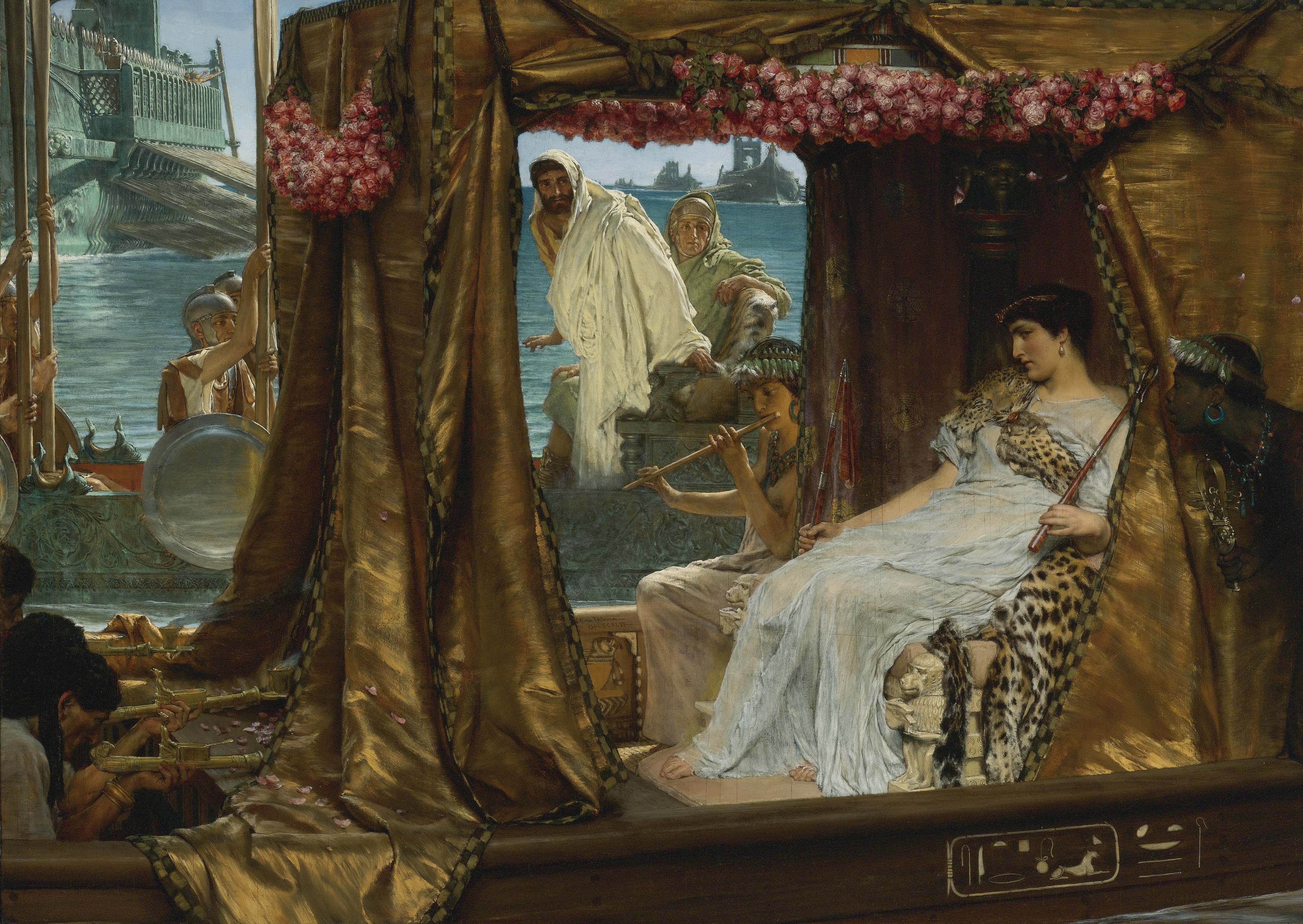
This delivery and the afore-mentioned deliberate pacing also meant that the “performances” of A&C were foregrounded. A&C were the hammed-up actors in their own blockbuster, not just in terms of the ludicrously over the top way they voice their love but also in the way they inject this passion, this risk-taking, into their behaviour in the political arena. Whilst also knowing they are a bit too old and tired for all this display and that it is unlikely to end well. But there egos can’t help themselves. This is also perhaps what has made the story, and especially the “idea” of Cleopatra, so alluring to subsequent generations. (Though as the preposterous flummery of Dutch/British Victorian artist above shows most of these generations preferred their Cleo to look like she had come from Surrey).
Making sense of the “epic” in the tale whilst still permitting us to make a personal, emotional, connection is Mr Godwin’s, and his casts’, smartest achievement here. Hildegard Bechtler’s revolving set (note to designers: always use the revolve on the Olivier to avoid the “acres of space” illusion) is sumptuously minimal, or minimally sumptuous, making the delineation between efficient Rome (modern war room with split screen conflict footage), sultry Egypt (Alexandrian palace with complete with pool – only slightly Vegas) and all places in between, including a submarine, clear without being fussy. Once again it does slow down proceedings but, like I say, that gives time to process what we learn from each of the sometimes rapid-fire scenes.
I’ve no doubt that Anthony Hopkins and Judi Dench did it better but this was the first time the play properly worked for me. Sophie Okonedo, dolled up in slinky ballgowns (Evie Gurney and the costume team can certainly tailor), breezes through Cleo’s caprice, wit, quick temper, self-obsession, but still manages to make her exposed, needing her soldier-boy especially when he is not there. The bickering is patently borne of adoration and mutual dependence, as well as their individual self-regard.
Ralph Fiennes brings a little of the faded rock star from A Bigger Splash as he dons baggy salvars when relaxing with his lady love. Yet he also, as you might expect, nails military bearing when required. Throughout he does seem troubled, burdened if you will, shoulders hunched, as if he knows how the picture will end. As do we particularly given Simon Godwin’s decision to show us the end at the beginning (and the end, obvs). I had forgotten how many wonderful lines Shakespeare gives Antony to grapple with his failure, his fading from view. Loved it.
Eternity was in our lips and eyes …. ‘fraid not Cleo as this excellent production shows. It will never be the Tourist’s favourite Shakespeare but finally I see the attraction.
Pinter at the Pinter Four: Moonlight and Night School
Harold Pinter Theatre, 6th December 2018
The Tourist is a bit off the pace what with that the holiday celebrations to enjoy/get through (delete as appropriate). Still three more of the Pinter one act plays season to look forward too as well as the Betrayal with that nice Mr Tom Hiddleston playing the part of Robert (with the actors for Emma and Jerry yet too be announced).
Pinter 4 though brought together a couple of the master’s longer one-act efforts leaving no room for any of the add-ons that have characterised the prior outings. Moreover Jamie Lloyd stood aside here to leave the directorial duties to, respectively, Lyndsey Turner and Ed Stambollouian. Moonlight, from 1993, is concerned with the way memory is constructed, and comes from a similar place to Landscape and A Kind of Alaska, the plays that anchored Pinter 3, whilst Night School, from 1979, is a more “conventional” comedy matching many of the smaller scale comic works in the previous collection.
Now I see that many of the proper reviews were not altogether convinced by Moonlight. The Tourist however actually found it to be one of the most intriguing plays of the season so far, even accepting its recondite character. Civil servant Andy (a testy and crude Robert Glenister) is dying and confined to bed. His wife Bel, (the wonderful Brid Brennan who I had unaccountably never seen on stage until The Ferryman) is, with good grace at his ingratitude, getting on with the job of tending to him. Andy, perhaps whilst dreaming, and in bracing conversation with Bel, looks back on the highs, and lows, of his life, including, maybe, an affair with Maria (Janie Dee) and affection for an old friend, football referee Ralph (Peter Polycarpou). We cut alternately to his two sons, the affected Jake (Al Weaver) and more prosaic Fred (Dwayne Walcott), ostensibly in another flat, engaged in enigmatic, (and on occasion near-nonsensical), conversation and impersonation, which, it transpires, is partly their way of avoiding the death of their father. Their younger sister, Bridget (Isis Hainsworth), dressed in bright red duffel coat, also flits in and out: my guess is she might already have died. She certainly has the best lines at the end.
Lyndsey Turner, never one to make her life easy, lets all of her excellent cast do their stuff leaving Pinter’s words and our imagination do the working out. Which is exactly as it should be. Like I say this is a play about a family constructing and re-constructing their past and present. As we all do. There is no definitive “reality” when it comes to our own stories. We only mis-remember fragments of our lives. HP might not be alone in understanding this but he is pretty much the only playwright whose language can turn this into a stage drama where, whilst the old grey matter is whizzing and fizzing in its quest for meaning, we can still simultaneously care about how so and so and such and such can get from A to B.
In Night School, which started life out on the TV, the versatile Al Weaver (it would be good to see him tread the boards more often) is an ex-con, Walter, who returns home to find his room has been let to the enigmatic femme fatale Sally (Jessica Barden). She, we discover, leads a double life as PE teacher, night-school student and hostess in a night-club owned by the seedy Tully (Peter Polycarpou). Walter, when he is not being verbally prodded by retired East End gangster sort Solto (Robert Glenister thoroughly enjoying himself). or molly-coddling landlady spinster aunts Annie and Milly (Bird Brennan and Janie Dee, likewise), falls hook, line and sinker for Sally, bigging up his gang-land connections whilst falling well short with his chat-up lines.
It is actually quite shocking in its ordinariness. As if Pinter were writing a Pinter play with all the Pinter removed and replaced by Ealing comedy and a dash of Orton. It is East End boarding house in the early 1960s right down to the tea trolley and extravagant dropped aitches.
Pinter may have clicked through the gears in terms of power, class, politics, gender, absurdity and metaphysics across his writing career, becoming part of, whilst remaining critical of, the elite, but I reckon his affection for the early days spent in rep and doing odd-jobs never left him. Maybe that’s the reason for Night School’s relative lack of guile. Ed Stambollouian shakes it up a bit though by having Abbie Finn pounding out rhythms on an on-stage drum kit when she is not playing Mavis and having the prodigiously talented Jessica Barden play Sally with a rudimentary ordinariness. No-one here is special, no-one here is either particularly good or bad and no-one here is judged. I could imagine that in the hands of a less talented cast the humour in the characters could come across as very stilted but I loved it.
I have to assume that Soutra Gilmour had, unbeknownst to me, visited the SE London home of my grandad Sid and grandma Lil in the 1960s, in order to secure inspiration for yet another pitch perfect set. Though not the night-club scene in Night School obviously. Mind you it wouldn’t surprise me at all if there was more to Sid’s younger days than met the eye. All I remember is his bottles of Pale Ale, him telling us kids to “sod off” if we came anywhere near him or his newspaper, a bladder-damaging procession of tea courtesy of Lil, an outside privy, wash-basins and shockingly overt racism.
Moonlight was actually the longest play HP wrote in his last three decades and tends to be dismissed thanks to its awkward and uber-cryptic structure. I disagree and reckon Lyndsey Turner has made a case for more frequent revival. Hard to be as ardent about Night School but committed actors made me laugh and I am very grateful for the opportunity to add it to the Pinter tick list.
The Orange Tree, along with the Royal Court, must presumably be one of Martin Crimp’s favourite theatres. Whilst he has primarily been engaged with writing libretti for George Benjamin’s excellent trio of operas in recent years, Into the Little Hill, Written on Skin and Lessons in Love and Violence, and will have his next play, When We Have Sufficiently Tortured Each Other, premiering at the National next year (the Tourist has tickets, yea), many of his early plays started life at the Orange Tree, where he was championed by Sam Walters.
So it was nice to see the Orange Tree hosting English Touring Theatre’s revival of MC’s breakthrough play 30 years after its premiere in this very house. Surprisingly I managed to rope the SO and the Blonde Bombshells into the evening. Now, whilst I have an inordinate amount of time for the opera collaborations and his Chekhov translation, I am still making my mind up on Mr Crimp’s original drama. Mind you this was only the second such exposure, after The Treatment at the Almeida. Now there is no doubt there is something substantial there in his caustic stories which pick away at the underbelly of human behaviours, and in the painfully direct language he employs to tell them, but there is also a streak of irksome pretension which needles me.
Clair (Lizzy Watts) is an estate agent acting for the increasingly loathsome bourgeois yuppie couple Mike (Tom Mothersdale) and Liz (Hara Yannas). Anna (Roseanna Frascona) is their ill-used Italian au-pair. Art-dealer James (Michael Gould) is the increasingly threatening potential buyer. The cast is completed by Gabriel Akuwudike who variously plays Clair’s colleague, a builder and Anna’s boyfriend.
Now the play was originally written a couple of years after the still unsolved disappearance of the estate agent Suzy Lamplugh in Fulham (and who is commemorated in a stained glass window just down the road from the OT in East Sheen). Coincidentally the police were pursuing a new lead in the case as this revival opened. For those familiar with the circumstances of these tragic events it isn’t too difficult to guess where MC goes with the plot. But what he was really trying to expose was the venality of the time, the greed of the property owning classes, as well as playing with his usual themes of power and violence. It could have been written yesterday alas.
Fly Davies has delivered a cube on a raised platform in the centre of the OT stage masked by diaphanous gauze curtains and coldly lit by Joshua Carr. This only serves to heighten the voyeuristic quality that permeates MC’s play. We begin with Clair in her tiny, train-blighted flat on the phone to an unseen caller setting out, for want of a better term, the aggression that underpins the “art of the deal”. Every one of the cast, (even Gabriel Akuwudike at the end), is tasked with drawing out the worst traits in each of the protagonists, (and way more in the case of Michael Gould as James’s sadistic intent is revealed), whilst making sure we know they are still “one of us”. It is an unsettling watch in that respect and, for me, Lizzy Watts, given the truncated part she played, was particularly adept in capturing Clair’s ambitious pragmatism to get on and get the sale done even as her discomfort with James’s behaviour grew.
Clair’s flat also serves as the location for the disturbing, and slightly hyperbolic, ending but most of the action tales place in Mike and Liz’s house which they are looking to trade up from, (see how transactional language now permeates the everyday and which MC cleverly elides with the “business” of relationship). They start off blathering on about their “ethical” stance but their evasive attitudes, their treatment of Anna and the conversations they have behind the backs of Clair and, after his first viewing, James, reveal their true avaricious and condescending colours. Pretty soon they are making jokes about the “crumbling spine” of the buyer they happily gazump and gleefully ramping up the price they will settle for. Hara Yannas and, especially, Tom Mothersdale have plenty of opportunity to reveal the odiousness of the couple which, in terms of their performances, they relish.
Michael Gould as James runs the gamut from curt and business-like, through slightly odd, to Pinteresque menacing, then into creepy, sinister and finally full blown abusive psycho. I do hope in real life he is a kindly uncle type for here, in the scenes with Clair especially, he genuinely made me fell queasy, which is ironic in some ways, given that in a particularly memorable scene, Mike is the one who is actually sick in the play.
So some very fine performances, dextrously directed by ETT director Richard Twyman, of an intelligent play, built out of considered language and symbols, with streaks of dark humour, which deals with the dark side of human nature. So what’s not to like Tourist? Well I think it might just be the cumulative effect of the slightly off-kilter naturalism of the action and dialogue. It feels to me, with the odd stresses and unbroken pessimism, to be about 5% away from where it should be. I appreciate that is a daft thing to say, and I wish to be clear that it is not the subject or the form that I mildly object to, just the tone which I found a little wearing over the 100 minutes. And, whilst I am sure that MC is, like Pinter, merely highlighting the iniquity of misogynistic threat through his characters, thereby to condemn it, it would be reassuring if he this was occasionally made a little more explicit.
Mind you, like all good theatre, the bloody thing has got stuck in my head ever since, and, even with the misgivings, I am looking forward to his new play, so clearly MC is doing something right even as I think he might not be. The SO, hasn’t volunteered much of an opinion on DWC, not one to waste her words, but is happy enough to join me in the next leg of the Crimp journey.
Regular readers will know that the Tourist doesn’t like musicals. However, with Company now ranking alongside Follies, Caroline, Or Change, Groundhog Day, Gypsy, Girl From the North Country, Junkyard and White Teeth, the list of exceptions to the rule is growing alarmingly long. Looks like I may need to revise my opinion. Maybe I just don’t like crap musicals. Or, in a witlessly circular way, just musicals I don’t like.
Company, as you can read at great length elsewhere, is very far from being crap. It’s Sondheim for a start. With a twist as the, artistically and commercially, gifted Marianne Elliott (Angels in America, Curious Incident, War Horse) has inverted the story casting Bobbie (Rosalie Craig, there she is) as a single, female thirty-something mulling the “attractions’ of a life of domestic, married bliss. All done with the blessing and assistance of Lord Sir Stephen S, (well he would be if he were British), who is notoriously, and rightly, possessive about his work. And a trademark, stunning multi-neon, multi-light box design a la Curious Incident from Bunny Christie that could even accommodate a bigger stage.
Now there were still one or two moments when the Tourist’s anti-musical radar started twitching. A fair few of the c(C)ompany dance routines were a little too slick, with choreographed “leaning in” and the suspicion of jazz hands. The camp quotient meter lurched close to the red on occasions. Some of the dialogue seemed a little workaday in places. I am probably alone in failing to understand why Patti LuPone, playing Joanne, is a legend, or maybe the cliche of hard-bitten Broadway broad is just not my bag.
But the music, here played by a bad-ass band under musical supervisor and conductor Joel Fram, with its motifs, repetitions, parodies, consistent surprises, and the lyrics, intelligent, arch, acerbic, funny, thoughtful, wistful, put it into a different league from the fluffy, zero to hero, musical norm. It’s not Chekhov, but unlike what I think of as most musicals, it does ring true to life. It doesn’t have a plot or chronology to speak of, rehearsing Bobbie’s central dilemma over and over again, with different partners and different couples, it doesn’t resolve and it certainly isn’t any sort of “genre”. In fact I can see why, in its garish expressionism, why some punters think this production is all actually going on inside Bobbie’s head.
SS, together with book-writer George Furth, set their musical in the New York of 1970, and built it around nine linked scenes that Furth had previously created for a play. “The increasing difficulty of making emotional connections in an increasingly dehumanised society”. That was how SS described the theme at that time. Marianne Elliot has stuck with the setting, but by inverting the gender of the protagonist, (and many of the gender roles in the couples who come together to give her a surprise 35th birthday party), she brings it bang up to date. Mind you, given extended single-dom, Tinder and the quest for on-line perfection, maybe the world has moved closer to the theme. Don’t ask me, this sort of caper is miles outside of my comfort zone, but Company still struck chords, and not just musically, ta-dah. Anyway throwing the so-called “biological clock” into the mix is a master-stroke. The personal is still political.
There are some absolutely stunning set pieces, in part due to illusionist Chris Fisher, lighting design of Neil Austin and choreography and dance routines of Liam Steel and Sam Davies. Bobbie’s Tardis of an apartment, the street and subway scenes, Another Hundred People, the party games, Company and What Would I Do Without You, the daily routine of living together and the imagined future, (this is where the babies come in), in instrumental Tick Tock with the procession of Bobby body doubles, Jamie’s (Jonathan Bailey, brilliant, again) altar-jilting of Paul (Alex Gaumond), Getting Married Today, the barbershop trio of You Could Drive A Person Crazy (the three boyfriends now being PJ, Andy and Theo),
That’s All I Can Remember. Oh hang that’s not a song that’s just a remark. Whatever. Not knowing the songs or the story, such as it is, means I am not a particularly reliable correspondent but I can assure you that you can believe the positive reviews.
Now Rosalie Craig can sing. And she can dance. But best of all she can act, as the Tourist knows from her turns as Rosalind in the Polly Findlay NT As You Like It alongside Patsy Ferran, and as Polly in the NT Threepenny Opera. Here she plays Bobbie as a wry, detached, almost observer, of her own life, (is it a dream?), occasionally breaking out into a more impassioned soliloquy, firstly in Marry Me A Little and then, most vehemently, in the finale Being Alive. She humours her friends, accepting their foibles, justifications and disappointments and accepting with good humour their attempts to couple her up. but you always sense her reticence in embracing an unknown future when compared to her spirited past and predictable present. Her red dress, and forgive me for the crass and cliched observation, her flame-red hair, make her the focus of attention even when the action is flowing around her. Bobbie’s ambivalence towards coupledom is always present.
Whilst I may not have been entirely convinced by Joanne as performed I see exactly why the character is necessary. With Bobby now as Bobbie, the forceful and intelligent, if somewhat embittered, older woman serves as both guardian and warning. Gavin Spokes, (I wondered where I has seen him last – as the unfortunate Major Ingram in James Graham’s Quiz), as Harry gives Mel Giedroyc, as wife Sarah, a run for her money in the hamming it up stakes. Both are very funny. I was also struck by Jennifer Saayeng’s uneasy Jenny, Ashley Campbell’s conflicted Peter and Daisy Maywood’s haughty Susan but this really is a fine ensemble.
From what I read Company always wows audiences and critics when it is performed, from its first run through many major revivals. It’s easy to see why. If it wasn’t for that Hamilton caper this Elliott/Harper production would sweep up all the musical awards for 2018. I wonder, when it gets its next major UK or US outing (for it is off, of course, to Broadway next year), whether anyone would dare return to Bobby.
Plenty of seats left for the remainder of the now extended run to end March. The prices they are charging for the best seats are in the category of “you’re sh*tting me” but for once it might be worth it and, if you want to, or have to, go cheaper, the Gielgud is not the worst of the West End theatres for sight-lines and legroom. Whatever you do through, don’t miss it. Even if, like me, you hate musicals!!!
You probably now Don DeLillo as the US author of provocative, existential contemporary fiction such as White Noise, Libra and Underworld. Well he also writes plays. Five of them to date apparently. IMHO he shouldn’t. They have been compared to Beckett and Pinter. They’re not.
The Print Room under AD Anda Winters has set itself up as a purveyor of knotty, off beat theatre with a pronounced literary bent. This puts it at the more challenging end of the London theatrical entertainment spectrum but then again who wants to watch Bat Out Of Hell every day (or any day come to think of it). When the USP delivers, The Outsider or Babette’s Feast come to mind, it can match the best that the London fringe can offer. When it tries a little too hard then it can turn into a long evening, even in the surprisingly comfortable seats of this shabby chic auditorium.
Love Lies Bleeding was firmly in the latter camp I am afraid. Alex Macklin (Joe McGann no less) is a craggy American land artist now in a persistent vegetative state after a second stroke. His son Sean (Jack Wilkinson) and second wife Toinette (Josie Lawrence) come to visit him and his fourth wife Lin (Clara Indrani) who is caring for him out in his desert hideaway. They discuss whether to accelerate his death. There are a couple of flashbacks with Alex pre-stroke. Oh and an extended metaphor about amaranthus caudatas for you biologists. That’s it.
Whilst it succeeds in its aim of getting us to reflect on the meaning of life, its worth, the question of how life should end, what constitute mercy and the like, we have so much time, even in the 80 minutes or so running time, to chew on these questions that, frankly, the case for killing him off early becomes overwhelming. Hard to fault the acting of the cast, the directing of Jack McNamara, an advocate for DeLillo’s plays (who was the hand behind The Fisherman at the Arcola, which was the polar opposite in terms of dramatic momentum), the inventive set of Lily Arnold and the video work of Andrezj Goulding. But these are paper thin characters in a plot devoid of narrative given to meandering reminiscing and repetitive philosophising. It kicks off with an interesting premise, Alex describing a corpse on the subway, but the play then disappears into its own (dark) metaphysical tunnel. Bleak, wordy, “comedy” so black it isn’t even funny,
Not for me then. Mind you I wouldn’t mind staying in a beach house designed by Lily Arnold. Just not with these people.
He’s only gone and done it again. Director Robert Icke has taken Ibsen’s perhaps most circumspect, but probably greatest, masterpiece, from 1884, and adapted it to make it shine anew and say something profound about our world today. There may be a small price to pay in terms of subtlety, (and the sense of eyebrows-raised irony that permeates old Henrik’s world), but the gain, in terms of the clarity of text and story, and the lecture on the nature of truth, more than compensates. Mr Icke, to paraphrase Ian Drury, ain’t half a clever bastard, and he has no qualms about showing us that he is, but when he creates theatre as powerful as this then we should all be grateful. Mary Stuart, Uncle Vanya, Oresteia, Hamlet, 1984, Oedipus, Romeo and Juliet and now this. One or two hiccups outside these triumphs for sure but when he takes a classic and lets fly with his intellectual vajazzling you know you are in for a treat.
Gregory Woods (yep, as in his Vanya, Icke has anglicised the names), has just returned from a self-imposed exile. His father Charles is having a party to celebrate his betrothal to his housekeeper Anna Sowerby, also attended by Greg’s old school chum, jobbing photographer James Ekdal. James has married Gina, previously a servant in the Woods household, who may have had an “affair” with patriarch Charles, at least according to Greg’s now dead (unhappy) mum. Greg believes James and Gina’s life is built on a lie. In subsequent acts, set in the Ekdal’s apartment and photography studio, we also meet James’s own broken, alcoholic father Francis, once Charles’s business partner, daughter Hedwig, who is slowly losing her sight, and cynical neighbour, John Relling.
Oh and there is a wild duck upstairs, (or not as it turns out). And, when Bunny Christie’s set extravagantly pays off near the end, (in tandem with the production itself), much more besides. It is artifice, of course, that’s Icke’s point, but it is so dammed affecting.
You might have guessed that Mr Icke treats us to more than the naturalism normally accorded to Mr Ibsen’s play however. The play opens with an empty stage. It’s the old rehearsal room schtick. Kevin Harvey as Gregory, (last seen by me in preposterously high heels and sparkly drag in the marvellous community theatre Pericles at the National), sets the scene armed with microphone and explanation. “All stories are lies”. That’s the gist of it. Edward Hogg’s James enters from the stalls and borrows a jacket from an unfortunate front-rower. He takes the mic and starts to explain his character. And so we continue with the actors coming in, seizing the mic, (Nicholas Day’s Charles started off in a seat next door to the Tourist), and then breaking into the narrative of the play itself to offer reflections on their characters motivations, the way Ibsen’s own life, (notably the illegitimate daughter he fathered with a servant girl and abandoned), interact with the play and to explain sub-text. Gradually though Ibsen’s own words, (filtered through modern Norwegian and then Icke’s idiomatic English from archaic Danish-Norwegian as Greg reminds in an initial aside), take centre stage and the brilliance of his plot is revealed. Simultaneously the stage is, almost imperceptibly, transformed into a period version of the Ekdal household, as the props accumulate and Elliot Grigg’s lighting gradually dims.
Pretty much everyone in the Wild Duck lies to themselves and to each other. For that is what they do just to keep going, just like we all do. Their “life-lies” in Ibsen’s words. Political idealist Greg though is having none of this and, as he picks away at the scabs of the past, starting with his Dad, everything unravels. For him truth is what matters, regardless of the damage caused by its revelation. So he wades in with his size twelves leaving James as the main casualty, as the multiple skeletons cascade out of multiple metaphorical cupboards.
Now you might contest that Mr Icke too has aggressively waded in feet first in his determination to expose the message and the context of the play. Mind you I don’t know how big his boots are nor, indeed, whether he is, indeed, too big for them. It is just a clumsy metaphor. Just like the many that Ibsen employs. And now Icke. The real time “deconstruction” hammers home these metaphors but the attention to detail and intelligence of the “interventions” only serves to increase our understanding and enjoyment. The audible gasp from the audience at the big reveal shows me that Icke’s restoration job has made the Ibsen “original” arguably more powerful and more vivid. It certainly doesn’t want for emotional power. I’ll even forgive him the torch version of Love Will Tear Us Apart. Some might prefer their Old Masters in a mausoleum, dark, dingy and covered with layers of accumulated interpretative varnish. Not me. Get back to the original colours, slap them in a white, light filled room and provide copious notes please.
I’ll warrant that the cast also profited from the reworking. Kevin Harvey strikes just the right note of fractured righteousness in his soft Scouse. Edward Hogg is mesmerising as his pride is undone and his moods shift alarmingly. Nicholas Farrell and Nicholas Day excel as the two estranged fathers and Rick Warden as Relling and Andrea Hall as Anna Sowerby both offer convincing support. However for me the standout was Lyndsey Marshall as Gina, whose pain is most acute but who still has to pull the threads of her family together. “I don’t know if I love you but it is my best guess that I do”. Just marvellous. And finally I was frankly bloody stunned by the performance off Clara Read, as Hedwig in our performance. Little Hedwig is largely the reason why so many lies are told. Most young actors, when surrounded by adult characters, are always still acting however good their performance. Ms Read didn’t appear to be acting, ironic since, as I recall she was the only one on stage who didn’t break the fourth wall. I would love to see her perform again.
The Wild Duck sadly has flown away from the Almeida and, like The Writer, I suspect it may prove a little bit too cerebrally audacious for a West End sojourn. But it does prove the current No 1 rule of London Theatre. Always take a punt when booking opens on anything at the Almeida. Especially when directed by Mr Icke, Mr Goold or Ms Frecknall. Sounds like the Tragedy of King Richard the Second with Simon Russell-Beale is dividing the criterati – I have yet to see it, though reading between the lines and based on Joe Hill-Gibbons’ recent Shakespeare outings I suspect I’ll love it. But the new play by Annie Washburn, Shipwreck, looks tempting, (even if I had some reservations about her last two outings premiered here, Mr Burns and The Twilight Zone), and the Three Sisters, in an adaption by Cordelia Lynn, directed by Rebecca Frecknall, (whose Summer and Smoke is now bowling ’em over at the Duke of Yorks), and with Patsy Ferran and Pearl Chanda in the cast, is near guaranteed to be a belter.
Regular readers of this blog, (ok some kindly chums), have oft remarked that I am prone to generosity in my reviews, if not in life. True. But in this case if you don’t believe me then take the word of the SO who rated this Wild Duck up there with Network and The Lehman Trilogy as her plays of the year. And trust me she isn’t always easy to please. Theatrically that is, not domestically.
One final aside. I spend a lot of time in the theatre. It is therefore quantifiably a large part of my own reality. And sometimes it feels more real than reality. This was one of those times. I could still happily be sat in the Almeida watching the unhappiness of the Ekdals and the Woods three weeks later so immersed was I by the end. Pick the bones out of that.
Nina Raine has a knack for dramatising contemporary social issues from multiple perspectives and a gift for sharp comedy observation. At least based on her last work Consent as I have not seen her other acclaimed works Tribes and Rabbit. However here I wonder if her determination to cover the ground, and to entertain us in each of the many scenes, may have ended up stalling the momentum of the whole play. As well as serving up a few slightly jarring moments. And the decision to cast, and give free rein to, Sam Troughton in many of the male “candidate” roles, whilst he is very funny, did rather detract from the central dilemma.
Everywoman Anna (unassumingly played by the always accomplished Claudie Blakley) is 39, successful in her theatre career but wanting a baby, after partner, the conceited, and fraught, man-child/mummy’s boy Tom, (our first taste of Sam Troughton’s comic range), decides he wants to split. This despite the couple investing in a couple of years of IVF. Bourgeois Mum (Margot Leicester) and Dad (Stephen Boxer), both excellent, are supportive, if occasionally a little un-PC, as is gay young brother Joe (Brian Vernel). And so the search for the ideal sperm begins. She auditions a procession of possibles (and occasionally their partners), in person as well as mail-order, whose pros and cons are entertainingly dissected, with help from family and friends (most notably Thusitha Jayasundera’s forthright Beth. Tom, who is somewhat younger than Anna, even gets to make his case for a second chance.
The direction is sympathetic, unsurprising given Nina Raine herself takes on the task, Jeremy Herbert’s set of moving boxes is neat and unobtrusive, as is Bruno Poet’s lighting and Alex Baranowski’s music and sound. All the requisite bases are covered, including the grown-up searching for a birth parent, but the narrative lacks surprise and the whole ends up as less than the sum of its parts. In making her conundrum believable, and explaining why she might contemplate some of the prize c*cks on show here as potential donors/fathers, Anna comes over as a bit wet in her exasperated optimism if I am honest. Too many ideas, not always fully developed, with a bit of awkward shoe-horning in of situation, character (a wide-eyed child, a Russian octogenarian) and her research on occasion.
Having said that, given the quality of the lines that Nina Raine puts into the mouths of her characters to elucidate her wry observations, it is impossible to dislike the play even as the lack of a killer punch frustrates. Ms Raine is particularly good at nailing the excuses that the men offer for their hesitancies and the validations they demand for their, brief, potential participation. In fact maybe too good, as this squeezes out the space to understand what Anna is feeling. Or maybe that is precisely the point that Nina Raine was trying to make.
BOGOF. An inelegant retail term, Buy one get one free. Which is exactly what you get here. Two stripped-down, straight to the point versions of Will’s 1604 riff on justice, told as mirror images with gender reversal.
So much gender swapping in Shakespeare, whilst interesting, and occasionally illuminating fails to serve a real purpose. So many shouty attempts to point up how “relevant” Shakespeare is to today come over as heavy-handed or desperate. Of course Will is for now, for “all time” because he understood and could illuminate human nature, our psychology whether as individuals or in a social context, which is the same now as it was in Jacobean times. However there are undeniably times when Will’s punctilious gender politics radar flies a little off course. So some gentle coaxing, some redirection, is needed to change the point of attack.
And this is what Josie Rourke has done in this production. Problem play? Not here. Whilst not everything at the Donmar has come off during her stewardship of the Donmar alongside Executive Producer Kate Pakenham, the productions she has directed (notably St Joan, The Vote, Privacy, Coriolanus, The Weir and Berenice) have all be outstanding IMHO. The Donmar legacy is substantial and IMHO the last few seasons have always been interesting, with some palpable gems, the houses packed and, I am guessing, audiences broadening. Remember where JR and KP took over they were the first women to run a major London theatre. Fortunately now they are not quite alone.
Anyway she has a way with Shakespeare and is unafraid of making bold decisions to shed new light on the works. Now MFM, like its near companion the Merchant of Venice, is intended to be comic in form but deals with serious moral and ethical issues, as the title, drawn from you know who in the new Testament, implies. The slipperiness of justice and mercy are highlighted through abuses of power, in the context of a decadent and troubled society. But, as usual WS doesn’t offer up a simple morality play. He draws on the internal conflicts within the main characters to cover all the bases. Usual story, with no ambiguity, no grey areas, no “tragicomedy”, no complexity, there is a risk of no drama, just a lesson. Even saying this MFM, along with All’s Well That Ends Well and, for somewhat different reasons, Troilus and Cressida is a tricky customer. From classical comedy to medieval Romance to Renaissance satire, and any number of combinations in between, these are fascinating plays.
Angelo, not his ostensible boss, Escalus, is left by the Duke of Vienna to enforce the laws of the corrupted, morally lax state. When the novice nun Isabella comes to plead for mercy on behalf of her brother Claudio, condemned to die for the sin of pre-marital fornication, (which incidentally the 18 year old Will S and the 26 year old Anne Hathaway “committed” pre wedding), he tries to seduce her by trading Claudio’s life for her body. She refuses and threatens to unmask him. Angelo sneers that no-one will believe her. The Duke meanwhile, disguised as a Friar, after telling Claudio he has to accept his tragic fate, then comes up with the classic Renaissance comedy bed switch to trick Angelo into sleeping with his abandoned fiancee Mariana (it was very, very dark in those days) thinking she is Isabella.
This is the point where verse turns to prose, the Friar unmasks as the Duke, Angelo turns up the treachery dial, and dubious plot manipulation leads to the not actually dead Claudio (there has been a comedy “head” switch to explain this) reunited with Isabella, Angelo forced into marrying Mariana (and the comic lead Lucio to a prostitute, just to ram home the point) and the Duke “proposing” to Isabella. So “tragedy” is averted but far from a comic ending.
So the formal justice of the state is contrasted with the concept of natural justice, the morality and ethics of the individual with that of society and the Church, and lustful and venal behaviour gets its comeuppance, or doesn’t.
Now it would seem that the Jacobean mind was a bit more up for this lurching from comic to tragic, from deep and dark to light and fluffy, to allow the playwright (here, as the Duke, in the form of an on-stage agent) to push his characters where he (rarely she) will regardless of credibility, cogency or tone. We seem to be less flexible nowadays. Complexity and ambivalence are OK but moral uncertainty is unsettling. The setting for MFM, almost exclusively “indoors”, with dungeons, palaces, courts and chambers also lends any humour a darker, sourer edge than the knockabout and wordplay outdoors in some of the more obviously comic plays.
Which I think is why productions of MFM, The Merchant of Venice, The Winter’s Tale and Timon of Athens which, whilst being careful not to completely jettison the tonal unevenness and behavioural uncertainties of the texts, offer up a firm(ish) contemporary ethical framework. You need to know where you are so you can then work out where you aren’t as it were, whilst still enjoying all the usual Shakespeare stuff, language, plot twists, rapid scene changes, rule-breaking, bonkers settings (here we are Vienna but everyone has an Italian name reflecting WS’s source, a 1578 play by George Whetstone called Promos and Cassandra).
So this means Angelo’s blackmail, Venice’s anti-semitism, Leontes’s jealously, the greed, corruption and misanthropy of Timon and “friends” all need to be drawn out and signalled before being muddied.
Anyway enough of the amateur criticism. What Josie Rourke has done is get to the heart of the male domination which underpins MFM through a, as it turns out, not so simple reversal. So take one, in “period” dress, sees Hayley Attwell as Isabella and Jack Lowden as Angelo in a speeded up, but largely complete, run through and the Duke, Nicholas Burns, as her nemesis at the close. Take two, it’s now 2018 and we are in modern dress, phones brandished, sees the switch of Isabella and Angelo’s lines, so with pronoun and other minor deft changes, we now see Angelo, as a member of some unspecified radical church organisation, as the chaste “victim” and Isabella as the predator. Except that it doesn’t quite pan out that way.
As Isabella, Hayley Attwell is resolute and defiant convincing us that her principles trump her desire to save her brother’s life but also her yielding to a pragmatic way out. We are in no doubt though of the predatory bargain that the sententious hypocrite Angelo tries to strike (and its obvious parallels for the MeToo generation). And, when the manipulative Duke traps Isabella at the end with his marriage “proposal” she lets out an anguished howl and screams into his face (and, by implication, the face of every bloke through history). Cue dissolve. Part two. Now the blunt and unfeeling enabler of the law, Hayley Atwell is equally as convincing as she soliloquises about her lust for Angelo. Admittedly the mechanics of her move on Angelo and his rejection now stretch credulity a little but it still intrigues. However the most powerful moments come as it becomes clear that even now Isabella is the victim of the men around her, as she is mocked and shamed by them, tricked into bed with (now male ex) Frederick (Ben Allen), and them married off by a gloating Duke, who in turn now lusts after and entraps Angelo.
Now you might think that this conceptual trickery might prove to be hard going. You would be wrong. The story moves along at a hell of a lick, both times, with minor characters excised, “head” and crowd scenes thinned out and Mariana downplayed. Peter McKintosh bare stage doesn’t get in the way of the message. Ms Atwell, who frankly I could watch for several hours just wrapping Xmas presents, is matched by Jack Lowden. Sule Rimi, as he has been in a number of recent productions I have seen, is also hypnotic as Claudio (especially in his cyclical rejection of the Duke/Friar’s pep talk ahead of his impending death second time around), and the comic interventions of Matt Bardock as Lucio, Jackie Clune as a now female, Russian inflected Pompey and Rachel Denning as Miss Overdone are delicious.
This was Josie Rourke’s penultimate production at the DW. This theatre’s loss will be film’s gain. Which reminds me. I must see her Mary, Queen of Scots with Margot Robbie and Saoirse Ronan









 At Home He Feels Like A Tourist