Another Kind of Life exhibition at the Barbican review ***

3843311166_a42dfd87c4_o

Another Kind of Life: Photography at the Margins

Barbican Art Gallery, 29th March 2018

I am lucky I have the time to visit popular galleries at quieter times. For there are some which, by dint of the material they are presenting, seem to get extremely busy at certain times. There are often queues round the block, (well not quite), of pensioners for the blockbuster exhibitions at the National, and similarly at the Tates, albeit with a more varied demographic. Good to see, if not good for seeing once you’re in.

The Barbican similarly attracts a crowd but here it is much younger and hipper. To stop myself harrumphing when they get in my way, or fiddle with their phones, and to avoid the embarrassment of being stared at given my tramp-like appearance, I find it best to go early before the layabout students are up or late when they are planning their evening’s entertainment.

Seriously though the Barbican curating team seems to be doing something right. Whilst it would be impossible to match the impact of the Basquiat spectacular (Basquiat exhibition at the Barbican review **) which I swear I tried to like but couldn’t, this new collection seems to be packing them in.

Photography, for me, is a less interesting artistic medium than, say paint, but when it shines a bright light on society, as here, than I can get drawn in. The curators have pulled together the work of, I counted, 20 photographers in total, who have documented people who have chosen to live at the margins, or right outside, mainstream society, either because of, or to reinforce, their individual, or collective, identities. The exhibition is careful to explore this theme across cultures and time. I knew next to nothing about any of the artists (bar Boris Mikhailov and Diane Arbus), and can’t pretend much knowledge subsequently, but I was struck by the strength that many of the individuals whose images are captured here derive from peer groups.

Whether it be the retro, rockabilly, multi-racial Parisian gangs photographed by Philippe Chancel, the very cool Teds of Chris Steele-Perkins, Danny Lyon’s Easy Rider biker mates, Bruce Davidson’s early 1950s New York ruffians and, most strikingly for me, Igor Palmin’s Russian hippies, there is an obvious attraction in these rebels. Choose your tribe. I never quite got over being too young for the Summer of Love.

The exhibition kicks off with the legendary Diane Arbus’s portraits of circus performers, nudists, transgender people and others from the 1960s and 1970s. Hard to believe she started as a fashion photographer alongside husband Alan. These portraits border on the intrusive and sensational but there is no doubting their influence on later generations. Take a look upstairs at Katy Grannan’s intimidating portraits of those who aren’t now part of the American Dream, or Alec Soth’s documentation of US survivalists.

The best of the rooms downstairs shows the work of Daido Moriyama and follower Seiji Kurata. The former’s blurred nighttime photos of the murkier side of Tokyo, and the latter’s more polished studies of a similar milieu, are more disquieting than some of the other groups on show. Here is real confrontation. As there is in the Tulsa photos of Larry Clark; he is one of the teens shooting up here.

The most striking documents though downstairs are to be found in the vitrine full of holiday snaps taken at Casa Susanna in the early 1960s. Casa Susanna was a weekend retreat for transgender women and cross-dressing men run by Susanna Valenti and her wife Marie in New York State. Remember this was a time when being publicly transgender was still a criminal offence. The photos were taken by Andrea Susan, one of the guests, which explains their relative quality. They were eventually discovered in a flea market and published a few years ago and inspired the play Casa Valentina at Southwark Playhouse in 2015. Everyone seems to be having a good time. It’s pretty uplifting.

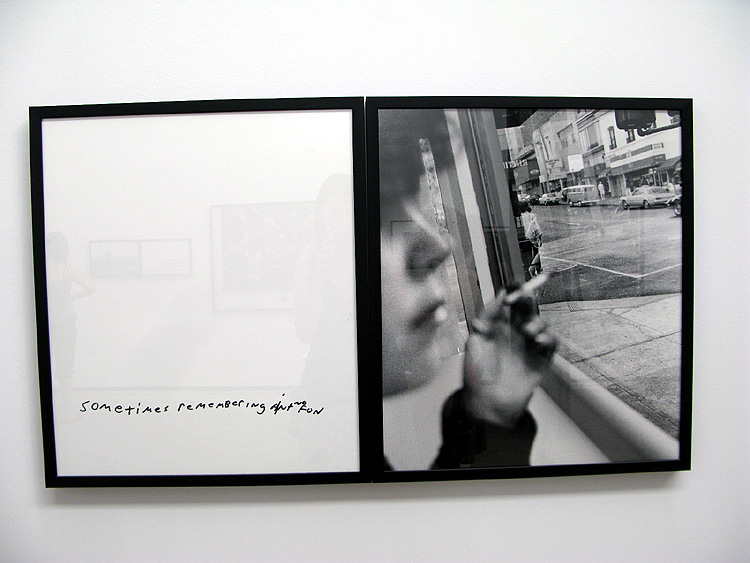
The photographers showcased upstairs are more focussed on individual or small group portraits. Most striking perhaps are Jim Goldberg’s stories of street teenagers, led by Dave and Echo, from California first published in 1995 entitled Raised by Wolves. His observational technique, accompanied by text, video and other material,  is pretty harrowing, and it does, like other material in the exhibition, get you to thinking about the relationship between photographer and subject and your own relationship, as you trot around the gallery in the company of an audience of observers who are firmly within the mainstream of society (even if some may think they are not), with the subjects here, who have been forced, or chosen, or some combination thereof, to be “different”. Queasy voyeurism comes with the price of the ticket here.

The intervention of the photographer is most acute in the small room devoted to Boris Mikhailov’s photographs of a staged wedding of a homeless, alcoholic couple in contemporary Russia. It is provocative but it gets its point across. I found these hardest to look at. Paz Errazuriz’s pictures of transgender women from Chile are doubly arresting, precisely because that is what would have happened to her is she had been caught taking such photographs in Pinochet’s Chile.

You will also be intrigued by the stories behind Pieter Hugo’s portraits of Nigerian men and their captive animals, hyaenas and baboons, that live on the fringes, and alarm, South African society. Mind you some of them are gang members, drug dealers and debt collectors so the fear may be justified. They are certainly imposing and, I think, the photographs which I found most aesthetically pleasing if that makes sense. Pathologist turned conceptual artist,Teresa Margolles’s pictures of transgender prostitutes set amidst the ruins of their nightclub workplaces in Mexico, pulled down by the authorities, in an attempt to move them on, have a similar artistic sensibility.

I realise as I have written this, and learnt more about the photographers involved, that I probably need didn’t try hard enough and need to revisit and relook. That’s what can happen if you have time and an open mind. Time, and open minds, is what changes attitudes, beliefs and behaviours.
 

Red Star Over Russia at Tate Modern review ****

telemmglpict000145225768_trans_nvbqzqnjv4bqypyjo1pwgys_nihur4pqykuep74enkx9bwcmwer2y_a

Red Star Over Russia: A Revolution in Visual Culture 1905-55

Tate Modern, 19th January 2018

I have always coveted a collection. I mean a proper collection. I have a fair few CDs, (I have bought maybe 6 or 7 download only albums in my life – not having a physical copy brings me out in a cold sweat), a bit of vinyl, rather too many books, (the SO and I no longer know where to put them), programmes and exhibition catalogues and some 1960s pottery. But none of this counts. What I really want is a full-on, take over your life, obsessive, world’s leading authority, type of collection.

Mind you I have no idea where the people that do end up doing this find the time, money or space. But I am very glad this people exist. An entirely digital, thingless world where punters consume  everything on screen unsettles me. Aa it happens one such collector was graphic designer David King, and his chosen subject were prints, posters, journals and photos which document the history of Russia and the Soviet Union in the first half of the C20. Unfortunately Mr King did not live to see this remarkable exhibition largely drawn from his collection, but we should thank him for his legacy/.

Now 2017 was the centenary of the Russian Revolution and one of the first posts on this blog recorded my visit to the excellent Royal Academy survey of Soviet Art at the beginning of the year (Russian Art at the Royal Academy review ****). Since then I have been immersed in Chekhov, (a couple more Cherry Orchards, and the early plays), more Shostakovich than is good for my nerves, sundry reading and exhibitions, the Death of Stalin film and, most recently, a play from current Russian dramatist Mikhail Durnenkov. So the way in which art has explored the relationship between people and State in Russia pre and post Revolution and beyond has been a particular source of interest this last year.

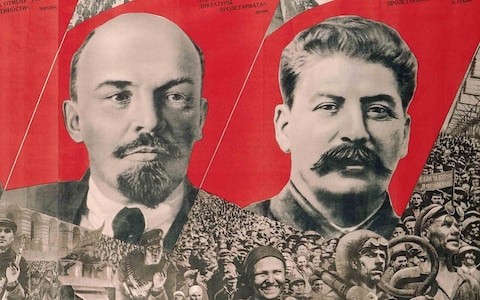
What is most striking about this exhibition, at first glance, is the ubiquity of many of the images. In the early years of the USSR many avant-garde, modernist artists saw art and architecture as tools for social change. This vision was propelled by the Constructivists/Productivists, (though there are signs that Suprematism, Futurism and Neo-Primitivism also had a hand in shaping poster art). Room 2 draws together work by artist couples El Lissitzky and Sophie Lissitzky-Kippers, Aleksandr Rodchenko and Varvara Stepanova and Gustav Klutsis and Valentina Kulagina, who embodied these ideals. Forms are simplified, colours are bold and abstraction applied to human endeavour.

Red and black predominate, sharp angles, exhortations to embrace the future and beware the enemy in sans serif type, heroic poses. Even as Stalin’s regime became suspicious, or worse, of modernist art, and the visual language drifted towards the cliches of Soviet Realism, the messages remained unchanged.

Even if you don’t actually know any of these images you will think you do. But even as you marvel at the terrific wall of posters in the first room proper, and before you get to the rooms of smaller images and objects, notably rare photographs, it becomes clear that something else is going on here. For the overriding impression beyond the familiar vocabulary, is of the manipulation and avoidance of truth. Reconstructions of significant events, caricatures of Party enemies, early “photoshopping”. This is most acute in the fascinating photographs where the faces of individuals executed and murdered by the regime are cut or crossed out, or cropped in official publications, notably Trotsky. The vitrine display of photographs of victims of Stalin’s Great Purge is very moving. The execution of military leader Mikhail Tukhachevsky and suicides of renowned poet Vladimir Mayakovsky and Stalin’s own wife Nadezhda Alliluyeva are explored in detail.

Yet even in the early years, after the Revolution, the scale of the effort by the Bolsheviks to win hearts and minds across this vast. largely illiterate, population is laid bare. Many of the messages are multilingual to reflect the diversity of the Soviet Union. Agitprop trains took the message of proletariat emancipation across the land. Monuments were erected. In the 1930’s the imagery of Socialist Realism was exported, as the room devoted to the utopian murals of  Aleksandr Deinaka which were exhibited in Paris in 1937, graphically illustrates.

So we have some absolutely fascinating and striking material, very directly and compactly curated without gimmickry, which maps out the way in which hope turned to despair over the space of a few decades. It gets you thinking long and hard about the way in which art and visual media are used to create and record history, both in the Soviet Union, and dare I say, today.


Natural Selection exhibition at the Former Newington Library review *****

image

Andy Holden and Peter Holden: Natural Selection

Artangel at the Former Newington Library, 24th November 2017

This might just be the best exhibition I have seen this year. The Former Newington Library was new to me I confess, and reeks of institutional instruction, which matched the tone of this “installation” to a tee. Apparently it used to contained the natural history collection of a father and son, Richard and Henry Cumming. Well done to Artangel for sniffing out the space and to video artist/cartoonist/animator Andy Holden, (who i See has his own band, the Grubby Mitts), and his ornithologist Dad, Peter, for creating this marvel.

It all apparently started when Andy, who could have stepped straight out of a 1970s Open University TV programme, saw a blackbird building a nest in Dad’s garden. Cravatted Peter Holden, who could in turn have stepped straight off Blue Peter, (in fact he was did), is an avian guru and, when Andy returned home after art school, their shared passion was rekindled. This then, even before we get to the bird and other stuff, is a poignant study of a father and son relationship. (It even begins with Andy in the pram wrestling with a book on birds).

After a series of joint lectures Andy started to gather material for the first part of the exhibition on bird’s nests. Upstairs there are some marvellous examples of nests contained in a vitrine in an “old style” museum format, another collection of feathers, a smattering of bark, a giant recreation of a bowerbird’s bower and some other bits and pieces. Not all is what is seems: this turned wooden objects are created from sonograms of bird song and some of the nests were created by Andy and mixed in with the real thing. Art and nature start to intertwine.

A quick perusal and then you sit down for the video with father and son taking it in turns to explain and illuminate, whilst a central screen shows footage from their own field trips, as well as various documentaries and the like. They look like old style nature documentaries but as father and son range through types of nests, nest sites and nest materials, some fascinating themes emerge. Peter Holden focusses on the “scientific” explanations of nesting behaviour, Andy gets you thinking about the bird as creator, even “artist”. The “practical” and the “beautiful” are explored.

How do those birds who build these elaborate structures “know” what to do? Do they have a picture in their “minds” of what they want the nest to look like? Why does the bowerbird go to so much effort in creating his bower, and the extraordinary display of themed objects he gathers? How does this relate to the Holdens’ own collections? Can it really just be a process of “sexual selection”? How do partners, families and communities collaborate (various bird species of course but also here father and son)?

Downstairs we first encounter a rook character in a cartoon strip that Andy created which has his father Peter as a “Mr Holden” charged with keeping the rook in line. The father/son relationship mined further. 

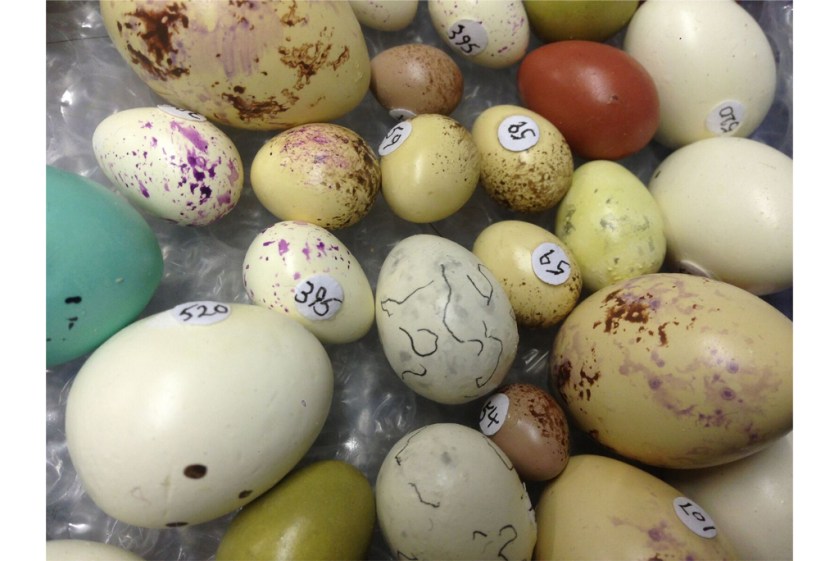
We also have another “collection”, How the Artist was Lead to a Study of Nature, which recreates the hoard of 7,130 eggs police discovered at a “collector’s house in 2006. These eggs are laid out on the floor in cardboard and plastic boxes, as they were on discovery, which also emphasises their fragility and increases the level of temptation for us the audience as these are undeniably beautiful objects. As a kid I was fascinated by birds, and the opportunities the world of ornithology gave to a boy who craved the pleasure of classification. Observing, ordering, listing, collecting. This never extended to eggs, that was already forbidden, but I could see the attraction. This, fortunately, never developed into a full blown, twitching habit, I have seen the impact this can have first hand, but I understand the obsession.

Next door is a video installation, The Opposite of Time, narrated this time by Andy Holden alone, in the form of an animated crow who first appeared in Peter’s RSPB magazine contributions. The crow passes through real habitats, notably when charting the battle between egg “collectors’ and the RSPB and volunteers over the first ospreys to return to Scotland in the 1960s. However the crow, who ages, also flies across multiple paintings, representing the best of the British landscape artistic tradition (Constable, Turner, Nash, Ravilious, Hockney). There is a further screen showing photos and some film which documents the history of egg collecting in the UK, from aristocratic pursuit by “gentlemen of science”, through to the 1954 Act which criminalised it and finally on to the “working-class” undercover activity of more recent decades.

This becomes an insightful analysis of the psychology of collecting, and how the public and scientific consensus on the morality of the “hobby” has changed through time. What makes the desire to possess so powerful that “collectors’ are prepared to destroy the very thing they purport to love? How can we enjoy such aesthetically exquisite objects, knowing their history? What gives humans the right to collect from nature? Why were toffs feted for their “scientific advances”, whilst the dispossessed collectors of today are banged up?

There are multiple parallels through the exhibition with “human” artists. The materials used by sculptors (Andy Goldsworthy), the landscape artists (Richard Long’s mud), the forms we encounter (Barbara Hepworth eggs), the collections and classifications of conceptualists (Susan Hiller), the ready mades and found objects tradition (from Duchamp on), the Pollock like lines on many of the eggs, the watercolour like pastels. Play your own game with this.

So there you have it. A natural history programme. An introduction to aesthetics. A history of landscape art. A lecture on class. Science and art. Father and son. Nature and nurture. Passion and obsession. Nerdiness. Eccentricity. Nostalgia. Some very pretty things. All in a couple of ramshackle rooms in SE17. The exhibition was extended but I think is now over. I do hope it gets another outing. I really, really need to see it again. 


Queer British Art at Tate Britain review ***

Bathing 1911 by Duncan Grant 1885-1978

Queer British Art 1861-1967

Tate Britain, 18th August 2017

I learnt a lot from this exhibition. A damming reflection of my ignorance of gay history in Britain over the period under review. However I am afraid I didn’t really see much in the way of compelling art or artists which I had not already encountered. No matter. Sometimes it is good just to learn and with a muppet like me sometimes all that is required to achieve that aim are a few pictures and some well chosen words.

Now in some ways the reason why the history lesson was of such interest was precisely because curator Clare Barlow mixed up work by gay artists, with portraits and mementoes of courageous heroes of gay history, as well as art which depicts ostensibly gay themes, whether acknowledged or moreorless concealed. For someone with no prior insight the shifting content did not detract from the edification. For those more versed in the art itself or gay social history this jumbling up may prove less satisfying. It did also mean there is a lot of rippling torso on show to draw the eye from the absorbing captions.

The first room kicks off with a Pre-Raphaelite extravaganza, reminding me of how much I detest this art, but also how overtly camp it is even as it hides, badly, behind its classical allusion. Sorry if you feel differently. But it does neatly emphasise the enduring link back to the High Renaissance and in turn to ancient Greece. It seems some will never tire of the classical nude. Room 2 explores how gay identity filtered through into public and “scientific” discourse through the late C19 and early C20. Room 3, largely through some fine photographs, explores how the notion of the “theatrical” acted as a conduit for queer expression to a sometimes knowing audience. As with Room 2 no real art of any great consequence (a sign of the artistic times) but bags of insight for me. In Room 4 we get a some recognisable pictures, but largely from the Bloomsbury Group and their acolytes. Now I know these toffs are terribly important in the development of British Art in the C20 and they are an endlessly fascinating bunch of characters, but this is hardly unexplored territory, and Vanessa Bell excepted, (and obviously Keynes in his chosen field), their output isn’t up to much – witness the Duncan Grant contribution above. (The SO will kill me if she reads this given the implied dissing ofVirginia Woolf). Room 5 finally serves up some fine pictures (to my eyes) for example the Laura Knight self portrait (though the thematic link here is tenuous) and explores notable female same sex relationships. Room 6 was the most interesting to me in terms of painters with works from diverse names such as Edward Burra (a real highlight), John Craxton. John Minton and Keith Vaughan all offering new viewing opportunities. Great stuff. Back to the history lesson in Room 7 showing the dichotomy between public and private gay lives in the 1950s and 1960s before the first step to decriminalisation in 1967 (the exhibition timeline having begun with the abolition of the death penalty for sodomy in 1861). Room 8 loads up Hockney and Bacon, though there might have been more of their genius .

So I would say carve out some time to get along to the exhibition (it ends on October 1st) ideally with a chum or two (this is not a show for private contemplation) to soak up some defiant stories of fearless people sticking it to the fearful. Just don’t expect too many draw-dropping pictures.

The Radical Eye at Tate Modern review ***

radical-eye-book-hardback-17733-large

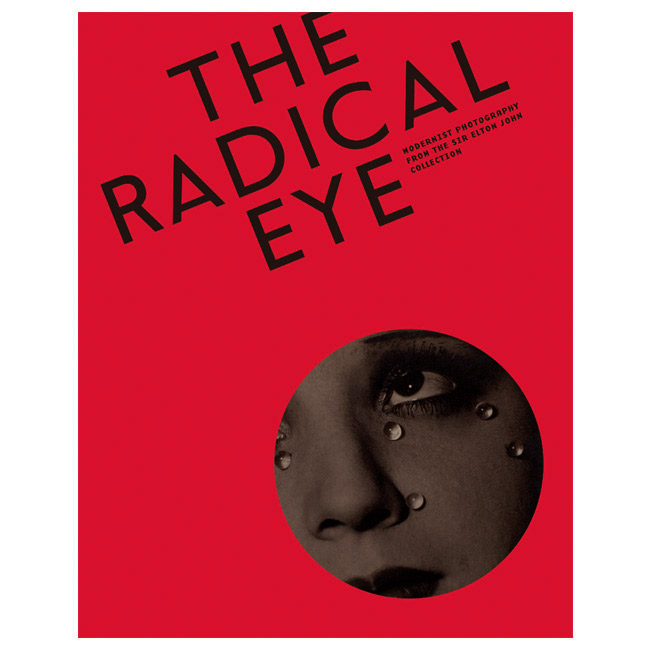
The Radical Eye: Modernist Photography from the Sir Elton John Collection

Tate Modern, 29th March 2017

Sir Elton John is a thoroughly good bloke in my book. Firstly, for letting the Tate conjure up an exhibition of iconic works by renowned photographers (Man Ray, Dali, Kertesz, Strand), secondly for not coming over like a pretentious kn*b when explaining why he started buying them in the video that accompanies the exhibition – essentially because he liked them and it helped him get over the booze – and thirdly because he intends to gift the collection in time I gather. I can even forgive him for accepting the invitation from Kate Bush to sing on the Fifty Words for Snow album (mind you Stephen Fry should also have put the phone down). Though to be fair it is Kate’s fault for asking and my theory is she deliberately makes these lapses of judgement to confuse us into thinking she is human and not actually a god.

Having said that the house where Sir Elton displays them could do with a bit of colour accessorising in my view – there is a whiff of show home here. As perhaps could this exhibition. There are some absolutely stunning images here make no mistake, but they are all so perfect in pristine black and white, whether portraits, nudes, landscapes, close ups, surrealist mash-ups or still lifes, that in the end I was overwhelmed rather than engaged. The “coffee table book syndrome” that can often hit me in photography exhibitions came fast and came big. It is entirely my fault but I just ended up needing a hit of paint (mmm a bit of Doig would have done the trick if I had time – I know, I know now who is the pretentious kn*b).

If you know what you are looking at then I gather this is the bee’s knees. If you are a casual observer is it worth a whizz round? Yes. But if I only had time for one in Tate Modern right now the Wolfgang Tillmans would get my vote. Nothing pretty about most of his photos but way more to chew on.