Opera: Passion, Power and Politics exhibition at the V&A review ****

320

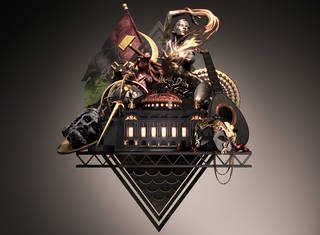
Opera: Passion, Power and Politics

V&A, 13th November 2017

You can’t seem to navigate on t’Internet, (all right, the bit that isn’t hate, porn or celebrity, which doesn’t leave much), for confessionals from opera lovers telling you how they came to love the “queen”, or is it “king”, of art forms. Alongside this are guides on where to start and how to enjoy your first opera. All this tends to come with an undercurrent of pleading though. The rare opera reviews here from the Tourist always seem to start with a diatribe about how bad opera can sometime be. I have tried with limited success to convert the SO, MS, BD to the cause though BUD, given his admirable lust for life, has responded magnificently. 

The fact is that opera can be hard work and that all of us inside the tent, by trying to appear welcoming and non-patronising, often come across as the exact opposite. Like evangelical Christians. The other problem is, despite what some of us want to believe (“it’s for everyone”, “you can pitch up in shorts”, “there’s tons of tunes”), there is always a proportion of the audience, especially at the ROH, who are there because they, (or someone else on their behalf), can afford it and not because they love it. And whisper it, some of it is unadulterated shite with preposterous plots, silly costumes, designers and directors craving kudos over interpretational vision, under-rehearsed divas who can sing for sure but can’t act and don’t care what happens beyond their arias. Yet when it works the “state of grace” you enter cannot be matched, even in my beloved “straight” theatre or from music alone.

It’s an utter mystery to me how this works for those who get off on Wagner (I’d rather have an enema), Verdi or Puccini but, as Aretha would have it, Doctor Feelgood has pitched up for me during Britten, Mozart and Monteverdi to name but a few.

So how were the curatorial boffins going to make this work. A minority art form, which may have a visual component but is primarily aural, which spans hundreds of years. Surprisingly well as it turns out. Through the simple device of picking a few specific works, premiered (though not the Wagner) in specific European cities in specific years, usually periods of immense social, political and economic change. And by not going in too deep. And with the use of those natty headphones which have worked so well since the ground-breaking David Bowie Is exhibition.

Now there are proper reviews bleating about what is “missing” in terms of composers and/or locations. Or saying the “wrong” works have been chosen. Or saying there isn’t enough musical content. Doh, it’s an exhibition not a performance and all this carping comes across “as I know better” elitism, the very thing this exhibition should eschew. For my money, given the obvious limitations. the team has done a terrific job in pulling together all manner of material and relating it to the contexts they have chosen to highlight.

You will get a sense of how the chosen operas reflect the societies from whence they came, the themes that each engaged with and the process of their creation and performance. All spiced up with lots to stimulate eye and brain. I accept that the soundtrack, with excerpts from the seven chosen operas, is a bit limiting but I didn’t care. I got to see lots of lovely objects, maps, paintings, scores, costumes, props, posters, programmes, models and instruments. I got some well chosen video footage of performance. I got a recreation of a set for Handel’s Rinaldo in booming London and of Shostakovich in his study banging away on his piano. I got all sorts of spurious feminist interpretations of Strauss’s still horribly ropey Salome in Dresden backed up with some dirty pictures from Kirchner. I got a sense of just how much ducking and diving Dmitry had to do to create his two premieres of Lady Macbeth of the Mtensk District in Leningrad. I saw why the Italians are proud of the boy Giuseppe V, here with the big chorused Nabucco in Milan. I could hear how Monteverdi changed the Western musical world, albeit all for the decadent few of La Serenissima. I could see and hear how the Enlightened Mozart and Da Ponte stuck two figures up to the Viennese elite. The exhibition even has a swing at equating Wagner’s dodgy Medieval comic book warriors with the genius rebellion of Manet. Yeah, right.

Now I admit sometimes the urge to capture the big picture, and the need to make exhibits relevant, leads to some overly imaginative treatments from the curators. I would also have liked a bit more hard information on the handful of post 1945 productions we were treated to at the end. The footage was all well and good, (and the selection suited me), but might have left the uninitiated a bit bemused. Which is a shame because, for my money, the stories, plots, acting, productions and ideas which contemporary operas encapsulate are far easier to stomach than some of the “classics”, and the music no more challenging than the soundtracks to many big budget cinema releases.

Still mustn’t grumble. This is another blinder from the V&A and the new gallery is nice and airy (I know it’s underground). It isn’t going to pack ’em in Pink Floyd style and I have to say that my attendance, admittedly on a weekday afternoon, only served to reduce the mean average age. If you have some interest in opera, and are not too snobby, you will definitely be rewarded. Perhaps more importantly I would say that, if you have any interest in European social, economic and cultural history, even if opera isn’t your bag, over the last 500 years, this is also for you. Which frankly should include everyone who goes through the doors of the V&A.

Right there’s my puff. Now can I have my Punk and Post Punk 1977 to 1985 exhibition please Mr V&A.
 

Giulio Cesare opera at Hackney Empire review ***

eto-giulio-cesare-pi-aw17-l-r-christopher-ainslie-giulio-cesare-soraya-mafi-cleopatra-credit-richard-hubert-smith-2-700x455

Giulio Cesare in Egitto, Parts 1 and 2

Hackney Empire, 7th October 2017

The more opera I see, the less I want to see. Yet this does not mean I don’t enjoy opera: on the contrary, when it works, it can match the best that theatre can offer in terms of transcendent entertainment. The problem is that there are so few composers, (and even fewer librettists), who do it for me. This opportunity set narrows even further with disappointing productions. I mean to continue to try to unravel this paradox though even if it risks being, frankly, a bit bored for parts of an evening.

So we come to the English Touring Opera’s production of George Frideric Handel’s Guilio Cesare in Egitto, Julius Caesar in Egypt to you and me, at the lovely Hackney Empire. It isn’t on my back door but I have an affection for this lovely theatre, which always feels airy to me and where the views and tickets are good value.

This was my first Handel of the billions he wrote. I realised that taking on one of the old boy’s very longest operas (over four hours uncut), even split into two parts, and in one afternoon/evening, was asking for trouble. But I figured, from what I know of his music and having listened to a production as part of my homework, that the tunes were sufficiently digestible to allow me to slip a bit on the concentration front.

And so it proved. Since I don’t know the piece I can’t really tell you anything about the musical structure, but the tunes, smoothly delivered by the Old Street Band, under the baton of Jonathan Peter Kenny, are very easy on the ear. Maybe a bit too easy. The ensemble, a mix of modern and appropriate period, burbled along at the brisk pace that underpins much of Handel’s score, and the balance between soloists and musicians was spot on from where I was sitting. The chorus, in smart casual, occupied the slips, creating a nice surprise on their entry.

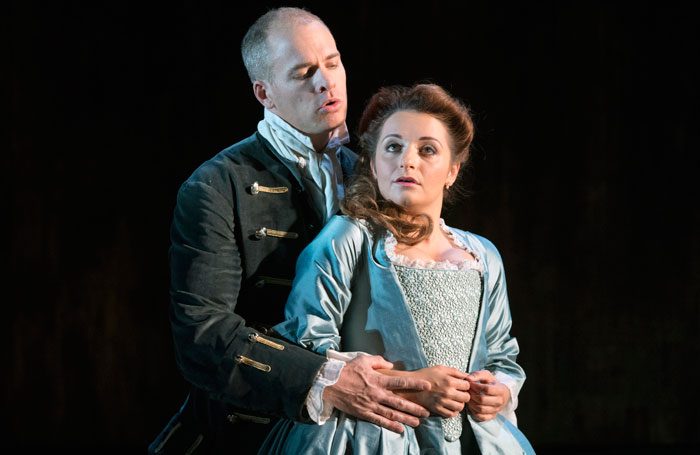
I also enjoyed the singing and acting to a large degree. The counter-tenors, Christopher Ainslie playing an up-right/tight Giulio Cesare, and Benjamin Williamson as the craven Tolomeo, were captivating. Remember these parts would have been castrati in original productions, along with Nierno, here sung by Thomas Scott-Cowell. Fortunately authentic performance doesn’t extend that far. Soprano Sonaya Mafi as mendacious Cleopatra, was probably the best of the bunch vocally, with Kitty Whately as her son Sesto, a little less forceful, though she captured the character’s ineffectual simpering very well. Ever the disappointment to his Mummy. There was a perhaps a little bit too much of contralto Catherine Carby’s Cornelia. Not the fault of the singer; it was just there were only so many ways she could convey her grief at the loss of brutally beheaded hubby, Pompey. The cast was rounded out by the two basses, Frederick Long as Caesar’s faithful sidekick Curio and Benjamin Bevan as Achilla, Tolomeo’s brother in arms who turns against him.

I was very struck by the elegant set and costume design of Cordelia Chisholm and by the lighting design of Mark Howland. ETO Director James Conway wisely chose to locate the production at the time of its premiere in 1724, with sumptuous Regency threads and gilt and blue hues predominating. The Romans stand in for the upright Hanoverian Protestants and the Egyptians the Catholic troublemakers. There were a handful of effective visual coups, including Cleopatra’s dissonant entrance posed as a Virgin Mary bent on seduction (!). There are some excellent essays in the programme (which also covered ETO’s other current production Rameau’s Dardanus), on the differences between Italian and French opera at the time and on the contemporary performance of Handel’s opera. James Conway also persuasively explains his interpretation of the motivations behind the characters, the sub-text relating to the Protestant succession and the pesky Jacobites, his decision to stretch the full text out over two parts and to up the seria quotient and expunge any buffa.

And this for me was where the production went slightly awry. Old Handel was never at the cutting edge of musical fashion so the structure of the opera is still firmly Baroque with some admittedly fine, showy arias, interspersed with quite a lot of dry recitative. Every character, bar the two retainers, gets a few turns. This tends inevitably towards a “park and bark” delivery. The narrative is pretty straightforward with little in the way of pace change or surprises. Caesar has pursued Pompey to Egypt. Tolomeo has had Pompey’s head chopped off. Cornelia, his now widow and her son Sesto, swear vengeance, repeatedly. Cleopatra wants to oust brother Tolomeo and enlists Cornelia, Sesto and Caesar into her cunning plan. Caesar falls for Cleopatra, and, much to her surprise she reciprocates. Tolomeo attempts to have Caesar killed but he escapes. Dirty Tolomeo is eventually skewered by Sesto. Caesar returns with turncoat Achilla and conquers Egypt installing Cleopatra on the Egyptian throne.

To make the two parts, titled The Death of Pompey and Cleopatra’s Needle, work independently, Mr Conway gives us a near hour of overlap at the start of the second part. As I say, given the fairly even pace of proceedings, musically and dramatically, this was a little frustrating, especially as the scenes which follow the overlap are about as dramatic as the whole affair gets. It also means we end up with a surfeit of Cornelia and Cleopatra, but not when they are most interesting (from the plot, and for Cleopatra musical, points of view) in the final scenes. And we are hours in before we get to Caesar and Tolomeo’s most exciting turns. My fault. I should have found out more about the structure ahead of the production.

So a nice to be there rather than a must see. and probably enough to persuade me not to add Handel to the small list of opera composers I have to seek out: Monteverdi if the director takes some risks, Mozart, if the production can make sense of the misogyny and any daftness, Fidelio obviously, Janacek, Berg, Stravinsky, Britten and some modern/contemporary stuff.

However, if the Baroque twirls of Handel get your juices flowing, and you are appraised of the production length, then this is definitely worth a shot. At the time of writing this I see that the good people of Portsmouth, Norwich, Buxton, Durham, Saffron Walden, Bath, Exeter, Keswick and Great Malvern, are all due a visit from these exemplary troupe.


The Exterminating Angel at the Royal Opera House review *****

33833687752_2aa55614a0

The Exterminating Angel

Royal Opera House, 24th April 2017

Without a shadow of a doubt the third act of Thomas Ades’s third opera, The Exterminating Angel, is the most powerful piece of musical theatre that I have ever seen. And it is up there with the best theatre I have ever seen. Oh and Acts 1 and 2 aren’t half bad either.

This is really, really good. There are times when the interplay of Mr Ades’s hugely inventive score, the excellent singing (to my ears) across the ensemble, the monumental set design and the brilliantly conceived lighting (and other visual trickery) left me open-mouthed in astonishment. I would say speechless, but clearly even this pleb knows that goes with the opera house territory. I was stuck up in the cheap seats, so goodness knows what it was like downstairs. If the characters were caught up in some sort of “enchantment” from which they could not seemingly escape and for which there was no rational explanation, well so was I.

The score is brilliant. I am no expert and so have no insight into the musical structures. The experts can walk you through that. But I can hear how Mr Ades’s magpie-like approach to the entire history of art music (and beyond that into the religious music which preceded it) creates a sound world which not just supports the drama but possesses it. I could hear Britten, Shostakovich (the menacing drum beat at the end of Act 1) and Nielsen, I could hear Stravinsky, Ravel and Bartok. There are plenty of more romantic tinges and Wagnerian blasts. There are strained Straussian (J whizzed up with R) waltz motifs which keep recurring. There are C12 songs and Jewish poetry. There is some jazzy, distorted piano, there is a bit of flamenco. And there is a glorious chaconne like structure as we move towards a resolution that isn’t really a resolution at the end. There’s is a constant swirl of sometimes lovely, if bitty, melody and big, hairy rhythmic dissonance. And plenty of percussion and low woodwind which is a good thing. Blimey it’s all there, but there is still a clear compositional voice at work here so it is not the dog’s breakfast that it might be in other hands. But subtle (with one or two rare exceptions) it ain’t – and that’s what I loved.

And then there is the eerie presence of the ondes martenot, signifying the unexplained Exterminating Angel. I am guessing this is a tricky customer to play (I have heard it in a Turangalila, but not sure who was playing, as well as in the hands of Jonny Greenwood in the live soundtrack to There Will Be Blood – that reminds me must get on to my top 10 films). Here, in the hands of Cynthia Millar, it was perfect. Not overly involved to avoid sounding like the soundtrack to a dodgy episode of Tales of the Unexpected, but enough to suggest an other-worldly take on events. The use of bells to conjure up deeper forces is also a winner. And the solo piano parts are inspired.

And there are arias of a sort. memorably for me from Audrey Lina’s coloratura Letitia at the end, (based on the C12 Jewish song), from Sally Matthews’s Silvia de Avila whilst cuddling a dead sheep (not a phrase you hear too often) and from countertenor Iestyn Davies as Francisco de Avila as he gets wound up about the size of spoons (I kid you not). And the duet from Eduardo (Ed Lyon) and Beatriz (Sophie Bevan) is spell binding. Oh yes and the chorals are overwhelming.

Now I admit that this score is not going to wash over you, and will likely put you on edge, but that is the point of the drama. Thomas Ades and his librettist, Tom Cairns, who is also the director here, and clearly a talented chap as well, have taken Bunuel’s enigmatic film and drawn out most of its essences. They have crunched down the number of characters but it is still a big crew. They turn up for the dinner party after the night at the opera (cue a few goodish gags), find themselves unable to leave for no clear reason, descend into a still sometimes polite savagery, then leave but don’t really escape. But why all this happens is unexplained. Bunuel famously couldn’t or wouldn’t explain it. Why should he? Ades and Cairns incorporate the surrealist absurdity (sheep, bear, creeping hand, gushing water), capture the empty decadent entitlement of its bourgeois protagonists and reveal the thin veil between society and anarchy. It maybe comes across as more mysterious and intense, rather than slyly comic and satirical when compared to the film, but this reflects the incorporation of music (there is no soundtrack in Bunuel’s art films) and the psychological insight into the characters offered through explanatory arias. That’s the point of opera after all.

it is another belter of a set from Hildegard Bechtler after her recent triumphs at the Almeida. She loves a bit of revolve but here we also get a gigantic arch which separates the deco-ish interior where the dinner party guests are “trapped” and the exterior world of hoi-polloi and authority. There is also a nice whiff of Goya for me in the visual effect from having a lot of people on stage a lot of the time and in the lighting colour palettes.

So all up this is outstanding. I don’t like most opera and wouldn’t willingly slash out 120 quid for a decent seat at Covent Garden. It isn’t a relaxed evening and you won’t come out humming. Whilst there is wild variety in the score, there is less in the pace and tone of the drama. Stuff doesn’t get resolved. It also probably helps if you have an eclectic musical taste. But if you want a sustained and heightened musical and theatrical experience, have the means and have a reasonable expectation about what you might be letting yourself in for, then I cannot recommend this highly enough.

Oh and make sure you pitch up to one of Mr Ades’s Beethoven symphony conducting stints at the Barbican with the Britten Sinfonia. This musical brain applied to the greatest music ever written. Sure fire winner.

Balm in Gilead at the Guildhall School review ***

milton-court_04

Balm in Gilead

Silk Street Theatre, 27th March 2017

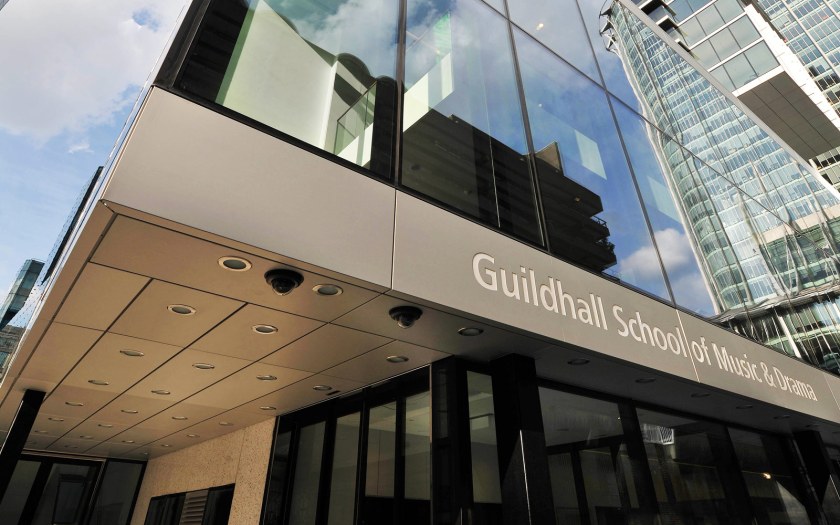
Less a review, more a plug for the terrific music, drama and opera on offer to you, the London public, from the massively talented students (and teachers) at the Guildhall School on the Barbican site. There’s all manner of free stuff and for no more than £10-20 there are plays and operas of the highest quality.

Balm in Gilead was the last play I saw there. Written in the mid 1960s by Lanford Wilson who I didn’t know before this, the play is set in a contemporary New York cafe frequented by assorted prostitutes, addicts and petty criminals. Think Taxi Driver without the Travis nutjob. There are many stories on show but the key narrative is the relationship between Joe, a drug dealer who is in too deep, and Darlene a recent, and naive, arrival in the City.

There are all manner of formal devices employed here. A large cast of largely unsympathetic characters, though sympathetically played, a lot of overlapping dialogue, simultaneous scenes, a fugal song at the beginning and end to highlight the vicious circle in which the characters are trapped, cutaways where characters amplify the plot. The set design was masterful allowing these formal devices to take wing and the cast uniformly strong in putting the case for what I suspect can be a tricky play to convince an audience.

So what else has caught my eye at the School. Well the student’s contribution to the recent Philip Glass days in the Milton Court Concert Hall (which has one of the best acoustics in London I think) was outstanding. Myself and MS thoroughly enjoyed the Tale of Januarie, a new opera by Julian Philips and Stephen Plaice. On the face of it an opera, written in Middle English, based on a bit of Chaucer, with a dense and powerful score, is not an easy sell, but it was pretty much packed out and the kids absolutely nailed it. In the Milton Court Theatre I have also enjoyed a Crucible which exceeded most of the “professional” productions i have seen (this is one of my favourite plays) and a Top Girls (another favourite) which was similarly outstanding. I also had good reports of the recent Great Expectations from TB and partner.

So if you are interested in the future of culture and a cheapskate like me, don’t hesitate to get along to the School’s performances. In the new season I am drawn to The Wager, a contemporary Chinese opera co-produced with the Shanghai Opera, and the Gershwin musical Crazy for You.