

Alys, Always at the Bridge Theatre review ****

Books HD

Alys, Always

Bridge Theatre, 25th February 2019

Said it before and I’ll say it again. You have to be careful with adaptations of novels and/or films on stage. There may be enough in character and plot to justify the transfer but there may not always, (no pun intended), be enough in the form of drama, spectacle and movement to make it a resounding success. So it proved here. There is plenty to enjoy here, and Nicholas Hytner’s direction wrings as much colour as its possible out of the material, especially against the backdrop of a crisp design concept from Bob Crowley, and it is, no doubt, a good story, but as theatre, well not quite.

I don’t know the Harriet Lane novel from 2012 on which Lucinda Coxon, (whose work for stage and screen I have also contrived to miss bar The Crimson Petal and the White adaptation), has created the text. But I can see the temptation. It would make a terrific mini-series. As would, I suspect, Her, Ms Lane’s second novel from the sound of it. Harriet Lane began as a journalist herself, I remember her Guardian column, before becoming a novelist when her eyesight was unfortunately imperilled.

Frances Thorpe is a humble millennial sub-editor cum factotum for a Sunday supplement, the Questioner, who, by a twist of fate, finds her life and career catapulted into a new, gilded league. How she plays the circumstances is the nub of the tale. Gold-digging schemer or realistic opportunist? Becky S, Brideshead, Ripley (without the sociopathic tendencies), Eve Harrington, Holly Golightly, those who find, or position, themselves amongst their “betters” are a cultural staple and these are only the most interesting ones. And, as it happens, in one of those serendipitous coincidences which punctuate the life of the idle Cultur-tarian, the Tourist has subsequently seen two of these iconic parvenus in the guise of stage versions of The Talented Mr Ripley and All About Eve. (More to follow, informed, as these comments are, by the far greater literary intelligence of the SO, my carer for all these entertainments).

The tale of Frances is more subtle than many of these comparators, being more contemporary, set in the rarefied world of publishing, but there isn’t too much that will come as a surprise here. Psychological thriller? That is probably a bit of a stretch. Wry comedy of manners? In parts yes, there is plenty to laugh at, but this doesn’t go all out to skewer the manners, pretensions and behaviour of its characters. We need Frances to present a conundrum, difficult to pin down, but not a total blank, and we do need the dimensions of her character to be explored. Which, by and large, they are not.

Frances’s journey is sufficiently supple though to require a convincing lead performance and, in Joanne Froggatt, (made famous by Downton Abbey I gather), that is what it gets. Whilst the narrative of put upon mouse at work rising to the top and dumping on former colleagues along the way is a little cumbersome it is, in parts, a treat. The relationship that develops with Alys’s family and specifically her grieving husband, Laurence Kyte, (not giving much away here you can’t read elsewhere), also provides an opportunity for some sparkling dialogue. However Robert Glenister has to work awfully hard to bring the overweening, prize winning author to life and the knife-edge of Frances’s conflicted motives starts to blunt in the later two-hander scenes.

Leah Gayer as vacuous daughter Polly has a lot more fun. This is her stage debut. She’ll be back. Polly verges on “poor little rich girl” cliche but Ms Gayer somehow manages to elicit some sympathy for the position her character finds herself in. Her brother Teddy (Sam Woolf) is initially on to Frances but fizzles out thereafter. Sylvestra Le Touzel has a lot of fun with Mary, Frances’s long-serving, frayed boss, as does Simon Manyonda as her condescending, partying colleague, Oliver. The rest of the cast don’t get much opportunity to delve beneath the lines with the exception of Joanna David as Charlotte, the family friend who alone seems to penetrate Frances’s feelings and actions.

If directing is all about moving actors from A to B then there is n0-one better than Mr Hytner, who creates forward momentum and some suspense, from what are quite static scenes. The set, with its thrust stage, sliding room configuration and generous use of video (Luke Halls), is likewise silky smooth. As is sound (Gareth Fry) and lighting (Jon Clark). But the impeccable presentation is part of the problem. The play’s two acts clock in at just over two hours but it doesn’t outstay its welcome nor feel rushed. I was intrigued and entertained but never really challenged. Nor was Frances. Her progress is untroubled by doubt, from self, the other protagonists or audience. I remember only one knowing aside from Frances and one killer line from Charlotte.

I gather the book is altogether darker and Frances a far sharper piece of work, and less reliable narrator, than we see here. Translating that tone, that voice, to stage is always challenging. By taking the safe route Mr Hytner, in the first play he has directed written by a woman, will deservedly get bums on the superb Bridge seats, which is after all his purpose, but I hope his next outing, a new Dream will be something more memorable. Mind you it’s Shakespeare so he is off to a head start. After all when it comes to stage tales of self-advancers big Will served up the very best. Richard III. Now that’s how to do it.
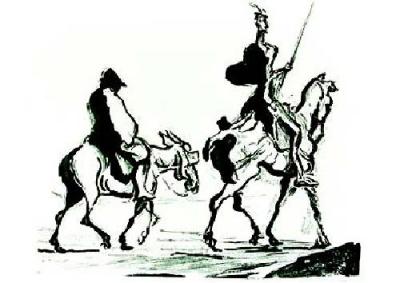
Don Quixote at the Garrick Theatre review ****

Don Quixote

Garrick Theatre, 2nd January 2019

Finally the Tourist gets to see this. Took a chance that it would, after the mostly strong reviews, eventually find a home in London, and waited for the run to settle in to secure a fairly priced ticket. If you are of a similar mind, and haven’t seen it yet, I would advise you to do the same in the remaining few weeks. I am not sure it is quite the triumph some of the criterati would have you believe but the spry adaptation of James Fenton, the creative staging under Angus Jackson’s animated direction and the straight man – funny man double act of David Threlfall and Rufus Hound make it impossible not to enjoy.

Indeed once you strip out the comedy, Rufus Hound’s audience patter, the gags, the pratfalls, the puppetry, the knowing asides, the gurning, the mugging, the bun fight, all superbly orchestrated by comedy director Cal McCrystal, this is actually a moving, and occasionally, insightful play. In that regard it captures the spirit of the Cervantes novel(s). DQ may be an aged eccentric, living in a fantasy world, harking back to a world of chivalry unknown by early C17 Spain, let alone today, but he is also a man of conviction and belief, and this, surprisingly, just about squeaks through in this RSC production.

As the bond between DQ and sidekick Sancho Panza develops, and as we see the melancholic DQ doggedly stick to his quest despite the incredulity of those around him, we get ever closer to the “real” character. Result: a hushed audience taking in a closing deathbed scene, (sorry folks DQ does snuff it), where DQ regains his sanity, that is both moving and poignant. That this should be so is in part due to the sincere warmth that a padded-out Rufus Hound brings to SP, but mostly thanks to the wonderful performance of David Threlfall. Whilst the rest of the cast shifts, swirls, sings and dances around him, playing characters who, predominantly see him as a figure of fun to be endlessly mocked, DT plays it absolutely straight, even when flying Peter Pan like above the stage.

Mr Threlfall is no longer, unfortunately, the most prolific performer on stage or screen. The Tourist has only seen him once before, in the Young Vic Skellig many years ago. The last TV outing I can remember is his performance in the valuable, if flawed, recent BBC/Netflix retelling of the Greek myths, where he played Priam. Now it looks to me like DT is only interested in parts that allow him to proudly display his magnificent silver hair and beard. For his Don Quixote there is a whiff of aged Frank Gallagher, in looks, if not moral complexion, with whiskers, straggly hair and crumpled stockings. After the humorous introduction to SP, his wife and the villagers, all it takes is a few quick deft touches, by both adapter and actor, before we are convinced that reading too many chivalric romances from previous centuries could inspire our geriatric hidalgo to become a knight-errant and set off on his fantastic adventures. He may be deluded but we believe that the world he sees is all too real.

A short three hour play (it breezes by) is never going to be able to capture the complexity of Cervantes’s picaresque novel. There is a reason, actually there are many reasons, why DQ is considered the greatest literary work from the Spanish Golden Age, indeed one of the greatest of all time, comparable with contemporary Shakespeare. The first “modern” novel indeed. It is both stirring adventure (the Tourist’s take on first reading when a tween) and fountain of intertextuality (the lesson from the second reading a couple of decades latter). It is tragicomedy, genuinely both funny and sad, a plea for the primacy of the individual non-conformist and a nuanced social commentary, a satire on misplaced nationalism, a discourse on the nature of truth and reality and a tragedy centred on the corruption of idealism. It is road movie, buddy movie, heroic fantasy, action movie, tall tale, parody, burlesque, fairy tale, slipstream fiction and psychological thriller.

Cervantes’s own precarious upbringing and life of adventure (duels, midnight flits, military service, serious illness, paralysis, years of slavery in Africa, prison sentences, stabbings, affairs) are reflected in its pages. It is pretty much the only work for which Cervantes is remembered but, despite the great success of Part 1 (1605) and then sequel Part 2 (1615) he barely made a penny out of it. He died in poverty a few days after Shakespeare.

All this sort of stuff was meat and drink to writers, and readers, in C17 Spain, and clearly given the speed with which its fame spread, the rest of the Western world, but its cultural ubiquity ever since speaks to its resonance. Films, TV shows, books, songs, paintings, illustrations, tapestries, sculptures, operas, ballets, tone poems. And of course a Broadway musical in the form of The Man From La Mancha. A quick perusal of London entertainment guides will show you that in the next few weeks you can see this very musical at the ENO or, should you prefer, Marius Pepita’s ballet version at the Royal Opera House.

Whilst not quite matching the stirring cheesiness of Joe Darion and Mitch Leigh’s To Dream The Impossible Dream, this production has plenty of catchy Hispanic-inflected songs courtesy of Grant Olding and James Fenton. This does add to the somewhat episodic nature of the production, as does the need to wheel out the various sceneries, props, puppets and the like. Then again that is entirely in keeping with the tone and structure of the novel, as is so much here, and there is enough pantomime distraction to maintain momentum. The attempt to mimic the meta-theatricality of the novels by having DQ’s fame preceding him in the second half is a little stilted but, again, offers something to chew on besides the generous humour.

The set design of Robert Innes Hopkins, in common with his other recent RSC outings, has an elegant simplicity (and he does like to emphasis the vertical), and another meta touch with the giant cut-out of our hero as a backdrop, and the lighting of Mark Henderson and sound of Fergus O’Hare expertly delineates the mundane from the fanciful. Most notable however is the puppetry of Toby Olie, notably a peckish falcon, an angry lion and some convincing sheep (though maybe not quite the army that DQ sees!). Now frankly the Tourist is a bit fuzzy on the art of puppetry so he can’t be sure that the constructions signifying horse and donkey, with their human appendices, fall into the category, but they are the basis for some mighty fine entertainment.

White Teeth at the Kiln Theatre review ****

White Teeth

Kiln Theatre, 21st November 2018

I have never read Zadie Smith’s 2000 debut novel White Teeth. So I have no benchmark against which to set the adaptation by Stephen Sharkey, directed by Indhu Rubasingham, which is still showing at the Kiln. I gather it is something of a sprawling, hyperbolic tale of multi-cultural Britain across three generations beginning at the end of WWII, (though largely set on the doorstep of the Kiln), through the eyes of two, connected families. It is stuffed with plot, event, location, character and is both comic and tragic. 

Well if that is the case then I would say that the creative team here has done it proud. Not quite a musical, yet not entirely a play, there are times when the surreality of the story telling threatens to break the spell, but if you leave your critical eye, and ear, at home, don’t take it too seriously (as it doesn’t itself …),  and just go with with the exuberant flow you should have a great time. This feels and looks like community theatre, about the community in which it is performed, but, as is usually the case when Indhu Rubasingham is pulling the strings, making it look this spontaneous has, I would surmise, require a great deal of thinking, planning and rehearsing over its 5 years gestation. 

It doesn’t sound like the adaptation has been completely faithful to the book, chopping out strands and characters, and recasting the stream of events (as I gather did the 2002 TV adaptation). The story is told through a series of flashbacks from the perspective of millenial Rosie Jones (a droll Amanda Wilkin), the daughter of Irie (the superb, again, Ayesha Antoine), trying to find out about her “complicated” heritage, probably pregnant, in the present day. We still get the ornate intertwining of the Jones family, the bashful Archie (Richard Lumsden), and headstrong Clara (Nenda Neurer) with the Iqbal’s, peppery Samad (Tony Jayawardena) and forthright Alsana (Ayesha Dharker) and their two very different sons, volatile Millat (Assad Zaman) and studious Magid (Sid Sagar). And the posh Jewish-Catholic family up the hill, Marcus Chalfen (Philip Bird), Joyce (Naomi Frederick) and son Josh (Karl Queensborough) but we have assorted friends and colleagues along the way, notably local “character”, doomsayer and sometime deus ex machina, Mad Mary (the wonderful Michele Austin, who dives in with both feet). 

Unlikely suicide attempts, coin flips, parties, age differences, O’Connell’s, the improbable tank crew, a Nazi eugenicist, an inability to pull a trigger, the development of twins, religion, non-observance, affairs, fundamentalism, the worse named ever terror organisation, experiments on mice, the menage a trois, the unlikely denouement, dentistry. All this remains, but, and why not, now amplified with on stage band (Matthew Churcher on drums, Zoe Guest on guitar and Nanda Neurer, yes that’s right she is also playing Clara, on bass), 13 songs from composer Paul Englishby and multiple dance routines. 

Tom Piper’s set is a faithful line drawing, in exaggerated perspective, of the High Road, across which Oliver Fenwick’s lighting, and Lizzie Pocock’s projections, ring the changes. I  marvelled at the intricacy of Polly Bennett’s movement, which plays up the story’s slapstick strengths. With music director Chris Traves, and sound designer Carolyn Downing, this is, make no mistake, an A list creative team.

Is it easy to follow the story? Amazingly, given the activity, yes it is, in part thanks to some light-touch commentary and exposition when needed. Will it make you smile? Yes, unless you are some crotchety Daily Heil reader in which case I would politely us you to p*ss off out of our City. Are the songs a bit too pastiche, musical theatre, by pop culture numbers? Yes but their sly humour means you will forgive. Do some of the myriad of thoughts and ideas that Zadie Smith apparently threw out in her novel, notably the darker sides of the immigrant experience, get a little bit lost, or smothered? Yes I am guessing they do. Are the characters fully realised? No. But then this comes in at under two and a half hours so what do you expect. If you want Chekhov go elsewhere. 

But if you want theatrical story telling at its very best, homegrown magic realism, made by a team that really cares about what it has doing, brimful of energy, and you are proud of the cultural melting pot which is London, then look no further.

I don’t read much but White Teeth has now reserved a place in the summer holiday luggage. 

Switzerland at the Ambassadors Theatre review **

Switzerland

Ambassador’s Theatre, 16th November 2018

A couple of weeks prior to Switzerland the Tourist took in another play by Joanna Murray-Smith, Honour, at the Park Theatre. A very fine cast and a sharp enough dissection of a marriage broken by the cliche of the husband leaving for a younger woman, but alarmingly contrived, and borderline pretentious.

Still Switzerland has a sound reputation and the reviews for this Theatre Royal Bath production were pretty strong. And the SO is a massive fan of the talented Tom Ripley, especially in Anthony Minghella’s cinematic version (as opposed to Rene Clement’s earlier Plein Soleil). So a play which pitched the famously cantankerous Patricia Highsmith, author most famously of the Ripley novels, holed up in the mountains, and a fresh-faced flunkey from her American publisher, looked to be right up our strasse. It wasn’t difficult to guess that the young man would likely take on the attributes of Ms Highsmith’s sophisticated sociopath but even so we were intrigued by the premise.

Metaphysical conflation of an author and their most famous creation may not be entirely original but it should be the entry point into an illuminating and powerful drama. Switzerland started off well enough. William Dudley’s set delivered the lofty interior of a Swiss chalet, complete with distant mountain views and Ms Highsmith’s alarming antique armoury on the walls. The lighting of Chris Davey and sound of Mick Pool both got with the thriller project. A hint of Sleuth and especially Deathtrap, pervaded the stage, and, as it happens, the plot. (BTW both of these are better plays/films – in the case of Sleuth in either cinematic version). Phyllis Logan as Patricia Highsmith certainly looked and sounded the part: a lifetime of booze, fags and isolation leaving her character hoarse and suspicious. Callum Findlay, as the visitor Edward, had enough of the wide-eyed, naif superfan to persuade us that she would have let him stay. There’s a bit of a gear crunch as the irascible Highsmith is then persuaded by Edward to drum up a new Ripley plot, but so be it. 

However, slowly but surely the suspense then starts to drain out of the Ms Murray-Smith’s text. She piles up the biographical details of PH’s ghastly childhood (let’s just say she and her Mummy didn’t get on), adult misanthropy and overt racism, alcoholism, depression, illness, sexuality. Maybe she was insecure and damaged, particularly by the way her talent was dismissed because of the “genre” she chose to work in, and behaved this way for effect, or maybe she was just a nasty piece of work. The play doesn’t delve too deep. The attempt to turn Edward into a vision of Tom with a dapper pressed suit (out of a rucksack no less) and a whisky tumbler in hand is unconvincing. Tom Ripley is undoubtedly one of the C20’s greatest existential (anti-) heroes, up there with Mersault, Antoine Roquentin, Raskolnikov, Patrick Bateman, Rick Deckard, Port Moresby, Gregor Samsa and those two tramps. He is well-mannered, cultured, intelligent but also a narcissistic serial killer, a con-man whose sexuality is unresolved. He literally gets away with murder. What’s not to like? That is the whole point. We can’t help liking him. 

There is not enough opportunity for Calum Findlay to get anywhere close to Ripley though. After a while it begins to feel that all we are getting is Patricia Highsmith’s Wiki page and some quick notes from the 1999 film. I was hoping for and expecting some shift in the direction of the play, not a twist as such, but some leap that took the story beyond prosopography (yep it is a word, look it up, I am trying to find the moment when I can drop it into a casual conversation). It never came. The alter-ego theory was laid out but never explored. So I ended up underwhelmed as did the SO, for broadly similar reasons. For a play about a writer whose books are artfully dramatic this seemed a shame. 

This was even more of a surprise given director Lucy Bailey’s recent pedigree. She directed the two very recent successful Agatha Christie adaptations, Lover From A Stranger and Witness For The Prosecution. The Tourist hasn’t seen either (yet) but, being a high falutin’ sort of fellow he did see Cave, Tansy Davies’s latest opera at the Printworks, which she directed and which was terrific (if you like that sort of thing – which I do). She also has a string of feted RSC Shakespeare to her credit.

So it is, with regret as Sir Alan would have it, that I have to report that Switzerland was a disappointment as a play if not in its execution. In contrast to its predecessor here at the charmingly intimate Ambassadors, Foxfinder which was a fine play let down by the realisation of the revival.