
Orestes at Silk Street Theatre review ***

Orestes

Guildhall School, Silk Street Theatre, 27th March 2019

Even the most casual reader of this blog will observe that the Tourist spends an inordinate amount of time in a theatre. A recipe for pity or jealousy depending on your point of view. Despite this satisfying his urge to hoover up the, er, classics of Classical Greek drama is proving surprisingly elusive. There isn’t as much of it about as you might expect. I appreciate that this might be the Firstest of First World Problems but it has, nonetheless, come as a surprise. So first sniff of a Sophoclean, Euripidean or Aeschylean (??) opportunity and the Tourist is straight in. As here. Also taking advantage again of the chance to see tomorrow’s acting and creative talent today, this time from the Guildhall School.

Orestes was written by Euripides and first performed in 408 BCE and tells the story of young Orestes after he has killed his Mummy. It follows on from the events catalogued in Electra, the play about his sister, dramatised by both Euripides and Sophocles, and in between The Libation Bearers and The Eumenides by Aeschylus, the latter two plays in his trilogy The Oresteia. In fact the well educated amongst you will be aware that young Orestes is perhaps the central character in this, to say the least, dysfunctional family tale. He crops up in something like a quarter of the extant plays by the three Greek tragedians.

He kills Mum Clytemnestra to avenge the death of Daddy Agamemnon by said Mummy. Mummy’s justification being that Agamemnon had, before setting off to bash the Trojans because they pinched his brother Menelaus’s wife Helen, (she of the ships), killed little daughter Iphigenia, Orestes’s Sis, to secure some favourable wind. Not a relieving flatulence you understand, but wind to set the fleet off to Troy. Now some would also have it that naughty Clytemnestra actually recruited lover Aegisthus, (who had a claim to the throne of Mycenae albeit via an incestuous route), to kill Hubby. So Orestes, taking no chances, bashed him in as well.

And you thought GoT was complicated. Next Christmas, when it’s all kicking off, cheer yourself up by thinking at least it isn’t as bad as this, the Atreus family curse. In fact it all started with Tantalus, oen of Zeus’s sons, who, to get back at his Dad and the other gods, boiled up his son for them to feast on after they had banished him, Tantalus that is, for having nicked some ambrosia. (Who would have thought they liked rice pudding so much). Tantalus goes to hell, the son, Pelops, is revived but, after some chariot race fixing skullduggery and general cursing, Pelops’s boys Atreus and Thyestes then fall out. Affairs, and some more pie based cannibalism, mean that the next generation, the generation described above, inherits the curse.

And so to this play. Electra opens up with a quick “and previously in the House of Atreus” synopsis whilst a weary Orestes kips next door. Auntie Helen swans in wanting to make an offering at Clytemnestra’s grave, the chorus of Argive women pitch up and Orestes awakes, tormented by Furies. Rough night. Uncle Menelaus and his father in law, so Orestes’s Grandad, Tyndareus, arrive, and Orestes makes his pitch for mercy to then, requesting an opportunity to talk to the Argive men. Cue discussion of the tensions between divine justice and natural law. Menelaus takes a stern line though. After all the Greek people have just about reached the end of their tether what with going to war for years just to get his missus Helen back and are in no mood to listen to any appeals for clemency.

Orestes, with his mate Pylades and Electra, then go direct to the assembly but this fails to forestall the death penalty for Brother and Sister, so the trio hatch a further play involving, you guessed it, more murder, this time of Helen and her daughter Hermione. Helen vanishes, but the trio capture Hermione, as well a slave who saves his own skin with some rousing argument. Menelaus catches the conspirators in the act ……

….. and then, ta-dah, deus ex machina in the form of the god Apollo who sets things to rights by explaining that Helen is in the stars (whaaaaaat), Menalaus must go back to Sparta, Orestes to Athens where the court will acquit him, after which he must marry Hermione, oh, and Electra will marry Pylades. Job done. Humans can go away in peace. Apollo can go back to arching, averting evil and all round being beautiful. As usual with Euripides, the gods don’t come across as the sharpest tools in the toolbox, their relationship with the humans is messy, the nature of justice is questioned and war is, as sagely observed by Boy George, stupid.

The director here Charlotte Gwinner, who has had spells at Sheffield Theatres, Liverpool Everyman and the Bush, opted for the prose translation by one Kenneth McLeish. Now as I am new to this game so have no idea how one translation differs from another, though I can imagine there are some high faultin’ verse options, but there is no messing about here. On with the action and as idiomatic as you like. Mind you I see Mr McLeish translated the complete Greek drama, all 47 plays, as well French farces, Ibsen and much, much else. Clever fellow.

Added to this was an impressive design concept courtesy of Simon Daw and equally uninhibited sound from Elizabeth Purcell and lighting from Guildhall student Christopher Harmon. I see young Harmon wants to make a career of this. On this evidence he will. The split level set showcases a dark, colonnaded underbelly, think vandalised car park/temple underneath a promenade which opens up at the end to reveal …. an Arcadian Olympus. Against this a majority of the final year acting students are able too strut their collective stuff. One or two were familiar from the four/five hander Detroit earlier in the season. I hate singling anyone out but I was very impressed by Uri Levy’s articulate and full throated, delirious but not mad, Orestes and, especially the Electra of Mirren Mack. And the members of the Chorus, complete with school uniform, were also impressive complete with choreography and howls.

I guess I could imagine an interpretation that plumbed the rhetoric more effectively and, as always with these productions, some of the actors are asked to play characters well beyond their years, which they gamely do, but as an astute, compact (90 minute) intro to the play my profound thanks to the Guildhall School. More please.

Shipwreck at the Almeida Theatre review *****

Shipwreck

Almeida Theatre, 18th March 2019

The Tourist, as this blog shows, is a nice bloke given to giving creatives the benefit of the doubt. Hence the string of positive reviews on these pages. He likes to think that he is wise in his choice of entertainment. The reality is that he just wants to be liked, even when it manifestly doesn’t matter.

Even so he admits to toddling off to the Almeida to see Shipwreck with some trepidation. Reviews were mixed but rarely overwhelming. The SO, BD and LD had all bailed out in advance, for good reasons, though Dad’s sales pitch was about as convincing as that of The Apprentice candidate, (a clever Trump reference there people), who is fired in week one. The Tourist and BD had abandoned Anne Washburn’s Mr Burns one act in, though this was in part due to “cold-induced fatigue”/teenage hangover, and the SO had to abandon The Twilight Zone, now playing at the Ambassadors Theatre, due to a domestic crisis. A poor familial showing all round. Would lightning strike thrice then?

Certainly not. I bloody loved this. As usual that is of no use to you if you fancy seeing it since it is now all over but it really shows why Rupert Gould and the Almeida have such faith in Ms Washburn’s abilities. There may be some dramatic shortfalls, largely born of excess ambition, but boy can she turn a phrase. Now I don’t know when, or if, this will make its way to the other side of the pond but if it does, assuming you are a member of the very echo chamber it purports to excavate, then you should definitely see it. (I think I can safely assume that the Trumpian side of the cultural divide will have no interest in watching their “opposition” introspect, though they would get apoplectically wound up).

Shipwreck is a meticulous unpicking of liberal America’s current paralysis in the face of angry populism. It may be very time and place specific but its messages are universal. Populist politics, which can and will turn ugly, cannot be dismissed, mocked, pandered to or ignored. It has to be confronted and unpicked, piece by piece, through argument, mobilisation and democratic will. Hand wringing and virtue signalling won’t cut it.

By bringing together seven privileged, articulate, white bar-one, liberal American progressives in a snowbound, holiday farmhouse in upstate New York, and then letting then slug out the arguments one by one, with a useful, if not unsurprising twist, AW is able to rehearse all the arguments in forensic detail. The dialogue is actually centred on June 2017 after the ex head of the FBI, James Comey, offered up his damning testimony before the Senate Intelligence Committee. Comey, you will recall, or maybe you won’t for that is one of the points the play forcibly makes, was the bloke who was fired by Trump, ostensibly on the recommendation of the attorney general Jeff Sessions and deputy attorney general Rod Rosenstein because the FBI rank and file had allegedly lost confidence in their director, but, in reality, because Trump feared the net closing in the the strands of collusion with Russia in the election, taken up subsequently in the Mueller enquiry. Comey, you may also remember, was the chap who rashly indicated that he was re-opening an investigation into the so-called Hilary Clinton e-mails just before the election having previously said there was no case to answer. Confused? I am and that is the point. Keeping up with the truth is tough enough. Unpicking truth, lies and fantasy when narrative and ideology conflict and when there are multiple “reporting” platforms makes it near impossible even for those with the time, inclination and critical faculty to care.

One of the pivotal moments in the debate between the Shipwreck crew comes when, I think, Adam James’s lawyer Andrew reminds then of the time when Trump, in a Republican primary event, claimed the GOP bigwigs had pleaded with him to cool his opposition to the Iraq War. He had not publicly declared any such opposition. He just made it up. And kept repeating it. Then this kind of breathtaking audacity was a surprise. Now many have have become inured to it, just accept it or positively embrace it. Truth has always been a slippery fellow, manipulated by teller and beholder, and more so as time passes, but deliberate, outright fabrication is plainly dangerous to the body politic. But pitifully easy it seems.

The other key moment comes when Andrew’s partner, banker Yusuf, (Khalid Abdalla), admits he voted for the comb-over bogeyman in the election. With the age old excuse of “wanting to shake things up”. Justine Mitchell plays Allie, the sarky, Facebook-ing keyboard warrior “activist”, who criticises the complacency of others but whose logic can send her liberalism way off-beam. The hosts Jools (Raquel Cassidy) and Jim (Elliot Cowan) are more concerned with day-to day accommodation of the changed environment, expecting a reversion to their comfortable mean, whilst Tara Fitzgerald as Teresa and Risteard Cooper as Lawrence are the hippyish slackers, who bang on about the natural birth they have just come from and who see their green-tinged, near-socialism as adequate inoculation. And so all the strands of liberal call and response are represented.

Now I would have been happy with a couple of hours of this fascinating, pointed, if admittedly wordy, to and fro, but, AW being AW, she clearly felt we needed more. So we are introduced to Mark, an orphan of Kenyan descent, who has ended up in the foster care of a traditional, Christian, Trump-voting, rural couple Richard and Laurie, doubled by Risteard Cooper and Tara Fitzgerald. The connection is the farmhouse which Jools and Jim bought from them. Mark then becomes the mouthpiece for racial politics and identity. It is a clunky device but all is forgiven pretty much as soon as Fisayo Akinade as Mark opens his mouth. Now for those that don’t know Mr Akinade, he was the comic turn as Eros in the NT Antony and Cleopatra where he near stole the show from under Ralph Fiennes and Sophie Okonedo. He also starred in Barber Shop Chronicles which, for my sins, I haven’t seen, and in the Donmar’s Way of the World, St Joan and The Vote, as well as the Caryl Churchill short Pigs and Dogs, all of which I have. Here, in a series of monologues, in total contrast to the structure and mood of the group scenes, he charts the subtle, and not so subtle, racial dilemmas in his upbringing, imaging what it would be like to be a slave and describing his difficulties in describing the American racial divide to his own child. It is powerful stuff, sharp, funny and rhetorical, made more so by a very fine performance.

And there’s more. As if enough ideas haven’t been explored, AW then goes on to subvert the dramatic form in a very Churchillian (Caryl not Winnie) way and thereby offer up multiple theatrical opportunities for Mr Goold and, especially, the lighting and sound of veterans Jack Knowles and Paul Arditti. Firstly by having Fisayo Akinade playing a sheepish George HW Bush who is rounded on by the besuited, megalomaniac Trump about the Iraq War. And secondly, and this is where the fun really starts, going all out fantasy as Elliot Cowan (I think), bravely, morphs into a gold-painted, Caesar-esque unhinged tyrant, complete with bird-hooded priests, (yep you read that right), berating a nervous James Comey (Khalid Abdella again) during the infamous one-on-one meeting with Trump in the Oval Office where the POTUS allegedly tried to influence the investigation and demanded his loyalty. Mythic.

As in her previous plays AW shows she doesn’t seem to have an edit function, so even within the tripartite form she crams in so much more. References to Greek tragedy, the nature of art, politics and theatre (“art needs time, space and reflection” as Jools says – not here, AW just gets stuck in), class, incessant social media chatter and mock outrage, the lack of food and drink and their practical shortcomings, disparities in wealth between the couples. But always returning to the uncomfortable idea that the rise of Trump is a retaliation to the pious entitlement and performative shortcomings of white liberalism. And that what these people are most afraid of is losing their economic and cultural dominance to the unenlightened.

No plot, occasionally bonkers, no apologies speechifying, three hours plus, repetition and circularity. Shipwreck is so obviously flawed. But I don’t care because AW, even when she goes too far, can still slum-dunk ideas, message and theatrical thrills which the uniformly excellent cast and Rupert Goold, (and the rest of the creative team, including Miriam Buether symbolic, circular design and Luke Halls, who else, with his striking political and religious iconographic video,) greedily feast upon. It is complex, over-stuffed, baggy, ill-disciplined but in going beyond the usual incredulity at how the Orange One gets away with it, it is brilliant and telling.


Unmythable at the Vault Festival review ****

Unmythable, Out of Chaos

Vault Festival, 3rd March 2019

There was all sorts of cutting edge theatre, comedy and performance on at the Vault Festival this year, but being the old fart that he is the Tourist largely plumped for the safe options of comic takes on Greek myths. Satisfying his pretensions and ensuring he doesn’t get too close to all the intimidating, fashionable London twenty-somethings who all seem to be permanently switched on whilst the Tourist languishes in his catatonic bubble. So having really, really enjoyed Pants on Fire’s Ovid’s Metamorphoses it was off to an hour or so in the company of Unmythable from Brighton based Out of Chaos.

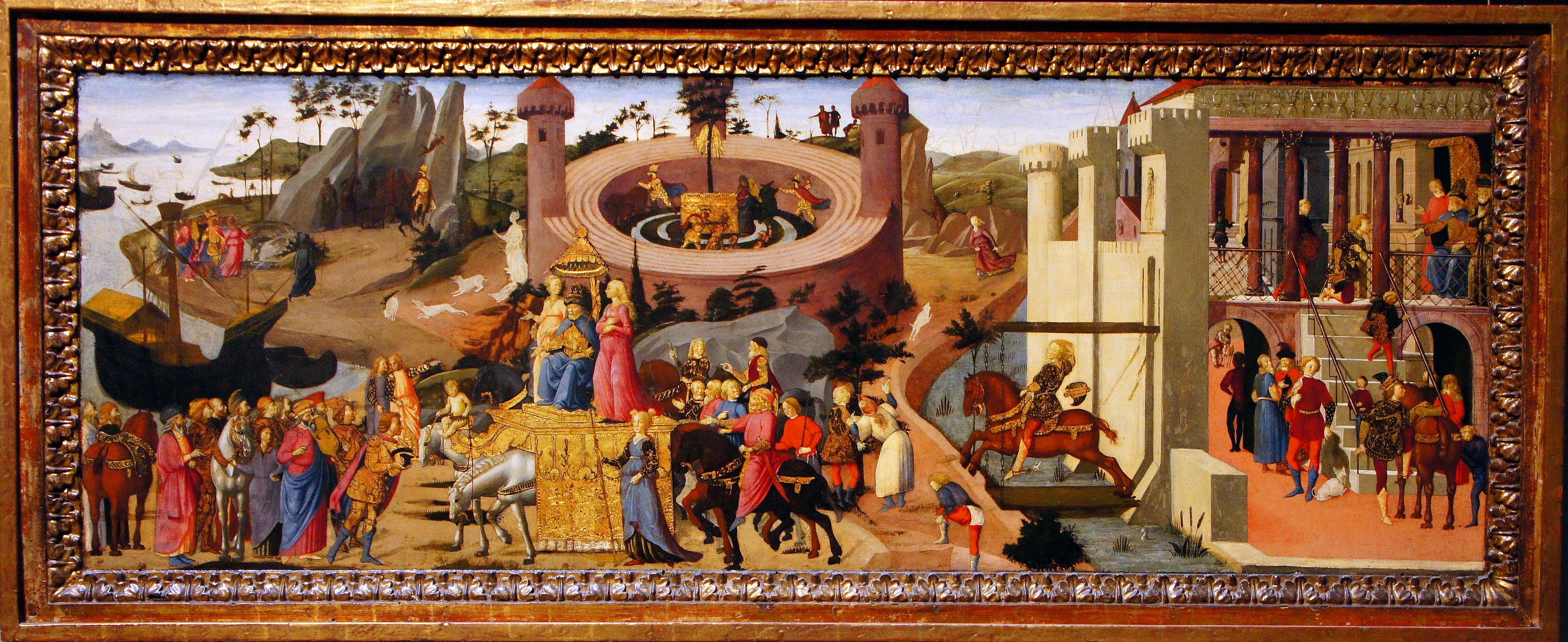
Devised by the company and directed by Paul O’Mahony and Mike Tweddle, with sound from Rob Castell and Phil Ward and designed by Claire Browne (just a couple of boxes if truth be told), Unmythable offers a comic take on all the Greek myths (well maybe not all of them but a remarkably wide spread in just an hour) courtesy of three actors, I think Alice Haig, Hannah Barrie and one other whose name, to my eternal shame, I can’t find, having failed to secure a flyer. It takes the story of Jason and his 50 odd Argonaut mates and their city break to Colchis on the hunt for that Golden Fleece (above is a quattrocento Florentine take on the story) . The big name Argonauts get their own turns, as do I think, some non Argonaut gods and heroes, in the form of songs and skits. However Jason’s key wing-persons are the slightly less courageous bessies, Beta and Gamma. Nice touch.

Physical comedy, funny accents, costume changes, contemporary pop culture references, audience interaction, narrative, dialogue, monologue, are all employed with the emphasis on pointing up the brutality and often weirdness (and misogyny) of the myths. They don’t hang about so occasionally the switches are a little too swift, and the humour isn’t too subtle, but when to works it is genuinely hilarious. Jason dragging his feet, understandably, when out comes to marrying Medea, The Labours of Hercules, shushing in the Trojan horse, Midas at the salon, Aeetes as Brando as Don Corleone, Persephone as an adventurous pony club member and, simultaneously, peeved mum Demeter, trying to avoid the clutches of Hades.

Unmythable has already toured the globe over the past few years and I suspect if has many more years to go, though I think this years outing may be over. If you haven’t see it, and get a chance to, don’t hesitate. Ideally with mates and beer. No need to bone up on the Greeks. Didn’t bother me.