English Chamber Orchestra: Vivaldi at Cadogan Hall review ****

English Chamber Orchestra, Choir of the C21

Cadogan Hall, 2nd December 2018

Raphaela Papadakis (soprano), Lotte Betts-Dean (mezzo-soprano), Stephanie Gonley (violin), Caroline Dale (cello), Harry Winstanley (flute), Michael Collins (conductor)

Antonio Vivaldi

  • Gloria in D RV 589
  • Concerto for Violin in F minor, ‘Winter’ from The Four Seasons, Op 8 No 4, RV 297
  • Concerto for Violin in E flat major (La tempesta di mare), Op 8 No 5, RV 253
  • Concerto for Violin and Cello in B flat major, RV 547
  • Concerto for Flute in D (Il gardellino), Op 10 No 3, RV 428

Vivaldi now is generally the preserve of the specialist Baroque ensembles. With audiences to match. Don’t get me wrong. If you want to hear a performance of the Four Seasons in London and aren’t too sniffy about who performs it you won’t have long to wait. Gloria may not be up their with the Faure or Mozart Requiems or Allegri’s Miserere in the popularity stakes but it still gets a fair few outings. Beyond that though if you, like me, crave repeated fixes of Vivaldi then you normally need to wait for the experts to visit. I can see why Vivaldi’s vast and exquisite output has been hijacked by a just a handful of his pieces. And I can also see why, a la Stravinsky, there are so many classical music buffs who airily dismiss Vivaldi as a lightweight, one-trick pony, before they return to their Wagner or some such other turgid dross.

Well let me tell you they are wrong. I can’t pretend an encyclopaedic knowledge of the RV’s and anyway life, literally, would be too short to “know” all of AV’s music, (even now that so much has been recorded by specialists). The cantatas, much of the sacred music outside the familiar and of course the operas, (with their risibly stereotypical plots) are unknown to me. None of this matters though since Vivaldi’s music is so immediate, so deceptively, but rarely actually, simple that even on the first listen it can be enjoyed. Which means all you need to do, (look away now buffs), is grab some cheap, web regarded collections and switch on your shuffle. Result. Life enhanced. Simple really.

So this all Vivaldi bill by the ECO, under conductor Michael Collins, caught my eye. A Gloria, a Winter, a couple of the best concerti, for respectively violin and flute, outside of you-know-what and then a comparative rarity, one of the handful of double concerti scored for violin and cello. From a chamber ensemble with a fine pedigree; remember their first Patron was Benjamin Britten and some of Britten’s finest recordings of his own music were made in partnership with them. They are not though, and this is in no way intended to be disparaging, experts in the Baroque. In fact they are one of the most versatile of orchestras anywhere on the planet. Look at their immense list of recordings. They will even do weddings. Though it helps if your names are Harry Windsor and Megan Markle.

The Choir of the C21 led by Max Barley is a similarly broad, though still top drawer, church. Our soloists for the Gloria were well matched soprano Raphaela Papadakis and mezzo Lotte Betts-Dean with ECO principals Stephanie Gonley and Caroline Dale taking the instrumental leads along with young flautist Harry Winstanley. Now I can’t pretend that these performances were up there with the best of the Vivaldi interpreters I have heard, La Serenissima under Adrian Chandler, the Concerto Italiano, the Venice Baroque Orchestra, Brecon Baroque and Gli Incognito, but they were still very enjoyable. Especially in the Gloria.

I was particularly taken by the double concerto where Stephanie Gonley and Catherine Dale’s familiarity paid dividends, This is one of only four concertos for this coupling of which one is incomplete. The Allegro comprises arpeggio figures which begin in the ripieno before being taken up by the soloists, offset with more lyrical passages. The slow movement is a conversation between the soloists a la Bach and the final pacey allegro offers more virtuoso opportunity against a triple rhythm accompaniment.

The flute concerto, No 3 of the six which make up Op 10 was likely published in 1728. A cardellino or gardellino is a goldfinch, a popular caged bird in Vivaldi’s Venice, (and in Golden Age Holland, as you will no doubt know from Carel Fabritius’s exquisite painting in the Mauritshuis in The Hague and which inspired Donna Tart’s ambitious novel). The goldfinch often crops up in Renaissance paintings of the Madonna and Child, the little fella symbolising the foreknowledge that mum had about her son’s eventual gory death. No such iconography here though, for Vivaldi the relevance was the wee bird’s song. The tweeting is most obvious in the last movement which allows the flautist to develop ever more extravagant virtuosic tweeting. The first movement isn’t quite so ornithological with the flute offering trills, runs and staccato repeats more in counterpoint to the bouncy riternello dance. The fast movements sandwich a lilting cantabile into which tousle-haired Harry injected a surprising quote of lyricism.

Vivaldi was quite keen on stormy seas. RV 433 is a La tempesta di mare for flute and RV 570 a Concerto grosso with the same sub-title. RV 253 is the violin concerto equivalent, part of the Op 8 twelve titled the Contest Between Harmony and Invention of which the first four are the Seasons. No surprise I guess for a Venetian with a view from the Ospedale della Pieta out over the lagoon to the Lido and beyond to the Adriatic. Now I happen to think that there is as much in the other 8 concertos as there is in the Four Seasons, certainly in terms of tunes, if not in pure rock ‘n’ roll theatricality. An original score for 253 survives in Dresden, probably brought by JG Pisendel the violinist when he returned from studying with Vivaldi. Pisendel was the man who introduced Vivaldi’s music to JS Bach. Diamond geezer.

253’s fast movements are marked Presto not just Allegro so they need to be quick. The central Largo is the three minutes or so of relative calm though even at the end the storm is plainly on its way back. Both storms call for seemingly never-ending (well a few minutes) of descending figurations, the last set against a sort of dotted fanfare rhythm, the first even more frantic arpeggios against a scrubbing ritornello. I enjoyed Stephanie Gonley’s rendition but you probably also need to hear this played at more extreme tempi from one of the big-boned Italian outfits with, say, Federico Guglielmo or Giuliano Carmignola in the hot seat. Same is true of 297 Winter (which has that bit of summer in it just like Summer often feels a bit wintry).

Before the Gloria we were treated to a burst of medieval carol arrangements to beef up the festive quotient. At least those of us not underneath the gallery, where the choir was located, were treated. Still a nice touch. (Now as it happens I have a jolly collection of medieval carols, songs and chants from Pro Cantione Antiqua and the English Medieval Wind ensemble on CD I can recommend). It was as much as MSC and I could do to stop MS popping upstairs and joining in for he is the expert on all things Black Death to the end of the War of the Roses.

I am not actually sure if MS and MSC had heard a recording of the Gloria before but this was certainly their first Vivaldi gig. It is simply not possible for anyone raised in the culture of Western musical tonality not to like Vivaldi’s Gloria. Unless they are dead. And even then it will be on most of the playlists in heaven I would guess. Were that, Pascal’s Wager style, to actually exist. Anyway MS and MSC seemed to like it unless there were being their usual polite selves when it comes to their overly solicitous Dad/Future-Father-In-Law.

The Gloria was composed around 1715 for the residents of the Ospedale. They probably drafted in a few blokes for the tenor and bass lines. The young women of the Ospedale were prodigiously talented, after all Vivaldi composed music for them that even today taxes the very best of musicians (especially for violin), but they probably couldn’t quite get to the gruffer end of the vocal scale. After Vivaldi died in 1741, impoverished after the failed attempt to set up shop in Vienna, the score of Gloria was lost and forgotten until being rediscovered in Turin in the late 1920s. It is a setting of the eponymous section of the Latin Mass divided into twelve sections, all mercifully short and it is resolutely upbeat even as it contrasts keys, moods, tempi, instrumentation and voices.

It is perfect.

Mistero Buffo at the Arcola Theatre review ****

Mistero Buffo

Arcola Theatre, 15th November 2018

This probably ranks as one of the Tourist’s least insightful assertions, (and trust me there is stiff and substantial competition), but, in his experience, there are two types of one person theatre. The pure monologue, often fairly static, relying on the appeal of the character and the strength of the writing. The kind of story-telling that has been there since the dawn of human time. Or the multi-role tour de force which relies on movement as much as the word and where the physicality of the performance is as important as the text. 

Either way it is stripped back, and let’s face it, cheap, theatre. Which is why it is a staple of festivals and, specifically, Edinburgh. That doesn’t mean it is necessarily any good, but generally those works that get the nod at Edinburgh, and then get a showing here in London, are invariably worth seeing. I am reminded of Henry Naylor’s plays for example, Angel, which visited this very house, Grounded at the Gate a couple of years ago or Silk Road at the Trafalgar Studios, (the latter a very amusing multi-character delight from Josh Barrow). 

What I will say is that the actors in these shows certainly earn their, presumably, modest, corn. And that was doubly true of Jules Spooner in Mistero Buffo. Mr Spooner is one half of Rhum and Clay Theatre company,  with Matthew Wells, and their aim is to create theatre with “a playful sense of anarchy, vigour and originality”. They trained at L’École Internationale de Théâtre Jacques Lecoq which is the pinnacle of physical theatre. Here he collaborates with director Nicholas Pitt. 

And if you are going to put on a solo performance they why not the iconic Mistero Buffo from the master Italian writer, actor, director, comic, singer, painter, activist and all round Marxist top bloke, Dario Fo. Now you probably know Mr Fo (pictured above) from plays such as Accidental Death of an Anarchist, (which I once saw in the West End in the company of a friend who was, shall we say, under a psychotropic influence, and insisted on shouting out encouragement to the cast at vital moments), Can’t Pay, Won’t Pay, Trumpets and Raspberries and The Open Couple. He brought improvisation, satire, criticism, parody, mockery and farce to attack the Italian state, the Catholic church, organised crime, violence, racism, speaking truth to power, echoing the style of Medieval giullari (or jongleur in French/English as here) and commedia dell’arte. His work and performances have ben continually reworked and his influence stretched far beyond Italy. Indeed I see that Northern Broadsides is currently showing an adaptation of Can’t Pay, Won’t Pay. 

Over 30 years Fo himself took Mistero Buffo around the world delighting atheists everywhere. For the play is essentially a p*ss-take of the absurdity and hypocrisy  of 13 of the New Testament miracles , and Christianity generally. Ir certainly wound up the Vatican. Now if this doesn’t sound like it would be a recipe for an entertaining evening out in 2018 you’d be wrong. First off there’s a fair chance you’ll know the 5 stories included here, reminding you how deeply ingrained that book still is. This means that Fo’s mocking, and Rhum and Clay’s pop culture updates thereon, of said stories is easily digested. Secondly, to be fair, sone of these stories are quite jolly, even with the moralising, and especially when undercut by our combined creatives, which give a pointed relevance. Just what is truth and just what can people be led to believe? Thirdly Mr Spooner is an amazing performer, shifting between characters with chameleonic dexterity. Take the sermon on the mount, the raising of Lazarus (backed by the White Stripes), the marriage at Cana (complete with drum and bass beats) or Crucifixion skits. OK so they are dead ringers for Python, but one man literally creates a crowd in front of your eyes. Finally it is, and he is, very funny.

Rhum and Clay will be touring this for the next couple of years. If it comes anywhere near you don’t miss it. And that is the truth. 

Mantegna and Bellini at the National Gallery review *****

Mantegna and Bellini

National Gallery, 11th November 2018

11th November was turning into a very busy day for the Tourist. Fresh from the heady Edward Burne-Jones phantasmagoria at Tate Britain and a proper Sunday lunch, it was off to the National, now solo, for these Old Masters, before rounding off at the Barbican for a bit of choral pleasure (I realise that sounds a little dubious).

Anyway this double header was everything the Burne-Jones wasn’t. Indisputably, vibrantly, thrillingly, alive. Now I know that endless bible extracts, with Jesus suffering and the Virgin Mary looking beatific might not strike you as the stuff of reality, any more than the silly romantic legends that make up the pre-Raphaelite world, but trust me they are. The religious settings, like the music of the time, were just the templates to tell more human stories as well as create work of astonishing beauty. If the Church is the only patron, or rather religious images are what wealthy patrons require, then that is what artists will provide. Can’t buck the market. For me this very restriction on subject is what creates the conditions for supreme innovation.

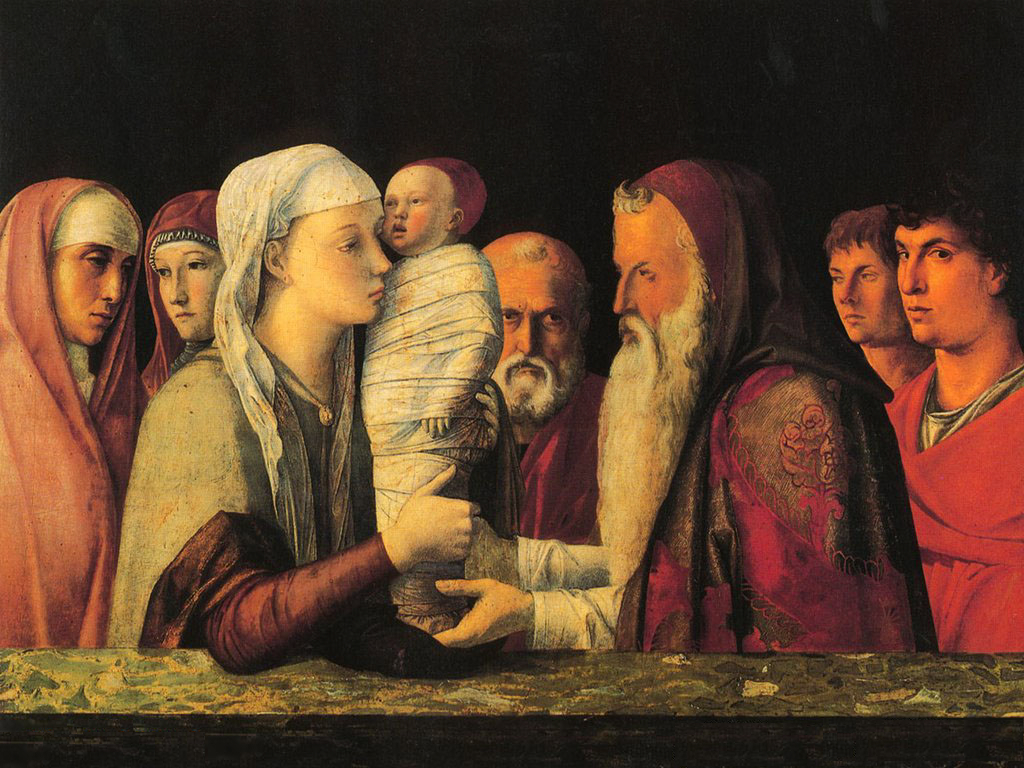
And in this exhibition we get the ultimate BOGOF. In 1453 Andrea Mantegna, already an established painter, trots in to Padua to marry Nicolosia Bellini, daughter of the venerable Jacopo, to become the brother in law of Gentile, and, our subject here, Giovanni. Giovanni, a relative novice, picks up on Andrea’s compositional experimentation and fascination with antiquity, and, in time, for me at least, overtakes him. Mantegna in turn harnesses Bellini’s facility with landscape to produce his greatest works when he moves in 1460 to the Gonzaga court in Mantua. Bellini stays in Venice, but even apart they tread similar paths, though with different results. Mantegna’s precise, flinty, sculptural, sharper, masculine, intellectual work contrasts with Giovanni Bellini’s lighter, softer, airier, more lyrical, enigmatic and emotional output. Same subjects and stories. Radically different ways of seeing and showing them

Guess which is which in the The Presentation of Christ in the Temple above? 20 years separate top from bottom. I’ll leave it to you.

This is not the only direct comparison in this superb exhibition. It would be fascinating just to play that game over a few paintings but here they just keep on coming across the six rooms. Some may be familiar to you (from the National Gallery, British Museum or Berlin museums from which they are drawn)  but it doesn’t diminish the wow factor.  Saint Sebastian, The Agony in the Garden, Crucifixions. The curators walk you through how and why the brothers-in-law created their own interpretations, which, for the interested layman is insightful, though you have to make sure, post comparison, you take the time to examine each painting individually. However there are enough individual unique subjects to offset the comparisons and avoid being overwhelmed by the scholarship.

The exhibition opens with a book of drawings. Pretty much all that remains of Daddy Jacopo’s art. We have to assume, given the importance of family and patronage in making and selling art in the C15, that Jacopo will have had a big hand in the direction of the business. He certainly kick-started the expanded artistic ideas that would emerge from the extended family. Alas this is the last we hear of him. Still the eye is probably already alighting on the two Presentations and your first starter for ten. 

What did Mantegna bequeath the next generation of the Italian Renaissance? The rise of the classical theme. The big picture. Literally in his Triumphs (of Caesar) of which just three are shown here (check them out in Hampton Court Palace when they return). Maybe the birth of the individual in art. That he was a master of perspective following in the footsteps of Masaccio and Uccello, and, in a different way, Donatello, is made pretty clear here. 

And Bellini? Colour, back-stories, people you can identify with, even if they were in deserts or on crosses or generally undergoing some sort of taxing trial or trauma. Maybe Mantegna was the more obvious influencer in his day, but Bellini, “the best Venetian painter of the C15”, may have endured for longer. I reckon I can see in him a thread through to Courbet and, eventually, the modernists. 

Mantegna imposes his narrative from without. Bellini’s flows from within. Pretentious w*ank. Maybe but fast forward to the end and compare Bellini’s OMG portrait of the Doge Leonardo Loredan, the cerulean background, the gold and silver impasto cloak, the confident, steely gaze. Perfectly lit. A very formal, contemporary portrait, that also looks timeless. In oil. Which Mantegna never used. Look then at his Minerva Expelling the Vices from the Garden of Virtue, painted in his 70’s. A complex, symbolic, Classical allegory. Intellectual to a tee. Painted for private contemplation not public edification.

Warm flesh. Cold marble. Head or heart. Fortunately in this exhibition you don’t have to choose. 

Romeo and Juliet at the Barbican review ***

Romeo and Juliet

Barbican Theatre, 8th November 2018

You can stay right next to Juliet’s balcony in Verona. Le Suite de Giulietta. The Tourist, SO, BD and LD can vouch for the lovely decor, the sizeable rooms and the delicious breakfast. The courtyard is closed at night so it is very tranquil and, in the day, it is quite fun watching the crowds do a double take when you exit from the hotel. And Verona itself is a very fine city. 

Now I am not a berk. I know it was a window not a balcony. And that this is a story which Will S nicked from William Painter via Arthur Brooke via numerous Italian medieval raconteurs, including Dante, and then all the way back to Ovid and Xenophon. But even this cranky curmudgeon can get swept along by the definitive tale of young love dashed. Though Shakespeare being Shakespeare there is a lot more too it than that, what with the examination of gang violence, pointless vendettas, family loyalty, sexual freedom the curious nature of Mercutio, the expanding eloquence of Romeo, the precocity of Juliet (she’s supposed to be coming up to 14 remember), the constancy of Benvolio, the comic good-naturedness of the Nurse and the misguided and hare-brained intervention of Friar Laurence.

It’s easy to see why R&J is so popular and has been presented in so many ways. The denouement with our two dead teens is always, or should be, a tearjerker, even as we know the outcome, the idiocy of Friar John – all you had to do was deliver a letter, how hard is that numbnut – is always a reason to shake your fist, the reconciliation of the families, (even as you know it won’t last), always stirs, there are some good, often dirty, jokes and some fine, sweet verse. 

It can endure a lot of textual and/or directorial abuse, (though it is hard to fathom the happy endings of previous centuries), and, even with the sub-plots is a breeze to follow, even without the Friar’s helpful “brief” summary at the end. What it doesn’t like though, in my book, is less than clear delivery of the verse. You need to hear the clever way WS matches language and form to character, you should clock the sonnets, you ought to grasp the filter of metaphor and religion through the language of love, and hate, you should be left to decide for yourself whether the narrative is driven by “fate”, by “chance” or by character “flaws” or “humours” and you need time to ponder on Shakespeare’s preoccupation with, well, time.

In this respect I wasn’t entirely convinced by director Erica Whyman’s gung-ho interpretation. The youthful cast, in the relevant roles, certainly brings to the fore the recklessness of their behaviours, their strutting self-absorption, their need for peer validation, and the brings out the parallels to contemporary knife crime. Bally Gill’s impetuous, swaggering yet still sensitive, Romeo and Karen Fishwick’s animated, “mature beyond her years”, Juliet could live in any city near you right now. They certainly have the chemistry. Charlotte Josephine brings a whole new dimension to Mercutio’s complexity, his/her relationship with Romeo and exaggerated masculinity. To me there was almost a rap like quality to Mercutio’s wilder flights of linguistic fancy. Josh Finan’s Benvolio offered counsel to Romeo which maybe also sprung from a deeper admiration. The gender fluidity in the Houses of Montague and Capulet also extended to Donna Banya’s timid Gregory. 

In the adult roles casting Beth Cordingley as Escalus pays off especially when she spits out “you men, you beasts” and Michael Hodgson is a severe Daddy Capulet who pushes his daughter into disobedience. Ishia Bennison’s Nurse also delivers, offering up her deceptively “simple” verse complete with funny accent. Andrew French’s Friar L relished every syllable. Tom Piper’s set, with oxidised cube, doesn’t really add much, then nor does it detract, (well maybe a bit at the end), and Ayse Tashkiran’s movement seems more in tune with Erica Whyman’s vision than some of the other creatives. As well as time, Will S bangs on about light and dark, night and day, sun and moon/stars, incessantly through the play, and the whole tone lurches to the minor post Mercutio’s slaying by Tybalt, but this contrast didn’t fully emerge. Sophie Cotton’s score similarly veered towards the murky. 

Overall then, in trying to explore the “tragedy of youth” and the intricacy of passion in a fresh and recognisably modern setting, to get to the root of “feelings”, the words sometimes ended up grating. The chopping of text wasn’t always helpful. And the delivery was uneven. I want to believe that this unlikely chain of events really could happen, to see the “if-onlys” as exactly that, and not to watch some swooning melodrama, but I also want to hear and digest exactly what everyone is saying. So big picture, this works, in some of the details, it is a little less cogent.