Creditors at the Jermyn Street Theatre review ****

Creditors

Jermyn Street Theatre, 27th April 2019

I am still tiptoeing my way into Strindberg. A long history of ignoring him after an early dismissal many years ago was corrected with the companion piece to this, a version of Miss Julie, also translated by Howard Brenton, also directed by JST AD Tom Littler and also co-produced with The Theatre By The Lake which seems to serve the good people of Cumbria very well and probably needs a visit. There was also Polly Stenham’s version, simply Julie, in 2018 at the NT, a variation on her usual style. Neither were completely convincing, the former because of the play, the latter because of the production, but I recognise there is food for thought here, though far less than with Ibsen and Chekhov where I am now properly in the swing after some similar false starts many years ago.

It’s the underlying misogyny, even when old August may well be confronting it, and the violent swings in emotion which seem to be more necessitated by plot than character, which put me off. That is not to say that the grumpy Swede had nothing to say about the nastier side of love and passion just that the way he tackles it feels artificial to me. Now I know. It’s theatre. It isn’t real and doesn’t have to look like. Except that this is intended to be naturalistic and, like his contemporaries, offer an insight into the human condition, and specifically that thing that gets bound up in the phrase “love/hate relationship” or, more lazily I think, “the battle of the sexes”.

Mind you I have to say that this Creditors was a more engaging experience than Miss Julie. Maybe I am getting better at this theatre viewing lark, which would be heartening given the time and money invested, or maybe the way in which Creditors approaches the three way romantic tussle, here MFM rather than FMF, was more “relatable” (ugly word) to me, though I hasten to add I have never been caught up in such a scenario. The benefit, (or maybe curse), of being dull and painfully inept when it comes to matters of the heart.

What it can’t be, obviously is the creative approach. Like I say its the same team. Even down to the set where Louie Whitemore employs the same basic structure to create the seaside hotel reception room in which the sensitive, would-be artist, Adolf is convalescing with his fervent wife Tekla, that she employed to create the Scandi period kitchen for Miss Julie. Maybe the cast here was a little more to my taste though it is the same James Sheldon playing Adolf here in Creditors as the sexy servant Jean in the Miss Julie. I have a lot of time for Dorothea Myer-Bennett most of whose recent performances I have seen (Rosenbaum’s Rescue, Holy Sh*t, The Lottery of Love, The Philanderer) and she always stands out even if the play isn’t entirely convincing. Here she captured Tekla’s independent spirit, her devotion to Adolf and her still unresolved passion for the third character in this conflicted trinity, Gustaf.

He was played by David Sturzaker, another very fine theatre actor as it was my pleasure to discover recently in the multiple parts he mastered in the RSC’s excellent Tamburlaine. Here he shows how Gustaf’s insistent charm first cast doubts in Adolf’s mind about Tekla’s history, fidelity and ambition and then, as it is revealed that his presence in the hotel is no coincidence, he attempts to “win back” his ex-wife whilst Adolf eavesdrops from the room next door. These two scenes sandwich that between Tesla and Adolf where Adolf’s suspicions are angrily voiced despite her attempts to reassure.

Pretty straightforward huh and maybe not an especially original subject for drama you might think. But it is the way that Strindberg explores the motives and psychologies of his three protagonists, and the the way their emotional ambiguity is expressed, that turns it into something compelling. Why is Adolf so weak and open to persuasion? Tekla has expanded his artistic horizons and the marriage has been happy so why does he fall so easily for Gustaf’s Iago-like duplicity? She is intelligent, educated, sophisticated and worldly so why just WTF is Adolf’s beef? What is driving Gustaf to wreak this emotional havoc? Revenge, love for Tesla, wounded pride at the way Tekla, thinly disguised, ridiculed him in her autobiographical novel, toxic masculinity? Are Adolf and Tekla hiding something about their own history? Who is dependent on whom? Is Tekla still attracted to Gustaf’s “stronger” character? Is this just a game for Gustaf? Why the melodramatic ending?

Howard Brenton, like so many theatre types, is fascinated by the interiority, (yep it’s a real word), questions that Strindberg poses. As he is with other literary greats – see my forthcoming attempt to pick the bones of his latest play Jude inspired by Hardy (and, somewhat bizarrely, Euripides). As with Miss Julie this seemed, at least to this novice, an admirably forthright adaptation but then I know no better. It certainly, like the Miss Julie, serves up contemporary dialogue and caustic humour to set against the period setting and it comes in at a crisp 80 minutes or so. Same goes for Tom Littler’s direction and the unfussy lighting of Johanna Town and sound of Max Pappenheim. Howard Brenton has written a play, The Blinding Light, about Strindberg’s drift into madness, his “Inferno” period, which was directed by Tom Littler, and they have also combined for AS’s dances of Death, so you have to think they know what they are about here. So I am guessing this is about as good as it gets when it comes to modern interpretations of our August. Especially in the very intimate surroundings of the JST.

There is a lot more to Strindberg than the early, naturalistic plays which deal with that are most often performed. There are the the later more ambitious, symbolist works (A Dream Play, Ghost Sonata and The Dance of Death). Various history plays. Theatre director and producer. Novels. Poems. Essays. Scientific investigations. Painting, (his symbolist landscapes, example above, tick the boxes for the Tourist). Also dabbled in theosophy, though this was very trendy in fin de siecle artistic circles, occultism and alchemy. Not surprising he went a bit bonkers. A social/anarchist with a strong antipathy for all forms of authority but also an anti-semite. A campaigner for women’s rights who helped transform the role of women in drama who was also an ugly misogynist in print and whose wives where decades younger than him.

When you read about his him, his plays and his place in Swedish culture it is easy to see whay he holds such an important place in world drama. Am I persuaded? I’ll let you know in a few more years, and after a few more productions.

Small Island at the National Theatre review *****

Small Island

National Theatre Olivier

If you know Andrea Levy’s Small Island either from the original 2004 book, (not me I confess), or the 2009 Two part BBC adaptation with script from Sarah Williams and Paula Milne and starring the inimitable Ruth Wilson and Naomie Harris then you will know roughly what to expect from Helen Edmundson’s adaptation directed by NT head honcho Rufus Norris. This is an epic social history, set in post-WWII Jamaica and London, and centred on the lives of two ordinary couples, or more specifically two, extraordinary, women, Hortense and Queenie.

It is a brilliant story, brilliantly told, but, even with the NT’s formidable financial and creative resources to hand, it was still an ambitious ask to bring it to life on the stage. Now I reckon Rufus Norris has been unfairly pilloried in some quarters during his stewardship at the NT. Not all the new commissions have come off but there have been some absolute belters as well. Keeping the progressive and conservative stakeholder congregations onside at the NT would test the patience of a saint, especially in these interesting times, and I reckon RN has had a pretty good stab at it. And a couple of the projects where he has taken the director’s helm himself, Everyman and Mosquitos, were superb. Yet for me he is at his best when pulling together multiple narratives and kaleidoscopic forms; as long as the writing on which any work is created is up to snuff and the stories he helps tell make an immediate emotional connection. London Road, Behind the Beautiful Forevers, The Amen Corner, Feast, (both of which I missed), Festen and, I gather his takes on Cabaret, all fit that bill. So I was pretty sure this would work and fill the Oliver stage with technicolour life again.

And it does. Superbly. We first meet Hortense (Leah Harvey) in the Jamaican school she teaches in alongside glamorous American Mrs Ryder (Amy Forrest). A hurricane is coming. Michael (CJ Beckford), the rebellious son of Mr Philip (Trevor Laird) and Miss Ma (Jacqueline Boatswain), who are also Hortense’s, very strict, stand-in parents, (she is the illegitimate daughter of Mr Philip’s affluent white cousin). arrives. Hortense loves Michael but he has eyes only for Mrs Ryder. Cue a brilliant set piece prologue, bravura lighting (Paul Anderson), sound (Ian Dickinson) and, especially, projection design from Jon Driscoll, taking us through the storm, interspersed with Michael and Hortense’s childhood, (not sure who played little M and H but blimey they are brave), and an explosive argument at the dinner table. In this Tempest-ian prologue it soon becomes clear we are in for an aural and visual treat thanks to these creatives in tandem with the sedulous stage and costume design of Katrina Lindsay, music of Benjamin Kwasi Burrell and movement of Coral Messam. Heaven knows how many hours they all put in but not was worth it.

This is worth the ticket price alone. Especially if, like the Tourist, you only pay £15. The proper reviews have come in and they are excellent. If Billers at the Guardian and DC at the Telegraph both say 5 stars then you would be a t*t to miss it. There are plenty of tickets left towards the end of the run from which to take your pick. With acting of this level and stories with this much passion I would happily have paid £75 for centre front stalls but trust me, with stagecraft of this quality and scale you’ll be fine in the cheap seats as well.

Now the characters do take a little time to fully come to life. The setting does dwarf the actors a little in the prologue and, in the preview I attended, the delivery of the dialogue initially lacked a bit of fizz. But when we move to England, the “mother country”, to meet Queenie (Aisling Loftus) and her awkward, repressed suitor, bank clerk Bernard (Andrew Rothney), and then track the progress of Gilbert (Gershwyn Eustache Jnr), during the war as an airman and then when he returns after the war, with Hortense who has married him to realise here dream of escape, things really begin to crank up.

Andrea Levy’s story, replayed deftly by Helen Edmundson, is built on memorable episodes which together create an irresistible momentum topped, at the end of the first, long, half by the arrival of the Empire Windrush, and then in the shorter, more constrained second half, set in 1948, by the return of Bernard and the momentous decision which finally binds the two couples. Queenie’s date with Bernard in the cinema, her first encounter with Michael’s irresistible charm after he too arrives in GB to fight for Empire, Hortense mistaking Gilbert for Michael on first meeting, the ill-fated fight in Yorkshire, Hortense’s desperate betrayal of best friend Celia (Shiloh Coke). Queenie’s tender care for her traumatised father-in-law Arthur (David Fielder), the overt racism Gilbert and Hortense encounter, as postie and would-be teacher, (audience visibly outraged), and from Bernard after he returns. And many more. Each scene is expertly navigated and beautifully mounted.

Small Island is, of course, primarily about race and prejudice, and the journey that the protagonists take, both geographical and emotional. It reflects Andrea Levy’s own, mixed race heritage, and the legacy of Empire. In this adaptation though, and maybe just because of the brilliance of Leah Harvey as the proud, uptight, determined Hortense and Aisling Loftus as the openhearted, optimistic but tough Queenie, I was particularly drawn to the compromises the women had to make to carve out any sort of meaningful life for themselves. All the main characters have dreams that, in order to be realised need to confront unpalatable realities, but the two women, in their own, intertwined, ways have so much more to overcome. This, ultimately, is what makes them so sympathetic and the story itself so warm, uplifting and, dare I say, inspirational.

Without the somewhat syrupy narration, and with the exuberant, (even in some of the darker passages), innovation which was required to bring each scene to life, this stage version is more moving and satisfying than the TV version. It is around three hours, even without the interval, but it never feels like it and, though I can’t be sure not having read the book, it seems to offer a more than faithful distillation of Ms Levy’s intention. Unfortunately she passed away in February before the play opened so we can’t be sure but she was apparently fully signed up to director and adaptor’s vision . The programme contains an extract from her 2014 essay “Back To My Own Country”. Everyone should read it.

“We are here because you were there.” I was particularly struck by this quote from Ambalavaner Sivanandan, prime mover in the Institute of Race Relations, highlighted in the programme notes from Leah Cowan. Remember everyone who came to Britain from Jamaica and elsewhere was a British citizen. Same rights as my grandad. Who just happened to be, I knew even as a child brought up in an entirely white monoculture, an ugly, visceral racist. He’s long gone. Yet it seems the open abuse he habitually lobbed at his black neighbours still hasn’t.

Small Island with bowl you over as a piece of theatre, make you laugh and maybe even cry, but it should also make you think long and hard about our shared history. Do go.

(As an aside can I beg Naomie Harris, Hortense in the TV adaptation, to return to the London stage. You will know her from her film roles as Eve Moneypenny in the last few Bonds or Moonlight, amongst others. I think the last time she was in the theatre was in Danny Boyle’s amazing sounding Frankenstein which I never got to see. Come to think of it it would be good to see Mr Boyle’s boundless imagination let loose again on the Olivier stage. He would fill it I am sure. As for Ruth Wilson, Queenie in the TV Small Island, anyone who saw her magic in Ivo van Hove/Patrick Marber’s Hedda Gabler will be counting the days to her UK stage return).

The Remains of the Day at the Yvonne Arnaud Theatre review *****

The Remains of the Day

Yvonne Arnaud Theatre, Guildford, 13th April 2019

Right all you good citizens of Derby, Salisbury, Cambridge and Bristol. There is still time for you to book tickets to see this excellent adaptation of Kazuo Ishiguro’s celebrated novel The Remains of the Day. A very well crafted script by Barney Norris, (just the fellow to write pensive studies of “Englishness” based on his previous work), in an excellent production from one of our premier touring companies Out of Joint, thoughtfully directed by Christopher Haydon, (latterly of the Gate Theatre), with a pair of sparkling central performances from Stephen Boxer and Niamh Cusack.

Now the Tourist has never been much good at reading. Nothing ever seems to sink in without repeated exposure. Especially with fiction. And especially with fiction he read in his youth. A vague recollection of the big picture, a few specific episodes and a general “I like that author”. Not like the SO who can trot out plot, character, meaning, style, context, like an A* student even for things she read decades ago. Maybe this low level intimidation is what stops the Tourist picking up a book except when on hols. That and spending too much time at the theatre and writing this stupid f*cking blog.

Anyway you probably. like the Tourist. know this work more from the 1993 Merchant-Ivory film with Anthony Hopkins and Emma Thompson as Stevens and Kenton, both quietly upstaged by Peter Vaughan as Stevens Senior. Nominated for 8 Oscars, won none. Mind you that was the year the Academy rewarded Spielberg for Schindler’s List. Fair dos. I see that one Harold Pinter wrote an original screenplay for the film when Mike Nichols was slated to direct. Bits of Harold’s work made it to the end but he removed himself from the credits. Might have been a very different film with him and Mr Nichols in the driving seat.

Instead I remember the central, unrequited, relationship between the stiff Hopkins and the droll Thompson, the look and feel of the thing, (Merchant-Ivory being allowed to film in any toff’s house at the time such was their fame), and the almost elegiac take on the history under examination, the 1950’s and the 1930’s. Yes the politics were there but not as sharply delineated as in this play. Class, deference, knowing one’s place, belief in the wisdom of the elite, are common to both treatments but I was far more struck in this treatment by the desire of many in the aristocratic class in the 1930’s to broker a deal with Hitler, to appease, than I was in the film. And specifically the reasons why, the guilt at having inflicted so much economic misery on Germany post First World War, as well as the memory of the human carnage of that war, and, of course their anti-semitism, which motivated them to pursue this course.

It may just be that, like my reading of the book, I just don’t remember the film very well. Which is salient given that The Remains of the Day is a memory book/film/play. Or maybe more specifically a memory of a history, personal and political, book/film/play. To solve the “problem” of butler Stevens remembering the events at Darlington Hall in the run up to the Second World War, (as he undertakes the road trip in 1958 to pay the visit to the ex-housekeeper, Miss Kenton, prompted by her letter), the film makes generous use of flashbacks. And a cast of thousands.

Well maybe not quite but tons of extras and actors of the calibre of James Fox, Christopher Reeve, Hugh Grant, Michael Lonsdale and Tim Pigott-Smith to fill all the named characters, (trust me, a lot of people found their way to Darlington Hall). Even the minor parts are filled by the likes of Ben Chaplin, Patrick Godfrey, Peter Eyre, Pip Torrens and, the go-to actor for Germans in British films, Wolf Kahler. Blimey even a young Lena Headey, Cersei in you know what, gets a look in. Basically if you could do plummy or gor-blimey, and you weren’t engaged elsewhere, you got a part in the film.

No such technology of budget for Out of Joint and Messrs Haydon and Norris. So a fair bit of character pruning, some adroit exposition to incorporate those written out, and extensive doubling. But this is not just any old “exit Act 1, turn up as someone else in Act 2 with new costume and wig” stagecraft. This is seamlessly executed, on stage choreography, a hat, a coat, a pipe, to turn a cast the cast of 8 into the staff and guests of pre war Darlington Hall and the locals Stevens meets on his pint-sized odyssey of self-discovery. This means that the ghosts of the past are always present. Very clever and very easy to follow.

Stevens devotion to duty even in the face of the shocking demand by Lord Darlington to sack the two Jewish maids, Kenton teasing Stevens about his book, Stevens carrying on his duties even as his father dies and Mme Dupont, (a gender change to accommodate the casting pyrotechnics), whinges about her feet, Reginald’s increasing awareness of what his godfather is up to, Stevens disowning the past in his conversations with Dr Carlisle, the mocking Stevens is forced to undergo from “Sir David” the composite collaborator with Lord D, the radical conservatism, or conservative radicalism, espoused by everyman Morgan in the pub and, of course, the extraordinarily moving scenes between Kenton, or Mrs Benn later on, and Stevens, as the happiness they might might have had slips through their fingers. You flipping noodle Stevens.

All of these scenes are memorable, providing plenty of minor key drama, but the best things about the play are the performances of Mr Boxer and Ms Cusack. I’ll stick my neck out here and say that for me, and remember this is based on my faulty memory, they capture the essence of Stevens and Kenton more that Hopkins and Thompson in the film. The ten year age gap between these actors seems more convincing than the 20 years of the film. Mr Boxer seems to me to bring out more of the interior life of Stevens, the way he buries the emotions that he plainly has in the cause of maintaining the dignified exterior he believes is required of him, the way he is puzzled by, but still craves, Miss Kenton’s attention. Ms Cusack seems more playful as Kenton, holding back the regret until the very end. the structure of the play lends more prominence to the conversations in the pub and the way this changes Stevens’s perspective.

The directness of the political dilemma, and its flawed morality, is far more pointed here than in the film. And the reliability of Steven’s recollection is more nuanced as in the book, (yes I took a quick peep again whilst writing this). In fact generally Mr Norris seems to capture the essence of the book in a, er, more reliable way that the period-drama aesthetic of the film does.

The rest of the cast step up. Miles Richardson captures the naivety, in life as well as politics, of Lord Darlington and the middle class bonhomie of Dr Carlisle. Sadie Shimmin offers us an uncomplicated pub host in Mrs Taylor alongside the hauteur of fascist sympathiser Mme Dupont. Edward Franklin warms to his task as the bespectacled, conscientious godson Reginald, (drawn from the film not the book), Patrick Toomey is the arrogant American politician Lewis (and, I think Farraday, Steven’s current employer) and Pip Donaghy marks out Stevens Senior decline. Top marks to Stephen Critchlow though as he he shifts from Morgan to the real “villain” of the piece the anti-semitic Sir David.

I see a lot of plays but this is one of the more satisfying I have seen so far this year. “Knowing” the content helps of course, and, from a personal geographical perspective a hop to Guildford, and the fine design and accumulated history of the Yvonne Arnaud Theatre, was no inconvenience. I get that Out of Joint rightly values its touring credentials and I am grateful to the Royal and Derngate, (on my list to visit), and the Oxford Playhouse for co-commissioning Barney Norris’s script. But I am stunned that this hasn’t secured, as far as I know, secured a berth in London.

The familiar story, the quality of the acting, the script and the production, (Lily Arnold’s set is another stand-out as is Elena Pena’s sound design), the themes it explores and their contemporary echoes – the dangers of passivity and nostalgia – all would suggest to me that this would pack them in in a mid sized West End venue. There is plenty for the customary theatre demographic to enjoy, (they certainly did on this Saturday afternoon), but, with the right tone, I reckon some younger folk could be persuaded. I know that Out of Joint’s last major production, Rita, Sue and Bob Too, had a false start, understandably, before eventually gathering plaudits as the Royal Court but most of the rest of their historical efforts have popped up in the capital. This, whilst still posing some thorny questions, looks to be a far more commercial proposition than many of those predecessors.

Barney Norris plainly says that “the play must be unlike the book or the film or it shouldn’t exist” in the programme. Fair dos. But, whilst its structure and perspective match his manifesto, there is more than enough of both earlier manifestations to justify your attendance should you know them.

Over to you nice people at ATG.


The Talented Mr Ripley at the Vault Festival review ****

The Talented Mr Ripley

The Faction, Vault Festival, 14th March 2019

Having missed this on a couple of previous occasions the Tourist was delighted to see it pop up on the Vault listings and even more delighted that the SO deigned to come. Downfall or The Talented Mr Ripley. The SO’s two contenders for greatest film ever. Worrying you might think for her husband given the nature of the lead characters. Still I admit they are both excellent films, though mind you with, as a minimum, an annual retrospective chez Tourist, I don’t have much choice.

After our last Ripley related entertainment, the somewhat disappointing play Switzerland at the Ambassadors, we were pining for success. From reading reviews of the Faction’s original version of the play from 2015, at their adopted home of the New Diorama Theatre in Euston, I see that it ran to over 150 minutes, which suggests to me that Mark Leipacher’s adaptation may well have clung too closely to Patricia Highsmith’s book and/or film and may not have fully exploited the opportunities of theatre. You couldn’t say that now. Down to just 90 minutes, but with all the key scenes and narrative, of book mostly and not film, moreorless intact, (verified by the SO), this is, even as it slows down fractionally in the second half, an exciting and explosive drama which gets to the heart of Tom Ripley’s dark soul using the bare minimum in terms of ensemble, set and props. Having secured the stage rights from Ms Highsmith’s publishers Diogenes Verlag, Mark Leipacher, who directs, and the seven strong Faction company, have created a play which complements, though doesn’t quite match, Anthony Minghella’s film and the original novel. (I haven’t seen Purple Noon, Rene Clement’s 1960 cinematic take on the story starring Alain Delon, though I see the buffs prefer it).

From the start, back to audience and typing, “have you ever had the feeling you’re being followed”, Christopher’s Hughes’s Ripley, with his presentational asides to the audience, is the unhinged sociopath we know and love, albeit of the tigerrish variety. Making him English and having him bark out his lines takes a bit of adjustment initially but this exaggeration, which is mirrored, albeit less assertively, in Christopher York’s confident Dickie and Natasha Rickman’s wistful Marge, contributes to the energy of the adaptation and allows the audience to quickly get inside the dynamics of the trio.

I am not saying you need to know the story to follow the play but I can see that it would help. With just a raised white plinth, with gap in the centre, rapid on and off stage costume changes, some doubling, no exposition, jump scenes punctuated with cries of “cut/action” to reference the location changes and to re-run scenes, physicality, (every trick in the movement director’s handbook is on show here), it comes together to create a kaleidoscope of images which replay the story but in a very different way from the big budget, location led, close-up cuts, thriller genre and naturalistic acting of the film. We still want Ripley to get away with it but here he is a much bolder incarnation of “evil”, as in the book, trying to stay one step ahed of the game, in contrast to the more inscrutable filmic Matt Damon.

Given the effective economy of Frances Norburn’s design it was left to Chris Withers’ lighting and Max Pappenheim’s sound to assist in taking us from the NYC club where Ripley’s first meets Dickie’s anxious Dad, Herbert (Marcello Walton), through to fictional Italian resort, (I imagine the Neapolitan Riviera), the streets of San Remo, the ill fated boat trip, the Roman apartment, the alley where Ripley dumps the body of caustic Freddie (Vincent Jerome) after battering him to death, Venice, where Ripley, per the film, attaches himself to the guileless Peter (Jason Eddy), and finally to Greece, where Ripley now rich and ostensibly free of his crimes but forever tormented: “have you ever had the feeling you are being followed”. Vincent Jerome doubles as McCarron. the private detective Herbert sends to investigate his son’s disappearance, and Marcello Walton as Roverini, the Columbo-esque Italian policeman who is all but on to Ripley as he dodges across Italy. This just leaves Emma Jay Thomas who takes on the other female roles of Emily and Buffi.

All in all a fine addition to the Ripley industry and an excellent ensemble performance. I see The Faction has previous with even meatier fare. Hopefully there will be a chance to catch this at their Euston home in the not too distant future.

Berberian Sound Studio at the Donmar Warehouse review ****

Berberian Sound Studio

Donmar Warehouse, 14th March 2019

I sort of stumbled across Peter Strickland second full length film by accident. Always keep half an eye on what’s coming up on Film 4. Record anything that I recognise as requiring a watch, (on the basis of pretentious film buff recommendations), probably leave it unwatched for months and then likely dump it. Just occasionally though a bit of research and or plain old fashioned curiosity means I end up watching them before pressing delete. And so one rainy Sunday afternoon on went Berberian Sound Studio. The presence of Toby Jones helped but, five minutes in, laptop and phone were switched off and I sat, bewitched, for the next hour and a half. Have raved about it ever since whenever the chance comes up to raise it in conversation. Which, as those of you that may know it, isn’t really that often.

For the film is a critique, or maybe continuation, of the Italian giallo film genre. Giallo, to quote Wiki, is “a particular Italian thriller-horror genre that has mystery or detective elements and often contains slasher, crime fiction, psychological thriller, psychological horror, exploitation, sexploitation, and, less frequently, supernatural horror elements“. It reached its apogee in the 1970s and stems from the Italian for yellow, the colour of the paperback mystery novels popular in post-WWII Italy which provided th plots for many plots for many of the early cinematic examples.

Now, to be clear, these films wouldn’t be my cup of tea, though, to be fair, I haven’t tried. Mr Strickland’s film though takes the post-production studio for one of these films as the setting for a surreal mediation on the main character’s dislocation and eventual breakdown. Gilderoy has arrived at the studio to work on a film about horses. Or so he believes. He is a Foley artist whose work has come to the attention of the film’s director, Santini, through the soundtrack to a nature made in Gilderoy’s home county of Surrey, Dorking to be exact, where he lives with his Mum. Out of his depth, and plainly shocked by the nature of the film, Gilderoy nonetheless sets to work on mixing the sound effects for the film’s torture scenes and the voice-overs from session actresses, Silvia and Claudia. He is held captive by a mixture of professional pride, bullying by the film’s producer Francesco, failed attempts to get his expenses reimbursed, (it turns out the flight he came over on doesn’t exist), concern for the actresses and, maybe, fascination with the material. The language barrier, his own lack of worldliness and the material he is dealing with leave him increasingly disorientated and unhinged. A new actress arrives Elisa to replace Silvia who has been attacked by Santini. Gilderoy eventually goes full-on gaga mixing up reality and the film. The end.

Now I can’t pretend that there weren’t times when the film became a little frustrating and, well, just a bit weird but it is so atmospheric, so different and so fascinating that I have watched it again and, as with all good art, have occasion to think on it. Toby Jones is brilliant as Gilderoy, (as he is in pretty much anything he does – most recently on stage as Stanley in last year’s Birthday Party revival) ,as are the rest of the Italian, largely based in Britain, cast. The exposure of the mechanics of film-making, specifically the sound-track, composed in the film by Broadcast, the Foley effects and the voice effects from Hungarian performance artist Katalin Ladik is intriguing, especially the horror genre, and the theme of alienation, on many different levels, is intriguingly explored. Strickland himself was brought up in Reading but lives in Eastern Europe.

So how to put this on stage. Well clearly the first thing you need is a convert which is where Tom Scutt comes in. Mr Scutt is a top drawer designer, (Julie, Summer and Smoke, The Lady from the Sea, Woyzeck, Les Liasons Dangereuses, King Charles II, The Deep Blue Sea, Elegy, Constellations – and that’s just what the Tourist has seen), and Associate at the Donmar, but this is first directing gig. He has teamed up with Joel Horwood, (whose work I don’t know but who I see has previously focussed on pantos !!), to adapt BSS for the stage.

And what a very fine job the two of them have done. The adaptation stays close to the original story, with some changes in chronology, for most of the 90 minutes run time but wisely condenses the breakdown of Gilderoy at the end. This shifts the focus more directly to the relationship between him, Francesco and, eventually, Santini, (a confident debut from Luke Pasqualino), and the actresses, where the characters have been mixed up and changed a bit. Elena/Sara is played by Eugenia Caruso who actually played Claudia in the film and starred in Strickland’s next major film The Duke of Burgundy. Sylvia is played by Lara Rossi, (who I remember well from The Writer at the Almeida), Carla by Beatrice Scirocchi and vocal composer Lore Lixenberg takes on the Katalin Ladik part. All clear? Nope. Don’t worry. there is no confusion in the play. Well aside from in Gilderoy’s mind.

It also lays bare the process of creating the sound-track to the film with two on stage Foley artists in the form of the silent Massimo and Massimo, (Tom Espiner, who has form on this as the on-stage Foley for Simon McBurney’s Magic Flute of which more to follow on these very pages shortly), and Hemi Yeroham), brooding janitor Lorenzo (Sidney Kean) and the voice of Giovanni (Stefano Braschi). The distance between the process, squashing a melon say, and the intention, some unspeakable violence, of the sound is as sharp a metaphor for the illusion of theatre, or film, as you could imagine.

However the heart of play lies with the performance of Tom Brooke as Gilderoy. He initially cuts a more confident air than Toby Jones in the film, determined to show his skill, (which also allows us even more insight into the technological processes). However the constant harassment and worse by Francesco, Enzo Cilenti is superb here, and the entreaties from the women, are what push him over the edge, perhaps less than the content of the film. It feels more like he is lashing out rather than disintegrating as he goes round and round trying to create the “perfect” closing torture scene soundtrack. In the end he is complicit as we see him scare Carla into giving the perfect “real”scream . What is clever though is that large swathes of the dialogue between the Italian characters, except where Francesco intervenes ostensibly to help Gilderoy, are spoken in Italian. Leaving the audience, mostly, in the dark alongside our hero.

It also, of course, means that, in a story centred on sound, the sound design had to match the ambition of the adaptation. It did. Thanks to the go-to stage sound designers Ben and Max Ringham, alongside the aforementioned mentioned Tom Espiner’s Foley, (there is a lot of vegetable abuse here), and Lore Lixenberg’s vocals. Lee Curran as lighting designer, Sasha Milavic Davies (who is one of the best in her field methinks), projectionist Mogzi Bromley-Morgans and even the superb studio set of Anna Yates (with Tom Scutt’s input) all had to take a back seat to the brothers Ringham. Pound for pound I doubt you will ever see a more extraordinary manifestation of the technical craft of theatre-making.

Did it work as a play though? Yes definitely. The team has wisely not tried to go for broke with the more surreal visual conceits of the film and to offer more complexity in the relationships between characters, and, I think, to point up, by implication, the misogyny of genre and industry. The idea that creatives have some responsibility for the material they create also comes through even if the individual isolation of Gilderoy is less explicit. Santini’s twisted justification for the film to Gilderoy, and Gilderoy’s own disavowal of, I think, Elena, “I’m just a technician”, are key scenes in this regard.

There is suspense and direction in the story. There are even a couple of jump-scares. The play also expertly captures the slippery meta elision between play and film within a play, (I note that Jamie Lloyd captured the same vibe in his version of The Slight Ache in the Pinter season recently). To be fair it does sort of just end, there is no conclusion, but that is common to the film. I can see exactly why everyone here wanted to bring this project to life and I for one thoroughly enjoyed it. On the other hand if you weren’t familiar with the film, took a punt and are not nerded up by the technical aspects, then I could see this being a little frustrating.

Alys, Always at the Bridge Theatre review ****

Books HD

Alys, Always

Bridge Theatre, 25th February 2019

Said it before and I’ll say it again. You have to be careful with adaptations of novels and/or films on stage. There may be enough in character and plot to justify the transfer but there may not always, (no pun intended), be enough in the form of drama, spectacle and movement to make it a resounding success. So it proved here. There is plenty to enjoy here, and Nicholas Hytner’s direction wrings as much colour as its possible out of the material, especially against the backdrop of a crisp design concept from Bob Crowley, and it is, no doubt, a good story, but as theatre, well not quite.

I don’t know the Harriet Lane novel from 2012 on which Lucinda Coxon, (whose work for stage and screen I have also contrived to miss bar The Crimson Petal and the White adaptation), has created the text. But I can see the temptation. It would make a terrific mini-series. As would, I suspect, Her, Ms Lane’s second novel from the sound of it. Harriet Lane began as a journalist herself, I remember her Guardian column, before becoming a novelist when her eyesight was unfortunately imperilled.

Frances Thorpe is a humble millennial sub-editor cum factotum for a Sunday supplement, the Questioner, who, by a twist of fate, finds her life and career catapulted into a new, gilded league. How she plays the circumstances is the nub of the tale. Gold-digging schemer or realistic opportunist? Becky S, Brideshead, Ripley (without the sociopathic tendencies), Eve Harrington, Holly Golightly, those who find, or position, themselves amongst their “betters” are a cultural staple and these are only the most interesting ones. And, as it happens, in one of those serendipitous coincidences which punctuate the life of the idle Cultur-tarian, the Tourist has subsequently seen two of these iconic parvenus in the guise of stage versions of The Talented Mr Ripley and All About Eve. (More to follow, informed, as these comments are, by the far greater literary intelligence of the SO, my carer for all these entertainments).

The tale of Frances is more subtle than many of these comparators, being more contemporary, set in the rarefied world of publishing, but there isn’t too much that will come as a surprise here. Psychological thriller? That is probably a bit of a stretch. Wry comedy of manners? In parts yes, there is plenty to laugh at, but this doesn’t go all out to skewer the manners, pretensions and behaviour of its characters. We need Frances to present a conundrum, difficult to pin down, but not a total blank, and we do need the dimensions of her character to be explored. Which, by and large, they are not.

Frances’s journey is sufficiently supple though to require a convincing lead performance and, in Joanne Froggatt, (made famous by Downton Abbey I gather), that is what it gets. Whilst the narrative of put upon mouse at work rising to the top and dumping on former colleagues along the way is a little cumbersome it is, in parts, a treat. The relationship that develops with Alys’s family and specifically her grieving husband, Laurence Kyte, (not giving much away here you can’t read elsewhere), also provides an opportunity for some sparkling dialogue. However Robert Glenister has to work awfully hard to bring the overweening, prize winning author to life and the knife-edge of Frances’s conflicted motives starts to blunt in the later two-hander scenes.

Leah Gayer as vacuous daughter Polly has a lot more fun. This is her stage debut. She’ll be back. Polly verges on “poor little rich girl” cliche but Ms Gayer somehow manages to elicit some sympathy for the position her character finds herself in. Her brother Teddy (Sam Woolf) is initially on to Frances but fizzles out thereafter. Sylvestra Le Touzel has a lot of fun with Mary, Frances’s long-serving, frayed boss, as does Simon Manyonda as her condescending, partying colleague, Oliver. The rest of the cast don’t get much opportunity to delve beneath the lines with the exception of Joanna David as Charlotte, the family friend who alone seems to penetrate Frances’s feelings and actions.

If directing is all about moving actors from A to B then there is n0-one better than Mr Hytner, who creates forward momentum and some suspense, from what are quite static scenes. The set, with its thrust stage, sliding room configuration and generous use of video (Luke Halls), is likewise silky smooth. As is sound (Gareth Fry) and lighting (Jon Clark). But the impeccable presentation is part of the problem. The play’s two acts clock in at just over two hours but it doesn’t outstay its welcome nor feel rushed. I was intrigued and entertained but never really challenged. Nor was Frances. Her progress is untroubled by doubt, from self, the other protagonists or audience. I remember only one knowing aside from Frances and one killer line from Charlotte.

I gather the book is altogether darker and Frances a far sharper piece of work, and less reliable narrator, than we see here. Translating that tone, that voice, to stage is always challenging. By taking the safe route Mr Hytner, in the first play he has directed written by a woman, will deservedly get bums on the superb Bridge seats, which is after all his purpose, but I hope his next outing, a new Dream will be something more memorable. Mind you it’s Shakespeare so he is off to a head start. After all when it comes to stage tales of self-advancers big Will served up the very best. Richard III. Now that’s how to do it.

Don Quixote at the Garrick Theatre review ****

Don Quixote

Garrick Theatre, 2nd January 2019

Finally the Tourist gets to see this. Took a chance that it would, after the mostly strong reviews, eventually find a home in London, and waited for the run to settle in to secure a fairly priced ticket. If you are of a similar mind, and haven’t seen it yet, I would advise you to do the same in the remaining few weeks. I am not sure it is quite the triumph some of the criterati would have you believe but the spry adaptation of James Fenton, the creative staging under Angus Jackson’s animated direction and the straight man – funny man double act of David Threlfall and Rufus Hound make it impossible not to enjoy.

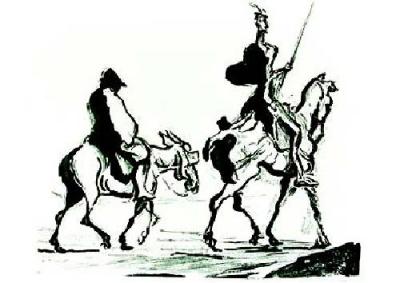
Indeed once you strip out the comedy, Rufus Hound’s audience patter, the gags, the pratfalls, the puppetry, the knowing asides, the gurning, the mugging, the bun fight, all superbly orchestrated by comedy director Cal McCrystal, this is actually a moving, and occasionally, insightful play. In that regard it captures the spirit of the Cervantes novel(s). DQ may be an aged eccentric, living in a fantasy world, harking back to a world of chivalry unknown by early C17 Spain, let alone today, but he is also a man of conviction and belief, and this, surprisingly, just about squeaks through in this RSC production.

As the bond between DQ and sidekick Sancho Panza develops, and as we see the melancholic DQ doggedly stick to his quest despite the incredulity of those around him, we get ever closer to the “real” character. Result: a hushed audience taking in a closing deathbed scene, (sorry folks DQ does snuff it), where DQ regains his sanity, that is both moving and poignant. That this should be so is in part due to the sincere warmth that a padded-out Rufus Hound brings to SP, but mostly thanks to the wonderful performance of David Threlfall. Whilst the rest of the cast shifts, swirls, sings and dances around him, playing characters who, predominantly see him as a figure of fun to be endlessly mocked, DT plays it absolutely straight, even when flying Peter Pan like above the stage.

Mr Threlfall is no longer, unfortunately, the most prolific performer on stage or screen. The Tourist has only seen him once before, in the Young Vic Skellig many years ago. The last TV outing I can remember is his performance in the valuable, if flawed, recent BBC/Netflix retelling of the Greek myths, where he played Priam. Now it looks to me like DT is only interested in parts that allow him to proudly display his magnificent silver hair and beard. For his Don Quixote there is a whiff of aged Frank Gallagher, in looks, if not moral complexion, with whiskers, straggly hair and crumpled stockings. After the humorous introduction to SP, his wife and the villagers, all it takes is a few quick deft touches, by both adapter and actor, before we are convinced that reading too many chivalric romances from previous centuries could inspire our geriatric hidalgo to become a knight-errant and set off on his fantastic adventures. He may be deluded but we believe that the world he sees is all too real.

A short three hour play (it breezes by) is never going to be able to capture the complexity of Cervantes’s picaresque novel. There is a reason, actually there are many reasons, why DQ is considered the greatest literary work from the Spanish Golden Age, indeed one of the greatest of all time, comparable with contemporary Shakespeare. The first “modern” novel indeed. It is both stirring adventure (the Tourist’s take on first reading when a tween) and fountain of intertextuality (the lesson from the second reading a couple of decades latter). It is tragicomedy, genuinely both funny and sad, a plea for the primacy of the individual non-conformist and a nuanced social commentary, a satire on misplaced nationalism, a discourse on the nature of truth and reality and a tragedy centred on the corruption of idealism. It is road movie, buddy movie, heroic fantasy, action movie, tall tale, parody, burlesque, fairy tale, slipstream fiction and psychological thriller.

Cervantes’s own precarious upbringing and life of adventure (duels, midnight flits, military service, serious illness, paralysis, years of slavery in Africa, prison sentences, stabbings, affairs) are reflected in its pages. It is pretty much the only work for which Cervantes is remembered but, despite the great success of Part 1 (1605) and then sequel Part 2 (1615) he barely made a penny out of it. He died in poverty a few days after Shakespeare.

All this sort of stuff was meat and drink to writers, and readers, in C17 Spain, and clearly given the speed with which its fame spread, the rest of the Western world, but its cultural ubiquity ever since speaks to its resonance. Films, TV shows, books, songs, paintings, illustrations, tapestries, sculptures, operas, ballets, tone poems. And of course a Broadway musical in the form of The Man From La Mancha. A quick perusal of London entertainment guides will show you that in the next few weeks you can see this very musical at the ENO or, should you prefer, Marius Pepita’s ballet version at the Royal Opera House.

Whilst not quite matching the stirring cheesiness of Joe Darion and Mitch Leigh’s To Dream The Impossible Dream, this production has plenty of catchy Hispanic-inflected songs courtesy of Grant Olding and James Fenton. This does add to the somewhat episodic nature of the production, as does the need to wheel out the various sceneries, props, puppets and the like. Then again that is entirely in keeping with the tone and structure of the novel, as is so much here, and there is enough pantomime distraction to maintain momentum. The attempt to mimic the meta-theatricality of the novels by having DQ’s fame preceding him in the second half is a little stilted but, again, offers something to chew on besides the generous humour.

The set design of Robert Innes Hopkins, in common with his other recent RSC outings, has an elegant simplicity (and he does like to emphasis the vertical), and another meta touch with the giant cut-out of our hero as a backdrop, and the lighting of Mark Henderson and sound of Fergus O’Hare expertly delineates the mundane from the fanciful. Most notable however is the puppetry of Toby Olie, notably a peckish falcon, an angry lion and some convincing sheep (though maybe not quite the army that DQ sees!). Now frankly the Tourist is a bit fuzzy on the art of puppetry so he can’t be sure that the constructions signifying horse and donkey, with their human appendices, fall into the category, but they are the basis for some mighty fine entertainment.

The Tell-Tale Heart at the National Theatre review ***

The Tell-Tale Heart

National Theatre Dorfman, 21st December 2018

No panto for the Tourist and family. This year’s entertainment was to be Anthony Neilson’s adaptation of the (in)famous Edgar Allan Poe short story about a writer who, let us say, loses a little bit of perspective. Some concern from our party, particularly those of a nervous disposition, as it gradually dawned on them what Dad had signed them up for, but I can cheerfully report that even LD took all the on-stage frights in her stride. For Mr Neilson, who is also directing, and the rest of the creative team, of which more later, have served up plenty of suspense and, occasionally gory, illusion but it is all undercut with humour and an air of wry parody. More Inside No 9 (though not quite as clever) than Texas Chain Saw Massacre.

Now Poe’s original story runs to no more than a few pages and tells of a madman haunted by the “vulture eye” of an old man. His obsession turns to murder which he confesses in fairly short order. So a classic morality tale of crime and punishment with the twist that it is narrated by the unhinged first person. Poe built on the Gothic horror tradition created by Horace Walpole, becoming the father of the psychological horror which film-makers today can’t get enough of, and the scary eye has been a staple of creepy stuff from the dawn of human existence. Check out Odilon Redon’s famous 1883 illustration for a copy of the story shown above. But Mr Neilson was going to need a bit more than that to fill a couple of hours of stage time and to appeal to us jaded sophisticates so Poe’s story has been subjected to some substantial, and largely, successful expansion.

Tamara Lawrance (soooo good in the adaptation of Andrea Levy’s The Long Song on the Beeb recently) plays Camille (or maybe Celeste) a young writer, feted for her first play, but having a bit of difficulty following it up (an NT commission ha, ha). So she holes up in a top floor garret in Brighton, Shining style, to tackle her writer’s block. Her isolated landlady, Nora, an all-in performance from Imogen Doel, is the chatty type, at first a welcome distraction, then increasingly annoying. She comes with a bit of a macabre back-story and an ostentatious patch over one eye. It doesn’t end well.

The story is told through flash-backs and flash-forwards which also involve the copper(s) sent to investigate Nora’s disappearance. It takes a bit of time to get going, though the first half, as Camille and Nora get to, very closely, friend each other, and detective David Carlyle begins his menacing/camp interrogations, doesn’t lack for atmosphere, but the real pay-offs come in the second half, both visually, and plot-wise. Anthony Neilson is probably guilty of a few too many meta twists and references by the end(s), though it does ramp up the breathless WTF quotient, and it doesn’t entirely all hang together, but who cares when there is this much invention on stage.

For designer Frances O’Connor, together with the lighting of Nigel Edwards, the sound and composition of Nick Powell and, especially, the video work of Andrzej Goulding, and everyone in their teams, have conjured up a visual and aural feast. Of course it is artifice, and deliberately so in many cases to keep pace with the knowing tone, but it is still very effective, there are some genuine audience jumps, and, for the slightly sad members of the audience (hello Tourist), a source of endless fun in ticking off the various techniques employed. As the hair-raising manifestations of her own mental state, (or did this really happen or maybe this just a script?), mount up, Tamara Lawrance steps up, never for a moment giving less than 100% commitment. Imogen Doel, and especially David Carlyle, have more in the way of comedy to deliver, which they plainly relish, and there are even a few unsubtle, though still funny, poo-based jokes.

Anthony Nielson I gather is a bit of a one for the collaborative, workshopping approach and his, and I assume, the rest of the creative team’s itch to pack in as much as they can in terms of plot, gags, schlock and stagecraft often shows, but this is still, for the most part, a thoroughly entertaining show that doesn’t take itself too seriously.

White Teeth at the Kiln Theatre review ****

White Teeth

Kiln Theatre, 21st November 2018

I have never read Zadie Smith’s 2000 debut novel White Teeth. So I have no benchmark against which to set the adaptation by Stephen Sharkey, directed by Indhu Rubasingham, which is still showing at the Kiln. I gather it is something of a sprawling, hyperbolic tale of multi-cultural Britain across three generations beginning at the end of WWII, (though largely set on the doorstep of the Kiln), through the eyes of two, connected families. It is stuffed with plot, event, location, character and is both comic and tragic. 

Well if that is the case then I would say that the creative team here has done it proud. Not quite a musical, yet not entirely a play, there are times when the surreality of the story telling threatens to break the spell, but if you leave your critical eye, and ear, at home, don’t take it too seriously (as it doesn’t itself …),  and just go with with the exuberant flow you should have a great time. This feels and looks like community theatre, about the community in which it is performed, but, as is usually the case when Indhu Rubasingham is pulling the strings, making it look this spontaneous has, I would surmise, require a great deal of thinking, planning and rehearsing over its 5 years gestation. 

It doesn’t sound like the adaptation has been completely faithful to the book, chopping out strands and characters, and recasting the stream of events (as I gather did the 2002 TV adaptation). The story is told through a series of flashbacks from the perspective of millenial Rosie Jones (a droll Amanda Wilkin), the daughter of Irie (the superb, again, Ayesha Antoine), trying to find out about her “complicated” heritage, probably pregnant, in the present day. We still get the ornate intertwining of the Jones family, the bashful Archie (Richard Lumsden), and headstrong Clara (Nenda Neurer) with the Iqbal’s, peppery Samad (Tony Jayawardena) and forthright Alsana (Ayesha Dharker) and their two very different sons, volatile Millat (Assad Zaman) and studious Magid (Sid Sagar). And the posh Jewish-Catholic family up the hill, Marcus Chalfen (Philip Bird), Joyce (Naomi Frederick) and son Josh (Karl Queensborough) but we have assorted friends and colleagues along the way, notably local “character”, doomsayer and sometime deus ex machina, Mad Mary (the wonderful Michele Austin, who dives in with both feet). 

Unlikely suicide attempts, coin flips, parties, age differences, O’Connell’s, the improbable tank crew, a Nazi eugenicist, an inability to pull a trigger, the development of twins, religion, non-observance, affairs, fundamentalism, the worse named ever terror organisation, experiments on mice, the menage a trois, the unlikely denouement, dentistry. All this remains, but, and why not, now amplified with on stage band (Matthew Churcher on drums, Zoe Guest on guitar and Nanda Neurer, yes that’s right she is also playing Clara, on bass), 13 songs from composer Paul Englishby and multiple dance routines. 

Tom Piper’s set is a faithful line drawing, in exaggerated perspective, of the High Road, across which Oliver Fenwick’s lighting, and Lizzie Pocock’s projections, ring the changes. I  marvelled at the intricacy of Polly Bennett’s movement, which plays up the story’s slapstick strengths. With music director Chris Traves, and sound designer Carolyn Downing, this is, make no mistake, an A list creative team.

Is it easy to follow the story? Amazingly, given the activity, yes it is, in part thanks to some light-touch commentary and exposition when needed. Will it make you smile? Yes, unless you are some crotchety Daily Heil reader in which case I would politely us you to p*ss off out of our City. Are the songs a bit too pastiche, musical theatre, by pop culture numbers? Yes but their sly humour means you will forgive. Do some of the myriad of thoughts and ideas that Zadie Smith apparently threw out in her novel, notably the darker sides of the immigrant experience, get a little bit lost, or smothered? Yes I am guessing they do. Are the characters fully realised? No. But then this comes in at under two and a half hours so what do you expect. If you want Chekhov go elsewhere. 

But if you want theatrical story telling at its very best, homegrown magic realism, made by a team that really cares about what it has doing, brimful of energy, and you are proud of the cultural melting pot which is London, then look no further.

I don’t read much but White Teeth has now reserved a place in the summer holiday luggage. 

Switzerland at the Ambassadors Theatre review **

Switzerland

Ambassador’s Theatre, 16th November 2018

A couple of weeks prior to Switzerland the Tourist took in another play by Joanna Murray-Smith, Honour, at the Park Theatre. A very fine cast and a sharp enough dissection of a marriage broken by the cliche of the husband leaving for a younger woman, but alarmingly contrived, and borderline pretentious.

Still Switzerland has a sound reputation and the reviews for this Theatre Royal Bath production were pretty strong. And the SO is a massive fan of the talented Tom Ripley, especially in Anthony Minghella’s cinematic version (as opposed to Rene Clement’s earlier Plein Soleil). So a play which pitched the famously cantankerous Patricia Highsmith, author most famously of the Ripley novels, holed up in the mountains, and a fresh-faced flunkey from her American publisher, looked to be right up our strasse. It wasn’t difficult to guess that the young man would likely take on the attributes of Ms Highsmith’s sophisticated sociopath but even so we were intrigued by the premise.

Metaphysical conflation of an author and their most famous creation may not be entirely original but it should be the entry point into an illuminating and powerful drama. Switzerland started off well enough. William Dudley’s set delivered the lofty interior of a Swiss chalet, complete with distant mountain views and Ms Highsmith’s alarming antique armoury on the walls. The lighting of Chris Davey and sound of Mick Pool both got with the thriller project. A hint of Sleuth and especially Deathtrap, pervaded the stage, and, as it happens, the plot. (BTW both of these are better plays/films – in the case of Sleuth in either cinematic version). Phyllis Logan as Patricia Highsmith certainly looked and sounded the part: a lifetime of booze, fags and isolation leaving her character hoarse and suspicious. Callum Findlay, as the visitor Edward, had enough of the wide-eyed, naif superfan to persuade us that she would have let him stay. There’s a bit of a gear crunch as the irascible Highsmith is then persuaded by Edward to drum up a new Ripley plot, but so be it. 

However, slowly but surely the suspense then starts to drain out of the Ms Murray-Smith’s text. She piles up the biographical details of PH’s ghastly childhood (let’s just say she and her Mummy didn’t get on), adult misanthropy and overt racism, alcoholism, depression, illness, sexuality. Maybe she was insecure and damaged, particularly by the way her talent was dismissed because of the “genre” she chose to work in, and behaved this way for effect, or maybe she was just a nasty piece of work. The play doesn’t delve too deep. The attempt to turn Edward into a vision of Tom with a dapper pressed suit (out of a rucksack no less) and a whisky tumbler in hand is unconvincing. Tom Ripley is undoubtedly one of the C20’s greatest existential (anti-) heroes, up there with Mersault, Antoine Roquentin, Raskolnikov, Patrick Bateman, Rick Deckard, Port Moresby, Gregor Samsa and those two tramps. He is well-mannered, cultured, intelligent but also a narcissistic serial killer, a con-man whose sexuality is unresolved. He literally gets away with murder. What’s not to like? That is the whole point. We can’t help liking him. 

There is not enough opportunity for Calum Findlay to get anywhere close to Ripley though. After a while it begins to feel that all we are getting is Patricia Highsmith’s Wiki page and some quick notes from the 1999 film. I was hoping for and expecting some shift in the direction of the play, not a twist as such, but some leap that took the story beyond prosopography (yep it is a word, look it up, I am trying to find the moment when I can drop it into a casual conversation). It never came. The alter-ego theory was laid out but never explored. So I ended up underwhelmed as did the SO, for broadly similar reasons. For a play about a writer whose books are artfully dramatic this seemed a shame. 

This was even more of a surprise given director Lucy Bailey’s recent pedigree. She directed the two very recent successful Agatha Christie adaptations, Lover From A Stranger and Witness For The Prosecution. The Tourist hasn’t seen either (yet) but, being a high falutin’ sort of fellow he did see Cave, Tansy Davies’s latest opera at the Printworks, which she directed and which was terrific (if you like that sort of thing – which I do). She also has a string of feted RSC Shakespeare to her credit.

So it is, with regret as Sir Alan would have it, that I have to report that Switzerland was a disappointment as a play if not in its execution. In contrast to its predecessor here at the charmingly intimate Ambassadors, Foxfinder which was a fine play let down by the realisation of the revival.