
Rembrandt’s Light at the Dulwich Picture Gallery (and others) review *****

Rembrandt’s Light

Dulwich Picture Gallery, 17th January 2020

The Tourist has been a bit remiss in keeping up the records on art exhibitions over the last few months so in addition to the above he will offer a few thoughts on other visits.

Rembrandt‘s Light first. The DPG exhibition space is bijou. Just four rooms. Which means you have to time your visit to get a good look. Left this late in the run but not too late but was still worried it might be busy. No need to worry. Late in the day worked.

It’s Rembrandt. With a twist as the rooms imagine the kind of light that the old, (and young with plenty of early/mid work on show,) boy was trying to capture. Like some sort of modern designer/cinematographer. Hence the drafting in of one Peter Suschitzy, a cinematographer on shite like Star Wars to light the show. Daft idea no? Still doesn’t matter. It’s Rembrandt. And by cobbling together loans from the great Rembrandt collections, including the likes of the Louvre and the Rijksmuseum, these 35 often still breathtaking paintings, and a fair few drawings and prints, show just what RHvR could create from one light source and often simple subjects.

So if you ignore all the stupid effects and dispense with an audio guide, (why do I need to listen to someone chirruping on when I should be looking and seeing, information can come later, or before), you’ll be reet. No need to filter these marvels through contemporary reception. If a punter wants to turn art into a flat, lifeless, colourless thumbprint on a phone let ’em I say. Though why they feel the need is a mystery to me. But if you want the hair-raising thrill of imaging just how RHvR fight multiple ways to shine a light on darkness, metaphorically as well as figuratively, then stand and stare.

The portraits at the end, (though I was floored by the Portrait of Catrina Hooghsaet from a private collection – lucky bastard), some of which will be very familiar to Londoners, and the earlier works (and School of) are a little less diverting. However the core of the exhibition, either side of the fake candlelight octagon, (and excluding the mess the concept made of Christ and Mary Magdalene at the Tomb from the Queen’s collection), play a blinder, largely with more intimate works than the blockbusters left at home in Amsterdam. The Flight into Egypt (see above), The Denial of St Peter, The Presentation in the Temple, the studio room etchings and drawings, many just student exercises, Philomen and Baucis, The Entombment, present drama where the biblical sources barely matter. Who’s that there lurking in the darkness? What’s going on in their minds? What happens next?

But mostly you wonder how this complicated man could churn out this sublime stuff for money and why pretty much no-one frankly has been able to match him since.

What else then? In reverse order.

The Bridget Riley retrospective (****) at the over-lit Hayward gallery was proof that less is more when it comes to the impact of the work of the eye-boggling Op Art pioneer. I much preferred the early, monochrome dotty and “folding” checkerboard works, recently revisited with the latest, (she is still had at work aged 88), limited colour palette but was also quite partial to the candy stripes and parallelograms. The Goldsmiths student drawings and life studies, and the later, private, portraits, were new to me but the plans and sketches felt like padding. I might have preferred a little more information on the how and why of her work; the response to nature and her lifelong fascination with how we perceive and see, though the debt to Georges Seurat was acknowledged. And maybe a little bit of science: after all experimental neuroscience and psychology now offer explanations for her magic which weren’t really there in the 1960s when she found her practice. Having said that the way she messes with eyes and brain, rightly, continues to delight pretty much any and every punter who encounters her work. Perhaps explaining her popularity; this was her third retrospective in this very space.

Lucien Freud‘s Self-Portraits (****) at the Royal Academy highlighted both the honesty and the cruelty the great painter brought to his depictions of the human form. The early work reveals the egoist presenting a front to the world – plainly this was a geezer who loved himself. The game-changing addition of Cremnitz white to his palette to create the full fat flesh in which he revealed. The room of often disturbing portraits of friends and family where he lurks in the background, often in reflection. Through to the final, famous, aged nude self portrait where finally he turns his unflinching eye truly back on himself. Seems to me he channeled a fair bit of Grandad Sigmund’s nonsensical methods and conclusions into his work. There is confrontation in every painting: artist and subject, subject and observer and, thereby, artist and observer, this latter being the relationship that most intrigues. It seems he wants to exert control over us but ultimately he cannot, in the same way that however hard he looks, (his sittings were notoriously punishing), he cannot truly capture what he sees.

I like to think that Anselm Kiefer would be the life and soul of the party, a witty raconteur, putting everyone at ease. If you are familiar with his work you might see this as optimistic. AK is the artistic conscience of Germany, now 74, but still constantly returning to its past and particularly the horrors of Nazism and the Holocaust. The monumental scale of his works, the materials, straw, ash, clay, lead and shellac, the objects, names, signatures, myths and symbols, the themes of decay and destruction, the absence of humanity, all point to his provocation and engagement with his birth country’s history. And, in this latest exhibition at the White Cube Bermondsey, Superstrings, Runes, The Norns, Gordian Knot (****), apparently the devastation that we have wrought on the earth itself. The blasted landscapes are thick with paints, emulsions, acrylics, oils and, of course, shellac, then overlaid with wire, twigs and branches, as well as metal runes, axes and, another AK constant, burnt books. The vitrines which make up superstrings are full to bursting with coiled tubes overlaid with equations in AK’s trademark script. As scary, as sinister and as insistent as all his previous work.

Kathe Kollwitz was an artist who confronted war, as well as poverty and the role of women, not as abstract history but as immediate reality. The small, but perfectly formed, Portrait of an Artist (*****) exhibition at the British Museum (after a UK tour), showcased 48 of her most important prints, woodcuts and lithographs, drawn primarily from the BM archives and elsewhere. Self portraits, premonitions of war, maternal grief, working class protest, all subjects stir powerful emotion but also mastery of line and form.

Elsewhere, Bomberg and the Old Masters at the National Gallery had minimal new to me works on show by IMHO the best British artist of the C20, Leonardo: Experience a Masterpiece at the NG was a joke, I have no idea why anyone would like William Blake‘s (Tate Britain) childish illustrations and Nam June Paik‘s (Tate Modern) admittedly prescient artistic investigation into technology from the 1960s onwards left me nonplussed. The Clash collection of memorabilia at the London Museum was, like so many of these music surveys, just pointless nostalgia.

We (BD and I) didn’t really devote enough time to Olafur Eliasson: In Real Life (****) at Tate Modern, it was pretty busy, but message and invention overwhelm, even if it all feels just a bit too Instagram slick. I dragged the family around Kew Gardens one evening in September last year to see Dale Chihully‘s (****) beautiful organic glass sculpture. I was mightily impressed, SO, BD and LD less so. Bloody annoying traipse around the west end of the park when all the action was concentrated around the Palm House.

Which just leaves the massive Antony Gormley (*****) retrospective at the Royal Academy. I know, I know. There is nothing subtle about AG’s work or “brand” but it is undeniably effective, even if its meanings are often frustratingly unspecific. Coming at the end of an already dark November day, to peer at the utterly flat, and silent, expanse of briney water which filled one room, called Host, was worth the entrance fee alone. It triggers something in collective memory and experience though fuck knows what he is trying to say with it. Same with Iron Baby nestling in the courtyard. Thrusted iron shell men modelled on AG himself, famous from multiple public art installations globally, coming at you from all angles, defying gravity. AG’s body reduced to arrangements of cubes. The imprint in toast. A bunch of rubbish drawings and body imprints. A complex coil of aluminium tube, 8km in total filling one room and a mega-skein of horizontal and vertical steel poles, enclosing, of course, a figure in an empty cube, in another. A metal tunnel that the Tourist was never going to enter in a month of Sundays. Sculpture as engineering to signal an eternal, and inoffensive, spirituality. AG as Everyman. Easy enough to pick holes in but just, er, WOW.

Natalia Goncharova exhibition at Tate Modern review *****

Natalia Goncharova

Tate Modern, 26th August 2019

Right cards on the table. If I don’t start getting a move on I am never going to catch up in terms of documenting my cultural adventures on this blog, Which would render it even more pointless and too much of a chore. So focus Tourist. Focus.

Cards on table again. I had a vague idea who Natalia Goncharova was before I pitched up to this. But I knew she was “important”, the reviews said go and Tate membership needed justifying.

Wise call. My guess is that I had seen some of her work in the Russian Art post the Revolution at the Royal Academy a couple of years ago. Mind you as someone who never fully signed up to any art movement, in fact quite the reverse as she plundered from everywhere and everyone, I can’t be entirely sure. What I can be sure of is that NG was an artist in the very top rank in the first half of the C20. Which is a pretty crowded field.

Quick bio. She was born in 1881 into an impoverished aristocratic, but academic, family, (shades of Chekhov), with money coming from textiles, in a village 200kms south of Moscow, to which she moved with her family in 1892. Studied sculpture at Moscow Art School at the turn of the century and met life long partner, and tireless advocate, Mikhail Fedorovich Larionov. European modernism, direct from Paris was an early influence on NG, but her early work actually drew more on traditional Russian folk art, most obviously the lubok, a popular coloured print format with simple graphics. Yet the works that she contributed to the first exhibition of the radical Jack of Diamonds Group in 1911, whilst still portraying folk art subjects, offer an abstracted, fragmented perspective clearly in debt to Cubism.

In 1912 NG and Larionov did found a school dedicated to traditional Russian art formats but this was quickly followed in 1913 by their so-called rayonism which took the geometric forms of futurism and vorticism but with subjects lit by prominent rays of light. In September of that year NG held her first solo exhibition in Moscow, comprising over 800 works, in a jumble of styles that peers dubbed vschestvo or “everythingism”. You get the picture (forgive the pun).

She then moved with Larionov to Paris where she fell in with the beau monde and specifically Diaghilev and the Ballet Russes for whom she designed costumes and sets most notably for works by Rimsky-Korsakov, Mussorgsky and Stravinsky. She was the go-to designer when Russian folk stories graced the bill whilst still continuing to paint, teach and illustrate books . Contributions to exhibitions in London and New York in the 1920’s and 1930’s extended her renown but commissions dried up through the 1940s and 1950s. In 1955 she and Larionov married and there was sufficient interest in their work to mount a major retrospective by the Arts Council in London in 1961. NG died in Paris in 1962.

This varied practice was fully represented in this extensive exhibition with 170 contributions from numerous private and public collections, especially her native Russia, and specifically Moscow’s State Tretyakov Gallery. It kicks off with early works and her own collection of objects that show, for all her affinity with up to the minute modernism, her life long connection to Russian folk art. One word people. Colour. For this is what leaps out across NG’s work. Take the electric orange she sprays around. Or the cobalt blue. Straight out of the tube with no attempt to dull then down or change the tone. Just delicious.

The second room takes pieces drawn from the collections of turn of the century Moscow industrialists, Ivan Moroznov and Sergei Shchukin, which mixed the best of post-impressionism and early modernism with traditional Russian folk art. Alongside NG’s own syntheses, seen in the work taken from the her 1913 exhibition, it is the bold colours, simple forms and flat surfaces which links everything together. The nine part (seven are brought together here) series of large scale oil paintings, Harvest, dominated by bright blues, oranges and purples, are probably the most striking examples of this synthesis but it is there across all the pieces from this period, whether prints, drawings, textiles, wallpapers or designs for theatre and clothing. It might look like a Cezanne, Gaugin, Matisse or Picasso, but the feel is recognisably NG.

This individual style wasn’t just in her art but also in her self. NG strutted around as a full-on boho, face painted, showcasing her own designs, which led to commissions from the trendiest Moscow couture houses. Remember this was still the streets of Moscow not Paris, at a time of massive social upheaval. The 1905 Revolution may have loosened things up a bit in Russia but this was still the most conservative country, give or take, in Europe. When WWI opened the couple were in Paris but had to return to Moscow in August 1914 when Larionov was called up, though it wasn’t long before he returned, wounded, from the front line and was then demobilised. NG’s response was a series of lithographs, Mystical Images of War, which combined the national symbols of the Allied Powers with images from Russian liturgical works and medieval verse. Angels wrestling biplanes, the Virgin Mary morning the fallen, Death’s Pale Horse.

These are tremendous, and served to broaden NG’s reach, but they are surpassed by the selection from the Evangelists series in room 6. These large scale, powerfully direct images were based on the tradition of icon paintings but proved too much for the Russian authorities who had them removed from the 1912 exhibition. and again in 1913, this was not just because NG was a woman co-opting an exclusively male artistic tradition but also because of their astonishing modernity. (This wasn’t the first time the Russian “taste” police took offence: her 1910 painting The Deity of Fertility was confiscated and she was charged with some “corrupting the public morals” bollocks). The label “Neo-Primitive” is sometimes applied to NG’s work, including these, but, like the term Flemish Primitive to describe the early Northern Renaissance, it is misleading. Lines may be simple, forms resolutely modernist, colours flat, but these induced a similar reaction in the Tourist to the jewels of the early C15.

All her ideas are also reflected in the collection of book illustrations, catalogues and other promotional material that NG produced in the 1910s and 1920s when she was at the centre of artistic life in Moscow and then Paris. Following this are works from NG and Larionov’s response to cubism and futurism and specifically their rayonist manifesto. Now the subjects are machines and urban, not rural, life and movement and energy are the forces she seeks to capture. Landscapes, plants and people still appear but NG quickly veers to abstraction. Remember this was still 1913, pre WWI, making NG, in her prolific abundance, one of the first major artists of the time to embrace specifically non figurative art. Mind you the years just before the outbreak of WWI might just have been the most fertile in the history of Western art and ideas circulated so quickly it is tricky to know who influenced who. Anyway the point is that NG and ML were right in there.

Now in some ways, given all this outpouring of beauty, that NG got somewhat hijacked by the commissions for fashion, costume and interior designs that flooded in as her work became widely known across Europe and into the US. Teaching also took up her time. The 1920s and 1930s revealed a fascination with Spanish culture and the iconic Spanish Woman is featured in much of her non-theatre work in those years. The final room is devoted to the set and costume designs for the Ballet Russes and others, accompanied by early film performance footage and music. The “exotic” vision of the East has been a staple of C19 and C20 Western performance art, and NG’s physical representations, for the likes of works such as Le Coq d’or, the unperformed Liturgy, Les Noces, Sadko and L’Oiseau de feu are as much a part of the aesthetic, if not more so, than the music of Rimsky-Korsakov or Stravinsky.

There isn’t much other work from the 1940 and 1950’s as NG turned to a more neo-classical style, maybe harking back a bit too much to her younger self, and rheumatoid arthritis took its toll. NG may be one of the most “valuable” woman artists in the auction room but I can’t help feeling her career, after the massive creative outpouring at the beginning, and even allowing for the beauty of the theatrical design, got pushed towards design and away from “fine” art. The world is catching up with the brilliance and diversity of women artists at work prior to the second half of the C20, though it has taken long enough, but, I would contend, NG stands somewhere near the forefront, for who she was as well as what she created. Modern and traditional and overflowing with life. Apparently she once punched a bloke for calling her “Mrs Larionov”. And not just because she was by far the more famous, and talented, artist.

As it happens this is only the second exhibition dedicated solely to her work outside of Russia. Mind you although she left all her work to her native country it didn’t appear in state museums until glasnost and even then it was only in 2013 that the collection was presented en masse in Moscow.

Van Gogh and Britain at Tate Britain review ****

Van Gogh and Britain

Tate Modern, 30th July 2019

Took me way ages to find the time to see this. And even longer to comment on it. Really what is the point.

Especially as even late afternoon on a weekday it was a bun fight with bugger all chance to stand, look and see. So not sure what to say. It’s van Gogh so of course there are paintings which, even when they shout out their familiarity, still stop you dead in their tracks. And wall upon wall of exquisite drawings. But no real opportunity to revel given the crowds.

VvG spent three years in London from 1873 to 1876, with trips back to the continent. I always get a thrill from the idea that he pitched up in Isleworth where he worked as a Sunday school teacher and then preacher. Look at the blue plaque opposite Isleworth Rec from atop the 267. Of course his time in Brixton (bit hipper I guess) is better known, working in central London. But this was in his early 20’s, in the art gallery Goupil, before he started painting. But he did draw. And maybe he did soak up the influence of these early years. Not in the same way as he did with Impressionists in Paris or from the Japanese prints he adored. At least that’s the theory here.

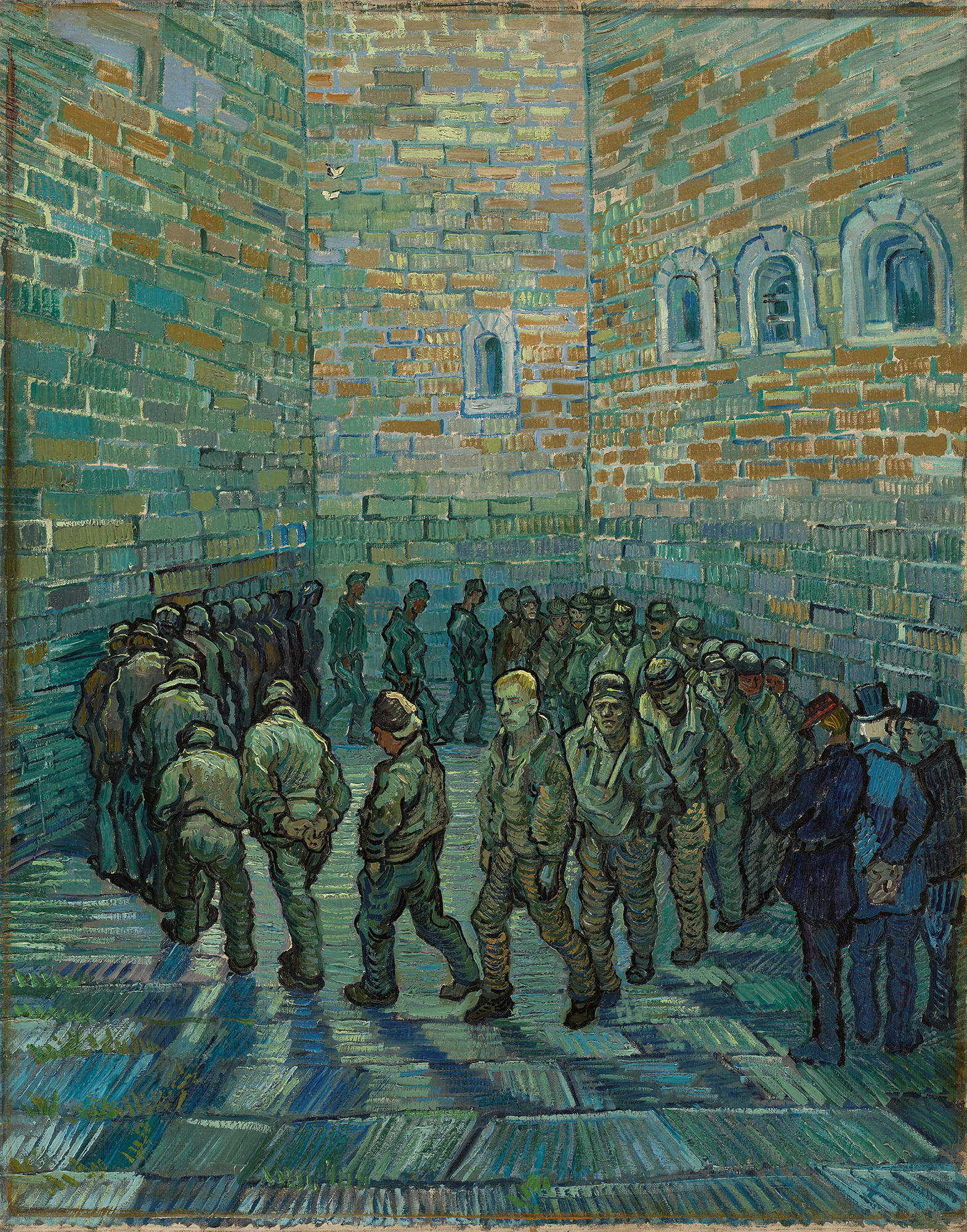
Cue a string of pearls in the form of self portraits, the NG’s Sunflowers, Starry Night over the Rhone (from the D’Orsay), Shoes, Hospital at St Remy, and other maybe lesser known works not drawn from the VG Museum in Amsterdam, like the extraordinary, and chilling, Prisoners Exercising (Moscow Pushkin) from 1890 and depicting Newgate Prison. There are a few half hearted attempts to show the London influences such as a Whistler Nocturne, but most of the interest for the Tourist came from the drawings. Never been to the Kroller-Muller collection in Otterlo, from which many of these drawings were, er, drawn, as well as a few paintings, but it is now a priority (if I can trick the SO into driving me there somehow).

The influence of French engraver/printmaker Gustav Dore is also plain to see in the copious copies VvG made of his illustrations which reveal the darker side of Victorian London. And the peasant landscapes that VvG painted in his early years owe a debt to the prints that he will have seen in English magazines from the 1870s. Apparently VvG read Dickens avidly, (and, exhibiting more taste, George Eliot), and his chair paintings might just have been inspired by a memory of an English print memorial after Charlie’s death entitled An Empty Chair.

At the end of the exhibition there are even a bunch of flower and portrait paintings, some actually quite pleasing, from the likes of Harold Gilman, Spencer Gore, Ben Nicholson and even Jacob Epstein, some just awful. There is even a Bacon triptych tribute to VvG, and a Bomberg self portrait. But it is the VvG flora, trees, wheat, flowers, blossoms, and people, which leap out here, almost literally, putting everything else into the shade. You can see the paint, every brushstroke, and you can feel the light, however coloured, but you can also know the subject, animal, vegetable or mineral, which is what makes VvG’s paintings so appealing to, well, everyone. Judging by this exhibition and by the Tourist’s most recent expeditions to Amsterdam.

Which is what made this exhibition just about worthwhile. For although this grumpy, old f*cker can get wound up by all these people milling around, only concerned with the image that they capture on their phones and not what is actually in front of them, it is still an immense rush to watch the joy transfer from canvas to viewer.

Dead at 37. What a waste.