Prom 15, Bavarian Radio Symphony Orchestra review *****

Prom 15 – Bavarian Radio Symphony Orchestra, Yannick Nézet-Séguin (conductor) 

Royal Albert Hall, 30th July 2019

  • Beethoven – Symphony No 2
  • Shostakovich – Symphony No 5 

It always surprises just how few Proms concerts tick all the boxes for the Tourist. I can usually only manage 4 or 5 in the season. Partly this reflects holiday and other clashes, and this year I was a few hours late out of the block when booking opened, (so missing the Voces8 and English Concert gigs at Cadogan Hall and the first Vienna Phil Beethoven/Bruckner with Haitink conducting), but mostly it stems from the preponderance of Romantic repertoire and the relative absence of Early/Baroque/Classical in the programming. If you like the likes of Berlioz, Rachmaninov, Tchaikovsky, Mahler, Bruckner, Dvorak, Strauss and Sibelius you were, as usual, in your element this year. If this is not your cup of tea a more judicious approach is called for. Mind you. This suits me in a way as, (whisper it), the dear old Albert Hall isn’t my favourite gaff even if the sound is never quite as bad as you might fear up in the Raising Circle where the Tourist perches.

So for me this concert was the one stand-out in the season. Beethoven 2, Shostakovich’s 10th, with the BRSO, under the baton of Mariss Jansons, which runs close to being the best orchestra in the world right now. Hold up chum I hear you say. Mariss Jansons? Shos 10? That’s not what it says above. Well no. Mr Jansons was ordered to take time off over the summer by his docs though it looks like he will be back in the saddle in Munich for the new season, (and maybe he will keep his mouth shut about female representation in music in future). Fortunately for Prommers and those at the Salzburg festival Yannick Nezet-Seguin was able to step in at short notice and his facility with Shostakovich was sufficient to see the 5th replaced the 10th. Which was no great disappointment.

Especially in an interpretation as powerful as this. Now the Tourist has had to wait a few years to witness the conducting, (or indeed pianistic), prowess of French-Canadian YN-S. Never heard the Rotterdam Phil when he was head honcho and am not about to jet over to the Met in NYC or Philadelphia to hear his current troupes. Also never heard the Chamber Orchestra of Europe where he guest conducts and always missed him a few years ago when he still did the same for the LPO. And judging by his discography there aren’t too many orchestral works where our paths might cross. But Shostakovich is clearly one, and, based on this Beethoven 2, it is also clear to me that I need to find a way to hear him lead a Mozart opera.

I am not smart enough to understand why certain conductors and orchestras lift music to another level. But I think I know when I hear it. The BRSO under MJ massively persuaded me with a Prokofiev 5 at the Barbican a couple of years ago. Their playing is powerful, accurate and precise. This was clear in the leisurely reading of the Beethoven Second. Easy on the vibrato, HIP style, but still with a foot firmly planted in the Romantic, focussed on the individual building blocks of the symphony though not utterly convincing on the whole. No 2 can be, shall we say, forgettable compared to what can after, but, in the right hands, is still a work of genius, especially the opening and closing movements.

It took a little time for LvB to bring it to together, interrupted by commissions and by encroaching deafness, and was largely written at Heiligenstadt, but, as is often remarked, you wouldn’t know about LvB’s personal travails from listening to this. The first movement Adagio-Allegro can’t match the Eroica in scale but it does signpost LvB’s future direction of travel. The Allegro wanders off to B flat before wending its way back to the D major home key and the rising scale of the allegro couldn’t be simpler but sets the tone for the surprisingly jolly vibe which pervades the work. The Larghetto, also in sonata form similarly doesn’t spend too long in the darkness, though its woodwind burbling does slightly overstay its welcome, and the following Scherzo and Trio movement marks the first use of the “joke” in a major symphony. The Allegro finale starts off like a classic LvB rondo but then develops into something far more musically complex and is dominated by rapid string passages. Immediately appealing, but satisfyingly clever, like all the symphonies which were to follow.

So a solid start. But it was the Shostakovich which really showed what this band and conductor can do. Given his opera jobs I suspect it may have been a little while since YN-S last tackled the Fifth but it is a work he knows well. And the BRSO certainly does. The complete Shostakovich cycle recording on EMI conducted by MJ may not, individually be best in class, but the 2, 3, 4, 12, 13, 14 versions on this set made with BRSO come close, and, at 20 quid, the cycle is a steal. I confess I prefer Haitink overall when it comes to DSCH, but also have versions of some of the symphonies from Rozhdestvensky and the USSR Ministry of Culture SO and Petrenko and the Royal Liverpool PO (whose complete set is also a bargain). And I would snap up a set of Kondrashin recordings should this ever return based on what the experts say.

The point is that whilst super smooth Shostakovich should be avoided, the extreme of the hardcore Russian approach does take a bit of getting used to. Extremes of anger, aggression, pain and pathos, are what these works are all about, and it is right that interpretations test the patience of the listener, whether it be in the bleak never ending slow movements, the sardonic scherzos or the melodramatic, ambiguous, opening and closing movements.. Whatever you think about what DSCH was actually trying to say in his music it definitely needs an edge, even if you end up concluding that it is sub-Mahlerian, film-music bombast as many have done. I love it but it is undeniably music of edge, effect, emotion and image, mixing high and low brow, light years away from the musical maths of a Bach or Stravinsky.

What it does need to convince however is perfect playing. Forgive the thoughts of this musical dummy but f you have a lot of instruments playing the same thing, or single instruments soloing over a sparse backdrop, then you need the players to be exact. DSCH does not forgive imprecision. The BRSO, perhaps more than any other outfit, move as one. Which means that all the “effects”, the fear, brutality, solace, the bright lights, the shadows, were perfectly executed. DSCH symphonies all, at least from 5 to 13 (1,2,3 are the avant garde formal experiments, 14 and 15 defiantly personal), conjure up images of war and terror and the capacity of humankind to overcome even if, like the Fifth, they came before WWII. But to pull together the passages in the movements to simulate the march of history, and then to lay on top the ironic detachment that, I think, DSCH sought, the last movement of No 5 being archetypical, requires conducting and playing of real skill. That’s what we got here. The sheen was there, no doubt, as were the debts to Mahler and Stravinsky in the phrasing, but this was also properly aggressive and emotional when it needed to be.

The Fifth is, I would assume, the most oft-performed of DSCH’s symphonies meaning the dangers of over-familiarity loom even larger. How to capture the thrill and surprise of the music without getting lazy? How to balance the ostensible formal conservatism of the four movements in DSCH’s “Soviet artist’s response to justified criticism” with the probing, questioning and cynicism which seems, even if this is wishful thinking on our part, to lie beneath? YN-S and the BRSO did not avoid echoing the folk tunes, festive dances and grandiose anthems that punctuate the work to meet Soviet requirements nor did they try too hard to subvert the “uplifting” coda to the finale as it turns from D minor to major. Nor did they over-reach in the still, hovering episodes of the opening movement which punctuate the aggressive tutti climaxes, nor in the heart-rending third movement Largo chant, (with some ear-strainingly quiet pianissimos), nor in the perverted waltz of the Allegretto. They just let it speak for itself. Whether as classic symphonic journey, as testament to the struggle of the Soviet people to escape oppression or as satirical indictment of the dread inflicted by Stalin and his regime. Or just as music which, whilst maybe too obvious and precipitate, immediately connects. As was very clear from the eruption of applause when finally the timpani and bass drum sounded out their last, immense, booms.

A bit of Mussorgsky for an encore. Dawn on the Moscow River from Kovanshchina. Arranged by guess who. Shostakovich.

Like I said. There are surprisingly few Proms that do it for me. But, just like last year and the BPO’s Beethoven 7 under Kirill Petrenko, I reckon I heard the pick of the season. (BTW sounds like Mr Petrenko means business kicking off the BPO season with what sounded like a belting Choral Symphony and serving up a diet of, unsurprisingly, Beethoven and Mahler in the first half of next year. I get the BPO will be glad to see the back of Rattle’s excursions into Rameau and Bernstein. Anyway the Tourist feels a trip to Berlin coming on).
Van Gogh and Britain at Tate Britain review ****

Van Gogh and Britain

Tate Modern, 30th July 2019

Took me way ages to find the time to see this. And even longer to comment on it. Really what is the point.

Especially as even late afternoon on a weekday it was a bun fight with bugger all chance to stand, look and see. So not sure what to say. It’s van Gogh so of course there are paintings which, even when they shout out their familiarity, still stop you dead in their tracks. And wall upon wall of exquisite drawings. But no real opportunity to revel given the crowds.

VvG spent three years in London from 1873 to 1876, with trips back to the continent. I always get a thrill from the idea that he pitched up in Isleworth where he worked as a Sunday school teacher and then preacher. Look at the blue plaque opposite Isleworth Rec from atop the 267. Of course his time in Brixton (bit hipper I guess) is better known, working in central London. But this was in his early 20’s, in the art gallery Goupil, before he started painting. But he did draw. And maybe he did soak up the influence of these early years. Not in the same way as he did with Impressionists in Paris or from the Japanese prints he adored. At least that’s the theory here.

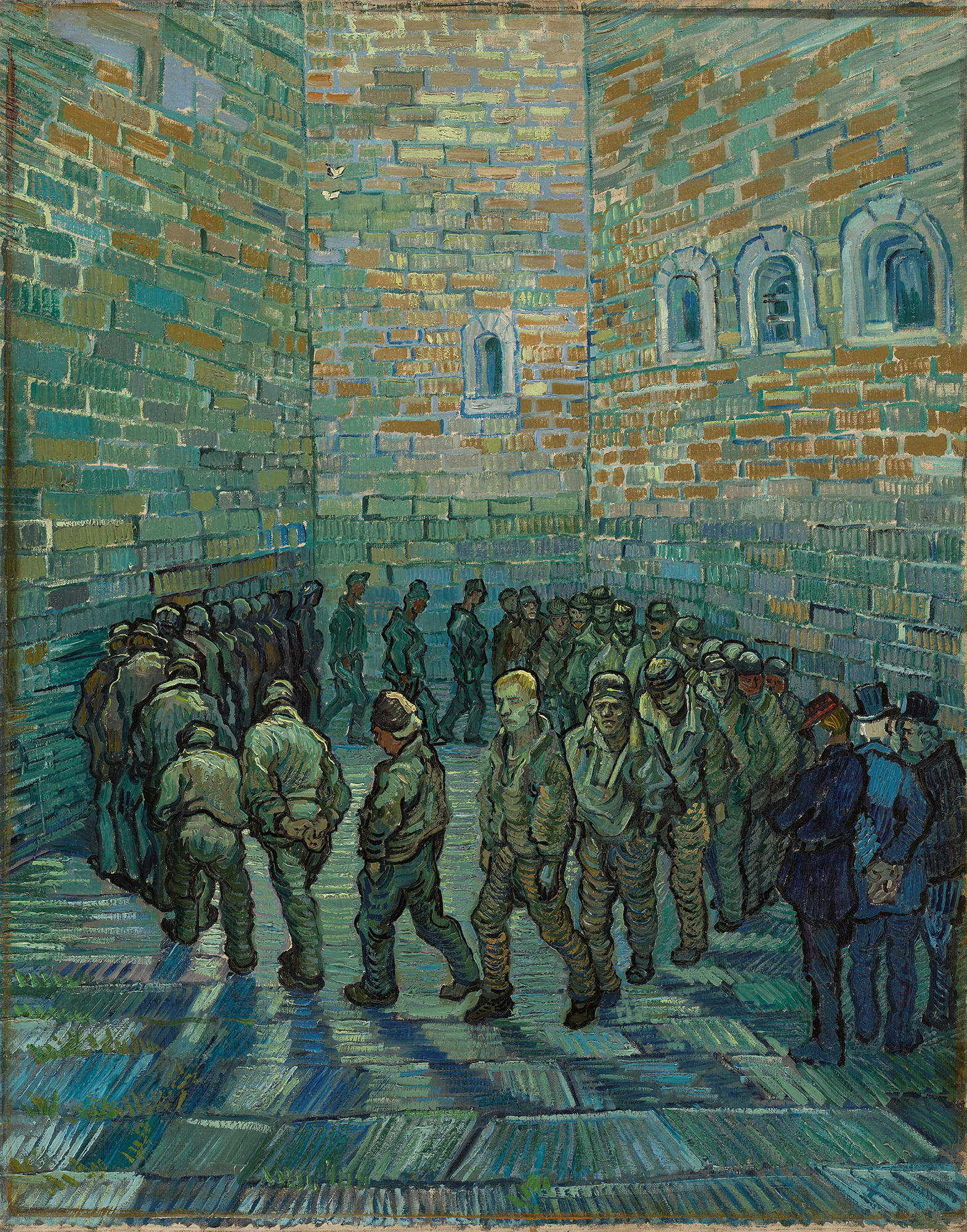
Cue a string of pearls in the form of self portraits, the NG’s Sunflowers, Starry Night over the Rhone (from the D’Orsay), Shoes, Hospital at St Remy, and other maybe lesser known works not drawn from the VG Museum in Amsterdam, like the extraordinary, and chilling, Prisoners Exercising (Moscow Pushkin) from 1890 and depicting Newgate Prison. There are a few half hearted attempts to show the London influences such as a Whistler Nocturne, but most of the interest for the Tourist came from the drawings. Never been to the Kroller-Muller collection in Otterlo, from which many of these drawings were, er, drawn, as well as a few paintings, but it is now a priority (if I can trick the SO into driving me there somehow).

The influence of French engraver/printmaker Gustav Dore is also plain to see in the copious copies VvG made of his illustrations which reveal the darker side of Victorian London. And the peasant landscapes that VvG painted in his early years owe a debt to the prints that he will have seen in English magazines from the 1870s. Apparently VvG read Dickens avidly, (and, exhibiting more taste, George Eliot), and his chair paintings might just have been inspired by a memory of an English print memorial after Charlie’s death entitled An Empty Chair.

At the end of the exhibition there are even a bunch of flower and portrait paintings, some actually quite pleasing, from the likes of Harold Gilman, Spencer Gore, Ben Nicholson and even Jacob Epstein, some just awful. There is even a Bacon triptych tribute to VvG, and a Bomberg self portrait. But it is the VvG flora, trees, wheat, flowers, blossoms, and people, which leap out here, almost literally, putting everything else into the shade. You can see the paint, every brushstroke, and you can feel the light, however coloured, but you can also know the subject, animal, vegetable or mineral, which is what makes VvG’s paintings so appealing to, well, everyone. Judging by this exhibition and by the Tourist’s most recent expeditions to Amsterdam.

Which is what made this exhibition just about worthwhile. For although this grumpy, old f*cker can get wound up by all these people milling around, only concerned with the image that they capture on their phones and not what is actually in front of them, it is still an immense rush to watch the joy transfer from canvas to viewer.

Dead at 37. What a waste.

the end of history …. at the Royal Court Theatre review ***

the end of history …

Royal Court Theatre, 29th July 2019

Jack Thorne, (recents include H. Potter, Woyzeck, Junkyard and Kiri and The Virtues on the box), writing, (so blame him for the lower case affectation). John Tiffany, (H. Potter, Road, The Glass Menagerie), directing. A cast of Lesley Sharp, David Morrissey, Kate O’Flynn, Laurie Davidson, Zoe Boyle and Sam Swainsbury. A family drama set against the travails of the political Left across the last two decades. Whose title references Fukuyama’s dodgy theory about the triumph of neoliberalism. All at the Royal Court.

What could go wrong? Well not much as it happens. On the other hand it never really delivered on its promise. Acting top notch as you might expect. Same true of the directing and the set (Grace Smart), lighting (Jack Knowles), sound (Tom Gibbons), score (Imogen Heap) and, especially in the choreographed passages between the acts, movement (Steven Hoggett). Never dull, in fact engaging throughout with sharp dialogue and rounded characters. But …. it just didn’t really surprise with the way it handled the big issues it purported to tackle.

Heart-on-sleeve Sal (Lesley Sharp), a veteran of Greenham Common, and David (David Morrissey), are old school Labour intellectual types living in Newbury. Shabby (not chic) interior. Piles of books. “Ethnic” art. It’s 1997. They have no truck with Blair and his gain about to get elected. Carl (Sam Swainsbury) is bringing his posh, moneyed new girlfriend Harriet (Zoe Boyle) home for the weekend and awkward daughter Polly (Kate O’Flynn) is up from Cambridge to join in the fun/interrogation. Which just leaves youngest Tom (Laurie Davidson) finishing his detention and dashing back from school.

The family doesn’t hold back in the ensuing ding-dongs with plenty of sarcasm, pointed argument and negotiation, and there is a real sense of shared history, but it just doesn’t really go anywhere. We see the children face down their own triumph and disasters and there is a, somewhat predictable, plot twist at the end, (when it is now 2017 after we have passed Act 2’s 2007). Sal and David grow increasingly disillusioned with the world around them, and veer towards self-acknowledged parody, but with no specific event for us to latch on to the effect is of waves of, albeit quotable, dialogue flowing over us and no persuasive narrative arc.

A shame in some ways. A theatrical dissection of the failure of progressive politics is not unique but is still necessary and with this writer, director and cast more might have been achieved.

Noises Off at the Lyric Hammersmith review ****

Noises Off

Lyric Hammersmith, 24th July 2019

Noises Off will transfer to the Garrick Theatre from 27th September.

It is a generally accepted truism in luvvie-world that Michael Frayn’s Noises Off is one of the funniest plays. An opinion with which the Tourist heartily concurs. Alongside Lysistrata and The Frogs, most of Shakespeare’s comedies, Volpone and The Alchemist, Tartuffe, Goldoni’s The Servant of Two Masters (Richard Bean’s version will appear on screen again on 26th September and a revival is due at the Queen’s Theatre Hornchurch), Uncle Vanya, Loot, The Real Thing, Serious Money, Dead Funny, The Habit of Art, The Lieutenant of Inishmore, Hangmen and The Play That Goes Wrong (whose makers have, not unreasonably, made a few quid following Michael’s Frayn’s lead). There’s probably a fair few more. But I haven’t seen them yet.

So I wasn’t about to miss this revival at the Lyric. And nor should you when it transfers to the West End. You know the drill or can easily find out. We see a touring performance of a sex farce, Nothing On, by one “Robin Housemonger”, or more precisely three performances of its first act: first in technical rehearsal at midnight the night before opening in Weston-Super-Mare, then from backstage a month later in Ashton-under-Lyme and finally from front of stage in Stockton-on-Tees at the end of the run. This is not an entirely happy troupe and the relationships between the cast, director and technical staff are, shall we say, complicated. Especially when their vanities, problems, passions and tantrums bleed into the performance. To, as the cliche goes, “hilarious effect”. So we get comedy driven by character, (notably the gap between on and off stage personas), situation, plot, wit and spectacle, through farce, slapstick and props. It is a treat for eyes, ears and also brain, as there is abundant comic logic just below the surface treats.

It requires immense skill to pull off. Not just from the cast but also from the creative team. To deliver a play within a play that doesn’t actually get pulled off. Michael Frayn completed the play in 1982 though the idea first came to him when watching one of his own farces, The Two of Us, from backstage in 1970. As with all of Mr Frayn’s plays, serious or comedy, he doesn’t stop where other writers might have done. He goes on buffing and polishing to create something close to perfection. Which I would contend he did, precisely, first time round here. though it hasn’t stopped him reworking it for subsequent revivals, and, as he reveals in the programme, actually editing out some unfortunate misprints which appeared in the original. Which is itself pretty amusing in a meta sort of way.

I can’t pretend this is quite up to the very high mark set by Lindsay Posner’s revival at the Old Vic in 2012. But it comes close. As it happens all the family saw that including LD, only 10 at the time. It is still, she says, the funniest thing she has ever seen, (along with the Mischief Theatre portfolio, so if you are tempted to take the nippers along don’t hesitate. In this production Headlong’s Jeremy Herrin directs which is helpful since he is the master of the high octane. Max Jones’s set does exactly what is required, front and back, as does Amy Mae’s lighting and Lorna Munden’s sound (which is at is most accomplished in the second act when the actors are effectively silent). And Complicite’s movement director, Joyce Henderson, shows why she is one of the best in the business.

Now it was pretty hot in the Lyric the night we went. Which wasn’t great for MIL who had to leave at the interval with the SO. A shame because I would have valued her opinion, since she is even more parsimonious with her praise that the SO. Still a thumbs up for the first half. It also meant that Daniel Rigby, as “leading man” Garry Lejeune probably lost a few pounds given how much he physically had to do. I was also taken with Lloyd Owen’s take on his namesake director, the supercilious predator Lloyd Dallas and with Jonathan Cullen’s take on the neurotic Frederick Fellowes. Frankly though a cast that includes the likes of Meera Seal as Dotty Otley who bankrolls the fictitious play, Simon Rouse as dipso lurvie Selsdon Mowbray and Debra Gillett as the maternal Belinda Blair, as well as Amy Morgan as the dramatically challenged Brooke Ashton, Lois Chimimba as put upon ASM Poppy and Enyi Okoronkwo as the even more put upon SM Tim, was always going to get this right, which with a couple of hutches they did handsomely.

Noises Off premiered at the Lyric Hammersmith, directed by Michael Frayn’s chief collaborator Michael Blakemore. It went on to a five year run in the West End. I hope they make a few quid from this revival.

And that Rachel O’Riordan’s in augural season turns out to be as good as it looks. There are still prime seats for a tenner at the previews of Solaris, Love, Love, Love and Antigone. Which frankly is a steal. The biggest bargain in London theatres anywhere right now IMHO.

Present Laughter at the Old Vic review ****

Present Laughter

Old Vic Theatre, 24th July 2019

Ummed and ahhed about whether to see this. On the one hand it was Andrew Scott in the lead as one of theatre’s most renowned hyper-narcissists, Gary Essendine. On the other hand it was a play from the dreadful old reactionary Noel Coward, albeit one of the quartet of classic comedies of manner, alongside Hay Fever, Private Lives and Blithe Spirit, before he became a terribly bitter sh*t.

Its problem is that it is smugly celebrating the very world and people that it purports to subvert. Of course it racks up caustic barb after knowing aside, many of which are admittedly pretty funny, all wrapped up in a well constructed, if gentle, farce, but it never really gets under the skin of its main, or supporting, characters. Which leaves me more annoyed than intrigued by the central conceit, that an actor/artist, and now just “celebrity”, needs the constant validation of others to stave off lonely despair as he/she negotiates the divide between reality and performance. Message to Gary/Noel. Just because you know you are a needy prick doesn’t make you any less of a needy prick. (Essendine, famously, is an anagram of neediness).

Still my adoration for Mr Scott won out, alongside a hunch, correct as it turned out, that director Matthew Warchus would be unable to resist having some fun making explicit the covert sexual relationships at the centre of the original play. And, in the end, I was very glad I went. Still can’t quite shake off the indignation that informs the above opinion of the snobbish, bullying Coward and his plays, but I have to admit the layers that emerge through the play really did surprise me.

Rob Howell’s set and costumes offer a striking jazzy deco period vibe, (the plays dates from 1943), with a contemporary twist, which helped enliven the somewhat cardboard supporting characters, and Mr Warchus instructed them not to hold back. Which suits the talents of Enzo Cilenti as Joe, Gary’s forthright paramour and Suzie Toase as his cuckolded wife Helen. Abdul Salis is Gary’s agent Morris Dixon, natural comic Sophie Thomson as Gary’s protective assistant Monica, Joshua Hill as stalwart valet Fred whilst rising talent Kitty Archer turns in another vivacious performance as young devotee Daphne. Though these are all a little overshadowed by Luke Thallon as super-fan and aspiring playwright Roland Maule and, especially Indira Varma as Liz, Gary’s world-weary wife. Not quite everyone is putting on a performance but Gary certainly is not alone in the attention seeking stakes. And they obviously need him as much as he needs them.

The deliberately ropey plot is never over-accelerated, although a few gags are still painfully telegraphed. And somehow the genius stage actor that is Andrew Scott managed to extract pathos and ambiguity, beyond the sexual, from Gary’s egomania. He cannot quite escape the masturbatory-squared approach that Coward takes to his stage alter-ego but he does leave you guessing as to his true feelings and the idea of Gary/Coward as some sort of mid-life, man-child, he is in his early 40s, is perspicacious. And, once again, Mr Scott manages that rare trick of projecting his performance not just to the whole audience but also to each and every one of us, (at least that’s what I felt).

So message received and understood. Though I don’t think I will ever feel pity for those who choose celebrity. If you can’t stand the heat get out of the kitchen. And definitely don’t stick your head in the oven whilst getting your publicist elicit public sympathy.

Noye’s Fludde at the Theatre Royal Stratford East review ****

Noye’s Fludde

Theatre Royal Stratford East, 3rd July 2019

You might think it’s a bit sad really. A grown man in his 50s on his own at a children’s opera performed by a community that he cannot claim to be any part of. Unfortunately my kids never caught the Britten bug when younger, despite what I thought were subtle attempts to influence them, and are now way too old to traipse along with Dad to this sort of thing. Actually what am I talking about? There was never a cat’s chance in hell that they were going to fall for Britten or opera, children’s or otherwise. A situation likely shared by 99.999999999% of the population. Which meant I was pretty much the only audience member there for the opera than the performers.

For this was the only Britten opera, (if you discount his version of Gay’s Beggars Opera), that the Tourist had never seen. And completism, as my regular reader undoubtedly registered sometime ago, is one of the Tourist’s many vices. As is condescension. So forgive me when I say that the bulk of the audience probably had next to no interest in Britten or his operas. But they did have a vested interest in seeing their little darlings on stage. And I can assure you that those kids made them properly proud. Though I would contend that, without the genius of BB, and the unnamed writer who created the Chester mystery play text from which the Victorian writer Alfred W Pollard drew his adaptation, this wouldn’t have been anything close to the uplifting entertainment it was.

BB had already written a little children’s opera, The Little Sweep, in 1949 (part of Let’s Make an Opera) and also previously adapted text from the Chester play cycle for his Canticle II, Abraham and Isaac. To Pollard’s text he added a few hymns, a Kyrie and an Alleluia chorus. There is a spoken Voice of God, played by acting royalty Suzanne Bertish no less, and Noah and his wife are both professional roles, here Marcus Farnsworth and Louise Callinan. Whilst Mr Farnsworth may be better known in recital he also has a distinguished opera CV to date and Ms Callinan is a veteran of multiple European houses. This, along with the 15 members of the ENO Orchestra, Martin Fitzpatrick, (Head of Music at ENO who conducted), Lyndsey Turner directing, and the likes of Soutra Gilmour (designer), Oliver Fenwick (lighting), Luke Halls (video), Lynne Page (movement), Oliver Jeffers (artwork) and Wayne McGregor (choreography), shows just how seriously the ENO took this production. This serious intent though never crushed the joy of its construction.

For Noye’s Fludde is really all about the amateur participants across the named human, (Noah’s sons and their wives and some gossips), and animal, (plenty of these, as you might expect), roles and the chorus. Step forward and take a bow Brampton Primary School, Churchfields Junior School, Newham Music and Newham Music Hub, and all the other local musicians and singers who were a part of this mammoth effort. And the Mums, Dads, siblings, Grannies, Grandads, carers, teachers, teaching assistants, community assistants, chaperones, ENO and TRSE back and front stage folk who chipped in. I hope you enjoyed it. I certainly did, even without any companions.

Special thanks though to BB. The idea of Noye’s Fludde had kicked around for a few years but it was a TV commission, eventually championed by Lew Grade at ATV, that spurred BB on to completing the score in March 1958. The wonder is that such genuinely inventive and atmospheric music should have been so brilliantly created for amateur musicians, as well as the professional core. And not just for the bugles, (hand)-bells, whistles and all manner of other improvised instruments that populate the music. No, there are proper parts for violins, violas, cellos, double basses and recorders. More than that these parts vary in difficulty with each section led by a professional. And there are plenty of passages which flirt with dissonance, in the manner of BB’s “grown-up” operas, well beyond the stuff you might expect from a “children’s” piece.

Listen to the first hymn which has an out of step bass line motif to contrast the chorus which lends a darker quality. This bass motif is taken up by the timpani to herald the first of God’s warnings. The syncopated song which follows as the Noah family come up is much more upbeat. The jaunty Mahlerian march which accompanies the Kyrie presages the entry of the animals and follows a striking, literally, as all manner of percussive effects are provided by the amateurs, passage as the Ark is built. There is a clever three part canon to introduce the birds. The storm scene at the centre of the opera is that old BB favourite an extended passacaglia, which uses the whole chromatic scale. Mugs hit by wooden spoons simulate raindrops, recorder trills become wind, strings become waves, percussion thunder and lightning, pianos provide the motif. A pastoral follows when the storm subsides and then, obviously, there are simple waltzes on cello and recorder to see off Raven and Dove. As the Ark empties out the bugles sound with handbells, (who pop up throughout until the very end), signalling the appearance of the rainbow. A rainbow that here spreads right across the stage, a fitting symbol of pride, to set alongside the. ecological message.

The way in which BB takes his trademark sound, simplifies it and recasts it for the different skills of his performers is really very, very clever. That it also able to incorporate all these various voices, including, sparingly, the audience and still create really effective, and moving, theatre is even more extraordinary. And just in case you are thinking this all sounds a little too tricksy-twee-schmatlzy-worthy there are plenty of clever visual gags from the animals to undercut it all.

BB specified the opera be performed in public, community spaces or churches rather than theatres. TRSE is such a dear old place however, and the “child’s picture book” design here, (which expertly captures the professional/amateur essence), so enchanting, that I am sure BB wouldn’t have complained. No idea if BB ever even met the architect of TRSE’s heyday Joan Littlewood but it is fitting that this vital piece of community theatre should have been so splendidly realised in such a space.

Bitter Wheat at the Garrick Theatre review **

Bitter Wheat

Garrick Theatre, 4th July 2019

The last time I saw a David Mamet play it was the very fine revival of Glengarry Glen Ross at the Playhouse with an outstanding cast of Christian Slater, Robert Glenister, Kris Marshall, Stanley Townsend, Don Warrington, Daniel Ryan and Oliver Ryan.

There is no doubt that Mr Mamet can write outstanding drama. But it has been a little while. And, when he has previously opted to lob his showcase incendiaries into the world of sexual politics, it is also true that opinion has been mixed. So we should have been warned. But it’s still David Mamet right? And more importantly it’s none other than Mr Charisma John Malkovich in the lead. as Barney Fein. A not even thinly disguised Harvey Weinstein. So topical huh?

What then is most bloody annoying about this play is not the material, the approach, the over- and under-tones. All this should not have taken us by surprise. It’s just that Mr Mamet doesn’t seem to have been arsed to even try to write a proper drama. Set up the monster lead. And then …. Well f*ck all really as the play goes nowhere in terms of plot, spectacle or message. And DM directed it. So he has no-one else to blame.

Yes there are a few funny lines, (when Barney discovers he is on the MMA board for example), though even some of these are so pointedly “close to the knuckle” that after a while they just come off as Mamet pastiching himself. And yes Mr Malkovich turns in a bravura performance which means it is never “boring” in the sense of clock-watching. But even he, the man who played the Vicomte de Valmont remember, can’t escape the clumsy material which weighs his down as much as the padding under his suit. Unlike Oleanna, there is no attempt at ambiguity here and hence no tension, moral or otherwise.

Go if you must to see the legend Mr Malkovich. Excuse, if you can, the ugly imperative that lies behind Mamet’s provocation. Even start to feel sorry, if you must though God only knows why, for the boringly venal character of Barney Fein as Mamet plainly intends. But surely even the most vocal proponent of “political correctness gone mad” won’t be able to excuse the fact that the dialogue is well, often a bit sh*t, the plot cumulatively tired and the supporting characters , (played by talents such as Doom Mackichan, Alexander Arnold, Teddy Kempner, Matthew Pidgeon and Zephryn Taitte and newcomer Ioanna Kimbook, who battles most valiantly) are pulp, not even cardboard, thin.

The programme cites 16 producers. To premiere this in London (presumably Broadway won’t touch it). Better that a couple of them rustled up a revival of Speed-the-Plow. You know. From back when DM was sharper, smarter and relevant. Mind you. What do I know. Looks like the theatre is being filled even if it requires a little discounting. So maybe they” make money. But I doubt this will make them proud.

Wife at the Kiln Theatre review ****

Wife

Kiln Theatre, 3rd July 2019

How difficult can it be to get to Kilburn? Very it would seem if you are the Tourist, this being the second time this year that he has missed the start of a matinee performance, (and having cut it perilously fine on another occasion). Message to self. Stop twatting about with the Overground and buses to get here and stick to the Jubilee.

Anyway it was a somewhat frustrating idea to watch the first scene of Wife on the tiny black and white stage telly, however accommodating the ever friendly front of house. Aussie Samuel Adamson’s latest play, (you may know him from The Light Princess musical at the NT of his Chekhov/Ibsen adaptations), is an intertwining affair which examines the relationships of four couples from 1959 to an imagined 2049. Ibsen is the stepping off point. Specially A Doll’s House, (there is a lot of Doll’s House inspiration coming up, see the Lyric Hammersmith, the Young Vic and International Theater Amsterdam).

After that scene and the infamous door slam, Wife opens with stiff-necked Robert (Joshua James) properly wound up after the performance, which he sees as an attack on the sanctity of marriage. His wife Daisy (Karen Fishwick), who dragged him along, doesn’t agree. She is in love with Nora the character and yearns for a similar freedom. Things ratchet up when we find out she is also in love with the actress, Suzannah (Sirine Saba) who plays Nora in the production. This is the scene I missed “live” but it was still plainly a compelling set up even if I couldn’t completely follow the subsequent ding-dong exchange of ideas and feelings between these three characters .

Next up 1988 and a couple of young gay men, with something of a class difference, the posh, volatile Ivar, (Joshua James again, named after one of Nora’s children), railing against the straight world, Thatcher and Section 28 and the younger, not-yet-out Eric (Calam Lynch) . They have retired to the pub after a Norwegian language version of the Doll’s House, and, after some exquisite verbal jousting, are joined by another Suzannah. On to 2019 and Clare (Karen Fishwick again) and Finn (the versatile Joshua James) who are at the Kiln Theatre bar (!) waiting for ….. well not the Suzannah who breezes in from the avowedly queer production of A Doll’s House being staged but Ivar, now 58 (Richard Cant, who also plays Peter in the first Doll’s House and the pub landlord in Scene 2), now bruised by life, and, after a while, his younger husband, bitchy actor Cas (Calam Lynch again). Clare and Ivar, as you pretty quickly surmise are connected.

And, in a final meta flourish, the finale is set in 2042, with an extract from a naturalistic play featuring Daisy, Robert, Suzannah and Marjorie (Pamela Hardman), a dresser. Now the whole point of this journey through time and coupledom is to show we are no closing to reconciling the struggle between the need to explore individual freedom, and the desire for equality, in domestic relationships, than Ibsen and his characters were in 1879.

In other hands this have could have become more than a little tricksy or worthy or muddled, but Mr Adamson pulls it off largely through the quality of his dialogue, they are some terrific lines and witty observations, and the way in which the cast it self has to shift pretty radically between the characters, even those that are linked by family ties, notably Joshua James (who has a knack of standing out in smaller roles in previous productions that the Tourist has enjoyed), Karen Fishwick (following her RSC stint, a fine Juliet, and Our Ladies from NT Scotland) and Calam Lynch (whose Claudio in the Rose Kingston’s Much Ado attracted disproportionate attention from LD, and not just for his acting talent). All three young actors served up really fine performances.

Of course it helped that Kiln AD Indhu Rubasingham took the chair herself lending customary energy to the production and papering over the cracks when words and actions pushed a little towards the artificial: these people don’t really do reflective silences. Richard Kent probably had more fun designing the costumes that the somewhat unremarkable set, as did Alexander Caplen with his sound contribution and Guy Hoare with lighting.

The proper reviews were, rightly, pretty positive overall. I have a very strong feeling that this will not be the last we see of this play.If so the Tourist will make damm sure he turns up on time.

Rachel Podger and Brecon Baroque: Vivaldi at the Wigmore Hall review *****

Rachel Podger (violin), Brecon Baroque, Marcin Świątkiewicz (harpsichord), Daniele Caminiti (lute)

Wigmore Hall, 1st July 2019

Antonio Vivaldi

  • Sonata a4 al Santo Sepolcro RV130
  • Concerto in G minor for strings RV157
  • Sinfonia al Santo Sepolcro RV169
  • Concerto in D for lute and strings RV93
  • Concerto in D Op 3, No 9 RV230 (arr. for harpsichord after JS Bach’s solo transcription BWV972)
  • The Four Seasons Op 8, Nos 1 to 4

The Tourist adores the sound that Rachel Podger makes in the Baroque violin repertoire and especially in Bach, Vivaldi and Biber. Moreover, and feel free to snigger at the back, but he still gets a thrill when a specialist like RP, or one of the Italian maestros like Giuliano Carmignola or Fabio Bondi, lets rip on the Four Seasons. You can stick all that turgid Romantic nonsense where the sun don’t shine. This is real music. And if you are too snooty in your choice of classical repertoire to agree then more fool you. The Tourist yields to no man when it comes to the outer reaches of early 80’s post punk funk (and, as we speak, has a bit of Stockhausen ringing in his ears), but that doesn’t stop him from wigging out to the perfect pop of Benny and Bjorn’s SOS come party time.

Ms P has a rich, dark tone which gets you right in the gut. Her interpretation with her regular chums Brecon Baroque is a little less Flash Harry than the Italian peers, (though they certainly don’t hold back in the fast movements in Summer and Winter), which pays huge dividends in the super slow Largos in Spring and Winter. This was still exhilarating when it needed to be though. As confirmed by the Tourist’s regular Baroque crony MSBD. Big grins all round. For if there is one thing that singles RP and this ensemble out, apart from their sparkling musicianship, then it is that they look like they are having a ball on the stage. Which infects the audience. Even at the somewhat staid Wigmore.

Before the Four Seasons we were treated to the Easter religious piece, the Sonata and Sinfonia “al Santo Sepolcro” which may have been written in Venice or Vienna when AV visited in the late 1720s to drum up business. The Sonata has a slow movement introduction which builds from a bass line through too an exchange between the solo violin line and full ensemble. The subsequent Allegro alternates between two complementary themes in classic AV fashion. The Sinfonia is similarly just two movements but here the home key is B minor and AV explores a couple of chromatic twists in the contrapuntal Adagio and then in the Allegro which zeroes in on one, sinuous theme. The two pieces were separated by RV157, one of the Concertos written of strings and continuo without soloist. There are 60 or so of these (RV109 to 169), some of which are named as Sinfonia, which seem to have straddled performance in both saved and secular spaces. This one has repetition, imitation, dazzling figuration and syncopation, the full monty of AV’s virtuosity. The step-wise slow movement is captivating and the finale, made up of repeated semiquaver rushes in the bass line and upper lines is terrific.

Sicilian, (so its in the blood), Daniele Caminiti stepped up from theorbo continuo to lute soloist for the RV93 concerto which was probably written by AV for one Count Wrtby during a sojourn in Vienna and for the smaller soprano lute rather that the standard Baroque instrument. It was conceived as a chamber piece, with accompaniment from two violins and continuo, with each of the three movements divided into two repeated halves. It has a more stately feel against which the treble lines of the lute are set, largely down to the exquisite central Largo. This was also part of the programme from funky mandolinist Avi Avital concept with the Venice Baroque Orchestra at the back end of last yea in this very Hall.

Op 3 no 9 is one of seven AV concertos that JS Bach transcribed for harpsichord in 1713/14 when he worked in the Weimar Court. He made small changes to the right hand part and more generous detailing in the left hand part to thicken up AV’s loose textures. From this and the original BB, and especially the Polish harpsichordist Marcin Swiatkiewicz, (who plays on RP’s sublime Rosary Sonatas recording), have devised a harpsichord concerto, a form that AV himself eschewed. Like everything else on this lovely evening this was a perfectly balanced ensemble performance, the soloist a lucid, but never shouty, voice alongside the rest of BB.

RP’s next outing in her residency at the Wigmore are a bunch of Bach concertos which I will miss followed by a Sunday morning slot of the Bach Sonata and Partita No 1 which I most assuredly won’t.

Sancho: An Act of Remembrance at the Orange Tree Theatre review ****

Paterson Joseph – Sancho: An Act of Remembrance

Orange Tree Theatre, 30th June 2019

OK. So let me get this out of the way at the beginning. Paterson Joseph’s one man homage to Charles Ignatius Sancho, the first Black Briton to vote, sometimes comes across as just a little too fulsomely luvvie. Not over-acting but certainly not holding back. Mr Joseph passionately cares about this project. And Mr Sancho was a big man. In every sense. Who lived a big life. And his story is indisputably worth telling. So I will forgive the occasionally overly exuberant portrayal and tell you why you should seen this if you have any interest at all, which you should, in this subject.

Mr Sancho was born on a Spanish slave ship bound for modern day Colombia around 1729. His mother died very soon after and his father, crushed by this and the Middle Passage, took his own life after they landed. His owner sent Sancho to Greenwich in London to be the plaything of three daft sisters. The Second Duke of Montagu took a shine to the young fella, taught him to read and took him in when he escaped the sisters. He worked as butler for the Duchess and received a pension when she died. He married a West Indian woman, had seven kids and saw service again in the revived Montagu household. He was famously painted by Gainsborough, (the image that first intrigued PJ), and exchanged letters with Laurence Sterne . His writings became a key prop in the abolitionist cause and, after setting up as a greengrocer, Sancho was able to pursue a career as playwright, composer and occasional actor. Financial independence left him qualified to vote. His colourful and forthright letters were published shortly after his death in 1780.

Even if Sancho were of no historical or cultural importance you can see that this life would be cat-mint to an actor looking to create a solo show. The fact that Patterson Joseph was able to tell this particular story takes it into another league. There are now black British actors knocking it out of the park every day on the stage, and in Hollywood, and there are increasingly playwrights of colour in the UK emerging to tell their own stories. But this is something different given Sancho’s place in history, which echoes down the decades through Windrush and into the present day, and the fact that PJ was one of the first black actors to appear with the RSC in the early 1990’s even if you may know him better from his various TV roles.

The play dates from 2015 and has toured on and off since then. This was a one-off at the OT on a Sunday night with a pretty good turnout from the somewhat restricted Richmond theatre-going demographic. Given how much passion and emery PJ commits to his portrayal I am not surprised it was one night only. PJ freely admits to a hefty dose of dramatic licence in the way he has detailed the story, (is Sancho Panza really a namesake?), and kicks off with some break the ice, fourth wall pounding, shop observation of what it is to be a black actor. He never once takes his eyes off the audience. All of the audience it seemed. He has also given Sancho a soft lisp and a fine line in self-deprecation. Which means when it comes to the more harrowing episodes in Sancho’s history there is a real impact. And he packs in a lot of reference.

You never quite lose the feeling that there is an “actor” at work here and, like all one-person dramas, the need to maintain our interest can lead to a surfeit of costumes, props, movements, impressions, comedy turns, pathos and energy. But all this is deliberate and the combination of PJ’s charisma and the story more than compensates. This would be bloody brilliant as a Sunday night BBC mini-series. And I bet the lead, (at least for the older Sancho part – sorry PJ, would do it for minimum equity rates.

Here’s a quote from PJ about how he feels after bringing this story to life. “I now walk the streets of London knowing that probably 30,000 black people were walking these same streets 250 years ago. Knowing that makes me feel solid.” The politics and exhortation embedded in this 60 minute piece are plain of all to see but this is also an uplifting and entertaining piece of theatre and a committed piece of acting.