Pinter at Pinter 3 review ****

Pinter at the Pinter Three

Harold Pinter Theatre, 19th November 2018

  • Tess
  • Landscape
  • Apart From That
  • Girls
  • That’s All
  • God’s District
  • Monologue
  • That’s Your Trouble
  • Special Offer
  • Trouble In The Works
  • Night
  • A Kind Of Alaska

Just to be clear I am a fan of the work of Harold Pinter. And now it seems is MS, after he joined me at this, the third instalment of Jamie Lloyd’s season devoted to all of Pinter’s one act plays, and all manner of sketches and fragments besides.

If you not a fan, and actually occasionally even if you are, they will be times when the patience is tested by HP’s particular dissection of the psyche, but this is more than compensated by those times when the combination of mood, language and meaning, or lack thereof since the one thing you can depend on with HP is that you can’t depend on anything, leave you stunned at just how someone managed to right this stuff. 

Of course you need the right actors for the job. Here we had Penelope Wilton, a late addition kicking off with Tess a monologue about a posh lady who had experienced better times, Tom Edden, Meera Syal, Keith Allen, Lee Evans, and the now plainly incomparable, Tamsin Grieg. They were, all, unquestionably, the right actors for this job.

Apart From That saw Lee Evans and Meera Syal riffing on asking “how they were”, as simple and effective as comedy gets, Girls is a slightly uncomfortable monologue, (from Tom Edden), about spanking, That’s All is straight out of the Les Dawson school of comedy, God’s District, one of these weak, one joke (Hammersmith) , anti-religion sketches that HP was prone to, Monologue, one man’s nostalgic conversation with an imagined friend, brilliantly captured by Lee Evans, That’s Your Trouble, verbal sparring from two blokes in a pub, Special Offer a curious short sketch about “men for sale” that Meera Syal got saddled with, Trouble In The Works, a Pythonesque word-play on products in a factory (Lee Evans again hilarious) and Night, a tender duet from an old married couple reminiscing about when they fell in love, which is genuinely moving and had no right to be here.

Now it is really hard not to rave about the Lee Evans when he turns his physical comic genius on full beam as he did here. Especially as he came out of retirement especially for this run. He has form with Pinter, having played Gus in The Dumb Waiter in 2007, and has even successfully tried his hand at Beckett.  But the star of the night for me was Tamsin Greig in the two major works on show Landscape and A Kind of Alaska.

In Landscape, from 1968, she plays Beth who is reliving her past life and loves (specifically an affair (?) consummated on a sunny beach), presumably in her mind, whilst her vulgar, frustrated husband, Keith Allen, bothers her and chats about the everyday before, briefly, losing his temper. The deliberate contrast, and what it says about gender, power and the inability to communicate, is brilliant. This is Pinter as Beckett. Nothing much happens, we end abruptly, and there is deliberate repetition. It originally failed to get a licence from the Lord Chamberlain, ostensibly for its swearing, but probably because the LC didn’t like HP, but when censorship was finally consigned to the dustbin of history, Peggy Ashcroft and David Waller brought it to the RSC stage. There are squillions of other playwrights who explore this territory but don’t even get close to Pinter’s insight, in half an hour or so, in a lifetime of trying. 

Keith Allen, and in this respect this is meant as a compliment, has a natural mansplaining air about him. His waspish manner, which, based on previous stage, film, TV and interview performances, fits the role here of Duff perfectly. I am trying to avoid saying he is grumpy and slightly bellicose, but he is. I last say him playing the older Hogarth in Nick Dear’s The Taste of the Town at the Rose Kingston where he similarly fitted the part like a glove, albeit there as an older man riddled with pain and regret. (And he has the look of the older Hogarth if we believe the artist’s self portrait – not always a given). 

In contrast Tamsin Greig spoke her lines, in a soft Irish lilt, through a microphone, presumably to highlight the contrast between the two “monologues”, but it also ensured we could her every breath as she gave voice to the interior thoughts of the plainly damaged Beth. Enthralling.

Then in A Kind of Alaska (1982) she played Deborah, the woman on a hospital bed who wakes from a coma after 29 years to meet the stiff doctor who has “cared” for her, Keith Allen again, and her bemused sister Pauline, (Meera Syal in a role that finally gave her a chance to shine). AKOA is one of HP’s less cryptic offerings, (though the relationship between siblings and between doctor and patient might now be as straightforward as it seems), but it is still fascinating to see how, with an economic text, the bewilderment of a “child” who has become an “adult” without knowing how or what this means. Once again TG was terrific, confused, guilty, emotional, often in the same line. Two women then, locked in the past, but they could scarcely be more dissimilar.

Once again Soutra Gilmour’s set, here a rotating cube containing “period” interiors redolent of the period when many of these works were written, the 1960s, as well as the lighting of Jon Clark and sound of the Ringham brothers is sublime, and cleverly pulls the disparate strands, and writing styles, together. Jamie Lloyd once again proves he is pretty much peerless when it comes to Pinter. With no “guest” directors the contrast between the comic and the tragic in these works was well balanced and the pacing ideal. I don’t know how much rehearsal time the cast had but this really had the feel of a seasoned ensemble. 

Bring on No. 4. Moonlight from 1993 and Nightschool from 1960 where Mr Lloyd has passed over the reins to Lyndsey Turner and Ed Stambollouian. I don’t know either play and it sounds like these might be more muted than 1 and 3 but no matter, there will be something to take away. And the Tourist, and hopefully new fan MS, are primed and ready for the recently announced Betrayal. 

Mistero Buffo at the Arcola Theatre review ****

Mistero Buffo

Arcola Theatre, 15th November 2018

This probably ranks as one of the Tourist’s least insightful assertions, (and trust me there is stiff and substantial competition), but, in his experience, there are two types of one person theatre. The pure monologue, often fairly static, relying on the appeal of the character and the strength of the writing. The kind of story-telling that has been there since the dawn of human time. Or the multi-role tour de force which relies on movement as much as the word and where the physicality of the performance is as important as the text. 

Either way it is stripped back, and let’s face it, cheap, theatre. Which is why it is a staple of festivals and, specifically, Edinburgh. That doesn’t mean it is necessarily any good, but generally those works that get the nod at Edinburgh, and then get a showing here in London, are invariably worth seeing. I am reminded of Henry Naylor’s plays for example, Angel, which visited this very house, Grounded at the Gate a couple of years ago or Silk Road at the Trafalgar Studios, (the latter a very amusing multi-character delight from Josh Barrow). 

What I will say is that the actors in these shows certainly earn their, presumably, modest, corn. And that was doubly true of Jules Spooner in Mistero Buffo. Mr Spooner is one half of Rhum and Clay Theatre company,  with Matthew Wells, and their aim is to create theatre with “a playful sense of anarchy, vigour and originality”. They trained at L’École Internationale de Théâtre Jacques Lecoq which is the pinnacle of physical theatre. Here he collaborates with director Nicholas Pitt. 

And if you are going to put on a solo performance they why not the iconic Mistero Buffo from the master Italian writer, actor, director, comic, singer, painter, activist and all round Marxist top bloke, Dario Fo. Now you probably know Mr Fo (pictured above) from plays such as Accidental Death of an Anarchist, (which I once saw in the West End in the company of a friend who was, shall we say, under a psychotropic influence, and insisted on shouting out encouragement to the cast at vital moments), Can’t Pay, Won’t Pay, Trumpets and Raspberries and The Open Couple. He brought improvisation, satire, criticism, parody, mockery and farce to attack the Italian state, the Catholic church, organised crime, violence, racism, speaking truth to power, echoing the style of Medieval giullari (or jongleur in French/English as here) and commedia dell’arte. His work and performances have ben continually reworked and his influence stretched far beyond Italy. Indeed I see that Northern Broadsides is currently showing an adaptation of Can’t Pay, Won’t Pay. 

Over 30 years Fo himself took Mistero Buffo around the world delighting atheists everywhere. For the play is essentially a p*ss-take of the absurdity and hypocrisy  of 13 of the New Testament miracles , and Christianity generally. Ir certainly wound up the Vatican. Now if this doesn’t sound like it would be a recipe for an entertaining evening out in 2018 you’d be wrong. First off there’s a fair chance you’ll know the 5 stories included here, reminding you how deeply ingrained that book still is. This means that Fo’s mocking, and Rhum and Clay’s pop culture updates thereon, of said stories is easily digested. Secondly, to be fair, sone of these stories are quite jolly, even with the moralising, and especially when undercut by our combined creatives, which give a pointed relevance. Just what is truth and just what can people be led to believe? Thirdly Mr Spooner is an amazing performer, shifting between characters with chameleonic dexterity. Take the sermon on the mount, the raising of Lazarus (backed by the White Stripes), the marriage at Cana (complete with drum and bass beats) or Crucifixion skits. OK so they are dead ringers for Python, but one man literally creates a crowd in front of your eyes. Finally it is, and he is, very funny.

Rhum and Clay will be touring this for the next couple of years. If it comes anywhere near you don’t miss it. And that is the truth. 

The Habit of Art at Richmond Theatre review *****

richmond_theatre_2013-09-23_20-19-48

The Habit of Art

Richmond Theatre, 19th October 2018

There are a handful of plays that I regret not seeing when they first appeared. Not those I wish I had seen, That would be a very long list and cover those periods where I was not putting the required viewing effort in, being too consumed by work and/or drink. No I mean those where I toyed with the idea of going but didn’t get round to it one way or another. The Habit of Art is definitely one of those. I can see why some might get irritated by the voice of Alan Bennett. Not his actual voice of course. Surely everyone loves that unmistakable broad Yorkshire drone. No I mean his theatrical voice with its now ever-present risk of self-parody.

The Habit of Art, from 2009, along with The History Boys (2004), The Lady in the Van (1999) and The Madness Of George III (1991) must all surely rank somewhere near the top of the pile of great British plays written in the last three decades for all the pervasiveness of the last three.  The Habit of Art “imagines” a meeting between WH Auden and Benjamin Britten in 1973 as a departure for an investigation not just into their specific art and lives but into art and theatre as a universal. Right up my street. And best of all for me at least, Benjamin Britten, for all his flaws, which are far from concealed here, is one of my favourite composers.

My only concern then, perhaps, was the cast. The NT run saw Alex Jennings, near full time Alan Bennett impersonator, take on the role of BB with the sorely missed Richard Griffiths as WHA having stepped in for the indisposed Michael Gambon, which I gather was more than fortuitous. You can take your pick as to your favourite Richard Griffiths role: in Potter, as Hector in The History Boys or as Henry Crabbe. I have two words for you though: Uncle Monty. As for Alex Jennings. Is there nothing this man cannot play? There are literally no duff roles or performances on his CV. The last thing I saw him in on the telly was Unforgotten Series 3. As chilling sociopath doctor Tim Finch. Sh*tting ‘eck as AB might say.

Anyway Matthew Kelly as WHA and David Yelland as BB, and indeed Philip Franks as director of this production, Nick Hytner (who else) having directed first time round, had big boots to fill then. And fill them they did. And then some. This is the first ever revival and I can report that it is really very. very good. And don’t just take my word for it. TMBOAD can vouch for it as well, my viewing partner on this evening, and he is one of the cleverest people I know. Ditto some elegant and cultured Richmond ladies of my acquaintance. The production, in addition to Richmond, has popped up in York, Brighton, Salisbury, Oxford, Guildford and Ipswich. It is in Liverpool as we speak and goes on to Cambridge, Coventry, Salford, Southend and Malvern. Residents, you would be mugs to miss it.

Richmond Theatre doesn’t always get the best of touring productions but here they struck gold. The Original Theatre Company, led by Alistair Whatley and Tom Hackney similarly didn’t quite hit the nail on the head with their last outing, Torben Bett’s Monogamy (Monogamy at the Park Theatre review ***) but on this outing I should look out for their next production at the Park. Richmond also hosts pre West End fare. I can’t think of anything more suited to the West End than this brainy, but not too brainy triumph.

Anyway what about the play. Well as I should have pointed out Messrs Yelland and Kelly don’t actually play BB and WHA. For the players are actually Fitz (Kelly), Henry (Yelland), Donald (John Wark) and Tim (Benjamin Chandler), who are rehearsing a play called Caliban’s Day. The play is set in WHA’s rooms in Christ Church Oxford on the set (keep up) of said play with Company Stage Manager Kay (Veronica Roberts) and her Assistant SM George (Alexandra Guelff) keeping the luvvies, and precious playwright Neil (Robert Mountford) ticking over.

Neil’s play draws it’s title from WHA’s contention that The Tempest was incomplete and requires an epilogue. In the play Donald, playing Humphrey Carpenter, the real-life biographer of WHA and BB amongst others, has come to interview the somewhat impatient WHA (played by Fitz), who it transpires, confuses him with the time-limited rent-boy Stuart, played by Tim, that he has procured. Donald also though steps out to narrate proceedings. Henry as BB arrives to join the set-up. He has been auditioning boys to play the part of Tadzio in BB’s Death in Venice, but wants to discuss his concerns over its plot with WHA, despite them not having met since their falling out 25 years earlier in America after WHA wrote the libretto for the somewhat derided Paul Bunyan. WHA though assumes that BB wants him to replace Myfanwy Piper as librettist for Death in Venice. After his father-in-law was Thomas Mann, the author of Death in Venice.

Neil’s play however, as I said, is in rehearsal so we have Kay kicking things off before Neil arrives and her and George standing in for various minor roles. notably two cleaners. The actors constantly bounce in and out of character, though never confusingly, and this is what allows us to see into them as individuals, as well as into the process of acting and performing. At the same time the play itself and the discussions between the actors. Neil, Kay and George, about what it is saying and why, offers multiple insights into BB and WHA, their art and the society in which they practiced their art. Alan Bennett doesn’t hold back from showing what it meant to be a gay artist through the middle of the C20 nor the paedophiliac controversy that surrounded BB.

Now normally with this much learning on show, play within a play meta-ness, theatrical self-referencing, in fact all round arty-farty pretentiousness, you would be a) rightly very wary and b) waiting for the whole thing to unravel . Not here though and not with Alan Bennett pulling the strings. It is very, very funny, (this time the smut isn’t laboured), but also very, very sincere. It dazzles with just how much intellectual and emotional ground it covers yet never fails to entertain. Even if some of the references pass you by, they did me, the perspicacity of the insight into the “cast” will not. And being a play about an “event” it moves from A to B.

I have seen Matthew Kelly, “tonight Matthew”, on stage in recent years in Richard Bean’s Toast, and for about 20 minutes before rain stopped play (ha, ha), at the Open Air in Pride and Prejudice. He makes for an excellent Fitz, fruity and cantankerous, but still vulnerable, qualities that segue into WHA but with the intellectual spotlight switched on to full intimidating beam. An actor playing an actor playing a man who relished playing the role of artist. David Yelland’s Henry,  like BB, is more tentative, more restrained, who then takes on the needy, sickly and child-like BB and his “obsession” with innocence corrupted. Their debate about Britten’s obsessions in his art, as well as Auden’s creative regrets, are what drew me in the most but I am sure you will find your own point(s) of contact.

Robert Mountford shows us Neil’s exasperation with actors who wish to distort his precious script. Veronica Roberts expertly shows us how much, in this case, maternal nourishment is required to bring a play into being but also shows us how Kay rues her own missed opportunities. John Wark gets to reveal, at one point with surreal humour, just what happens when an actor tries too hard to look for meaning in character.

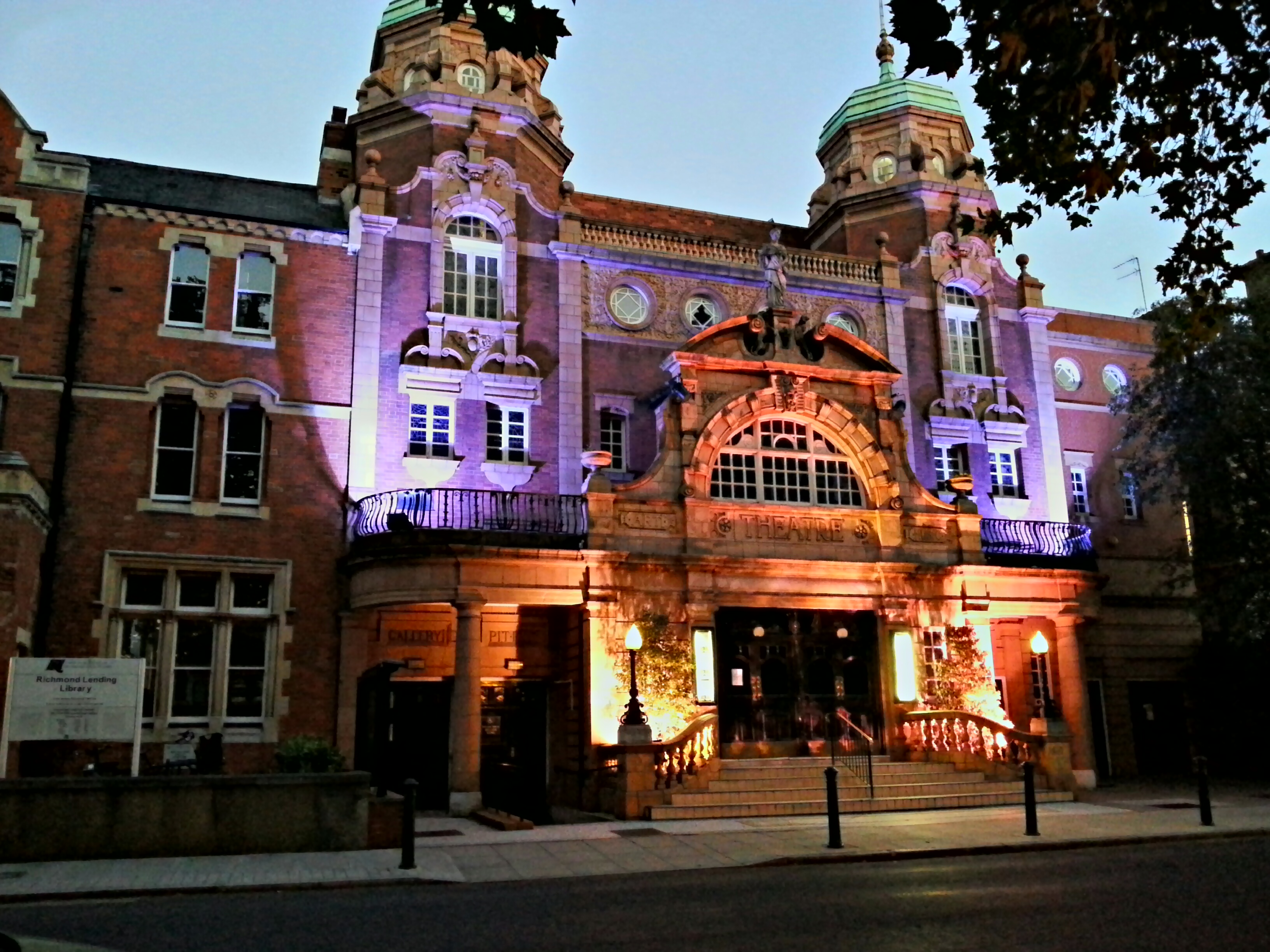
It is hard to imagine a more appropriate set that Adrian Linford’s rehearsal space, with rough cut scenery and busy props, fitting into a classic proscenium stage, which Frank Matcham’s Richmond Theatre jewel (there she is) perfectly frames in a nod to the play itself. Philip Franks’s direction makes everything perfectly clear, no mean challenge as you might surmise from the above.

By some margin my favourite Bennet play. Mind you next up Mark Gatiss and Adrian Scarborough in The Madness of George III. This is showing live at cinemas but I see there are more than a few tickets left at the Playhouse. So students of Nottingham University. amongst others, save your beer money and go see this instead.


A Very, Very, Very Dark Matter at the Bridge Theatre review ****

andersen-hc

A Very, Very, Very Dark Matter

Bridge Theatre, 13th October 2018

OK then. All of you fans of densely-plotted, cerebral, potty-mouthed, fairy-tale, political, splatter, revenge, comedy fantasies. Your ship has come in.

I have a strong feeling that Martin McDonagh’s new play at the Bridge will, in years to come, form the basis for many a Theatre and Drama Studies students’ dissertation. Let’s just say he doesn’t hold back here. All of his tics, tropes and obsessions are on show: moral instability, savage humour, verbal aggression, twisted irony, brutal violence, calculated abuse, punishment, justice and revenge, inversions, post-modernist borrowings, self-reverence, complex allusion, high and low art juxtapositions, exaggerations, call-backs, call-forwards and protean plot twists.

In a word: meta.

Once again he is pushing the audience, deliberately transgressive, a kind of theatrical meta-regression to keep us on our toes, but this time, unlike the best of his work, it doesn’t quite hang together on first viewing. The rhythm of the language is less immediately persuasive, less precise, (even allowing for a few timing issues at this early performance). It cannot be missed mind you, and it may be that the production will tighten up through the run, but overall I found it a little less convincing than Hangmen or The Lieutenant of Inishmore, or Three Billboards … or In Bruges. In these the intricate plotting and more naturalistic settings make for a more satisfying whole. On the other hand AVVVDM might turn out to have more intellectual depth: I am simply not clever enough to take it all in on one viewing. Probably closest to Seven Psychopaths for you students of MM, a film even he described as maybe a bit too meta, but one which I think gets better on repeated viewing.

AVVVDM is drawn from Mr McDonagh’s 1995 play The Pillowman, which was first performed in 2003 at the NT and also starred Jim Broadbent, (who plays Hans Christian Anderson in AVVVDM), as cop Tupolski, alongside David Tennant, Nigel Lindsay and Adam Godley. In this play a writer, living in an unspecified totalitarian theocracy, is accused of murders which mimic the plots of his own fairy tales. It is a bit Gothic, it captures the power of literature, there’s some Kafka going on, the ethical dilemma is fascinating if a little forced, of course there is violent imagery and of course there is humour.Like all of McDonagh’s plays The Pillowman’s morality is slippery, though not really ambiguous; it is normally pretty clear what he is saying, just that its compass is oscillating so rapidly between perspectives of right and wrong that we in turn start to lose our bearings.

Once again it he world of “fairy tales” that forms the starting point for AVVVDM. In fact the “plot” looks to be drawn from The Shakespeare Room, which Michal, Katurian’s damaged brother, references in The Pillowman. In this story it turns out that Shakespeare’s plays were written by a pygmy woman he kept in a box. MM has described in the past, reiterated in the programme here, how he made up fairy tales in his teens for his older brother John. One of these formed the basis for another of Katurian’s stories in The Pillowman, The Tale of the Town on the River, which tells how the Pied Piper “saved” one of the children by chopping off his toes. And so fairy tales get darker and darker with the telling.

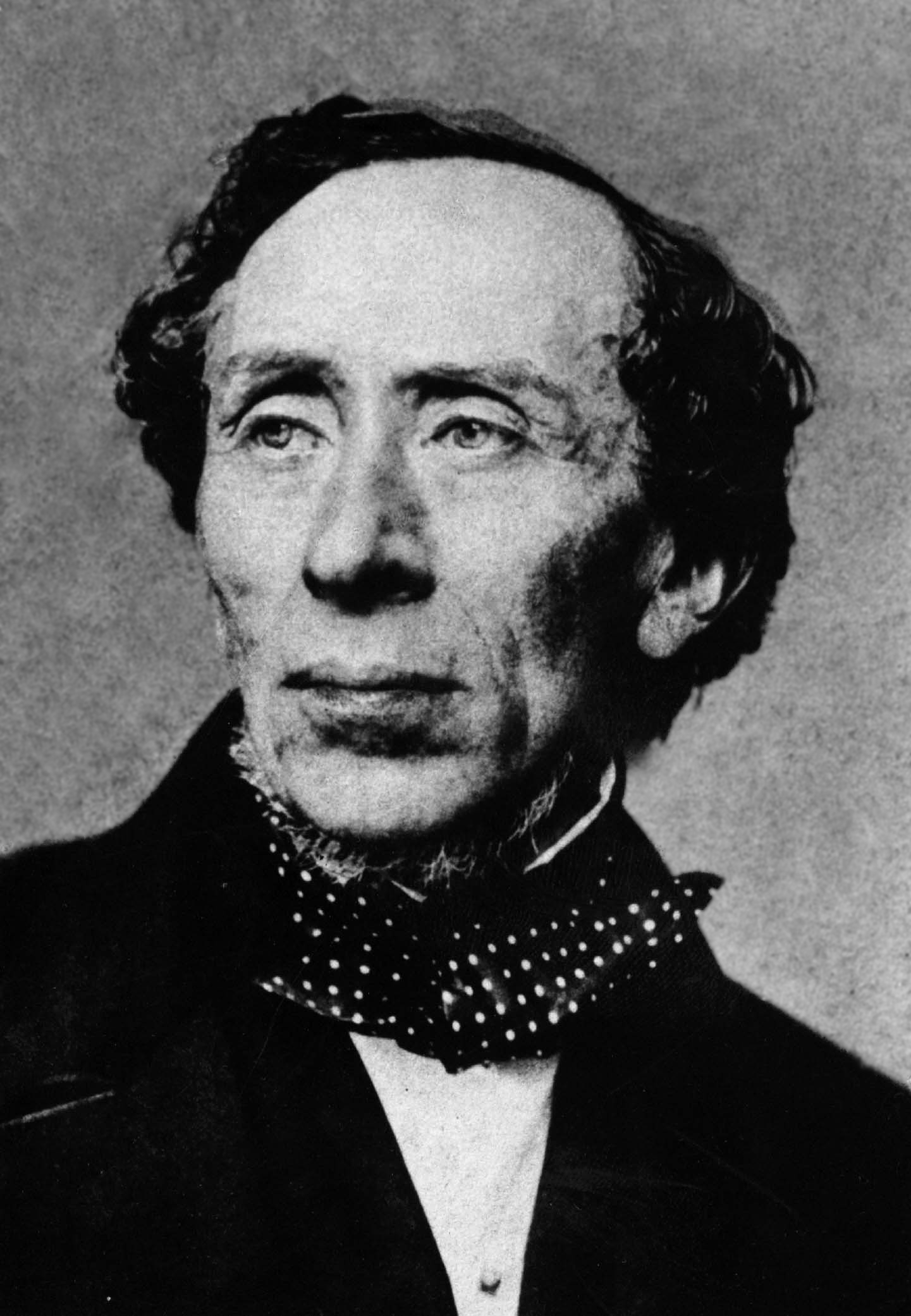
AVVVDM kicks off with Hans Christian Andersen giving a contrived recital of The Little Mermaid. Now it turns out that the real HCA was an awkward character, abused at school, with unrequited longings for men and women but likely celibate. One of the objects of his affections, Edvard Collin (Lee Knight), is in the crowd in this opening scene. And, incongruously, also there, well there in HCA’s mind, cue the scary music, are a couple of blood encrusted, walking and talking, corpses, Barry (Graeme Hawley) and Dirk (Ryan Pope), sporting fine moustaches. Well this is a fairy tale after all. Cut to the attic of HCA’s townhouse where, surprise, surprise, we discover that he has a secret, namely a Congolese pygmy, Marjory, in a box, who is writing his stories.

All this is accompanied by a gravelly narration from none other than Tom Waits. From here MM weaves together the genocide in the Congo Free State in the late C19 with the real life friendship of Charles Dickens (Phil Daniels) and HCA, which unravelled when HCA overstayed his welcome on a visit in 1857. I’ll stop there. Let’s just say the plot plays fast and loose with fact, fiction and time.

I guess MM’s main thrust is to contrast the near unbelievable horror of King Leopold II’s direct, private rule of the Congo from 1885 to 1908, where maybe ten million died, and which scarred the country through Belgian colonial rule, and post independence, with the pygmy population suffering most, (as it still does today), with the maudlin tales of innocence and virtue standing fast against corrupting forces of both HCA and Dickens. It is hard to avoid the stories told by the latter, they permeate Western culture: the barbarous reality of the former though, a couple of decades later, and far worse than anything imagined in fiction, is still barely known by many, including me until now.

The fact that MM tells this story in the form of a comedy, in an expletive-ridden contemporary vernacular, is only to be expected from MM. Casting Jim Broadbent and Phil Daniels, who are, by virtue of career and demeanour, are distinctively Dickensian, is surely no accident. After all a new MM script will pretty much guarantee any actor from his roster of favourites will sign up, sight unseen. Both went all out for laughs, many of which were at the broad end of the subtlety scale. Emily Berrington, as she so often does, near steals the scenes she is in as the earthy Mrs Catherine Dickens. I loved the sweary kids as well. Paul Bradley, as the inexplicit Press Man, also turned in his customarily fine performance.

However the play would not be possible without the formidable Johnetta Eula’Mae Ackles as Marjory, (and later Ogechi, you’ll see). From the moment she emerged from the box, suspended from the ceiling in Anna Fleischle’s amazing set, I couldn’t take my eyes off her. This was BUD, and KCK’s, first exposure to the wonderful and frightening world of Martin McDonagh. The SO was converted at Hangmen. When we emerged, not a little bewildered, after the 90 minutes, we debated the play long into the night. OK then maybe not long into the night, but certainly as long as it took to have a drink, some rarebit (highly recommended) and some madeleines, in the excellent Bridge foyer. Anyway BUD, being the analytical sort of chap he is, couldn’t get over the fact that the play could only exist with Johnetta Eula’Mae Ackles in the role. Surely it must have been written for her?

I agree. But not for the obvious reasons of appearance. Simply because she is an outstanding actor. Sardonic, bitter, vengeful, powerful yet also vulnerable, compassionate and forlorn. Don’t get me wrong she delivers plenty of killer (literally) comic lines but she also carries the entire weight of the emotional and political substance of the play on her shoulders. This is her professional debut. Extraordinary.

Now director Matthew Dunster, and Anna Fleischle, have previous with Martin McDonagh, having brought the Royal Court production of Hangmen into being. (Mr Dunster also has form with HCA, directing the Pet Shop Boys’ ballet adaptation of his story The Most Incredible Thing. Messrs Tennant and Lowe know a thing or two about stagecraft challenges but they are not a patch on MM).

Even so I suspect director and designer, and the rest of the creative team, James Maloney (music), Philip Gladwell (lighting), George Dennis (sound), Chris Fisher (illusions), Finn Ross (video) and Susanna Peretz (wigs and prosthetics), must have rolled their collective eyes at their first meeting. How were they going to make this leap of mischievous imagination from page to stage? Impressively, as it turns out.

So you see the thing with MM is there is just so much there. So many echoes yet uniquely his own voice. Scorsese, Malick, Pinter, Tarantino, Synge, Le Fanu, Mamet, Beckett, Borges, punk. Insert your own thoughts here. I for one really what to believe he likes The Fall.

A master story-teller. With maybe, in this case, not quite a master story. It might annoy you. It might frustrate you. It might provoke you. It might overwhelm you with “WTF” moments. It should make you laugh, (assuming you know a little of what you are letting yourself in for). It will certainly make you think. And you definitely won’t forget it in a hurry.

Cock at the Minerva Theatre review ****

rooster-clipart

Cock

Minerva Theatre, Chichester, 10th October 2018

Another addition to my collection of Mike Bartlett plays. I have professed my admiration for his work on numerous occasions on these pages. You see he just writes gripping drama. Hyper-real, sometimes going a bit over the top, but that is what you pay your money to see. Or at least I think you should. He can range widely across subjects, big and small. And he experiments with form. All in all probably the best of the current generation of British dramatists, of which there is currently a very fine crop. Just need a revival of 13 which I missed on its first outing.

Cock is a comedy which focusses on the machinations of the somewhat weak-willed John (Luke Thallon) as he attempts to choose between his two lovers M (Matthew Needham) and W (Isabella Laughland). It is a sort of companion piece to Bull, written a few years later, about workplace bullying. Both examine the “games that people play” and were kind of inspired by bull-fighting (and cock-fighting) which MB discovered were still very much alive when he visited Mexico City. There are no scene headings or stage directions or props in Cock, only lines between each of the “bouts” between characters (here marked with an electronic “bell”). MB stipulates that there should be “no mime”. He evens leaves out full stops and commas to express natural speech rhythms and inserts blanks to create equivalent pauses. So all your are left with is 2, then 3, then 4 actors circling each other and tumbling out the lines. Just the verbal sparring if you will. Of which there is plenty. It sounds tricksy but it is anything but as MB cannot help putting the right words, at the right time, into his characters. Emotions, as in his other works, are heightened by the formal structure. Everything is clarified.

It transpires that John was pretty young when he moved in with M. M is a bit of an emotional bully but when John wants out after seven years it’s pretty clear M is devastated. Especially when John falls in love with a woman. W doesn’t care that, until now, John has been gay. She pushes John into choosing when M invites them to, what you can probably divine, an “awks” dinner party. Especially when M’s Dad F (Simon Chandler) turns up.

There are plenty of killer comic lines but what MB really nails is the constant, and often brutal, ebb and flow of coercion and pleading that all four employ to get what they want out of the situation. John is agonised by having to decide between M and W, and by implication his sexual identity, bisexual not sitting comfortably, but he is also loving the attention. M is all over the words “emotional blackmail” but he does not want to lose John. W appears more reasonable but she is still determined to “win”. The world has moved on and become more fluid in terms of sexual identity but MB’s play still plainly shows that there are personal costs (and benefits) to be negotiated in all relationships. Monogamy exerts a powerful hold on all of us it seems. I would stab a guess that Cock is the sort of play Pierre de Marivaux would be writing if he were alive today.

This is I think the first time I have been party to Kate Hewitt’s direction. If there is a better way of showing off this play, here in the round, I can’t imagine it. I see she is in the chair for Jesus Hopped The A Train at the Young Vic next year. Excellent. I have espyed the Matthew Needham at the Almeida, and after this he will reprise his role as John (no relation) in Rebecca Frecknall’s production of Summer and Smoke at the Duke of York’s and Luke Thallon stood out in MB’s Albion at the same house and, I gather, in the Young Vic The Inheritance. I’ve only seen Isabella Laughland on the telly. Anyway even a chump like me can see all three actors are destined for even greater things. I can’t imagine Georgia Lowe will get an easier gig than this in terms of design, a red square on the floor in this red auditorium, but it still is the exact right solution.

With Press, his journalism drama, now over, until the next time presumably, I can’t wait for MB’s next work. I loved Press, obvs, most notably because it seemed to wind up many members of the fourth estate because “that’s not how a newspaper works”. Numbnuts. That’s the point. It’s a drama. Which uses your grubby, noble and powerful profession to shine a light on contemporary mores. Not a documentary. Which is also not “real” and constructed. As is your own “reality”. And your stories.


The League of Gentlemen Live Again! at the O2 Arena review ****

24050905658_f8ff1f2016_o

The League of Gentlemen Live Again!

O2 Arena London, 23rd September 2018

The Tourist really dislikes the O2 Arena. Awful sound, brutal lighting, terrible sightlines, cavernous, uncomfortable seats, no water, sh*te loos. Pretty much pointless choosing to “see” anything there. Still sometimes, as here, you have no choice.

And this, to repeat,was the League of Gentlemen, in the flesh. Mandatory. So off we trooped the SO, BD, LD and a couple more “local people” (really). Thanks to a cavalier approach to timing from yours truly, reasoning nothing ever starts on time there (this did), and a bloody ridiculous trek all the way round the Arena to get back to where started from for our allotted entrance, we snuck in late.

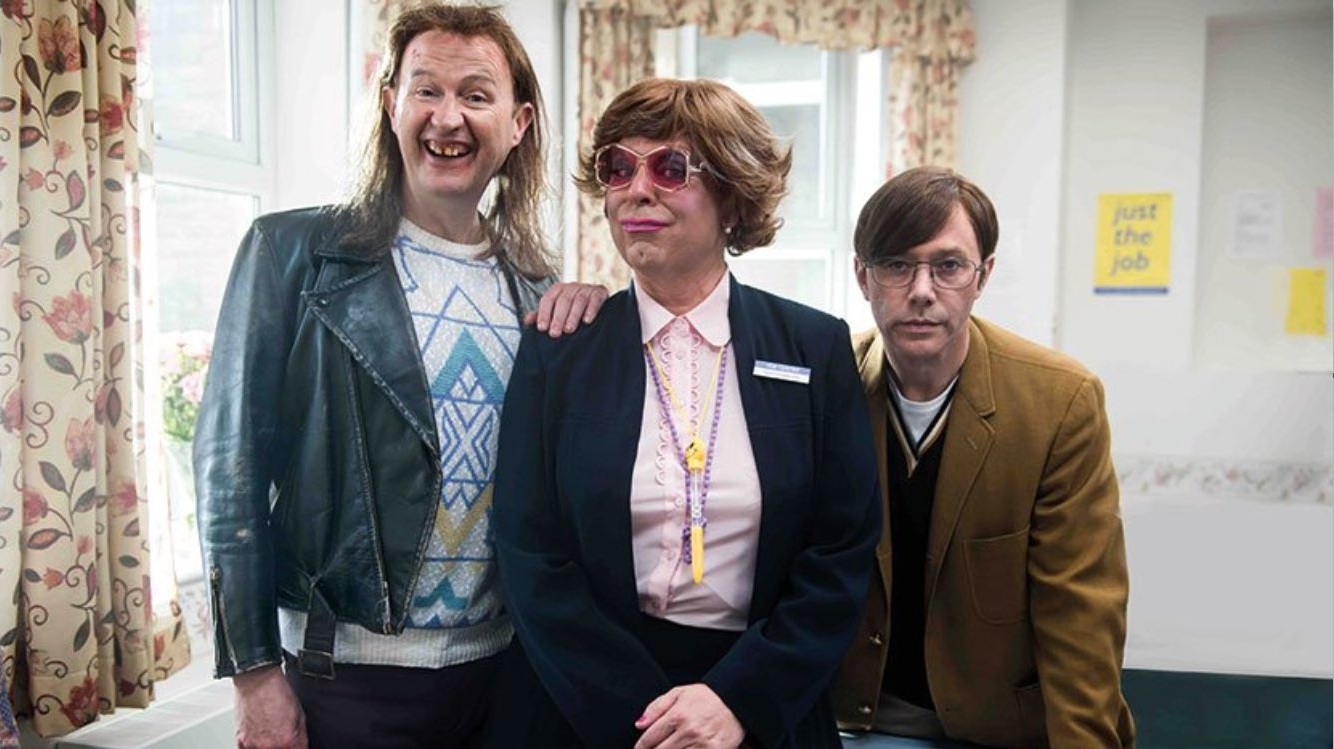
Still pretty easy to get into the swing of things with Go Johnny Go Go Go first up. The first half sees our three heroes in evening dress running through some classic sketches with blackouts whilst the furniture was re-arrranged. The second half is more ambitious with set and costume changes, with assistance from pre-recorded video to brings things together, (and get characters on and off stage). Now I am going to assume that you are either a fan or not. Either way there would be no point in my rabbiting on about the detail of the evening’s proceedings. Some sketches and sequences worked better than others, the same way that some characters make some of us laugh more than some others. For me the highlights were Legz Akimbo, (with Reece Shearsmith at his bitter best in Olly Plimsolls), Pop (especially when Steve Pemberton goaded Shearsmith into corpsing), Mordant Mick and Herr Lipp. Especially Herr Lipp with a bit of audience participation. For BD it was probably Edward and Tubbs, complete with musical theatre number, for LD it was Pauline and for the SO, as it always has been, it was Pam Doove.

That is the way it has always been. I get that some find LoG dark and disturbing. Not me. Though the third series does get a little weird I accept. The SO kept BD, and then LD, away from Royston Vasey for many years until they were “ready” and MS said he found it a bit scary at first. Just as well then I wasn’t in charge of their viewing as to me it is just funny.

What is interesting in seeing the LoG now, in this live show and in the recent three new episodes, after some sixteen years since the original three TV series’ came out, is not how grotesque it is, too much exposure to think that, but actually how direct it is. Not the often unreconstructed nature of the comedy, that was part of the point, but actually how rooted in comedy history so many of the set ups are. Which is what makes it so funny. An absurdly camp German trotting out a string of preposterous double entendres is not radical in any way. It is though one of the funniest things I have ever seen. The dark heart of comedy I suppose.

Now we know that Messrs Gatiss, Pemberton and Shearsmith, and, in his own way the silent partner, Jeremy Dyson, have all gone on to copious writing and performing success, on big and small screen and on stage, and in other guises. They are all brilliant in their very different ways. Which means that this is not some desperate revival show done for cash. And they were never going to dash off any old tosh. Way too clever for that. They all look like they are having a ball in the show but I have to say that Steve Pemberton, who let’s face it always nabbed the best of the grotesques, had the most presence.

Special stuff.


The End of the Pier at the Park Theatre review ****

llandudno2c_end_of_the_pier_1

The End of the Pier

Park Theatre 200, 2nd August 2018

Comic gold is not universal. We all have a different take on what is funny. The casting of Les Dennis in Extras (S1 E4) as a washed up, needy TV star in a pantomime, whose young fiancee is copping off with a stagehand, was a stroke of genius by its creators Ricky Gervais and Stephen Merchant. Specifically the scene where he is literally baring his all to Gervais in the changing room is as funny as funny gets. As it turns out this was a turning point in Les’s life and career lifting him out of a dark period after a marital break-up (visible on the execrable Big Brother apparently). Ironic too that Messrs Gervais and Merchant’s own comedy oeuvres have been largely downhill since then.

Anyway it means that Jolly Les is surely the go to casting choice if you are writing and producing a play about a washed up comedian whose career comes crashing down after making a racist joke. Which is exactly what writer and director Danny Robins and Hannah Price did with The End of the Pier. More than enough to reel me and the SO in to seeing it.

The joy is that this is actually a pretty good play. Funny, insightful, well structured and with some strong performances and not just from Les. His character Bobby was part of an, unsurprisingly, Northern double act, Chalk and Cheese. From working men’s clubs through to Saturday Night TV stardom they had it all into the 1980s. Eddie Cheese, now dead, was an unrepentant racist bully but it is Bobby who ends up telling the (unheard) joke, perhaps against his better nature, which catapults their careers, just when the audience, thanks to alternative comedy, is moving on. The twist is that Bobby’s son, Michael, played by Blake Harrison, (you know Neil from The Inbetweeners), is also now a household name “observational” comedian, with a partner Jenna, (the very talented Tala Gouviea), who is a TV comedy commissioning executive and fully paid up member of the LME.

Now as I write this I can see that the set-up does all sound a bit predictable. But the way in which Mr Robins goes on to develop the set-up is anything but. The politics of comedy, (and race and class), are smartly pulled to pieces, the relationship between father and son is similarly dissected and there is a brilliantly funny ending courtesy of Nitin Ganatra, who plays Mohammed, a schoolmate of Michael who comes back to haunt him. OK so there are a couple of clunky McGuffins to facilitate some plot switchbacks, and Michael’s character turns a little too adroitly on a attitudinal sixpence towards the end, but no matter, as once it gets going this is thoroughly entertaining stuff. Danny Robins is not the only TV/radio sitcom writer to be commissioned for the Park stage but on the strength of this I bet he gets another crack at a full length play. He has an ear for dialogue and could certainly succeed with subtler fare. Mind you I have to admit that some of the funniest lines in the play are Bobby’s cringey old-skool one-liners.

Hannah Price, (who I think worked with no less than John Malkovich on his The Good Canary at the Kingston Rose last year), directs with vigour and does a pretty guide job of patching over the contrivances and James Turner’s set, which shifts from Bobby’s Blackpool flat to backstage at the studio where Michael’s show is filmed, has a real flair for detail. As an aside the designers for productions at the Park seem to me to always be very well served by those who put their sets together so a big shout out to the chippies and the rest of the team. In our performance there was a problem with the sound but the team soldiered on regardless and came up with a couple of belts and braces solutions when it mattered.

There are better plays which address the nature of comedy, Trevor Griffith’s masterful Comedians and Terry Johnson’s Dead Funny for example, but this is a very entertaining, if occasionally overly earnest, addition.


The Flight of the Conchords at the O2 Arena review ****

flight_of_the_conchords

The Flight of the Conchords

The O2 Arena, 20th June 2018

Father and Son
Deana and Ian
The Most Beautiful Girl (in the Room)
Inner City Pressure
Bowie
Chips and Dips
Albi The Racist Dragon
1353 (Woo a Lady)
The Ballad of Stana
Bus Driver’s Song
Mutha’uckas / Hurt Feelings
The Seagull
Back on the Road
Carol Brown
Shady Rachel
Robots

Dairy products, meat, wood, locations for hobbits and rugby teams. New Zealand’s most valuable exports? Nope. The Flight of the Conchords, surely. Only joking. New Zealand has an extraordinarily rich cultural life from what I can see and landscapes of immense beauty, Sadly I suspect I will never get there.

So for the moment I will have to be content with Bret and Jermaine. Originally we intended to go en famille. BD’s loss, (poncing around at some uni bash), was MS’s gain. LD might not quite have the compulsion of the rest of us but has had enough exposure to the classic tunes to mean that it was pretty easy for her to get into the swing of the evening.

Over the last few years I have been constantly surprised by how few of my friends and acquaintances have caught the Conchords bug and, indeed, how many have never even heard of the boys. Clearly though filling this many large venues, (and the pre-tour at the Soho Theatre), even after the accident to Bret’s hand, suggests there are plenty of fans 10 years after the original HBO show and 15 years after storming the Edinburgh Fringe.

No need to preach to the converted then. You were probably there. On the night we went the boys took their time coming on, and by virtue of my miserliness, and a big of bad luck on the open for the original dates, we were about as far away as it was possible to be in the O2 which, as everyone knows, is A VERY BAD IDEA. But I figured we’d be so happy anyway that it wouldn’t matter too much if we relied on the screen to see the boys.

Of course they were brilliant (including Nigel on cello aka the New Zealand Symphony Orchestra). Of course the banter, less knowing and much looser than of old, was hilarious. Of course the classics were a joy even when they ballsed them up (deliberately?). But the best thing about the whole evening were the new songs. Especially the meta The Seagull, piano ballad Father and Son, country rock The Ballad of Stana and the hilarious madrigal 1353 (Woo A Lady). The reviews let us know what was coming but a song that might have been written especially for MS was the highlight of our evening.

There is not much point going on. If you don’t know “the fourth most popular folk parody duo in New Zealand”, or if you’ve had a look and don’t get it, then no matter. Your loss. For some of us this is still about as funny as funny gets.


Much Ado About Nothing at the Rose Kingston review ****

1024px-howard281828-3329_shakspeare2c_much_ado_about_nothing_vol12c_p219

Much Ado About Nothing

Rose Theatre Kingston, 20th April 2018

Come on fellow residents of the Royal Borough of Kingston and London Borough of Richmond – both upon Thames. Get your collective arses over to the Rose Theatre to see this new version of Much Ado About Nothing, celebrating the 10th anniversary of your local theatre. There are plenty of tickets left for the last handful of performances. It is not perfect but when it is funny, it is very funny, the setting is intriguing, there are a handful of strong performances, including the star turn Mel Giedroyc, and, in John Hopkins’s Benedick, there is Shakespearean comic acting to rival the very best.

Now I will admit that the main draw for BD, LD, myself, and latterly MS, was Ms Giedroyc herself. Obviously she is a national treasure and we have collectively seen her memorably translate her inimitable style, arch covers it, to the reading of Agatha Christie. Play, proximity and support for the local theatre was enough justification for me, but LD especially needed the hook of her off the telly. LD is probably a bellwether teen, suspicious of Shakespeare, unless forced to consume at school, and then normally pleasantly surprised when Dad mugs her into coming along, usually through vague subterfuge. And she thoroughly enjoyed this. It doesn’t mean a trip to an uncut Lear is just round the corner. Just saying that if it is good enough to entertain her it is good enough to entertain anyone who might be dubious about the Bard.

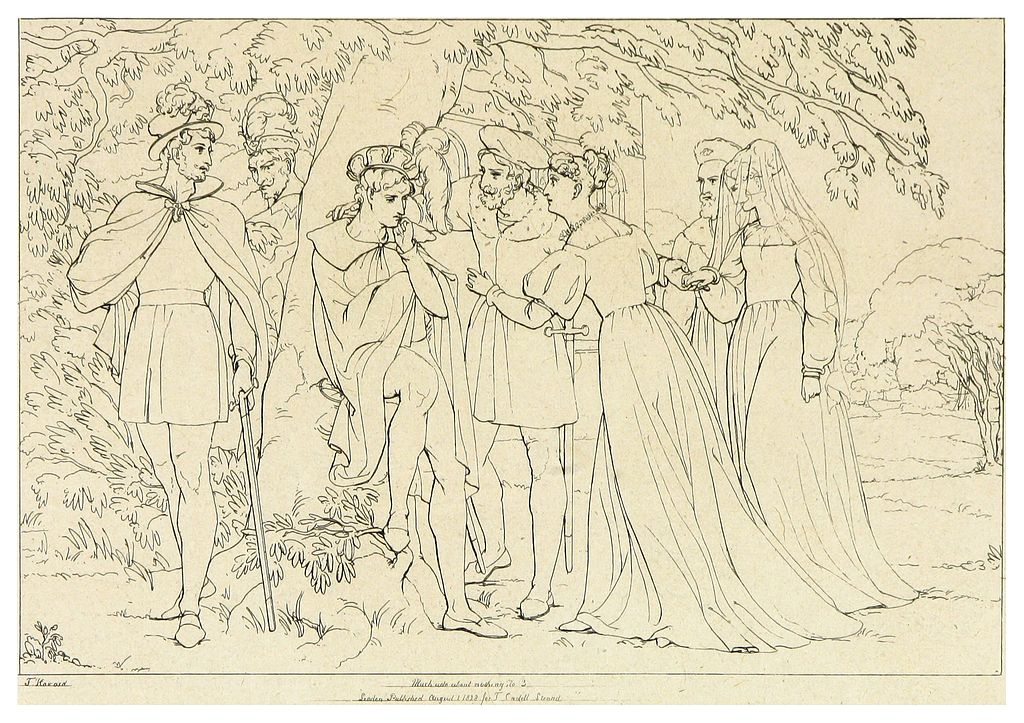
Moreover, this production, jointly staged with Granville and Parnham and Antic Face, rattles through the action so that we are all done and dusted in under 150 minutes inc. interval. That’s including a several minute intro as we are, just so we know, introduced to the resort hotel in a set shrewdly realised by Naomi Dawson. This is modern day Sicily and Leonato’s estate is now a luxury spa to which Peter Guinness’s suitably intimidating mafioso Don Pedro and crew have retired for a bit of rest, relaxation and intimidation. Suffice to say it looked nothing like the bucolic MAAN in the drawing above.

Director Simon Dormandy’s ideas do, fitfully, generate some insight, notably in the way that Kate Lamb’s Hero and Calam Lynch’s Claudio are so precipitously thrust together, in the fancy dress party which permits the romantic plotting, in the wedding scenes and, especially, in Hero’s fake funeral. Here the juxtaposition of modern sophistication with older, deeper, paternalistic traditions is most striking. We love Sicily, (well I do especially), but Sicilians are a wary bunch, unsurprising given colonisations by Phoenicians, Greeks, Romans, Vandals, Ostrogoths, Byzantines, Muslims, Vikings, Normans, Germans, French, Spanish, Italians, Mafia and Tourists. Mind you that is what is makes it endlessly fascinating to the outsider.

On the other hand there are times when the hotel set is a limitation, most notably for the Watch, though frankly that never works, even with Stewart Wright doing his very best as Dogberry. And, let’s face it, most people see MAAN for the comedy, specifically Beatrice and Benedick sparring. Mel, as customer services manager for the hotel and Mr Hopkins, as an unlikely consigliere to Don Pedro, deliver. Ms Giedroyc, is funny, we know that, and exactly the right sort of funny, and doesn’t hold back from mugging to the audience. When she needs to show Beatrice’s independence, and specifically her revulsion at the patriarchal conceits around her, she also shows she can seriously act. John Hopkins however is a cut above, the physical humour matches his brilliant delivery of the text. Their early disdain for each other is done snappily enough, with some evidence of their back story, but it is when they get serious about each other that they hit the heights. Mel’s immediate retort of “kill him” when asked by Mr Hopkins what Benedick could do for Beatrice to right the wrong Claudio has inflicted on Hero, got the laugh, but the audience was palpably nervous. It is their respective eavesdropping scenes which still the show: pure farce, but why not if it makes us happy.

We were taken with young Calum Lynch as Claudio on his professional debut, especially LD, and especially when his top came off. There was a harsh streak in him, where required, to balance the skittish wooing. Kate Lamb presented an initially diffident Hero but bristled wth anger as her reputation was impugned. Peter Bray, rather disconcertingly played Don John as a somewhat dim East London thug; in contrast his Clerk was more Home Counties solicitor. David Rintoul as Leonato, now hotel manager, was alternately brutal and oleaginous. Fine support elsewhere includes Nicholas Prassad as Borachio and Victoria Hamnett as Margaret conjuring up a saucy scene involving Hero’s wedding dress that provides a not unreasonable explanation for the mistaken identity window scene which leads to Hero’s “disgrace”.

There have been, and will be, sharper, richer versions of MAAN, Christopher Luscombe’s recent RSC production for example, but if you want some straightforward easy on the ear and eye Shakespeare comedy, Kingston, for the rest of this week, is the place to be.


Murder She Didn’t Write at the Leicester Square Theatre review ****

agatha3

Murder She Didn’t Write, Degrees of Error, Something for the Weekend

Leicester Square Theatre, 25th March 2018

Flushed with success from our previous outing to the LST for a bit of class improv, BD, LD and the Tourist slope off to see Degrees of Error and Something for the Weekend and their commended show Murder She Didn’t Write. If this was as anything like as good as Austentatious we were in with a treat (Austentatious at Leicester Square Theatre review ****).

Well, I can report, it is,  and we were. You wouldn’t think to look at kindly Agatha Christie that she could have such a devious and sly mind. For how else to explain how she re-wrote the rules on whodunnit plotting. Which delights in exposing human cruelty. Take a look at Sarah Phelps’s riveting adaptations courtesy of the BBC, Ordeal By Innocence on now, Witness For The Prosecution and And Then There Were None, if you want to see how Christie should be done.

Agatha Christie is, by some margin, the most famous product of Torbay. If the Tourist, who is similarly scion-ed, is to catch her up he needs to come up with something sharpish. This blog, with its still pitiful double digit readership, is not it. Her holiday home, Greenway House, is well worth a visit, and happens to be just down the road from the Tourist’s alma mater.

The classic Christie tropes, the grand locations, the secretive characters, the class divisions, the disguises and assumed identities, the clues and red herrings, the inspired investigator, the big reveal, are as amenable to spoofing as they are to cracking drama. So it’s not really a great surprise to see an improvisation troupe alight on Agatha as a source for its entertainment.

That is not in any way to decry the skill which Degrees of Error bring this to the stage. DoE are an improv theatre company based in Bristol and have been taking Murder She Didn’t Write to Edinburgh and on tour since 2013. So they know what they are about. Even so, as with Austentatious, improv comedy theatre on this scale, (we got around 90 minutes of action for our 15 quid each), is a tough gig. So they wisely help themselves in a number of ways. One of the company, (I think Tom Bridges but with no cribsheet I can’t be sure so forgive me if I am mistaken), plays the detective, who guides us through the “plot” with occasional interjections to give his “acting” colleagues time to pause for breath and to suggest scenarios which might add to the gag quotient. He also recruits a member of the audience to be his sidekick, Jerkins, who picks out both victim and murderer. Our cast is “colour-coded” Cluedo fashion to assist in the process. Jerkins also ultimately decides on the location and event for the murder mystery based on audience suggestions vetted by the Inspector.

All this buys a bit of time for cast to prepare and to fit the classic Christie tropes to their characters. Even so, early on, there are a few awkward diversions and cross-talking, but after the first 20 minutes or so the direction is set and the cast can settle into the flow. Then they start making it look easy. After the interval you would barely know it was improvised.

It is very, very funny. Our setting, a wine tasting, and location, a wine-glass factory worked a treat. I don’t know how much they might have squeezed in from previous improvs but nothing ever feels forced or less than spontaneous. Watching the comic ideas coalesce is delightful and seeing the cast grinning when they hit the comedy jackpot makes the whole thing even funnier. That is the shared joy of improv.

I think the cast was Peter Baker, Lizzy Skrzypiec, Tessa Gaukroger, Caitlin Campbell, Rachel Lane and John Lomas, but I can’t be sure as I say. No point singling out anyone in particular, the whole ensemble was fabulous.

If this even slightly piques your interest I strongly encourage you to take the plunge. The London gigs at the LST are at 4pm on a Sunday. What else are you going to be doing then FFS? This is one of those outings where you absolutely can take your mates along without worrying they won’t enjoy it and you will look like a tit, and there is, for a couple of hours at least, no question of FOMO or phone-withdrawal kicking in.

http://www.degreesoferror.com/tour/