Preamble
So there will a few of these. Obviously largely generated by AI Claude. With my interjections and prompts in red text. The subject interests me and this is a way of fixing in my head. Well sort of. Anyway, in short, more for me than you.
The Collision
In 43 AD, four Roman legions under the Emperor Claudius landed in Kent and within four years had pacified enough of the island to begin building in earnest. What followed was the most sudden and total architectural transformation Britain has ever experienced — before or since. In the space of a generation, a landscape of timber roundhouses, hillforts, and sacred groves acquired grid-planned towns, underfloor heating, public baths, amphitheatres, and a road network so well-engineered that many of its lines are still the routes of A-roads today.
But here’s the first complication, and it’s an important one: this transformation was not evenly distributed, and it was not simply imposed. Roman architecture in Britain is the first great example of a theme that will recur constantly — the negotiation between an imported architectural culture and a native one. The result is neither purely Roman nor purely British. It is something hybrid, and the hybridity is where the interest lies.
Materials and Technology
The Romans brought two things to British construction that changed everything: concrete and the fired brick.
Roman concrete — opus caementicium — is one of the great technological achievements of the ancient world and arguably still underappreciated. It was made from lime mortar mixed with an aggregate of rubble, tile fragments, and volcanic ash (pozzolana, imported or substituted locally). It could be poured into formwork to create walls, vaults, and foundations of a strength and flexibility that stone construction alone couldn’t match. It’s why Roman structures survive at all — the concrete core endures even when the facing stone has been robbed out for later building.
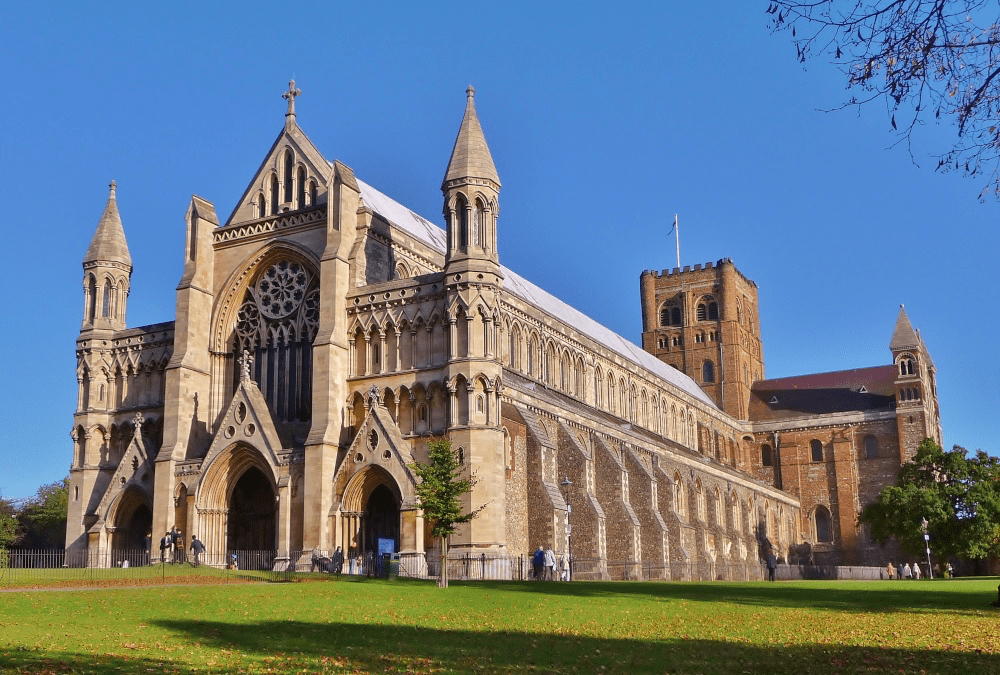
And robbed out it was, comprehensively. Almost every medieval building in Roman Britain incorporated recycled Roman material. St Albans Cathedral is built substantially from Roman brick taken from the ruins of Verulamium next door. You’re looking at Roman material throughout that building while thinking you’re looking at Norman work. The Romans didn’t just build Britain’s first urban architecture — they became the quarry for the next thousand years.
The hypocaust — underfloor heating — is worth pausing on because it represents a philosophical as much as a technological shift. The roundhouse organised life around a central hearth, fire as the literal and symbolic heart of the home. The hypocaust hides the fire beneath the floor, distributes heat invisibly, and separates the technology of warmth from its symbolic function. It’s a small thing but it tells you something about the Roman attitude to nature: not something to gather around in shared dependence, but something to be managed, controlled, and put to work beneath your feet.
The Romans also introduced tile to Britain on a massive scale — roof tile, box flue tile for channelling hot air through walls, tessellated floor tile for mosaics. The physical texture of Roman Britain is completely different from what came before or immediately after: hard, precise, geometric, fired.
Urban Form
The most radical thing the Romans introduced was not any individual building but the town itself. Pre-Roman Britain had hillforts, ritual centres, and trading settlements, but nothing that functioned as a true urban organism with civic institutions, a legal framework, and a designed public realm.
The Roman town followed a template wherever the legions went. A grid of streets, usually oriented to the cardinal points. A forum at the centre — part market, part civic square, part law court — flanked by the basilica, a long aisled hall that functioned as the town’s administrative and judicial heart. Public baths (thermae) — the social hub of Roman life, combining bathing, exercise, business, and gossip in a sequence of heated rooms of increasing temperature. An amphitheatre on the edge of town. Temples. A mansio — a kind of official inn for travelling administrators.
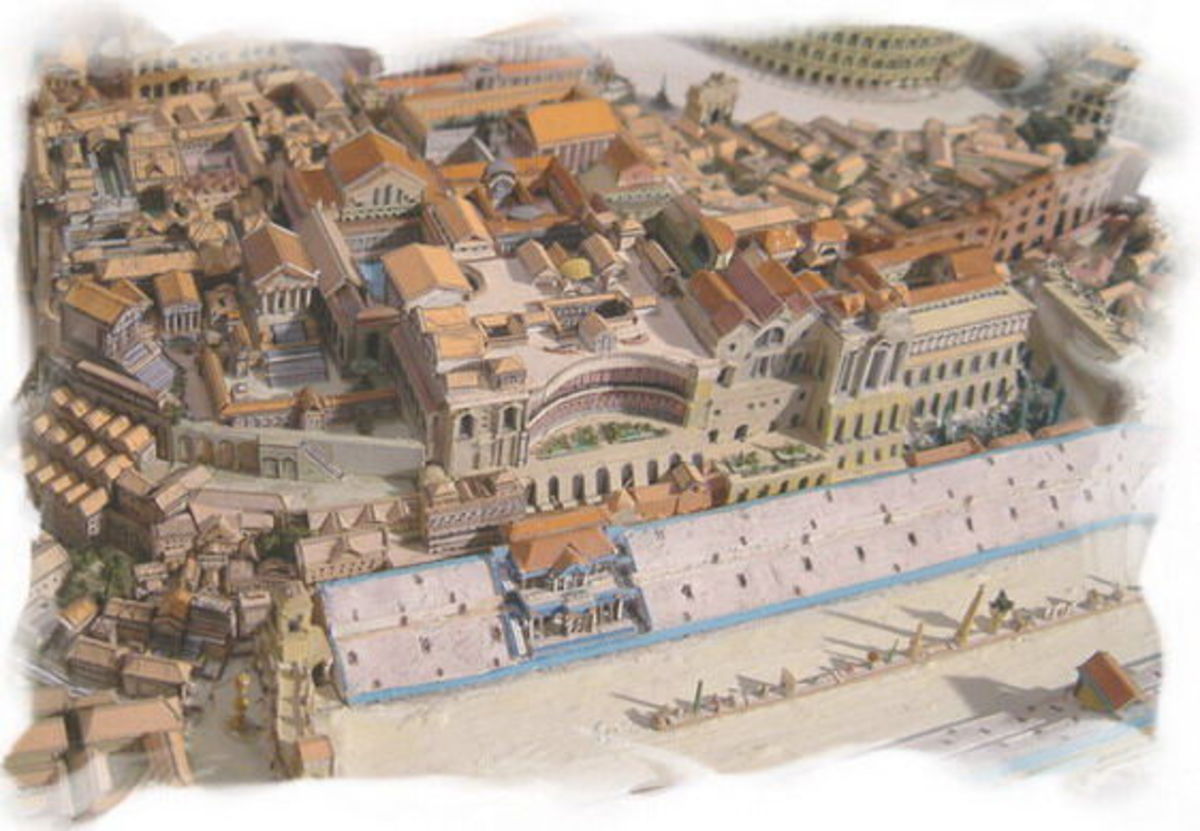
Londinium (London) had all of these. Its basilica, on the site of what is now Leadenhall Market, was the largest building north of the Alps at the time of its construction — over 160 metres long. Almost nothing of it survives above ground, but you can still see fragments of the Roman wall at Tower Hill, at the Museum of London, incorporated into the medieval city wall that followed its line almost exactly. The Roman street pattern still ghosts through the City — the routes of Cheapside and Cannon Street follow Roman lines.

Bath — Aquae Sulis — is the great surviving exception, and we’ll come to it in a moment.
The Hybrid: Roman Meets Celtic
Here is where it gets genuinely interesting. The Romans were pragmatic about local religion in a way that their later Christian successors were not. Rather than suppressing native cults, they tended to absorb them — a process called interpretatio romana, identifying local deities with Roman equivalents and building Roman temples to serve the merged cult.
The sacred hot springs at Bath were already a site of Celtic veneration — the goddess Sulis presided over the waters. The Romans built a classical temple complex around the springs, dedicated to Sulis Minerva, a composite deity who is neither fully Roman nor fully Celtic. The temple pediment — fragments of which survive in the Bath Museum — depicts a gorgon’s head with distinctly Celtic stylistic features: a male face (unusual for a gorgon), wild hair rendered in a swirling pattern that’s unmistakably La Tène Celtic in character, wrapped in classical architectural framing. You’re looking at two visual cultures in direct negotiation, and neither has entirely won.

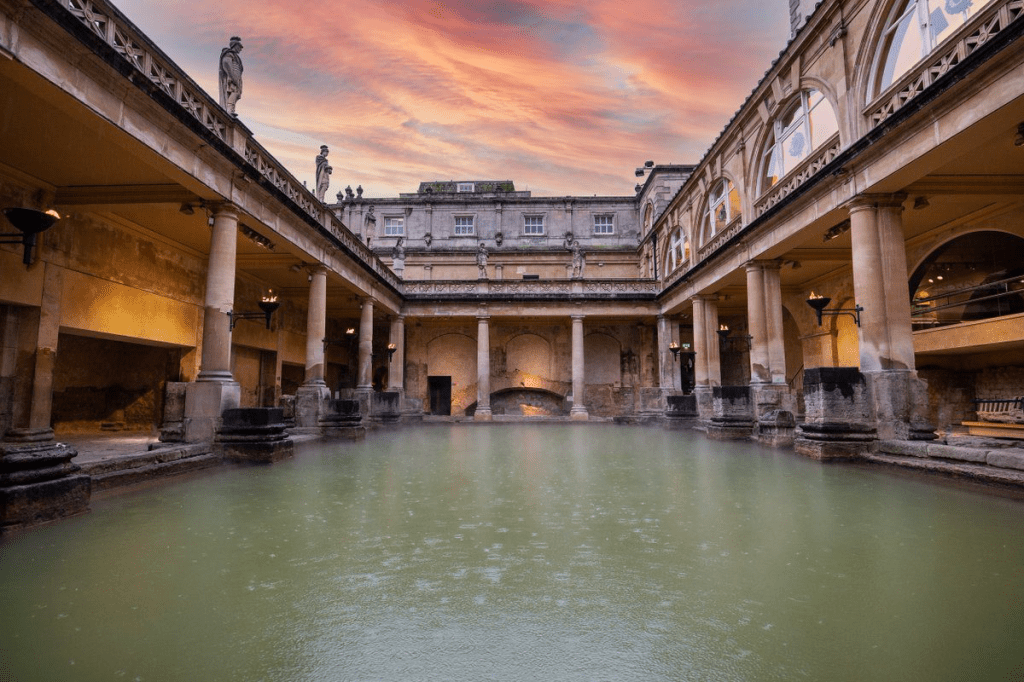
The baths themselves are the most complete Roman bathing complex in northern Europe. The Great Bath — a lead-lined pool fed directly by the natural hot spring, still steaming — was originally covered by a barrel-vaulted roof of Roman concrete, now gone. Standing at the edge of that green water, surrounded by Victorian additions but with the Roman stonework still visible beneath your feet, is one of those experiences where the distance between then and now suddenly collapses. The spring produces 1.17 million litres of water a day at a constant 46°C. It did that when the Romans were here. It will do it when we’re gone.
Hadrian’s Wall
No account of Roman architecture in Britain can omit the Wall, and not just because it’s extraordinary as an engineering achievement — 73 miles from the Solway Firth to the Tyne, with a fort every five miles, a milecastle every Roman mile, turrets between each milecastle, a vallum ditch to the south, a berm to the north — but because it raises the most interesting architectural question of the Roman period: what is a wall for?
The simple answer is defence. But Hadrian’s Wall was built (from 122 AD, under Hadrian’s personal supervision during his visit to Britain) at a point when the Roman military could have pushed further north if it had chosen to. The decision to build a wall was a decision to define an edge — to say here is Rome, and there is not-Rome. The Wall is as much a political and symbolic statement as a military one. It is Rome writing itself onto the landscape in stone, asserting that the island has been divided and the division is permanent.
The best surviving stretch is around Housesteads fort in Northumberland — wild, high, and genuinely dramatic. The fort itself preserves the barrack blocks, granaries, headquarters building, and latrines (communal, with a channel of running water beneath — another Roman hydraulic achievement). Standing on the Wall looking north into what the Romans called Caledonia you understand immediately why this was the edge. The landscape changes character. It becomes moorland, horizontal, treeless. The Wall runs along the top of the Whin Sill — a natural ridge of hard volcanic rock that the Romans adopted as their foundation. They didn’t impose the Wall on the landscape. They read the landscape and the Wall followed.

The End and the Afterlife
Roman Britain ends not with a bang but with a slow unravelling. From the late 3rd century, the empire was under pressure on multiple frontiers simultaneously. Troops were withdrawn from Britain in stages. By 410 AD, when the Emperor Honorius famously told the cities of Britain to look to their own defence, the administrative and economic systems that maintained Roman urban life were already failing.
What happened next is one of the great puzzles of British history. The towns didn’t suddenly empty. But they stopped being maintained. The hypocausts filled with rubble. The forum fell into disuse. The roads continued to be used — they were too useful to abandon — but the buildings on either side of them gradually collapsed or were cannibalised. Within a generation or two of Roman withdrawal, people were living in timber buildings inside the shells of Roman stone ones, lighting fires on the floors of rooms that had once had underfloor heating. The technology was there. The social organisation to maintain it was gone.
This is the first great lesson of British architectural history: buildings don’t die when they’re built badly. They die when the social systems that support them collapse. That lesson will repeat.
The Thread Forward
What Rome leaves behind is not just ruins. It leaves a conceptual legacy: the idea of the town as a designed civic entity, the basilica as a template for large covered public space (which Christianity will inherit almost immediately — the first churches are Roman basilicas with crosses added), the road as political infrastructure, concrete as a material that bends to complex form. All of these will resurface.
It also leaves something more subtle: the first demonstration in Britain that architecture can be an instrument of political power — that building in a certain style, at a certain scale, sends a message about who you are and who is in charge. Every subsequent era of British architecture understands this, consciously or not.
Three Questions. One: is there a dualism between Rome as the great pragmatic incorporator of the futures it subsumed and how does this square with the boundary/border creation and the maintenance of the centre – I guess a negotiation for all Empires. Two: how did the economy of the Roman built environment and technology advance work, who paid and got paid? Three: how militaristic was Rome in reality?
Three big questions. Let me take them in turn because each deserves its own space.
One: The Dualism of Incorporation and Border
You’ve identified the central tension of every empire that has ever existed, and Rome is its most instructive case study precisely because it lasted long enough and was documented thoroughly enough to show the tension working itself out in real time.
Rome’s genius was its promiscuity. It absorbed the gods, the legal customs, the architectural traditions, and crucially the administrative elites of the peoples it conquered. Sulis Minerva at Bath is the emblem of this — you don’t destroy the local cult, you give it a Roman name and build it a better temple. The conquered elite finds itself with a stake in the imperial project. Their children learn Latin, wear togas, build forums. Within two or three generations the distinction between conqueror and conquered is blurring at the top of society, which is the only place that matters for maintaining control.
But — and this is your dualism — that same promiscuity creates an anxiety about identity. If Rome absorbs everything, what is Rome? The answer, historically, was always the border. The Wall, the Rhine, the Danube. The border is not just a military line. It is the answer to the question of what Rome is: Rome is the thing on this side. The border produces Rome as an identity as much as it defends it.
This is why Hadrian’s Wall is so philosophically interesting. Hadrian was actually one of the great incorporators — he travelled the empire obsessively, adopted local styles, was fascinated by Greek culture to the point that contemporaries called him Graeculus, the little Greek. And yet it was Hadrian who drew the hardest line. The man most committed to cultural absorption was also the man who built the most emphatic border. That’s not a contradiction. It’s the same impulse operating at different scales. You incorporate everything you can manage, and you draw a line around what you can’t.
Every empire since has navigated the same tension. The British Empire was fanatical about this — the Colonial Office simultaneously celebrating the diversity of its subject peoples and maintaining an absolute hierarchy with Englishness at the top. The incorporation was real. The border — racial, cultural, legal — was also real. The two weren’t opposites. They were the mechanism.
For architecture, the consequence is that the most interesting buildings are always at the edges of empires, not the centres. The centre produces the canonical forms. The edges produce the hybrids, the negotiations, the strange beautiful things that happen when two traditions are forced to share a wall.
Two: The Economy of the Roman Built Environment
This is a question that archaeological and economic history has only recently started to answer properly, and the answers are surprising.
The first thing to understand is that there was no single model. Roman construction operated across several overlapping economies simultaneously.
The state funded the great public infrastructure — roads, walls, forts, aqueducts, the larger public buildings in provincial capitals. And the primary labour force for state projects was the army. This is crucial and underappreciated. The legions were not just a fighting force. They were the most skilled construction organisation in the ancient world. Legionary soldiers were trained in engineering, surveying, and construction as standard. When there was no war to fight — which was most of the time in a stable province like Britain — they built. Hadrian’s Wall was built substantially by legionary soldiers, organised into work gangs, with their output recorded and inscribed on stone plaques (some of which survive) as a matter of military record and unit pride. The centurion was a construction foreman as much as a combat officer.
This meant that the state’s construction costs were, in a meaningful sense, already paid — the soldiers were salaried regardless. The marginal cost of building was materials and specialist skills, not basic labour. It’s one of the reasons Rome could build at such scale.
The urban elite funded civic buildings through a system called euergetism — competitive public generosity. A wealthy citizen or local magistrate would pay for a bath complex, a temple, a market building, as a demonstration of status and civic virtue. The building would carry an inscription recording the donor’s name and the gift. This was not pure altruism — it was reputation management, social capital accumulation, and political positioning simultaneously. It also meant that Roman towns received a continuous stream of privately funded public buildings without any central coordination requiring it. The incentive structure did the work.
Specialist labour was a complex market. Architects — architecti — were educated professionals, sometimes slaves of exceptional skill owned by wealthy patrons, sometimes freedmen operating independently, occasionally freeborn citizens. Vitruvius, who wrote the only surviving Roman architectural treatise (De Architectura, which will resurface repeatedly in our story), was a military engineer who worked for Julius Caesar and Augustus. The trades beneath the architect — masons, plasterers, mosaic workers, tile makers — operated through guilds (collegia) that controlled training, standards, and to some extent pricing.
Materials were where serious money moved. Stone had to be quarried, sometimes transported enormous distances. The Purbeck marble used for decorative work in Roman Britain came from Dorset. Some fine marbles were imported from the Mediterranean at extraordinary cost — their presence in a building was itself a statement of wealth and connection to the imperial centre. Tile manufacture was partly military (legions had their own tileries, stamping their products with the legion’s mark — you can identify which legion built what from the tile stamps) and partly commercial, with civilian tileries supplying the private market.
What’s striking is how monetised the Roman construction economy was compared to what came before and immediately after. There were contracts, specifications, professional liability. Vitruvius discusses at length the responsibilities of the architect to the client and the standards to which work should be held. This is a recognisably modern professional relationship, and it collapses almost completely after Roman withdrawal. The post-Roman building economy is a barter and obligation economy, not a money economy. That shift — from monetised professional construction to feudal labour obligation — is one of the reasons post-Roman building looks so different. It’s not just that the knowledge was lost. The economic infrastructure that made sophisticated building possible had dissolved.
Three: How Militaristic Was Rome in Reality?
Less than its self-image suggested, and more than its admirers have sometimes wanted to admit.
The honest answer is that Rome was militaristic in its foundations and its ideology long after military conquest had ceased to be the primary mechanism of its power. The Roman state was, in origin, a city that survived by conquering its neighbours and then found it couldn’t stop. Each conquest created new borders that needed defending, which required more legions, which required more tax revenue, which required more conquest to acquire more taxable territory. The expansion was partly ideological and partly a self-perpetuating economic logic.
But by the time Rome was building seriously in Britain — the 1st and 2nd centuries AD — the empire was in a phase of consolidation, not expansion. The military was enormous (perhaps 400,000 men under arms across the whole empire at its peak) but most of it was engaged in garrison duty, road building, and border patrol, not active campaigning. Britain after the initial conquest was a relatively stable province. The military presence was real and permanent — you were never more than a day’s march from a fort — but the experience of Roman Britain for most of its inhabitants most of the time was not of military occupation in the way we might imagine it. It was of tax collection, legal administration, and the slow cultural pressure of a dominant civilisation.
The violence, however, was always available and was used without hesitation when required. The destruction of the Druidic centre on Anglesey in 60 AD — the Romans apparently terrified by the Druids’ ritual cursing on the shoreline but crossing anyway and killing everything — and the suppression of Boudicca’s revolt, which ended with a pitched battle in which the Romans killed an estimated 80,000 Britons, were not anomalies. They were the iron fist inside the toga. The incorporation was always backed by the demonstrated willingness to annihilate resistance.
What Rome was not, by the time it reached Britain, was a society in which military values dominated civilian life in the way they had in the early Republic. The Roman citizen of the 2nd century AD was not primarily a soldier. He was a litigant, a businessman, a patron, a client. The law was more central to Roman identity than the sword, which is perhaps why the basilica — the law court — became the most copied building type in Western history. When Christianity needed a building form for congregational worship, it didn’t take the temple (too pagan, too exclusive — the congregation waited outside while priests performed rites within). It took the basilica. The building where justice was administered became the building where salvation was offered. That’s not an accident. It tells you what Rome had actually exported: not military organisation but legal and civic culture, and the architectural forms that expressed it.
The thread that connects all three answers is this: Rome’s real power was not military force but institutional depth — the ability to create self-replicating systems of law, economy, and culture that outlasted any individual emperor or legion. The buildings were the physical expression of those systems. When the systems collapsed, the buildings followed. But the ideas encoded in the buildings — the basilica, the civic forum, the engineered road, the negotiation between local and imperial identity — those proved almost impossible to kill entirely.
Key Sites to Visit
Housesteads Fort & Hadrian’s Wall, Northumberland
The best-preserved Wall stretch. The fort preserves barrack blocks, granaries, and latrines. Looking north from the Wall, you understand immediately why this was the edge.
Roman Baths, Aquae Sulis, Bath, Somerset
The most complete Roman bathing complex in northern Europe. The Great Bath still steams. The temple pediment — a Celtic gorgon in a classical frame — is the hybrid at its finest.
Roman London, City of London
The London Wall fragments at Tower Hill and the Museum of London. The Mithras temple (now at Bloomberg). The ghost of the largest basilica north of the Alps beneath Leadenhall Market.
Colchester Castle Museum, Essex
Built on the vaults of the Roman Temple of Claudius — the largest surviving Roman vaults in Britain. The first Roman city in Britain and the focus of Boudicca’s revolt.
York (Eboracum), Yorkshire
The Roman column in the Minster undercroft. The Yorkshire Museum with its Roman collections. The city where Constantine was proclaimed emperor in 306 AD.
Chester (Deva), Cheshire
The most complete Roman street plan of any British city. The amphitheatre. The Grosvenor Museum’s Roman collections. The city walls follow the Roman line throughout.
Verulamium Museum, St Albans, Hertfordshire
The best in-situ Roman mosaic floors in Britain. The hypocaust system still visible. St Albans Cathedral next door is built from recycled Roman brick — the Roman quarry made medieval.
Fishbourne Roman Palace, West Sussex
The largest Roman domestic building in Britain, c.75 AD. Extraordinary mosaic floors still in situ. The formal garden has been replanted to the Roman pattern.
Bignor Roman Villa, West Sussex
Very fine, Roman mosaic floors.
Brading Roman Villa, Isle of Wight
More fine, late Roman mosaic floors.
Vindolanda, Northumberland
The writing tablets — personal letters, shopping lists, a birthday party invitation — are the most intimate Roman voices from Britain. Active excavation site; finds appear every season.
Caerleon Roman Fortress and Baths, Newport, Wales,
A unique opportunity to study the archaeology of a Roman Legionary fortress, less affected by medieval and subsequent urban activity.
Anglesey / Mona, Wales
Site of the Roman destruction of the Druidic centre in 60 AD. Tacitus describes the Roman soldiers frozen by the ritual cursing of the Druids on the shoreline before crossing anyway.


Leave a Reply