
The Unreturning at Theatre Royal Stratford East review *****

The Unreturning

Theatre Royal Stratford East, 24th January 2019

Denizens of Leicester, Swansea and Oxford. Consider yourself lucky. There is still time for you to catch the tour of Frantic Assembly’s The Unreturning which has already travelled to Plymouth, (the Theatre Royal who cannily commissioned it), Southampton, Edinburgh, Liverpool, Birmingham and Chichester, as well as Stratford East. For make no mistake this is a fine piece of theatre that deserves your attention for a number of very good reasons.

First off Anna Jordan is clearly a very talented playwright. I haven’t seen Yen, her much lauded breakthrough play, though on the strength of this I really hope it is revived soon. I am though looking forward to what she brings to Brecht’s Mother Courage which she has adapted and which has just opened at the Royal Exchange Manchester.

In The Unreturning she has interwoven the stories of George, Frankie and Nat, who return to their home town of Scarborough, damaged from their experience of war. In 1918 George is shellshocked after his experiences in the trenches in WWI and his wife Rose cannot cope with his breakdown; in 2013 disgraced Frankie is not welcomed back as a hero from his turn in Iraq and cannot put a lid on his anger; and Nat is stricken by guilt about the brother Finn he left behind after escaping as a refugee to Norway in 2026 from a future British civil war. Scarborough may be home but they are not welcome. Time may move on but the issues the returning combatants face remain the same.

This is no naturalistic drama however as Ms Jordan has created a far more episodic and lyrical structure for drama and text. That is not to say that the narrative does not quickly come into focus. The three opening monologues which together form a prologue, describe what each of the three protagonists are aching to experience when they come home, and that, together with the experiences they bring back with them (which go well beyond the simple “war is hell”), forms the nub of the play. In each case the multiple characters that Ms Jordan also introduces, as well as the prudent use of a chorus, serve to flesh out the personal histories and create real drama. The chorus, as well as further monologues, also n’tbring real poetry to contrast with the dialogue of each short scene.

As if that was enough, Frantic Assembly’s trademark physicality also brings a further, thrilling, dimension.. At first glance, Andrzej Goulding’s set, a revolving (when pushed, no fancy technology at TRSE) shipping container, is hardly revolutionary, but when combined with his strikingg video design (for which he is more renowned), Zoe Spurr’s prominent lighting design and Pete Malkin’s bold electronic soundscapes, the effect is invigorating. Especially when combined with a four strong cast who are constantly in motion. It is difficult to believe that they play all twenty five named parts, in addition to the chorus, as well as shifting sets and props. An immense technical achievement, especially when I see no attributed movement director. Though as it happens the stock-in-trade of director here, Neil Bettles, who is a Frantic Assembly Associate Director, is movement.

Of course with this much activity it occasionally takes a second or two to work out exactly who is who in each scene though the reason for each of the supporting characters being there is plain enough to fathom. The cast. Jared Garfield (Frankie), Joe Layton (George), Jonnie Riordan (Nat) and Kieton Saunders-Brown (Finn), are all past alumni of Frantic Assembly’s Ignition project which each year supports twelve young men from across Britain from backgrounds which normally preclude access to drama education to create a performance over a week in London. Whilst all of them have gone on to successful TV and theatre careers they have come together to work on The Unreturning offering conclusive proof, if such where needed, of just how effective this venture has been. They are all tremendous, not just in the effort they put in, but in the way they tease out character from relatively few lines and from the ensemble effect they create. I would happily watch this team, with this creative team, in a future production. In fact I would watch them all again in an extended version of each of the three intertwining stories.

Regular readers of this blog will know that the Touris,t given that he loves his theatre, and, he contends, chooses wisely, is easily pleased. But you don’t have to take his word of it. The matinee performance he attended was chock-a-block with local schoolkids, the TRSE not having forgotten its local identity even as AD Nadia Fall looks to broaden its audience and create destination theatre (which this most certainly is). Always a discerning audience, there was the usual shuffling and tittering early doors but pretty soon these young’uns where as gripped as I was.

I see that the proper reviewers were generally not as overwhelmed as I was with many emphasising the triumph of technical style over dramatic substance. They are wrong. Yes it is a viscerally exciting piece, with a clear message, but it is also expertly constructed and beautifully written. I know we are only a couple of months in, and this is not quite the best play the Tourist has seen this year, that honour goes to Sweat at the Donmar, (now transferring to the Gielgud I see – do not miss), but I reckon it it will prove one of the most ambitious and memorable theatrical experiences of this or any other year.
I’m Not Running at the National Theatre review ***

I’m Not Running

National Theatre Lyttleton, 22nd January 2019

If you have a moment one day take a look at the writing credits of David Hare, both for stage and screen. There are a lot, including some of the finest dramas written in the English language over the past four decades. And he shows no sign of slowing down in contrast to some of his eminent peers. I enjoyed his interpretation of Chekhov’s The Seagull and his last original play, The Moderate Soprano, (even if it veered towards the hagiographic), as well as his screenplay for the film Denial, and prior to that the Worricker thriller trilogy on telly, which he also directed. I can’t say I was completely persuaded by The Red Barn, his adaptation of a Georges Simeon story, his last outing at the NT, though it looked brilliant nor by Collateral, his four part TV police procedural/thriller on the Beeb last year, which was packed with detail and performance but didn’t quite hang together (especially when compared to the likes of Line of Duty and Informer).

So is the old boy going off the boil. Well, obviously not. Here is someone who can literally churn out line after line of exquisitely apposite dialogue in his sleep, (even if it does verge on catechism), his drama continues to be stuffed with commentary on big moral, political, social and economic issues, the sine qua non of state-of-the-nation drama, he can sketch out a character in just a few lines, (even if deeper psychological details can sometimes move elusive), and his stories normally have a verve and pace that rapidly draws you, in provided you are prepared to engage the brain as well as the heart. All of this is on show in I’m Not Running, which also features a couple of bravura lead performances from Sian Brooke and Alex Hassell (and fine supporting turns from especially Joshua McGuire and Amaka Okafor, Brigid Zengeni and Liza Sadovy).

Yet it is not an entirely convincing play and, IMHO, falls short of vintage political Hare seen in the likes of Gethsemane, or The Power of Yes and Stuff Happens, and falls well short of the likes of The Secret Rapture, Plenty or, on a similar theme, The Absence of War. This, I think reflects, the slightly awkward conjunction of the personal connection and political rivalry of the main characters Pauline Gibson and Jack Gould, and the censure of a Labour party, (always a favourite target for Hare), which smacks more of the Blair years than the current incarnation. There is surely much that Mr Hare could have criticised about the current Opposition in his play, notably its enabling of Brexit, but here we are asked to look instead at how the party machine locks out “outsiders”, specifically a woman, in favour of well-connected, “professional” politicians, with the NHS as the idealogical battleground. Whilst the points it makes, and this being David Hare, the way it makes those points, are elegant and indubitably valid, the absence of Corbyn, Momentum and the B-word, seems curious.

The play opens with a media scrum ahead of an announcement from Pauline Gibson (Sian Brooke) and her adviser Sandy Mynott (Joshua McGuire) about whether she will stand as leader of the Labour Party. We then flashback to Newcastle University in 1997 and the Blair landslide when Pauline, a headstrong medical student, and boyfriend, hesitant would-be lawyer, Jack (Alex Hassell), are splitting up. Pauline, whilst dealing with the fall-out from her alcoholic mother Blaise, (a savvy, though somewhat wasted, performance from Liza Sadovy), enters Parliament as an Independent defending her Corby hospital from closure. She crosses paths again with Jack, scion of an intellectual heavyweight of the Left, who is now a smooth careerist rising up the Parliamentary ranks tasked with NHS reform. Principles vs pragmatism, single issue vs party machine, popularity with party and public, institutional sexism in politics, all are explored against the backdrop of the smouldering passions of the voluble couple.

It is still a testament to Mr Hare’s dramatic gift that the arguments can be interrogated without any hint of cumbersome exposition and that the characters he recruits to the cause still come across as real, if not in both cases here, as completely likeable. Director Neil Armfield could hardly do more to tease out the detail of the text and Ralph Myers rotating blank room set doesn’t get in the way (though there are occasions when the actors look a little lost when standing at the wings of the Lyttleton stage).

Sian Brooke’s Pauline contains enough distanced vulnerability to set alongside her self-righteousness and Alex Hassell’s fly-by-night Jack convinces as he treads the path littered with compromise that he was ordained to follow, but the Tourist couldn’t escape the feeling that this was all a little bit David Hare by numbers and that the couple, even with the supporting characters, seemed to be operating in a bubble devoid of external context. Still well worth seeing though for me James Graham’s Labour of Love was a far more entertaining, and insightful, take on similar territory.

Stan and Ollie film review ****

Stan and Ollie, 22nd January 2019

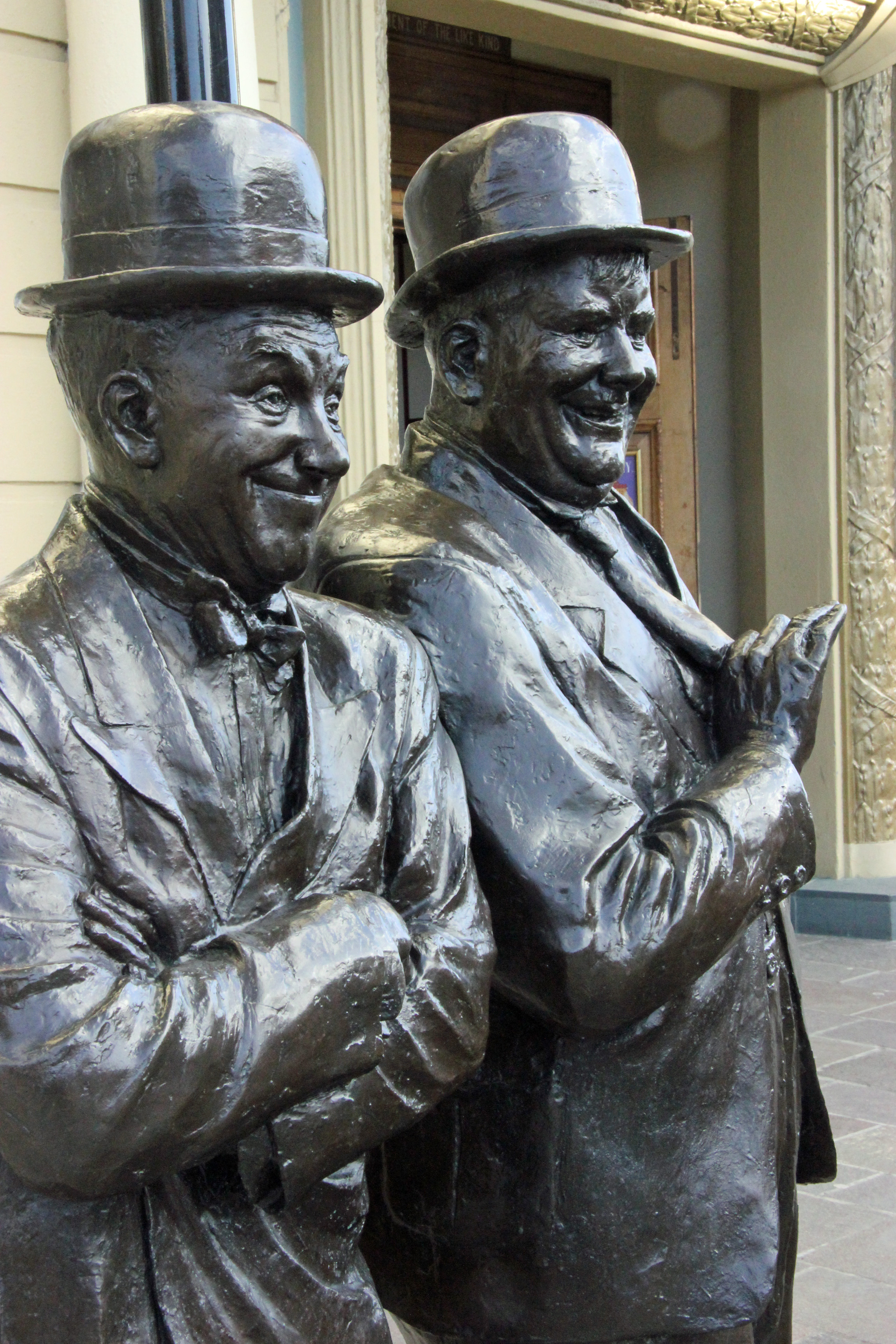
For the avoidance of doubt the two fellas above are not Steve Coogan and John C Reilly, the stars of film Stan and Ollie, nor indeed are they yer actual Stan Laurel and Oliver Hardy. No this, obviously is a statue of the comedy duo, courtesy of artist Graham Ibbesson, propped up against a lamp post outside the Coronation Hall in Ulverston near the seaside in South Lakeland, Cumbria. Where Stan Laurel was born. Pretty good likenesses you’ll warrant. Art initiating life imitating art imitating life …. you get the picture.

For imitation is what the film does best as the two lead actors turn in a couple of memorable, painstakingly detailed, turns as the beloved S&O. The story charts the return of S&O, down on their uppers, to Britain in 1953 to undertake a tour, organised by impresario Bernard Delfont (a well cast Rufus Jones). Only the boys are not offered much in the way of quality venues, (Delfont preferring the questionable comedy talents of one Norman Wisdom), so start off playing to tiny, nostalgic crowds Oop North, with Stan reassuring Ollie that, once in London, he can secure the backing for a new film script, a Robin Hood spoof, that will rehabilitate both reputation and bank balance. Word of mouth, and immortal talent, turns the tour into a massive success, and the lads are joined by wives, the devoted and fiercely protective Lucille H (the ever brilliant Shirley Henderson) and the terse Russian Ida (a pitch perfect Nina Arianda), comically hamming up their own rivalry (“two double acts for the price of one”). Cue a falling out and reconciliation when Ollie’s health takes a turn for the worse.

So cliched you could barely make it up. Except that it is true. And these are about the most lovable pair, as portrayed and in reality, that you could want to watch. There are obviously generations, my age or older, who are familiar with Laurel and Hardy from repeats on the telly. There will be other youngun’s as well, I am sure, who will have discovered them through their own volition or Mum and Dad’s reminiscing. Whatever, there was clearly going to be enough of an audience to make this film a success.

Which may also be why it is played so straight. Not straight as in lacking humour. Like I say Messrs Coogan and Reilly have the routines of S&O down to a tee. As they do when it comes to the more complex off-stage/screen personalities. Vocally and physically the resemblances are uncanny. No, it is just that the way the story is told contains next to no surprises. It isn’t mushily sentimental, but it doesn’t take any risks at all. It is cheesy, sweet and melancholic in all the right places. The two leads, director Jon S Baird and writer Jeff Pope (co-writer on Steve Coogan’s other major big screen success Philomena), all plainly, and rightly adore their subjects but a slightly less decorous tone might have paid dividends.

Still the best bits, the dolly shot opening in the Hollywood back-lot, Stan sticking it to Hal Roach (a cameo from Danny Houston), Newcastle in the rain, the “hospital sketch” repetitions (especially the exchange on Ollie’s actual sickbed), the double door routine, the ladies bitching at the reception, the venue interiors, Stan looking wistfully up at the Abbott and Costello film poster, are undoubtedly effective, laden with pathos, humour and affection. Cinematographer Laurie Rose takes much of the credit and the make-up and prosthetics of Jeremy Woodhead and Mark Coulier, turning John C Reilly into Oliver Hardy, especially in the later scenes, is remarkable.

All in all a very nice, touching and amusing film. Make of that what you will.

The Cane at the Royal Court Theatre review ***

The Cane

Royal Court Theatre, 21st January 2019

Somehow, until now, the Tourist has failed to see any of the work of Mark Ravenhill, either as writer, performer or director, or even his columns in the Guardian, surprising given the Tourist’s status as a paid up Guardianista. There was a recent revival of his breakthrough play, Shopping and Fucking, at the Lyric Hammersmith, but sadly the performance the Tourist signed up for was cancelled. (Made worse by the fact that the Tourist had gone straight to the theatre from an outing elsewhere during a period of deliberate mobile phone estrangement. It should be possible to chuck the bloody thing away, and to this day the Tourist doggedly persists without data, ring-tone or any social media, but realistically the everyday organisation of modern life prohibits a complete embargo. That, and the unhealthy compulsion to surf free wi-fi so as to rubber-neck the latest instalment in the Brexit car-crash).

Anyway the chance to see Mr Ravenhill’s latest play, after a hiatus of many years, at the ever reliable Royal Court, and its apparent subject, the education system, was not to be missed, and the SO agreed. Especially when directed by RC AD Vicky Featherstone and with a cast comprising Alun Armstrong, Maggie Steed and Nicola Walker. You will know all three off the telly, but their stage appearances are all too rare, though Maggie Steed was in the first instalment of Jamie Lloyd’s current Pinter anthology, and it was a privilege to watch Nicola Walker’s brand of nervy, restless emotional plasticity being applied to the role of Beatrice in Ivo van Hove’s A View From The Bridge.

Vicky Featherstone kicks off proceedings at a fair lick as we learn that Edward’s (Alum Armstrong) retirement as a teacher after 45 dedicated years is being disturbed by his historical engagement with capital punishment and by his school’s imminent takeover by an academy. There is a mob of kids outside Edward and Maureen’s (Maggie Steed) house and their estranged daughter Anna (Nicola Walker) has now turned up. It is a somewhat improbable set up but no matter. Mt Ravenhill uses this as a jumping off point to explore the uneasy relationship between the fretful couple and their seething daughter, how we apply the morality of the present to actions in the past, how much responsibility an individual should assume, and how much an institution, for excessive punishment and how violence and disciple become conflated, accepted and even internalised,

Within this tricky web Mark Ravenhill, using precise and considered language, cleverly shifts moral perspectives around and between the questions and the characters, sometimes even on a line by line basis. He asks a lot of questions but is never so crass as to give clear answers. There is a constant undercurrent of tension and hostility fuelled by the subject matter, and the symbolic cane, the weight of the past and the menacing family dynamic, visually realised in Chloe Lamford’s off-kilter, grim, and increasingly claustrophobic, set. The three actors are superb in the way they draw us in to this queasy moral maze. The looks they give each other, the barbs that they spit out, the arguments they advance and retreat from, the flashes of violence and acquiescence, all are expressively portrayed. However, over the unbroken 100 minutes or so, the flaws of all three characters become unremitting, the premise becomes over-stretched and just a teensy bit too slippery and the dialogue just a bit too predictably adversarial.

It made us squirm, it made us think and the acting is top notch. But this is a play that deliberately sets the audience outside its world. Fair enough but it might have worked better for us in more concentrated form, or with some eventual solid pay-off to all the rug-pulls and hypocrisy exposures.

Keep: Daniel Kitson at Battersea Arts Centre review *****

Keep, Daniel Kitson

Battersea Arts Centre, 20th January 2019

Beckett, Pinter, Stoppard, Kitson. I know, I know. He is only a stand-up comedian. So comparing him to these master explorers of the absurdity of the human condition is, to say the least, stretching it a bit. However, as those of us who have become addicted to his “story shows”, (I don’t think DK would like to think he has “fans”), as well as his “stand up”, in recent years. he is a very clever fellow, as are the chaps above, he is very funny and he delivers startling insights. Yes the conceits that underpin the structures of these stories can be as pretentious as they are inventive, and once set-up it is usually pretty easy to see where they will end up, (though the pay-off here is still worth the wait), and yes the man himself, or rather his persona, and his repeated tropes can be annoying, but when he hits it no-one comes close. And that includes many great dramatists who search for tragic-comic perfection.

In Keep he hits it. No question. The preamble, where he gives the audience a chance to excuse itself, as he describes what is coming, the threat, to read out a list of everything he owns, the diversions and repetitions which follow, the self reference, self reverence and self revelation, (now’s who’s being pretentious), the gentle provocations, the playful aphorisms, all are present and correct and all beautifully delivered. Maybe by the end the various layers become a bit too meta, and maybe, as DK himself admits the metaphor of stuff in filing cabinet for mind and self is a bit too creaky, and could be applied by anyone to anyone, but frankly I don’t care as no-one else comes close to being able to create this kind of work.

Don’t worry, there are plenty of laughs. And for those who appear to think it is too long I suggest they need to work on their attention spans. I would have taken another couple of hours no problem. Of course it meanders and digresses, it’s Kitson FFS, but, certainly not in the performances I saw, without considered effect. Love, loneliness, hope, regret, memory, agency, language, he has covered this territory before, but these are the staples of many of the modern dramatic greats including those mentioned above.

And all this for £12. It’s gone now. Don’t miss the next one.