
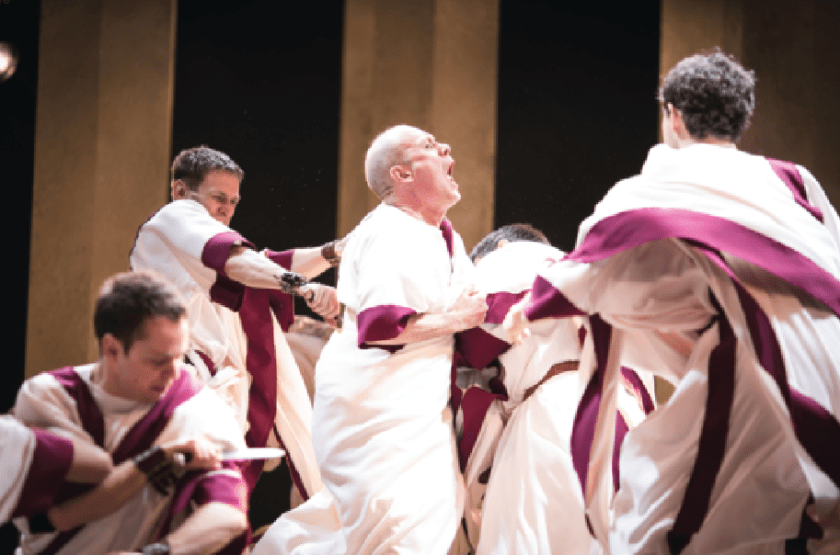
Julius Caesar
Royal Shakespeare Company, Barbican Theatre, 11th January 2018
The third instalment, (for me), of the RSC “Rome” season at the Barbican which originally aired at Stratford. And, as is so often the case with this idiotic blog, it is about to end and is sold out anyway. Et tu numbnut.
Now JC (1599) was written a fair few years before its sequel, Antony and Cleopatra (1606), but both draw heavily on Plutarch, (via Sir Thomas North’s translation), for the guts of the story. Yet they could not be more different in tone. JC is austere in its construction of architecture and language, dripping with rhetoric. A&C is loose-limbed and florid as we watch the saucy couple get it on, often funny, and certainly over the top. All will be revealed when I see A&C as the last part of the RSC quartet shortly. (I note this attracted the most glowing reviews of the four).
I have to say that, generally, JC is my favourite of the two. Here we have four chaps, (unfortunately this is a terrible play for female roles even if the sensible trend to cast Cassius as a woman is followed, though it is not here), whose actions and relationships can be interpreted in an infinite variety of shades. In this production we have an unyieldingly peremptory Julius Caesar courtesy of Andrew Woodall, (nailing all that third person humblebragging), an overly smug and somewhat vain Brutus from Alex Waldmann, a Mark Antony who is more devious than he at first appears from James Corrigan and a vituperative, beguiling Cassius from Martin Hutson. I have to say this latter performance brought out facets of Cassius that I had not observed before, and, as with his Saturninus in the RSC Titus Andronicus, Mr Hutson near stole the show. Alex Waldmann is the go-too if you want a character “plagued by doubts”, (last seen by me as a brilliant Henry VI in the Rose Kingston’s War of the Roses), but the way Martin Hutson works off of his uncertain Brutus is just mesmerising.
Will S’s brilliant innovation in JC is to telescope all of the action up to the big man’s brutal knifing by the conspirators into what seems like just a couple of days. This means the reasons for the conspiracy, to take down Caesar who has got way too high and mighty in an echo of the Roman kings of pre-Republic days, come flying out of the blocks thick and fast. This resolutely includes the personal as well as the political.
Angus Jackson’s direction allows the momentum to build whilst still clearly laying the arguments around the use and abuse of power, the morality of rebellion against oppression and the legitimacy of political assassination. It is not what Caesar has done, but what he might do. On whose behalf are the conspirators acting, the people or themselves and their own class? The hoi-polloi is never happier than when they have a “strong” leader remember. The uncertainty around what would happen after QE1 died, in the context of the struggle between Protestant and Catholic, would have been clear to Will S’s contemporary audience. The impact of uncertainty is just as clear now.
But big Will didn’t stop there. Oh no. The carnage “unleashed” in the aftermath of JC’s death as Mark A and Octavius put the plotters to the sword, whose own resolve is shattered, is just as effective and thought-provoking. That is the problem with regime change. It usually goes t*ts up because none of these blokes thinks about what happens next. All summed up in two minutes with the horrific murder of Cinna by the confused mob.
Because we never learn Will S can keep on teaching us. Clever huh.
And, in this production, with complete clarity in the delivery of the lines, it was very easy to see that the main players were as much victims, as shapers, of events. The conspirators were uncertain, their tone and movement revealing the dissension between them. Caesar has got all imperious in part because no-one stopped him. Mark A’s sycophancy reflected an eye to the main chance: his famous rhetorical speech to the crowd, cynical, a man realising he could seize control. Watch him build up, then tear up, Caesar’s will. Cassius egging on Brutus, not prepared to take the lead. Brutus and Cassius falling out big time in the tent but always knowing they had to make up since they only, ultimately, had each other. Kidding themselves they really were “honourable” even to the end by getting some poor sap to administer the “coup de grace”. Honour in our appallingly individualistic society may look like an anachronistic concept, but the effect on the audience of its study in this play suggests it still has a place in our hearts and minds.
No need for modern dress. Togas are fine. Would sir like Doric or Corinthian columns. No need for video of an orange Donny spouting hate or rioting millenials. No need to ham up the famous lines or cut out Will’s words. Frankly no need for an interval if it were my choice. One of the best ways to see and hear JC is still Mankiewicz’s 1953 film with Gielgud. Mason and Brando. Not to be confused with Stuart Burge’s 1970 film with Gielgud effortlessly shifting from Cassius to Caesar, but with execrable performances from Charlton Heston as MA and, worse still, Jason Robards as Brutus who appears to have wandered out of an old folks’ home.
Now I am not saying that JC cannot benefit from a little bit of tidying up and reshaping. I think Phyllida Lloyd’s all-female outing at the Donmar was the best of her trilogy last year, (and was a top ten production for me), and Hans Kesting’s speech to the crowd in Toneelgroep Amsterdam’s Roman Tragedies might just be the best 10 minutes of theatre I have ever seen. It’s just that the play can be as, if not more, powerful as a whole, without needing the full directorial vajazzle. I see that many of the proper reviews felt this production was all a bit old-skool, declamatory. I disagree. It is about the power of language to change the direction of political action. Praxis if you will. So emphasising that language should not be seen as embarrassing.
The good news is that we have another chance to see JC in the very near future, (from 20th Jan), as Nick Hytner and team at the Bridge Theatre have a crack. With Ben Wishaw as Brutus, Michelle Fairley as Cassius, David Morrissey as Mark Antony and David Calder as Caesar. How about that for casting. Can’t wait.
 At Home He Feels Like A Tourist