

Forgotten
Arcola Theatre, 10th November 2018
I was much taken, if not entirely convinced, by the British East Asian Yellow Earth Theatre company’s version of Tamburlaine at the Arcola 18 months ago. And this co-production, with Moongate, of a new play, Forgotten, by Daniel York Loh, which kicked off at the Theatre Royal Plymouth, sounded like it needed seeing.
Daniel York Loh looks like he is a busy fellow. When he is not writing he is acting, directing films or performing in a folk trio. Busy. Just like this play. It started off as a 5 minute script. It now runs to a couple of hours. Apparently his first draft ran to 300 pages. DYL has a lot to say and he means to say it. Mind you this is a story evidently worth telling. Giving a voice to the 140,000 Chinese labourers who left China to initially assist the French, and then the British, effort in WWI. Largely written out of history.
In trying to cram in as much of his research into these events as he can, the appalling famine and poverty blighting China at the turn into the C20, the hierarchical, violent and patriarchal village society, the volatile political situation and domination by foreign powers, the dream of escape and wealth, the Western view of China, and the Chinese view of the West, and Japan, at the time, the experience of the labourers in France and their shabby treatment, and their legacy, after the War, DYL offers a little too much exposition, a slight overdose of plot and leaves his characters looking a little too one-dimensional. Especially given only a six strong cast, (with some doubling up), the compact Arcola studio space and an experiment in form, namely having his band of villagers putting on a Chinese opera as they embark on their adventure.
So the cast and the creative team, director Kim Pearce, designer Emily Bailey, composer Liz Chi Yen Liew, lighting designer Jessica Hung Han Yun, sound designer Luke Swaffield and movement director Quang Kien Van had their work cut out to make this work.
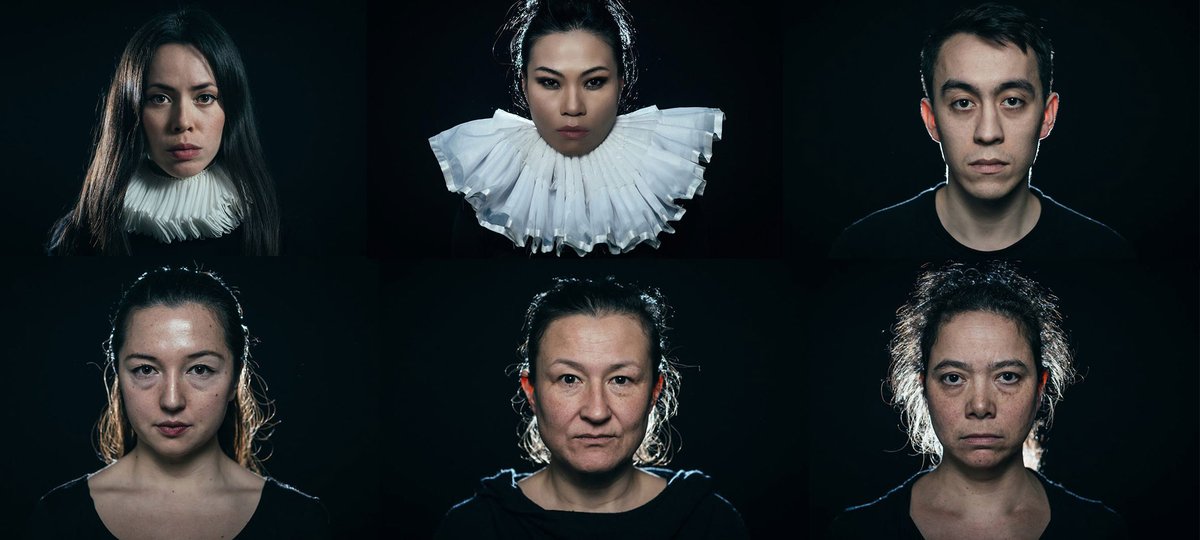
Work it does though and this I think is largely down to the fact that, weaved into the important history lesson, there is a believable human drama here, especially when the friends get to the Western Front in the second act. The play begins at the end but I’ll keep schtum on that. The cast are performing an opera which tells the tale of a Miraculous Traveller, (I am afraid I know nothing about Chinese classical literature), paralleling the story of the villagers. When all calms down we are in Horse Shoe Village in Shandong province in 1917 where Old Six (Michael Phong Le) and his wife Second Moon (Rebecca Boey) are struggling to earn enough to feed their young child. Big Dog (Camille Mallet de Chauny) is the village outcast, addicted to opium. Eunuch Lin (Zachary Hing) was castrated in a failed attempt to secure a position in the Emperor’s household. All are subject to the cruel whim of foul-mouthed Headman Zhang (Jon Chew). They agree to be recruited into the Chinese Labour Corps (from 1917 China declared war against Germany and Austria-Hungary) meeting the educated Professor (Leo Wan), and when they get to France, Wild Swan (Jon Chew again, equally potty mouthed) along the way.
Whilst there are battlefield scenes DYL wisely cuts these with other encounters and other characters, as well as the highly stylised opera, to offer multiple perspectives on the experience of the friends. This shines a little light on the more universal East Asian diaspora myth, “silent”, “hard-working” but largely disregarded and culturally held at arms length.
A valuable, if slightly awkward epilogue, explains what happened to Shandong province after the war and how the Chinese contribution was, literally, painted over in the now largely Americanised Pantheon de la Guerre. (America has a long history of mocking the contribution of France in global conflict). China was properly shafted at Versailles. Most of the surviving CLC returned home, but a few thousand stayed to build a Chinese community in Paris. The British CLC were given a medal, but it was bronze, not the silver awarded to everyone else who fought. There is a cemetery at Noyelles-sur-Mer on the Somme which honours 842 CLC dead.
So overall Forgotten is an ambitious play, generously and vigorously told by an excellent British East Asian cast (Leo Wan, in particular, is as good here as he was in Tamburlaine and The Great Wave, and I look forward to seeing Michael Phong Le again). Lucy Bailey’s set is effective, Kim Pearce’s direction manages to maintain the momentum even as the scenes jump around. It may not quite be the finished article but it definitely deserves a wider audience. I spy a couple of harsh reviews in the national press. Ignore them.
 At Home He Feels Like A Tourist