
Rembrandt’s Light at the Dulwich Picture Gallery (and others) review *****

Rembrandt’s Light

Dulwich Picture Gallery, 17th January 2020

The Tourist has been a bit remiss in keeping up the records on art exhibitions over the last few months so in addition to the above he will offer a few thoughts on other visits.

Rembrandt‘s Light first. The DPG exhibition space is bijou. Just four rooms. Which means you have to time your visit to get a good look. Left this late in the run but not too late but was still worried it might be busy. No need to worry. Late in the day worked.

It’s Rembrandt. With a twist as the rooms imagine the kind of light that the old, (and young with plenty of early/mid work on show,) boy was trying to capture. Like some sort of modern designer/cinematographer. Hence the drafting in of one Peter Suschitzy, a cinematographer on shite like Star Wars to light the show. Daft idea no? Still doesn’t matter. It’s Rembrandt. And by cobbling together loans from the great Rembrandt collections, including the likes of the Louvre and the Rijksmuseum, these 35 often still breathtaking paintings, and a fair few drawings and prints, show just what RHvR could create from one light source and often simple subjects.

So if you ignore all the stupid effects and dispense with an audio guide, (why do I need to listen to someone chirruping on when I should be looking and seeing, information can come later, or before), you’ll be reet. No need to filter these marvels through contemporary reception. If a punter wants to turn art into a flat, lifeless, colourless thumbprint on a phone let ’em I say. Though why they feel the need is a mystery to me. But if you want the hair-raising thrill of imaging just how RHvR fight multiple ways to shine a light on darkness, metaphorically as well as figuratively, then stand and stare.

The portraits at the end, (though I was floored by the Portrait of Catrina Hooghsaet from a private collection – lucky bastard), some of which will be very familiar to Londoners, and the earlier works (and School of) are a little less diverting. However the core of the exhibition, either side of the fake candlelight octagon, (and excluding the mess the concept made of Christ and Mary Magdalene at the Tomb from the Queen’s collection), play a blinder, largely with more intimate works than the blockbusters left at home in Amsterdam. The Flight into Egypt (see above), The Denial of St Peter, The Presentation in the Temple, the studio room etchings and drawings, many just student exercises, Philomen and Baucis, The Entombment, present drama where the biblical sources barely matter. Who’s that there lurking in the darkness? What’s going on in their minds? What happens next?

But mostly you wonder how this complicated man could churn out this sublime stuff for money and why pretty much no-one frankly has been able to match him since.

What else then? In reverse order.

The Bridget Riley retrospective (****) at the over-lit Hayward gallery was proof that less is more when it comes to the impact of the work of the eye-boggling Op Art pioneer. I much preferred the early, monochrome dotty and “folding” checkerboard works, recently revisited with the latest, (she is still had at work aged 88), limited colour palette but was also quite partial to the candy stripes and parallelograms. The Goldsmiths student drawings and life studies, and the later, private, portraits, were new to me but the plans and sketches felt like padding. I might have preferred a little more information on the how and why of her work; the response to nature and her lifelong fascination with how we perceive and see, though the debt to Georges Seurat was acknowledged. And maybe a little bit of science: after all experimental neuroscience and psychology now offer explanations for her magic which weren’t really there in the 1960s when she found her practice. Having said that the way she messes with eyes and brain, rightly, continues to delight pretty much any and every punter who encounters her work. Perhaps explaining her popularity; this was her third retrospective in this very space.

Lucien Freud‘s Self-Portraits (****) at the Royal Academy highlighted both the honesty and the cruelty the great painter brought to his depictions of the human form. The early work reveals the egoist presenting a front to the world – plainly this was a geezer who loved himself. The game-changing addition of Cremnitz white to his palette to create the full fat flesh in which he revealed. The room of often disturbing portraits of friends and family where he lurks in the background, often in reflection. Through to the final, famous, aged nude self portrait where finally he turns his unflinching eye truly back on himself. Seems to me he channeled a fair bit of Grandad Sigmund’s nonsensical methods and conclusions into his work. There is confrontation in every painting: artist and subject, subject and observer and, thereby, artist and observer, this latter being the relationship that most intrigues. It seems he wants to exert control over us but ultimately he cannot, in the same way that however hard he looks, (his sittings were notoriously punishing), he cannot truly capture what he sees.

I like to think that Anselm Kiefer would be the life and soul of the party, a witty raconteur, putting everyone at ease. If you are familiar with his work you might see this as optimistic. AK is the artistic conscience of Germany, now 74, but still constantly returning to its past and particularly the horrors of Nazism and the Holocaust. The monumental scale of his works, the materials, straw, ash, clay, lead and shellac, the objects, names, signatures, myths and symbols, the themes of decay and destruction, the absence of humanity, all point to his provocation and engagement with his birth country’s history. And, in this latest exhibition at the White Cube Bermondsey, Superstrings, Runes, The Norns, Gordian Knot (****), apparently the devastation that we have wrought on the earth itself. The blasted landscapes are thick with paints, emulsions, acrylics, oils and, of course, shellac, then overlaid with wire, twigs and branches, as well as metal runes, axes and, another AK constant, burnt books. The vitrines which make up superstrings are full to bursting with coiled tubes overlaid with equations in AK’s trademark script. As scary, as sinister and as insistent as all his previous work.

Kathe Kollwitz was an artist who confronted war, as well as poverty and the role of women, not as abstract history but as immediate reality. The small, but perfectly formed, Portrait of an Artist (*****) exhibition at the British Museum (after a UK tour), showcased 48 of her most important prints, woodcuts and lithographs, drawn primarily from the BM archives and elsewhere. Self portraits, premonitions of war, maternal grief, working class protest, all subjects stir powerful emotion but also mastery of line and form.

Elsewhere, Bomberg and the Old Masters at the National Gallery had minimal new to me works on show by IMHO the best British artist of the C20, Leonardo: Experience a Masterpiece at the NG was a joke, I have no idea why anyone would like William Blake‘s (Tate Britain) childish illustrations and Nam June Paik‘s (Tate Modern) admittedly prescient artistic investigation into technology from the 1960s onwards left me nonplussed. The Clash collection of memorabilia at the London Museum was, like so many of these music surveys, just pointless nostalgia.

We (BD and I) didn’t really devote enough time to Olafur Eliasson: In Real Life (****) at Tate Modern, it was pretty busy, but message and invention overwhelm, even if it all feels just a bit too Instagram slick. I dragged the family around Kew Gardens one evening in September last year to see Dale Chihully‘s (****) beautiful organic glass sculpture. I was mightily impressed, SO, BD and LD less so. Bloody annoying traipse around the west end of the park when all the action was concentrated around the Palm House.

Which just leaves the massive Antony Gormley (*****) retrospective at the Royal Academy. I know, I know. There is nothing subtle about AG’s work or “brand” but it is undeniably effective, even if its meanings are often frustratingly unspecific. Coming at the end of an already dark November day, to peer at the utterly flat, and silent, expanse of briney water which filled one room, called Host, was worth the entrance fee alone. It triggers something in collective memory and experience though fuck knows what he is trying to say with it. Same with Iron Baby nestling in the courtyard. Thrusted iron shell men modelled on AG himself, famous from multiple public art installations globally, coming at you from all angles, defying gravity. AG’s body reduced to arrangements of cubes. The imprint in toast. A bunch of rubbish drawings and body imprints. A complex coil of aluminium tube, 8km in total filling one room and a mega-skein of horizontal and vertical steel poles, enclosing, of course, a figure in an empty cube, in another. A metal tunnel that the Tourist was never going to enter in a month of Sundays. Sculpture as engineering to signal an eternal, and inoffensive, spirituality. AG as Everyman. Easy enough to pick holes in but just, er, WOW.
English Chamber Orchestra at Cadogan Hall review *****

English Chamber Orchestra, Jessica Cottis (conductor), Ben Johnson (tenor), Ben Goldscheider (horn)

Cadogan Hall, 16th March 2019

  • Ravel – Le Tombeau de Couperin
  • Britten – Serenade for Tenor, Horn and Strings, Op.31
  • Purcell/Britten – Suite of Six Songs from Orpheus Britannicus
  • Stravinsky – Pulcinella Suite

I love Britten’s Serenade, first performed in 1943. It might be one of my favourite ever pieces of classical music, up there with Beethoven’s Seventh Symphony, Bach’s Violin Sonatas and, I am not ashamed to admit, The Four Seasons. I am not alone. There was a delightful senior in the lift at Cadogan Hall who concurred. But it needs a tenor and, especially, horn player, of the highest rank, to pull it off. The ECO of course has it in its genes, Benjamin Britten having been its first patron and founding musical influence.

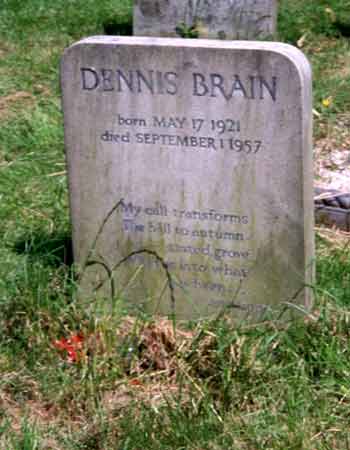
Now there are many fine recordings, (I assume based on the artists involved), but as ever in Britten’s music the best bet is to have the great man conducting and, in this, if not in all, cases, Peter Pears, singing. I can see why the experts reckon the recordings with the mercurial Dennis Brain, for whom the part was written, on horn are definitive, but the first, from 1942 a year after the piece premiered, is a bit period scratchy for my liking, emotional as it is, and the second, a decade later, falls a bit short musically. Dennis Brain might just have been the greatest horn player of the C20 coming from, and there can’t be too many of these, a veritable dynasty of horn players. He died far too young, in rock’n’roll style, by wrapping his sports car round a tree. If he had lived longer who knows what the next generation of modernist composers, the likes of Ligeti and Berio, might have conjured up for him.

As for the Serenade though I actually prefer the later Britten/Pears recording on Decca with the LSO and Barry Tuckwell on horn. More musical, and Pears less comedy toff sounding, even if the horn is a tad less mysterious. I also love the second Bostridge with the BPO and Rattle and their principal horn Czech Radek Baborak. After all Ian Bostridge is surely better than Pears in most of Britten’s supreme vocal music. On that note make sure not to miss his Madwoman in Curlew River with the Britten Sinfonia at Milton Court next March. The staging in 2013 for Britten’s centenary, directed by Netia Jones at St Giles Crippplegate, with players from the BS, and IB in the same role, was extraordinary. One of the best “opera” experiences of the Tourist’s life.

So tenor Ben Johnson and Ben Goldscheider on horn had a lot to live up to. And by and large they did. The Serenade is not performed as often as it should be IMHO which perhaps reflects the combination of small string ensemble, a skilled horn player and a dramatic tenor. Ben Johnson certainly has the flair for the dramatic, he was an ENO Harewood artist, and his clear, if not overwhelming voice, fitted the piece and hall well. Ben Goldscheider, a BBC Young Musician finalist, who is now studying with the aforementioned Radek Baborak, left a deeper impression, adept in the more virtuoso passages and capturing the mystery and thrill of the more striking passages, even if the more lyrical settings lacked a little emotion.

The six movements, (book-ended by solo Prologue and Epilogue for the horn eschewing valves to create natural harmonics), comprise settings of poems by Charles Cotton (Pastoral), Tennyson (Nocturne), Blake (Elegy), a C15 Anonymous Dirge, Ben Jonson (Hymn) and Keats (Sonnet). Serenade literally means “an evening piece” and the poems combine to take us through nightfall from dusk to midnight. The dark heart of the work is the Black “O rose thou art sick” and the scary, pounding march of the Dirge that follows, “This ae night”, but the tunes and, typically with Britten, the atmospheres, by turns haunting, comforting, placid, dancing, of the outer settings, are exquisitely rendered. As usual Britten uses all sorts of clever and arresting techniques, the lilting string chords in the Pastoral, the echoing horn in the Nocturne, the semitone infection in the Elegy shifting the key from major to minor, the vocal repetition in the Dirge against the sinister string Fugue, the hunting horn in the Rondo hymn straight out of Mozart’s playbook and the string sustains in the Sonnet as we drift off to sleep, (not literally of course, and in any event, BG’s off stage Epilogue reprise would soon wake you up).

I see that Australian-British conductor Jessica Cottis played the French horn and trumpet in her youth which perhaps explains her confident way with the Serenade. I intend no offence but, physically, there isn’t much to Ms Cottis, I estimate 3 of her to 1 Tourist. She has a heck of a presence on the podium though. The ECO numbers on the night may only have maxed out in the Stravinsky, but Jessica Cottis teased out plenty of energy and power when required in this and in the rather more phlegmatic Ravel. I see she has had a couple of recent chamber operatic gigs with the Royal Opera House for Mamzer and The Monstrous Child and has appeared as a regular guest conductor after roles as Assistant at the BBC Scottish SO and Sydney SO under Ashkenazy. On the strength of these interpretations if I where looking for fresh musical leadership I would give her a job.

My last exposure to Le tombeau de Couperin was from Angela Hewitt in the solo piano version at the RFH with MSBD and MSBDD. No review on these pages as, thanks to collective misunderstanding, we managed to miss the star turn, Bach’s Partita No 4, which was, to saw the least, bloody annoying. Still the Ravel was superb and MSBDD was particularly chuffed, this being one of his favourite pieces. Now Ravel was a dab hand at lushly orchestrating other composers’ piano works but for his own he was a little more restrained. That isn’t to say that LTDC isn’t brimful of “colour”, that being the standard word to describe Ravel’s gorgeous ideas, just that you can feel the sombre tones which come from the work’s inspiration as a memorial to the close friends Ravel had lost in the Great War. This version of LTDC takes four of the piano’s six movements: the Prelude, where the traces of harpsichord ornamentation, this was after all inspired by the Baroque harpsichord genius Francois Couperin, is most apparent in strings and oboe; the Forlane, a Venetian dance which the Pope at the time had tried to re-introduce to replace the smutty tango, (is there no end to Catholic sex guilt), but which Ravel spices up with some dissonant notes; a courtly Menuet that goes a bit Scottish jig and ends up with a bit of that Ravelian jazz vibe; and finally a Rigaudon which is a medieval Provencal dance with central processional. The whole piece gives woodwind and, especially, brass a good workout which the respective members of the ECO seemed to thoroughly enjoy. I don’t have a recording of this. Clearly I should.

Apparently Henry Purcell composed over 250 songs and vocal works in his short 36 year life with three volumes being published posthumously as Orpheus Britannicus. BB, like so many subsequent British composers, loved HP, as would anyone in their right mind. Indeed they have a lot in common: inventive harmony, matchless word painting and transparent and direct melody in their music for voice. BB, along with Michael Tippett, was instrumental in bringing the near forgotten HP back into the mainstream, in part through settings of songs from the OB volumes. HP had only provided figured bass lines as accompaniment to the vocal parts but that is all BB needed, along with his preferred chamber orchestral forces, to bring the songs to life. Peter Pears, in editing the vocal lines, foregoes any frilly ornamentation and together the lads created some cracking numbers, modest in sound even if the lyrics are a bit British bulldog patriotic. It doesn’t look like they crop up on the Last Night of the Proms. They should. I see that BB himself writing about his and PP’s arrangements hoped to capture “something of that mixture of clarity, brilliance, tenderness and strangeness which shines out in all of Purcell’s music“. Could just as easily have been his own manifesto.

Having literally changed the course of music with those ballets Stravinsky, and Diaghilev as the promoter needed to come up with a new trick after the War. Diaghilev, in yet another inspired move, presented IS with a collection of music by Giovanni Battista Pergolesi, he of the Stabat Mater, (and some criminally ignored operas and unrecorded orchestral pieces), and a book of stories about the stock commedia dell’arte character Pulcinella, or wife-beater and all round yob Mr Punch to us Brits. (BTW Pergolesi, like Purcell died way too young, though he only managed to get to the very rock’n’roll age of 26). From this IS conjured up the ballet Pulcinella which premiered in Paris in 1920 conducted by maestro Ernst Ansermet with choreography by Leonid Massine and designs by some bloke named Pablo Picasso. And so began IS’s neo-classical phase. Oh yessss.

The suite, written in 1922 and subsequently revised, (as IS was wont to do). is scored for chamber orchestra like the full ballet but the vocal parts are dumped and the material is condensed into 8 movements. I have recordings of the full ballet from Abbado and the LSO and Marriner and the ASMF, (unsurprisingly, given its genesis, Baroque specialists love having a go at this). In this performance Jessica Cottis and the ECO trod a nice line between the kind of crisp, HIP influenced, neo-classical Stravinsky now commonplace and the older, lusher, vibrato-ey style, though it didn’t quite make enough off the off-kilter chords and bouncy rhythms, after all most of the movements are based on dances. This is core repertoire for the ECO and it shows.

Next up from the ECO at Cadogan Hall on April 16th a brighter affair, the Mendelssohn VC with some Schubert, Suk and the cinematic Bartok Divertimento, led by the, er, ECO leader Stephanie Gonley and then. on May 22nd, some Mozart, Beethoven and Stravinsky’s Concerto in D, from the other end of his neo-classical period. Looking forward to the former concert but will miss the latter. Clashes with the Stockhausen Donnerstag aus Licht. What have I let myself in for.