
A Day in the Life of Joe Egg
Trafalgar Studios, 30th November 2019
Not a fan of the Trafalgar Studios which has been asking daft prices for mediocre seating in the last year or so, (though it seems to have eased up a bit now and is nowhere near as egregious as another ATG venue the Playhouse Theatre). So waited this out and finally secured a decent perch at the back (which to be fair is not too much of a problem in this venue, sight-line wise).
Peter Nichols’ most (in)famous play had been on my wish list for a few years. Written in 1967 and first staged at the Citizens Theatre, (also on my theatrical to-do list and mention of which just sparked a 3 hour diversion though the web – focus Tourist focus). The play, which has subsequently been turned into big and small screen versions, tells the story of married couple, stoical Sheila (here played by the marvellous Claire Skinner) and overwought Bri (equally marvellous Toby Stephens) and their daughter Joe, who has cerebral palsy, and is played by less-abled actor Storme Toolis. They are joined by liberal do-gooder Freddie (Clarence Smith), who runs the am-dram group which Sheila has joined, and his heartless younger partner Pam (Lucy Eaton) and then by Bri’s tactless and hidebound mother (effortlessly played by Patricia Hodge).
The caustic play examines the coping mechanisms that Sheila and Bri have created to bolster their failing marriage and to look after Joe, who is confined to a wheelchair and cannot directly communicate. Sheila just gets on with it but Bri is starting to unravel. What makes this such a powerful play is the tone that Peter Nichols adopts; an ironic, almost detached humour with little in the way of sentiment or homily. I can see why some might find Bri in particular, with his black humour and lack of fortitude, a difficult character and might view this approach to disability as somehow inappropriate or capricious. I disagree. The way the couple act and speak is entirely believable and relatable and shows the reality of disability and the love the family needs to stick together.
It is true that in the over 50 years since the play appears attitudes to disability have changed, (though as Storme Toolis observes in the programme less able young people and their families still often struggle to secure the resources they need to improve life quality), and the subject a far less “controversial” source for drama. The private role-play that the couple employ to verbalise and visualise Joe’s emotions and to leaven the routine therefore sounds even more awkward particularly in the hands of Toby Stephens who is, presumably at director Simon Evans’s behest, keen to show up Bri’s desperation and guilt at wishing for Joe’s institutionalisation. The differences between the couples attitudes to Joe, Sheila’s unconditional love compared to Bri’s self pitying are most visible in the direct to audience addresses that Peter Nichols’ uses to reveal their interior thoughts, (about each other and Joe), and to provide back-story.
In the second half, as the views of the other characters on disability, Joe and the couple are gently skewered, the humour becomes more comfortable and the play less raw, though maybe less powerful and humane as a consequence. Whilst the two leads excel the rest of the cast are careful to eschew caricature despite the obvious unease of their characters around Joe, and at the centre of it all is Joe. There is enough drama, and surprise, built into PN’s plot, even if it is unsurprising, and Peter McKintosh’s faithful 1960s room set, out of which Bri and Sheila step, alongside Prema Mehta’s broad lighting and Edward Lewis’s sound, create no serious distractions.
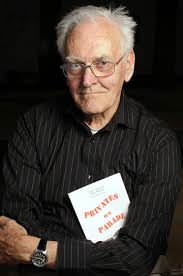
It probably comes as no surprise that Peter Nicholls, with wife Thelma, based the play on their own experience of bringing up disabled daughter, Abigail, who died aged 11. He went on to tackle big issues though the 1970s in other plays, The National Health, Poppy, Passion Play, Blue Murder and Privates on Parade, through formal experimentation (with copious reference, as in ADITLOJE to music hall and vaudeville), and ironic humour. However in 1982 he retired, apparently dissatisfied with the way his work was presented and was seen as unfashionable by many. Yet, based on this and what I have read about these plays, I would think there is an opportunity for contemporary theatre-makers to have a go at revisiting other of his frank, if sometimes unsubtle works, as has been done with Passion Play for example. Prickly and unsettling is not such a bad thing for theatre. PN passed away just before this revival opened but I hope he had a chance to see the justice that was I think done here to his breakthrough play.

 At Home He Feels Like A Tourist