
Rules For Living
Rose Theatre Kingston, 13th November 2017
The Tourist loves the Rose Theatre. Admittedly it helps that it is just a hop, skip and a jump, (well brisk walk), away from him. It does serve up some interesting theatre though, in amongst the music and comedy, and it does a grand job for the local community, notably for the young people. Understandably most of the theatre it produces is shared with other venerable regional houses but this makes eminent economic sense. And by and large, when it has nabbed something for itself, the decision has paid off. All this is achieved without an Artistic Director or commissions. Given the size of the place, 900 seats, comparable with the Lyttleton say, or the newly opened Bridge, this seems to me a laudable strategy.
Over the last couple of years we have had the excellent productions of My Brilliant Friend (My Brilliant Friend at the Rose Theatre Kingston review ****) and The Good Canary, the outstanding Junkyard, (Junkyard at the Rose Theatre review *****), which was a massive positive surprise for me and BD, a pretty good recent revival of The Real Thing (The Real Thing at the Rose Theatre Kingston review ****), the ambitious and largely successful Wars of the Roses, a fine All My Sons and decent productions of Toast, The Herbal Bed, The Absence of War and Maxine Peake’s Beryl, (looks like the marvellous Maxine will end as good a writer as she is actor). Oh and we got the Play That Goes Wrong before the West End.
Coming up we have a new production of Much Ado About Nothing with Mel Giedroyc, (which means BD and LD are already signed up), as Beatrice, (dying to know who will be Benny), and a Don Carlos, (shared with the Nuffield Southampton and the Northcott Exeter so LS will be instructed to attend), in which Tom Burke, (you know him off War and Peace), will partner again with the fancy-dan Israeli director Gadi Roll. A bit of Schiller should wake up the good burghers of Kingston.
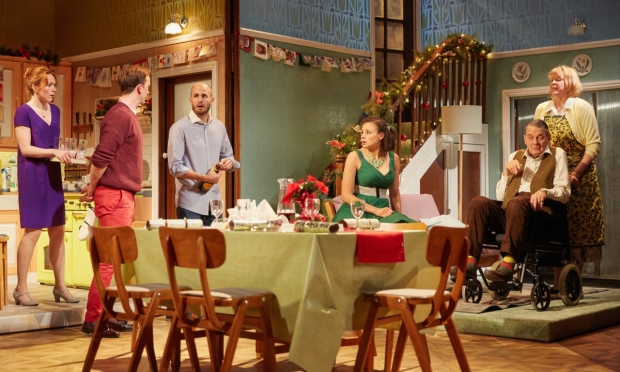
Right that’s the puff piece over. What about Rules for Living? This play by Sam Holcroft premiered at the National Theatre in 2015 where it was, by and large, well received. Brothers Matthew (Jolyon Coy, last seen by me in the somewhat different Little Eyolf at the Almeida) and Adam (Ed Hughes) have returned to the family home with, respectively, partner Carrie (Carlyss Peer) and wife Nicole (Laura Rodgers), for Christmas Day. Matriarch Edith (Jane Booker) is marshalling the troops ahead of her husband Francis (Paul Shelley) coming home from hospital, after, it transpires, having had a stroke. Last, and probably least since she is off stage in bed until the end, is Emma, the fragile daughter of Adam and Nicole.
So far, so middle class sitcom. Carrie is a flighty actress, who wants successful lawyer Matthew to pop the question. Adam was a cricketer whose career was ignominiously cut short when he froze on his Test debut. He is now a provincial solicitor. Adam and Nicole’s marriage is on the rocks. Dad Francis was a judge and doesn’t suffer fools gladly. Under Edith’s direction the festive activities are run with military precision.
Now the twist, because, as it stands, this cracker would be more Poundland than Waitrose. Each of the characters has to follow a rule to govern their behaviour. This flashes up above Lily Arnold’s lovely doll’s house set. The detail of this rule is expanded through the play. So, for example, Matthew has to first sit down, and then eat, when he tells a porkie. I will refrain from trotting out the other rules in case you chance to see this. You get the picture I am sure. Ms Holcroft took learnings from cognitive behavioural therapy as the inspiration for the play and cleverly ensures each of the rules matches the characters faults, frustrations and personalities.
This then is the catalyst for the hilarious goings-on and, initially, at least, there is much humour in this conceit. Having weaved this into the plot though, Ms Holcroft then doesn’t see to entirely know what to do with it, so we veer off into a quasi-farce which ends with a food fight. Amusing yes, and it bears comparison with the master it emulates in Alan Ayckbourn, but it felt to me that the idea was too clever for the execution. The conceit boxed the characters in and didn’t leave enough room for the pathos which was needed to balance the farce.
The cast entered into the spirit of the venture with energetic enthusiasm, even Ed Hughes and Carlyss Peer whose “rule’ was the trickiest to pull off without being annoying. Jane Booker had the pick of some very funny lines and Paul Shelley, with no lines as such and precious little stage time, was a hoot. Laura Rodgers probably dug deepest though her “rule” gave the most opportunity for nuanced development. Director Simon Godwin, who has had some notable successes at the NT, especially his Twelfth Night, chose to anchor proceedings in the family home and play down the “game-show” context of the original production.
All in all then like a game of family charades. A really good idea when it kicks off but wearing after an hour or so. We are going to try doing massive jigsaw maps in silence for Xmas this year. Yo ho ho.
PS. I see that Sam Holcroft is writing a play for the Bridge based on the novel The Black Cloud by astrophysicist Fred Hoyle. Blimey. There will be some big ideas in that for sure.

 At Home He Feels Like A Tourist