Uncle Vanya at the Hampstead Theatre review ****

Uncle Vanya

Hampstead Theatre, 12th January 2019

Should you be tempted to follow the Tourist into a life of excess …. theatre-going … then I have a warning. These luvvies do put on a lot of Shakespeare. No surprise there I guess. But they also really, really love their Chekhov. As will you after prolonged exposure. But I had not realised just how much there is lurking about. Particularly when you remember there are only really five full plays to choose from. There are a also handful of one-acters and “Platonov”, but basically you are going to get to know these five pretty quickly, particularly when you consider that, whisper it, they all explore similar themes in similar settings. Mind you, given the day-job as a doctor and the billions of short stories he wrote you could never say our Anton was an idler.

It’s the tragic-comedy thing I think. That’s what the directors, casts and, obviously, us audiences are attracted to. And the fact that there are so many layers. And that the characters, even if they are of a certain class at a certain time in a certain place, grapple with the real stuff of life. In short they spend a lot of time basically f*cking it up in one way or another, as we all do. The misery of dashed expectation.

The Chekhov industry also benefits from the seemingly unquenchable desire of other playwrights to adapt his dramas. Not just new works in some way drawn from or inspired by the great man, but countless new adaptations generally now taken directly from literal translations, which the dramatists have then stamped their own ideas, idiom and style on. And I am only talking about the English versions. Samuel Adamson, Torben Betts, Ranjit Bolt, Martin Crimp, Michael Frayn, Brian Friel, Pam Gems, Peter Gill, Christopher Hampton, David Hare, David Harrower, Robert Icke, David Lan, Mike Poulton, Carol Rocamora, Simon Stephens, Tom Stoppard and Nicholas Wright. That’s just the playwrights I have heard of. A very illustrious list I am sure you will agree.

This diversion was sparked by an interesting essay in the programme which looks at the translation and adaptation process and, in particular, how necessary or desirable it is to stay close to the language and/or spirit of Chekhov’s original text. Given AC’s ability to capture the universal, as well as the very particular, I can see why this continues to be a source of immense fascination to these clever and talented people.

Particularly when you consider the fact that this play, Uncle Vanya, is itself based on AC’s own earlier play The Wood Demon. This was written in 1889 though never published but sufficient manuscripts survived and many patient Russian theatre companies have given it a go. AC was pressured into writing it by his publisher Aleksey Suvorin who also contributed plot and even some text. By all accounts he was a bit rubbish but when he lost interest AC kept going and, after it was rejected by three theatres, The Wood Demon eventually got a showing only to be crucified by critics and (small) audiences alike. AC though didn’t give up on it, retaining two-thirds of the text but cutting the cast back to 9 main characters, (previously many of these had “doubles’ of one sort or another), upping the autobiographical contribution, (prevalent in all the plays), reworking Suvorin’s nepotistic bequest and stripping out a load of poncey literary references. And changing a crucial bit of plot, from a successful to a failed, suicide. Result? Well not quite overnight success,Uncle Vanya had a few provincial outings and a bit of a run in with the censors before the triumphant opening in Moscow, but it is, arguably, his most perfect work.

It was probably then only a matter of time before Terry Johnson joined the roll call of other very clever playwrights listed above and had his own shot at Chekhov. Here he upped the interpretative stakes by taking on the role of director as well, (and casting daughter Alice Bailey Johnson as Sonia). My regular reader will know that I am more than favourably disposed to the work of Mr Johnson, despite being a relatively late-comer, with his last original outing, Prism, in this very house, turning into one of those plays that continues to pop up in the memory.

Well he unashamedly opts for the traditional when it comes to the setting, though Tim Shortall’s design cleverly morphs the interior and exterior of stylised dacha with silver birches, and Ben Ormerod’s lighting attractively rings the diurnal and seasonal changes. And there is some mighty fine tailoring on show. The production thus continues the HT’s long run of exquisite sets. (Mind you, having set up the look of fin de circle rural Russia, the soundscape of Emma Laxton doesn’t do much to offer an aural equivalent). TJ has no truck with any of, for example, the modish Anglicisation of Robert Icke’s Vanya at the Almeida. The language is simple, direct and idiomatic. “Modest” is what Terry Johnson, in his own words, set out to achieve and a modest production is what he delivers.

Whilst this might, at times, leave a little bit of the characters’ complexity of motive of the table it does make for a beautifully crisp plot development. Who does what to whom is very easy to grasp and this leaves plenty of headspace to ponder why they do what they do. AC famously said he was better at writing middles than ends and beginnings and this straight reading emphasises that and doesn’t encourage too much in the way of contextual or historical analysis. It is though very funny. Mr Johnson is alert to the humour in Chekhov and, as director, he can, er, direct us towards it. Whilst still showing up the vulnerabilities and venoms that lie behind it.

Alan Cox is a perky, self-aware Vanya. He can’t resist conspiratorially pointing out the failings of others though he well knows his own. He could have been a contender but now he is mordantly shuffling towards …. nothingness. Robin Soans as Serebryakov is fall of flatulent entitlement and Kirsty Oswald, who stepped in at the last minute to replace debutant Abbey Lee, is an unusually sensitive Yelena. (Apparently she kicked off with script in hand in which case she has come a very long way very quickly. Bravo). Alice Bailey Johnson similarly gives us a Sonya who is more assertive than normal, completing, with June Watson’s Marina, a triumvirate of women who bear the burden of supporting their various menfolk. Kika Markham also turns in a solid performance as Maryia, blindly in thrall to her son-in-law’s feeble academic reputation, as does Alec Newman as pickled idealist doctor, and babe magnet by geographical isolation, Astrov, and David Shaw-Parker as the permanently chipper hanger-on Telyeghin.

The Tourist caught one of the last performances, which, in a classic as richly textured as this, is normally not a bad idea. which means it’s gone now. However, if you are still a Vanya virgin don’t despair, (at least not at all you see it). Just like the 38 bus there be another one along shortly.
Insignificance at the Arcola Theatre review ****

insignificance-arcola-700x455

Insignificance

Arcola Theatre, 21st October 2017

Regular readers of this blog (don’t be shy) will know that I adore the work of Terry Johnson. As do a lot of proper theatre critic types. I also have a very soft spot for the Arcola. With this revival of Insignificance the combination delivers.

However, I see from some other reviews that not all are persuaded. This is par for the course with Terry Johnson. I think the way he mixes high and low culture, and the multiplicity of meaning he inserts into his texts can leave some audience members a bit cold. He is, as my mum would have said, a “clever clogs”  and his humour is “knowing” with a capital K. In this play he is happy to trade ideas and words for the dramatic arc. The comedy, which often leavens Mr Johnson’s work, is less prominent in Insignificance and is downplayed by David Mercatali’s measured direction.

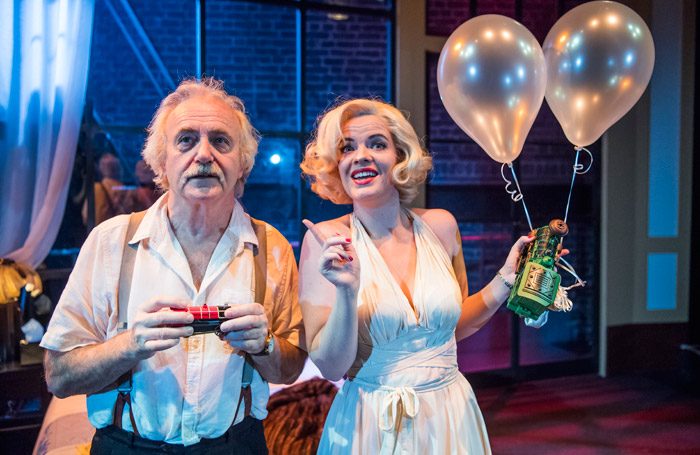
The Professor, played stoically by Simon Rouse, is in a hotel room, (Max Dorey’s utilitarian design copes with the Arcola space), working on the nature of space-time. He is interrupted by the Senator, played by Tom Mannion with increasing venom, who tries to bully him into testifying before the House Committee on Un-American Activities. The Professor refuses. The Senator leaves. The Actress (an excellent Alice Bailey Johnson who just happens to be the playwright’s daughter) appears in a recognisable white dress and, initially, trademark breathless voice. She and the Professor discuss the nature of fame and celebrity, she demonstrates, in ecstatic fashion, the theory of relativity using toy props in the room and then she attempts to seduce the Professor. They are interrupted by the Ball-Player played by Oliver Hembrough, who is not best pleased. The Professor leaves. The Ball-Player sleeps through the Actress’s announcement that she is pregnant. Next morning the Senator returns, mistakes the Actress for a prostitute and hits her. The Professor returns, chucks his work out of the window to thwart the Senator who leaves. the Ball-Player returns. The Actress miscarries and tells the Ball-Player their marriage is over. The Actress and Professor remain. The time approaches 8.15pm. The Professor visualises his recurring nightmare of nuclear destruction.

Now when you put it like I appreciate it doesn’t sound like a barrel of laughs. No so. Also it seems to me there is plenty going on in the play, it is just that it is confined to the one room. (Nic Roeg’s famous film version is obviously less claustrophobic). These characters are, of course, Albert Einstein, Joe McCarthy, Marilyn Monroe and Joe DiMaggio. None of this happened. But it might have done. That is the whole point. I never understand why people get worked up by drama which “strains credulity”. It is a play. It’s not real.

We see the world of science, politics, film and sport collide. These people were about as famous as it was possible to get in 1954 when the play is set. They still were in 1982 when the play was premiered at the Royal Court. And they still are today, notably in the case of Monroe and Einstein. The influence of fame and celebrity on the cultural superstructure is arguably even more profound. There was an actor in the White House when the play was written, there is a clown now. As Mr Johnson observes in a world which worships at the altar of celebrity society will fail to “question the power of the invisible”.

First and foremost the play is a meditation on the nature of fame, as many of Mr Johnson’s plays are. We think we know the public personae of these people and what they represent but we see very different identities in private. The Professor has sexual urges (Ms Monroe allegedly wanted to sleep with him). The Actress reveals a prodigious intellect in sharp contrast to Ms Monroe’s screen image. The Senator is an aggressive ideologue, as we liberal types would presuppose, but we shouldn’t forget that he mobilised an entire legislature to let him pursue his grotesque witch-hunt. The Ball-Player expresses his own renown in the most banal way through the greater number of bubble gum cards with his image when compared to peers. He too is more intelligent than the jock he presents but he sees little advantage in revealing this.

Mr Johnson also has some fun with other mind-bending scientific ideas with an off-stage cat belonging to a certain Mr Schrodinger and the Uncertainty Principle of Heisenberg. Science plays are ten a penny these days, not surprising as dramatists are creatures of wonder, but Terry Johnson was an early protagonist. He also squeezes in a Crucible gag. More moving are the Actress’s sorrow at her own objectification, the Ball-Player’s yearning for domestic normality and an heir and the literal cloud that hung over the Professor’s head in the latter years of his life as he reflected on the destructive power his science unleashed.

So there you have it. I would get it if this doesn’t float your boat but if any of this sounds remotely interesting please give it a go. You might be a convert.

Prism at the Hampstead Theatre review ****

prism

Prism

Hampstead Theatre, 14th September 2017

Full disclosure. I love Terry Johnson’s plays. The marrying of “high” and “popular” culture themes and structures, the mix of humour and, as he calls it “brainy stuff, the abrupt lurches in tone: all this works for me. I have many more plays to get through (here’s hoping for some revivals) but favourites so far are Insignificance, which explores the nature of fame by throwing together Marilyn Monroe (of which more later), Einstein, Je DiMaggio and McCarthy (and is coming up shortly at the Arcola), Hysteria which pits Freud and Dali in a farcical set-up and Dead Funny which pulls apart the nature of comedy. So this is not likely to be an unbiased review. And it isn’t. I thoroughly enjoyed Prism with just a couple of tiny misgivings.

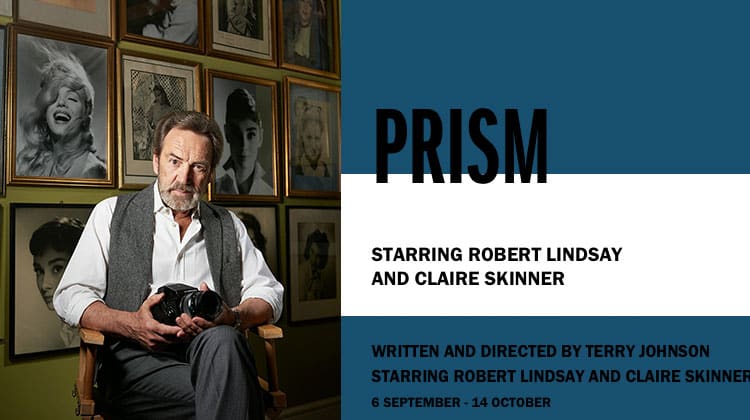
This is Mr Johnson’s first full length play in a decade or so though he keeps busy directing and writing for television and film. So for me this was something of an event. The idea for the play came from Robert Lindsay who is also a rareish sighting on the stage nowadays, which is a shame as he is a great actor in my book. Prism is based on the life of Jack Cardiff (1914-2009) about whom, I cheerfully admit, I knew nothing before this evening, though I was aware of his work. For Cardiff, who won a couple of Oscars, was the cinematographer behind such classic films as Powell and Pressburger’s Life and Death of Colonel Blimp, A Matter of Life and Death, Black Narcissus and The Red Shoes and John Huston’s The African Queen, of which more below. There were many others over his six decade career, as well as some directing assignments. By all accounts Mr Cardiff revolutionised the art of cinematography and he mixed with all the Hollywood greats. He was also something of a “ladies man” as my gran would say, and a fine looking fellow in the mould I think of a young Michael Caine.

If you are familiar with the films I name-checked above, as I am sure you are, you will know that the way these films are lit is jaw-droppingly impressive. Light, and the way we see things, is sort of the point of this play. And the golden age of Hollywood film has served Terry Johnson well as context before with the plays Insignificance and Hitchcock Blonde.

We first meet Jack Cardiff with his son Mason (Barnaby Kay), who has fashioned a studio of sorts out of a garage for his Dad to write his memoirs. This studio has one of his cameras (minus its vital prism thanks to Mason past carelessness) as well as photos of Hollywood leading ladies and Mr Cardiff’s own capable reproductions of Old Masters, such as Vermeer, Rembrandt, Renoir and Van Gogh, who captured light in paint before the photographic age and inspired our Jack.

Mr Cardiff is sliding into dementia, which provides the backdrop for much of the first act gentle humour here, so needs the help of a carer Lucy (Rebecca Night), who is also tasked with keeping the memoir on track. We also meet Jack’s second wife, Nicola (Claire Skinner) who was his assistant so is somewhat younger than Jack and is finding his decline difficult to cope with.

There is more than meets the eye here, quite literally. In a smart second act coup de theatre we shift to the location set for the filming of The African Queen with Barnaby Kay now playing Humphrey Bogart and Rebecca Night playing Lauren Bacall. And Claire Skinner metamorphoses into Katherine Hepburn. Now I go weak at the knees at the very though of Katherine Hepburn so, again, may not be the best judge of Ms Skinner’s performance but I was captivated. The flirting scene between Cardiff and Hepburn is terrific as are the references to the much reported hardships the cast had to undergo in the filming.

Mr Johnson also pulls another cracker from his bag marked “theatrical devices” with a scene involving Jack lighting Marilyn Monroe (Rebecca Night) followed by a fracas with Arthur Miller (Barnaby Kay). But this is an exact repetition of an earlier scene where Jack is explaining his work to carer Lucy. The doubling and trebling of roles here is a key element of the structure of the play as we probe Jack’s fading memory.

We learn about Jack Cardiff’s life, with Terry Johnson working his usual magic by stretching and shifting real events, the nature of light and ways of seeing in art and film, and the nature of memory. Lovely, very funny, insightful dialogue, the usual big ideas refashioned in comedy drama with real narrative and momentum and a more poignant, valedictory note (I won’t spoil the ending) than in previous Terry Johnson plays.

As usual Mr Johnson directs his own work, (some very interesting insights in the programme about this process), which means what he wrote and intended is what you see and hear. Tim Shortfall’s set is clever but not clever, clever and the performances are excellent. Minor quibbles are the slight lack of momentum through the middle of Act 1 as the “real” characters are mapped out, with Mr Cardiff’s dementia milked for laughs a little bit liberally, and the slicing in of Lucy’s tough background and circumstances, I didn’t see the point of this other than to lurch us from laughing to sadness in an instant which is a bit of a trait from this playwright.

So, as you can see, I really enjoyed and admired this, but like I say, I am a sucker for Terry Johnson’s plays. My guess, judging from the audience reaction, is that the overall reception may be a little more muted. But this seems to have been the fate of Terry Johnson’s work from the start. Some people rave, some people shrug their shoulders. What I would say is that even if you are not familiar with his work, if you have any interest in the subject, in film, like the cast or just want a funny, interesting night out then don’t hesitate.


Hysteria at the Greenwich Theatre review ****

iconsquarehysteria1

Hysteria

Greenwich Theatre, 29th April 2017

I will keep this short and sweet. Whilst this production by London Classic Theatre has been and gone from Greenwich it is still touring with dates in Oldham, Yeovil, Newtown, Aberdare, Dunstable and Colchester.

In my view this kind of touring productions deserves your support. These people work very hard doing something they love. I am not saying you should toddle off to anything just because it is on the doorstep. You need an interest in the play on show for sure. But if there is the merest inkling please take a look.

This was not, I fear, a packed house and Greenwich Theatre is in need of a little TLC which I hope will be forthcoming. This is a marvellous play which was very competently delivered and it was a shame there weren’t more bums on seats to see it – mind you it was a Saturday matinee to be fair.

I went with the SO, BUD and KCK last year to see the all-star production of Dead Funny in the West End which was an excellent account of Terry Johnson’s meta-comedy which he also directed. And I am praying that Mr Johnson’s Insignificance will be revived at some point as I am now a firm fan.

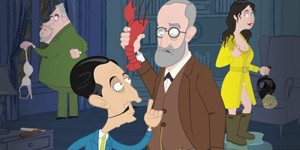
Hysteria imagines what happened when Sigmund Freud (played by Ged McKenna) met Salvador Dali (John Dorney) in 1938 in Freud’s London home (just before his death in 1939). Freud is resting but is startled by Jessica (Summer Strallen who I gather normally plys her trade in musicals), who turns out to be the daughter of one of his previous patients, who was the basis for his theories of presexual shock. Jessica gets out of her wet clothes (including Freudian slip obviously), hides in closet (!!), Freud’s doctor, Abraham Yahuda (Moray Treadwell) arrives, followed later by Dali, played in a deliberately over the top way. This is the set-up for a visual farce, which uses language and props to simultaneously examine Dali’s art and Freud’s theories of psychoanalysis. To give you an idea, at the point Dali enters, events have conspired to leave Freud holding a snail infested bicycle, with a bandage on his head which looks like rabbit ears, and his arm in a wellington boot. Geddit.

It is unabashedly a clever play and has Johnson’s trademark veering between low(ish) comedy, high(ish) intellectualism and dark insight often in the same scene. It examines many of the criticisms of Freud’s theories and Dali’s surrealist art – it rams this home through Yahuda’s criticism of Freud questioning the “Moses myth”. It demands attention. You will learn a lot – I had no idea about Freud’s turn on a sixpence on who bears “responsibility” for sexual abuse. But it also has some proper laugh out loud funny bits. And it does go from A to B – or maybe it doesn’t as the ending suggests a dream. It probably helps if you have a tiny bit of insight into the work of the two key characters. But it has a structure (farce) which is constant – which makes it easier to digest than early Stoppard the closest parallel I know.

I am sure there have been, and may well be, higher profile productions of the play but this audience member for one is grateful to LCT for taking it on. Thanks.