
A Day in the Life of Joe Egg at Trafalgar Studios review *****

A Day in the Life of Joe Egg

Trafalgar Studios, 30th November 2019

Not a fan of the Trafalgar Studios which has been asking daft prices for mediocre seating in the last year or so, (though it seems to have eased up a bit now and is nowhere near as egregious as another ATG venue the Playhouse Theatre). So waited this out and finally secured a decent perch at the back (which to be fair is not too much of a problem in this venue, sight-line wise).

Peter Nichols’ most (in)famous play had been on my wish list for a few years. Written in 1967 and first staged at the Citizens Theatre, (also on my theatrical to-do list and mention of which just sparked a 3 hour diversion though the web – focus Tourist focus). The play, which has subsequently been turned into big and small screen versions, tells the story of married couple, stoical Sheila (here played by the marvellous Claire Skinner) and overwought Bri (equally marvellous Toby Stephens) and their daughter Joe, who has cerebral palsy, and is played by less-abled actor Storme Toolis. They are joined by liberal do-gooder Freddie (Clarence Smith), who runs the am-dram group which Sheila has joined, and his heartless younger partner Pam (Lucy Eaton) and then by Bri’s tactless and hidebound mother (effortlessly played by Patricia Hodge).

The caustic play examines the coping mechanisms that Sheila and Bri have created to bolster their failing marriage and to look after Joe, who is confined to a wheelchair and cannot directly communicate. Sheila just gets on with it but Bri is starting to unravel. What makes this such a powerful play is the tone that Peter Nichols adopts; an ironic, almost detached humour with little in the way of sentiment or homily. I can see why some might find Bri in particular, with his black humour and lack of fortitude, a difficult character and might view this approach to disability as somehow inappropriate or capricious. I disagree. The way the couple act and speak is entirely believable and relatable and shows the reality of disability and the love the family needs to stick together.

It is true that in the over 50 years since the play appears attitudes to disability have changed, (though as Storme Toolis observes in the programme less able young people and their families still often struggle to secure the resources they need to improve life quality), and the subject a far less “controversial” source for drama. The private role-play that the couple employ to verbalise and visualise Joe’s emotions and to leaven the routine therefore sounds even more awkward particularly in the hands of Toby Stephens who is, presumably at director Simon Evans’s behest, keen to show up Bri’s desperation and guilt at wishing for Joe’s institutionalisation. The differences between the couples attitudes to Joe, Sheila’s unconditional love compared to Bri’s self pitying are most visible in the direct to audience addresses that Peter Nichols’ uses to reveal their interior thoughts, (about each other and Joe), and to provide back-story.

In the second half, as the views of the other characters on disability, Joe and the couple are gently skewered, the humour becomes more comfortable and the play less raw, though maybe less powerful and humane as a consequence. Whilst the two leads excel the rest of the cast are careful to eschew caricature despite the obvious unease of their characters around Joe, and at the centre of it all is Joe. There is enough drama, and surprise, built into PN’s plot, even if it is unsurprising, and Peter McKintosh’s faithful 1960s room set, out of which Bri and Sheila step, alongside Prema Mehta’s broad lighting and Edward Lewis’s sound, create no serious distractions.

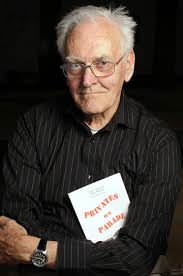
It probably comes as no surprise that Peter Nicholls, with wife Thelma, based the play on their own experience of bringing up disabled daughter, Abigail, who died aged 11. He went on to tackle big issues though the 1970s in other plays, The National Health, Poppy, Passion Play, Blue Murder and Privates on Parade, through formal experimentation (with copious reference, as in ADITLOJE to music hall and vaudeville), and ironic humour. However in 1982 he retired, apparently dissatisfied with the way his work was presented and was seen as unfashionable by many. Yet, based on this and what I have read about these plays, I would think there is an opportunity for contemporary theatre-makers to have a go at revisiting other of his frank, if sometimes unsubtle works, as has been done with Passion Play for example. Prickly and unsettling is not such a bad thing for theatre. PN passed away just before this revival opened but I hope he had a chance to see the justice that was I think done here to his breakthrough play.

The Best Man at Richmond Theatre review ****

38016_full

The Best Man

Richmond Theatre, 2nd October 2017

N.B. The Best Man has, as I confidently expected, found its way to the West End, to wit the Playhouse Theatre where it opens on 24th February and runs through until 12th May. Well worth a visit and not ridiculously priced, though steer clear of the Upper Circle unless you are a very small person.

Gore Vidal is very near the top of my list of invitees for that perfect dinner party. Winston Churchill, Karl Marx, Socrates, David Hume, John Rawls, Alfred the Great, Charlemagne and Nelson Mandela would be there too. (Note this is the politics bash – music, art, drama would follow in subsequent weeks if the caterers were free). He is the quintessential liberal who would be both horrified and amused, and not at all surprised for this is what he expected, by the America of today, as he was by the America of his lifetime.

In my humble opinion he is one of the greatest novelists of the second half of the C20. Whether it be his novels examining the nature of sexuality, The City and the Pillar, Myra Breckenridge or Myron, the fantastical satires of Messiah, Kalki or Duluth, the ancient histories such as Creation and Julian or the American histories of Burr, 1876, Lincoln, Empire, Hollywood, Washington DC and The Golden Age, there is stunning prose and visible erudition on show on every page. Best of all though these are page-turning stories, whether “fact”, fiction or a mixture of the two, with utterly believable characters. (real or imagined). Indeed I would say that the fact that his novels are overflowing with plot is one of the reasons why he is not as highly regarded as he should be – they are just not as hard work as the US cultural elite of the 1950s and 1960s would have liked. Moreover GV himself was the very antithesis of the macho artistic and literary culture of that era. He also chose to p*ss off most of the literary, artistic and political establishment in his native US with his barbed epigrams and constant feuding. Here was a man who thought he was better than everyone around him, because he was better than everyone around him.

Being the very clever fellow he was he turned his hand to screenplays as well as novels and brilliant essays, with one of his best works for film being the re-write of Ben-Hur, in which he mugged off Charlton Heston who seemingly failed to grasp the homosexual sub-text of the movie. He also wrote a handful of very fine plays which reflect the concerns of his novels. The Best Man which premiered in 1960, and was made into a film in 1964, is the most often revived I believe.

So, as you might imagine, I was very pleased when I heard about this latest production since I don’t think this has ever graced a major London (I know, technically Surrey) stage. A very strong cast has been assembled by impresario Bill Kenwright with Simon Evans entrusted with directorial duties after his smashing Arturo Ui at the Donmar (The Resistible Rise of Arturo Ui at the Donmar Warehouse review ****), Alligators at the Hampstead and the exceptional trilogy of miserabilism, Bug, The Dazzle and Fool for Love, at the now defunct Found 111. The liberal, middle classes masses of Windsor, Brighton, Bath and Cambridge have had, or will have, a chance to see The Best Man before, I assume, a West End run.

And you should see it. Every word of every line is as fresh as the day GV wrote it. It is, I admit, locked in its time and place, two hotel rooms at an imagined Democratic convention in the early 1960’s, but this does not mean the issues that GV raises about political culture are not as relevant today as they were then. Simon Evans and designer Michael Taylor have very wisely stuck exactly to the period of the play’s action, and use simple devices to switch between the two rooms.

Martin Shaw, commanding as ever with his gravelly voice and still demeanour, plays Secretary of State William Russell. His rival for the nomination is Senator Joseph Cantwell, a remarkablly bullish performance from Hollywood veteran Jeff Fahey. These two legends of the screen have a bit of form together having played good guy/bad guy before in the London stage version of 12 Angry Men a few years ago. Then, as now, they are perfectly cast as dualistic political opposites. Russell is the archetypal “good’ liberal politician who believes there are limits to what can, and should be done, on the road to power. Cantwell believes nothing should get in his way and is prepared to abandon truth in order to get want he wants. As I think Russell observes in the play there is very little idealogical difference between the two (GV despaired of the lack of real choice in American politics). It is the how, not the what, that distinguishes the political complexion of these two men.

Russell is a philanderer but his wife Alice, another fine performance from Glynis Barber, is prepared to stand by him in public on the road to Democratic nomination and potentially the White House. Mabel Cantwell, played by Honeysuckle Weeks with a little too much of the Southern Belle which made a few lines difficult to follow, is a more “old-fashioned” wife. It would be nice to think that, near 60 years on, these characters would look archaically sexist. Unfortunately I am not so sure they do.

We then have the mighty Jack Shepherd as the Trumanesque Art Hockstader, the outgoing President, whose homespun country boy public persona is matched by ruthless scheming behind the scenes. You may well know Mr Shepherd as Wycliffe off the telly but he can still command a stage, and caper about, even in his late70s. Our cast is completed by Gemma Jones as Mrs Gamadge, the harridan of the Democrat ladies, Anthony Howell and Jim Creighton as respective advisors and Emma Campbell-Jones, Simon Hepworth, Ian Houghton, Craig Pinder and David Tarkenter as the press, various senators and delegates and a pair of accessories for when the fight between our two nominees gets really dirty.

I will refrain from delving into the detail of the plot: suffice to say there was enough of a twisting narrative to keep the pensioners of Richmond on the edge of their seats as we moved through the various paybacks in the second half. As I say GV couldn’t help but write great stories, and he was, after all, a Democrat insider. The characters here are not particularly well hidden proxies for the 1960 Democratic nominees, with Russell as Adlai Stevenson who GV supported, and the Cantwells as the Kennedys, who were oft the subject of GV’s barbs. GV also uses thinly veiled episodes from the life of Joseph McCarthy to inform Joe Cantwell. Subtle it ain’t.

Whilst some of the historic specificity might be lost on a contemporary GB audience the moral arguments which flow from GV’s caustic wit will not. The play is very funny, (OK maybe I laughed a bit more than some), but this does not mask the seriousness of the messages about political culture. There were a couple of timing issues at the performance I attended, (with the SO who has stamped her approval on the endeavour), and a brisker pace might have paid dividends in the second half of Act 1, but all in all, this is a very fine production, with a very fine cast, of a very fine play by a very fine writer.

Highly recommended. And make sure you read some GV thereafter.


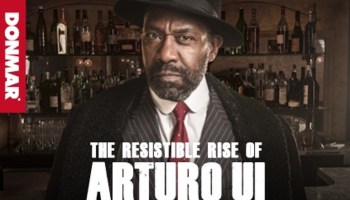
The Resistible Rise of Arturo Ui at the Donmar Warehouse review ****

the-resistible

The Resistible Rise of Arturo Ui

Donmar Warehouse, 18th May 2017

I see a lot of theatre now. Which means I read a lot of press reviews. Which is about the only time I ever step out of my Guardian reading, liberal, metropolitan elite cocoon. And that means reading reviews in the Daily Telegraph (because they often offer insight) and, when I just can’t resist it and assuming no-one is looking, the Daily Mail and Daily Express. (Why are all the hate rags called Daily – is it to remind staff and readers of the material fact of diurnality – if I were them I would be very wary of such scientific consensus).

Now I wagered to myself that in the satirical play about the rise of Hitler in 1930’s Germany (I know there is more to it but we will get to that once I have had my rant) by the Marxist playwright and guiding light of Epic Theatre, and proponent of Verfremdungseffekt, the still astounding Bertolt Brecht, that we might get some references to a certain orange POTUS. And that we might get a hint of a political message maybe even delivered direct to audience. And maybe God forbid a bit of audience interaction.

And I wagered further to myself when the Donmar announced this (with Bruce Norris as the adaptor – a man unlikely to be a scripting a Midsomer Murders episode any time soon), that the right wing rags wouldn’t be able to lay off with hysterical “beware of lefty creatives shoe-horning in references to poor defenceless Donnie” and “why oh why do these creatives have to distract us from the sacred text by involving the audience”. And I hoped it would be properly potty-mouthed as that still seems to get these people in a lather.

Well they, the rags, didn’t disappoint, and actually more of them than just the usual suspects. They really are a humourless bunch. It’s Brecht. We, the audience, are supposed to be bashed over the head with the message, both the direct historical satire and the generality of the warning. And we might find it funny. As we did. Whilst we have a good time. As we did.

Or maybe the DM and its ilk would be happier with a hot line straight to the Supreme Leader so they could denounce any of this degenerate stuff before it took root. Or maybe we should have some-one appointed to check this is all OK for us to see. Y’know just to be sure. I mean no-one wants faceless, unelected bureaucrats telling us what to do. But at least this would mean we could take back control and give the majority the strong and stable theatre that they crave. I mean right now, if you walk the streets of the West End, it is awash with subversive, pinko musicals and you risk some actorly type of indeterminate gender or, worse still, an American film actor, dragging you in to the theatre for a sing-song.

It was all so much better in the 1950s eh, Empire, no dusky types and the Lord Chancellor could help these luvvies see the error of their ways before they they could put on their so-called entertainments and thereby brainwash 27 of their Hampstead dwelling friends and colleagues (on a good night). Or better still back to the 1930’s eh, when any play critical of our Nazi friends could be refused a license. You know when the Daily Mail was firmly on the side of the righteous.

For the avoidance of doubt I am taking the p*ss here as I know that some of the silent majority that live in perpetual fear of us liberal, foreign-looking types may have a slim grasp of irony. Still you know what I mean. Or have I been too crude. Like Brecht and the key protagonists here, adaptor Bruce Norris, and director Simon Evans.

Anyway the play’s the thing. And in this case it was, by and large, a very enjoyable, energetic and thought-provoking thing. As I understand it Brecht was keen to create drama out of his gangster story as well as use the Verfremdungseffekt distancing effects to ram home the satire. I think that such drama did shine through with maybe just a little easing of the pace through scenes 11, 12 and 13, the murders of Roma and Dullfeet and I still think the Shakespearean references Brecht uses to augment the epic are sometimes more distracting than illuminating. I would also strongly recommend a bit of boning up on the rise of Hitler beforehand. The programme does an excellent summary of the events that each of the 15 scenes are satirising.

With the Donmar space done up at the outset to evoke a 1930s Chicago speak-easy, with the audience ranged around, a boisterous cast chatting to audience on entry, a wide variety of musical interjections, a narrator (with the obligatory swinging microphone) tasked with delivering a running commentary laced Marxist economic analysis and the coercion of audience members (who might now envy us up in the cheap seats), we also got the required “stepping away” from the story so that we could again examine how and why history takes this course, then, now, and, no doubt, in future.

All involved are to be congratulated notably Mr Evans and, especially for me, Mr Norris. Of his plays, I have only seen Clybourne Park, which I thoroughly enjoyed, (and I have never seen the play that provoked it, A Raisin in the Sun by Lorraine Hansberry, which I dearly wish to put right), back I hope more of them cross the pond. Of the cast my particular favourites were Giles Terera as a vicious Ernesto Roma and Lucy Ellinson as a hyper Emanuele Giri.

Oh and some bloke called Sir Lenny Henry. When you are very close to the top of the “National Treasure” pile you can do what you like, when you like, and I guess how you like. This is not naturalistic theatre but there were a couple of times when Sir Len’s AU had the whole place sh*tting itself at his barely controlled aggression. I tell you it was a relief when cuddly Sir Len ambled back on at the curtain call. Amidst all the comedy stuff his portrayal personified a damaged narcissist who pushes at boundaries, ostensibly manipulated by those who think they “control” him, and finds too few, through omission or commission, are prepared to resist. And that’s why the heavy handed contemporary parallels are not to be carped at but embraced in my book. Subtlety and allusion have their theatrical place but so does praxis.

They are amazingly a handful of tickets left. Nab one and see where, and if, you stand.