The Hunt at the Almeida Theatre review *****

The Hunt

Almeida Theatre, 1st August 2019

I am not sure where I stand on the films of director, controversialist and misogynist Lars van Trier. I guess if you venture into dark territory you are going to make the audience that follows you uneasy. Which is how I feel about the likes of Breaking the Waves, Dancer in the Dark, Dogville, Melancholia and Nymphomaniac. Brilliant film-making if not always brilliant films. 

Fellow Dogme 95 founder Thomas Vinterberg is a much more palatable director however. More interested in social rather than individual psychology, more polis than eros, and less prone to stylistic innovation. Festen (The Celebration) is a work of unsettling, tonally ambiguous, tragi-comic genius, Submarino somehow extracts redemption from the unremitting pain of the brothers’ lives at its centre, Far From the Madding Crowd is better than the original, (Schlesinger’s and, I regret to say SO, Hardy’s), I’ve just seen the intriguing The Commune and I have Kursk on the watch list. But his best film for me is The Hunt, though it is helped by an outstanding central performance by the coolest actor on earth Mads Mikkelsen. 

All of his “original” films seem to be to be intrinsically dramatic, focussed on character, plot and idea, rather than spectacle, and not expansive in terms of time or place. Which makes them eminently suitable for theatrical treatment. It is a matter of some regret that the original Almeida production of Festen in 2004, which cemented the reputations of both Rufus Norris, now NT head, and playwright David Eldridge, who adapted the script of Vinterberg and his regular co-writer Tobias Lindholm, coincided with a theatrical “dry” period for the Tourist. Hopefully one day it will return.

This time it is Almeida AD Rupert Goold directing, following on from his string of hits , Shipwreck, Albion, Ink, Medea, King Charles III and American Psycho. We should never forget that it all starts with the writer, and that in this regard the Almeida has been lucky. More over the theatre is, I assume, now flush with enough cash and kudos to pull in any actor and creative team that is desires. Even so, and maybe forgiving a few recent misfires, the last few years have been a purple patch for the house even by comparison to its very high historical standards. Simple rule. Just buy a ticket for everything they put on. Even now that Robert Icke is on his way since Rebecca Frecknall looks to be a very capable replacement as Associate Director. (Next up her version of Webster’s The Duchess of Malfi. Any playwright good enough to inspire a Bunnymen song gets my vote).

A story of a man or woman wrongly accused and shunned by a small community is obvious theatrical catnip. Reference the film where teacher Lucas returns to his Danish hometown and a job in a primary school after redundancy and the break-up of his marriage in the city. After a misunderstanding in the school with Clara, the daughter of Lucas’s best friend Theo, that we, but not the community, see, Lucas is accused of paedophilia. The set-up, the investigation that follows and the violent fall-out is all painfully realistic. The story though ends with neither forgiveness or banishment as you might expect. There is plenty of symbolism along the way as Lucas’s relationships with colleagues, friends, son Marcus, church members and hunting pals is dissected. A thriller with a moral message, rich in ambiguity, taking a potshot at Danish society’s complacent view of its own tolerance. Like I say. Theatrical catnip.

But it still needed adapting. Enter David Farr. I don’t know any of Mr Farr’s original writing or adaptations in the theatre but I, and probably you, will know his work for television, particularly his adaptations of John Le Carrie’s The Night Manager and, less successfully maybe, Misha Glenny’s McMafia. For The Hunt he has stuck pretty closely I think to the plot and chronology of the film, though he has made Lucas more solitary by removing girlfriend Nadja and friend Bruun, altered his relationship with Marcus and cleverly updated the schoolroom set-up. The deer hunts, and the ritualistic machismo that pervades them, have also been highlighted and provide some intense theatre assisted by the costumes of Evie Gurney, lighting of Neil Austin, sound of Adam Cork and movement of Botis Seva. Lucas is, graphically, turned into the prey.

I have said before that Rupert Gould strikes me as a generous director who brings out the best in the creatives around him and The Hunt is no exception. This is a gripping story but could have been delivered in a predictable enter/dialogue/exit, scene after scene fashion, as literal as its source. Instead, as in the string of his other plays mentioned above, the play is replete with movement, symbolism and visual diversion. The tone is set by, er, Es Devlin’s set. Yes it is another of her trademark glass boxes, set on a blond wood circular stage, but, whether as school, house, church, hunt meeting hall or, brace yourself, deer enclosure, switching from transparent to opaque, from place of safety to place or threat, it still works to brilliant effect.

Tobias Menzies is set to play Phil the Greek in Series 3 and 4 of The Crown but he has already decorated TV and film with distinction, though looking at his bio I haven’t seen nearly enough of him. On stage he was excellent as Mikhail/Michael in Robert Icke’s underrated Uncle Vanya at, yep you guessed it, the Almeida, but other than that, again, I haven’t seen him perform. Here though he was perfectly cast. Lucas is innocent, of the crime of which he is accused for sure, but also in a broader sense. This story is not an attempt to create false parity or deny the victim. It is about the hypocrisy and anger that can infect a small community when threatened. Lucas is neither good nor bad, simply the catalyst for the reaction, though we can sympathise with his plight. This doesn’t mean that the play dodges the uncomfortable truths it confronts, just that it doesn’t go in, as is the Dogme 95 way, for an overt moral stance.

For this to work requires Tobias Menzies to present Lucas as self contained, curiously restrained, almost withdrawn, in the face of what happens. This he does. To devastating effect. Justin Salinger as the feckless Theo and Poppy Miller as his unhappy wife Mikala, the three of them have baggage, are equally convincing, torn between believing their daughter or their friend. Around this trinity, Michele Austin as head teacher Hilde, Stuart Campbell as the gawky, raging Marcus, Danny Kirrane as the hyper-aggressive Gunnar and Howard Ward as the investigator Per also stood out. And Abbiegail Mills as young Clara should definitely stick with this acting lark (though not to the exclusion of her other studies of course).

Adaptations of films for the stage don’t always work. Witness many of Ivo van Hove’s creations. Though Network was a recent triumphant exception. This was in large part though thanks to the unsung adaptation of Lee Hall. In the same way we must thank David Farr for his smart contribution here. As good as the film? Maybe not quite. But still something remarkable to set alongside it.


Shipwreck at the Almeida Theatre review *****

Shipwreck

Almeida Theatre, 18th March 2019

The Tourist, as this blog shows, is a nice bloke given to giving creatives the benefit of the doubt. Hence the string of positive reviews on these pages. He likes to think that he is wise in his choice of entertainment. The reality is that he just wants to be liked, even when it manifestly doesn’t matter.

Even so he admits to toddling off to the Almeida to see Shipwreck with some trepidation. Reviews were mixed but rarely overwhelming. The SO, BD and LD had all bailed out in advance, for good reasons, though Dad’s sales pitch was about as convincing as that of The Apprentice candidate, (a clever Trump reference there people), who is fired in week one. The Tourist and BD had abandoned Anne Washburn’s Mr Burns one act in, though this was in part due to “cold-induced fatigue”/teenage hangover, and the SO had to abandon The Twilight Zone, now playing at the Ambassadors Theatre, due to a domestic crisis. A poor familial showing all round. Would lightning strike thrice then?

Certainly not. I bloody loved this. As usual that is of no use to you if you fancy seeing it since it is now all over but it really shows why Rupert Gould and the Almeida have such faith in Ms Washburn’s abilities. There may be some dramatic shortfalls, largely born of excess ambition, but boy can she turn a phrase. Now I don’t know when, or if, this will make its way to the other side of the pond but if it does, assuming you are a member of the very echo chamber it purports to excavate, then you should definitely see it. (I think I can safely assume that the Trumpian side of the cultural divide will have no interest in watching their “opposition” introspect, though they would get apoplectically wound up).

Shipwreck is a meticulous unpicking of liberal America’s current paralysis in the face of angry populism. It may be very time and place specific but its messages are universal. Populist politics, which can and will turn ugly, cannot be dismissed, mocked, pandered to or ignored. It has to be confronted and unpicked, piece by piece, through argument, mobilisation and democratic will. Hand wringing and virtue signalling won’t cut it.

By bringing together seven privileged, articulate, white bar-one, liberal American progressives in a snowbound, holiday farmhouse in upstate New York, and then letting then slug out the arguments one by one, with a useful, if not unsurprising twist, AW is able to rehearse all the arguments in forensic detail. The dialogue is actually centred on June 2017 after the ex head of the FBI, James Comey, offered up his damning testimony before the Senate Intelligence Committee. Comey, you will recall, or maybe you won’t for that is one of the points the play forcibly makes, was the bloke who was fired by Trump, ostensibly on the recommendation of the attorney general Jeff Sessions and deputy attorney general Rod Rosenstein because the FBI rank and file had allegedly lost confidence in their director, but, in reality, because Trump feared the net closing in the the strands of collusion with Russia in the election, taken up subsequently in the Mueller enquiry. Comey, you may also remember, was the chap who rashly indicated that he was re-opening an investigation into the so-called Hilary Clinton e-mails just before the election having previously said there was no case to answer. Confused? I am and that is the point. Keeping up with the truth is tough enough. Unpicking truth, lies and fantasy when narrative and ideology conflict and when there are multiple “reporting” platforms makes it near impossible even for those with the time, inclination and critical faculty to care.

One of the pivotal moments in the debate between the Shipwreck crew comes when, I think, Adam James’s lawyer Andrew reminds then of the time when Trump, in a Republican primary event, claimed the GOP bigwigs had pleaded with him to cool his opposition to the Iraq War. He had not publicly declared any such opposition. He just made it up. And kept repeating it. Then this kind of breathtaking audacity was a surprise. Now many have have become inured to it, just accept it or positively embrace it. Truth has always been a slippery fellow, manipulated by teller and beholder, and more so as time passes, but deliberate, outright fabrication is plainly dangerous to the body politic. But pitifully easy it seems.

The other key moment comes when Andrew’s partner, banker Yusuf, (Khalid Abdalla), admits he voted for the comb-over bogeyman in the election. With the age old excuse of “wanting to shake things up”. Justine Mitchell plays Allie, the sarky, Facebook-ing keyboard warrior “activist”, who criticises the complacency of others but whose logic can send her liberalism way off-beam. The hosts Jools (Raquel Cassidy) and Jim (Elliot Cowan) are more concerned with day-to day accommodation of the changed environment, expecting a reversion to their comfortable mean, whilst Tara Fitzgerald as Teresa and Risteard Cooper as Lawrence are the hippyish slackers, who bang on about the natural birth they have just come from and who see their green-tinged, near-socialism as adequate inoculation. And so all the strands of liberal call and response are represented.

Now I would have been happy with a couple of hours of this fascinating, pointed, if admittedly wordy, to and fro, but, AW being AW, she clearly felt we needed more. So we are introduced to Mark, an orphan of Kenyan descent, who has ended up in the foster care of a traditional, Christian, Trump-voting, rural couple Richard and Laurie, doubled by Risteard Cooper and Tara Fitzgerald. The connection is the farmhouse which Jools and Jim bought from them. Mark then becomes the mouthpiece for racial politics and identity. It is a clunky device but all is forgiven pretty much as soon as Fisayo Akinade as Mark opens his mouth. Now for those that don’t know Mr Akinade, he was the comic turn as Eros in the NT Antony and Cleopatra where he near stole the show from under Ralph Fiennes and Sophie Okonedo. He also starred in Barber Shop Chronicles which, for my sins, I haven’t seen, and in the Donmar’s Way of the World, St Joan and The Vote, as well as the Caryl Churchill short Pigs and Dogs, all of which I have. Here, in a series of monologues, in total contrast to the structure and mood of the group scenes, he charts the subtle, and not so subtle, racial dilemmas in his upbringing, imaging what it would be like to be a slave and describing his difficulties in describing the American racial divide to his own child. It is powerful stuff, sharp, funny and rhetorical, made more so by a very fine performance.

And there’s more. As if enough ideas haven’t been explored, AW then goes on to subvert the dramatic form in a very Churchillian (Caryl not Winnie) way and thereby offer up multiple theatrical opportunities for Mr Goold and, especially, the lighting and sound of veterans Jack Knowles and Paul Arditti. Firstly by having Fisayo Akinade playing a sheepish George HW Bush who is rounded on by the besuited, megalomaniac Trump about the Iraq War. And secondly, and this is where the fun really starts, going all out fantasy as Elliot Cowan (I think), bravely, morphs into a gold-painted, Caesar-esque unhinged tyrant, complete with bird-hooded priests, (yep you read that right), berating a nervous James Comey (Khalid Abdella again) during the infamous one-on-one meeting with Trump in the Oval Office where the POTUS allegedly tried to influence the investigation and demanded his loyalty. Mythic.

As in her previous plays AW shows she doesn’t seem to have an edit function, so even within the tripartite form she crams in so much more. References to Greek tragedy, the nature of art, politics and theatre (“art needs time, space and reflection” as Jools says – not here, AW just gets stuck in), class, incessant social media chatter and mock outrage, the lack of food and drink and their practical shortcomings, disparities in wealth between the couples. But always returning to the uncomfortable idea that the rise of Trump is a retaliation to the pious entitlement and performative shortcomings of white liberalism. And that what these people are most afraid of is losing their economic and cultural dominance to the unenlightened.

No plot, occasionally bonkers, no apologies speechifying, three hours plus, repetition and circularity. Shipwreck is so obviously flawed. But I don’t care because AW, even when she goes too far, can still slum-dunk ideas, message and theatrical thrills which the uniformly excellent cast and Rupert Goold, (and the rest of the creative team, including Miriam Buether symbolic, circular design and Luke Halls, who else, with his striking political and religious iconographic video,) greedily feast upon. It is complex, over-stuffed, baggy, ill-disciplined but in going beyond the usual incredulity at how the Orange One gets away with it, it is brilliant and telling.


Albion at the Almeida Theatre review ****

albion_new_1470x690

Albion

Almeida Theatre, 21st October 2017

Now we all know Mike Bartlett is a great writer. If you don’t know his stage work then, if you love your telly in the UK, you will likely have come across his mini-series Doctor Foster. So you will know that he can write a totally gripping story and that he is not averse in taking liberties with plot construction in order to generate a few outrageous WTF moments. Now it helps that this series was blessed with some top-drawer acting talent in Suranne Jones, (up next in a revival of Frozen alongside Jason Watkins and Nina Sosanya at Theatre Royal Haymarket in what looks like casting made in heaven), the chameleonic Bertie Carvel (I would watch anything he does), Adam James (ditto and who is a Mike Bartlett veteran) and the gifted Victoria Hamilton.

And it is Ms Hamilton who takes the leading role of Audrey Walters in Albion. She is, quite simply, brilliant. I will get to the play shortly but just let me wax lyrical about Victoria Hamilton for a bit. Her Audrey is sharp, snappy, curt, brusque, tactless. A seemingly detached mother. A wife who takes her (second) husband for granted. A friend who has no interest in the life of her oldest chum. An alpha businesswoman. Yet she is also very funny, and, as we increasingly find out, vulnerable. At the heart of Mr Bartlett’s rich text it seems that Audrey, in all her contradiction, is all of us, or more specifically, is this country, whatever it might be. I guess the clue was always in the title but Albion is an allegory which takes a substantial domestic family drama as the mechanism to explore issues of national identity, place and heritage. The Brexit convulsions ooze out of the very earth, of which there is plenty on stage, though the accursed word is never mentioned.

It is a bloody marvellous role and an equally marvellous performance. You may have seen Ms Hamilton in other roles on the telly, maybe in costume dramas and the like, and I envy you if you have seen her on the stage, for she is an infrequent board-treader. Her stage reputation is immense though. I can now see why. I have no right to ask, as someone who sits around on his lardy arse most days, but PLEASE PLEASE PLEASE Victoria, come back to the stage soon when this one is over. Mind you if this doesn’t get a West End transfer, I’ll be gobsmacked (though I can see some logistical challenges).

Panegyric over. What about the play? Our Audrey has left her successful “home-stuff” business in the hands of the minions. She has bought a pile she knew from childhood in rural Oxfordshire. and left London behind. It is the garden that matters to her though. It had been created by a certain Mr Weatherbury and was of immense national importance. It has gone to rack and ruin. Audrey wants to sink some of cash into restoring it to its former glory (see where we are going ….), and create a memorial to the dead of the Great War, and, we quickly learn, her son James, who was pointlessly killed in one of the recent wars. With her come her browbeaten, though wryly optimistic, husband Paul (a spot on Nicholas Rowe) and self-absorbed, millenial daughter Zara (an anxious Charlotte Hope) who wants to write and would rather be in London. Audrey inherits a couple of retainers in husband/gardener and wife/housekeeper Matthew (Christopher Fairbank, hard to imagine anyone else better suited to the part) and Cheryl (Margot Leicester, who shows perfect comic timing) but they are getting on a bit so Audrey, somewhat tactlessly, recruits ambitious Polish cleaning entrepreneur Krystyna (Edyta Budnik), and the rather enigmatic local boy Gabriel (a compelling Luke Thallon) to help . Our cast is completed by Anna (Vinette Robinson, who convinces in what is a tricky role), who is James’s grieving girlfriend, Katherine Sanchez (Helen Schlesinger), very successful writer, best friend of Audrey since university and overt “remainer”, and conservative neighbour, Edward (Nigel Betts).

No commentary on what happens next. I insist you see for yourself. There are though some moments of very high drama as the tensions between the characters unfold. Some of these scenes push us to the edge of credulity but, as with Mr Bartlett’s other work, he gets away with it because it is so damnably thrilling. 

Rupert Goold’s direction doesn’t stand in the way of any of this, indeed positively encourages it, and it gives his lighting (Neil Austin), sound (Gregory Clarke) and movement (Rebecca Frecknall) colleagues room to have some real fun. All the action is set in the red garden “room” of Weatherbury’s original design. Miriam Buether’s “thrust” forward design is a cracker. A raised oval lawn with trusty oak tree and seat at the back and with a bed all around which is transformed halfway through. This England indeed. 

If the set up above sounds like a certain Mr Anton Chekhov you’d be right. It unashamedly has Cherry Orchard crawling all over it, and, greedy bugger that he is, he even takes a few feathers out of The Seagull. Why not though? Chekhov being the perfect template for showcasing the intersection of the personal and the political, the delineation of class, the weight of history and the vice of nostalgia. The garden itself is a quintessential metaphor for change. We English have always been good at gardens and don’t we just love ’em. Chekhov meshes comedy, tragedy and banality whilst hurling in a few bombshells. Mr Bartlett does the same.

Into this set-up then is layered a whole series of perspectives of what “we”, have been, are now, and, possibly, are going to be, now “we” have taken this unprecedented step. The short answer, if you were to ask me, is that “we” have been monumentally stupid. Mr Bartlett, as you might expect, is rather less dogmatic, and offers ambiguity (and indeed his greatest nod to Chekhov), at the end. He reminds us that even dear old Blighty is regularly convulsed by clashes between those who welcome the future, and those who cling to the past. Because, in some way or other, we all embrace this dichotomy.

The text swirls with meaning. Perhaps a little too much. This is what holds me back from a full-on JFG 5* review. Direction, staging, performances – all tip top. Garden as metaphor, check. Chekhov as inspiration, check. Formal structure, check. Narrative arc, check. Plot and characters, check. Ideas and meaning, a qualified check. Not the subject, no way, nothing right now more important could appear on a London stage. Just that maybe a few of the threads can could have been pulled a little more tightly together.

Minor criticism. This is still a hefty slab of theatre which captures the zeitgeist. Maybe not quite as immediately remarkable as the last combination of Mike Bartlett and Rupert Goold at this very venue, King Charles III. But it may well turn out to have even greater resonance as, brace yourselves, the impact of this Brexit caper has only just begun.


Ink at the Almeida Theatre review *****

tony-turner-bertie-carvel-geoffrey-freshwater-richard-coyle-jack-holden-tim-steed_c-marc-brenner

Ink

Almeida Theatre, 24th July 2017

Recipe for a very satisfying night at the theatre.

  1. Choose your company. I spend the vast majority of my theatre going life flying solo. So it is such a pleasure to be joined by some choice chums. In this case the SO, the Blonde Bombshells, BUD and KCK. Lovely.
  2. Have a bite to eat beforehand. Now having a “pre-theatre supper”, (I f*****g loathe the concept of “supper” and all who refer to it – it is called dinner), is sailing perilously close to the limits of poncey stuckuppery as far as I am concerned. But I have to say plate of delicious comestibles at that Ottolenghi realy did hit the spot even if the price/volume interplay was very suspect. I may go again. What a toff I have become.
  3. Go to the Almeida Theatre. This is starting to get silly. As far as I can see the Almeida under Rupert Goold has not put a foot wrong in the last four years and is now, in my humble opinion, London’s best theatre. Mr Goold is blessed with Robert Icke as a wingman and can call on just about any stage acting heavyweight he fancies. And he and his team are fortunate to be well oiled by the cash of the professional and chattering classes of Islington. But what has been most impressive for me is the string of new works that have been showcased alongside the classics. As proof I give you Hamlet, Mary Stuart, Oil, They Drink it in the Congo, Richard III, Uncle Vanya, Little Eyof, Medea, Oresteia, Bakkhai, Carmen Disruption, Game, King Charles III. 1984 and American Pyscho. All great and, in many cases, outstanding works of theatre. Even the misfires have had something of value.
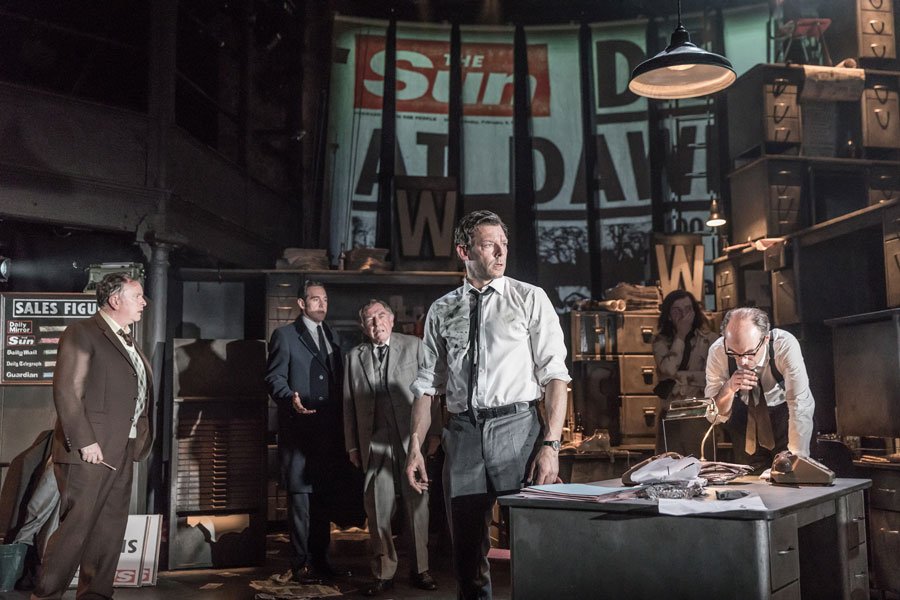
  4. Choose your writer, James Graham. Now it looks to me as if Mr Graham has found his groove and is now busy perfecting it. Dramatising relatively recent socio-political events brings recognition to us, the audience, which means we can ruminate on the parallels with the right now, whilst still being thoroughly entertained. Mr Graham just has the knack of picking and writing a good story. That is not as easy as it sounds. In the case of Ink he has gone one stage further than in This House for me by shining a light on the genesis of the populist tabloid, here the Sun, just at the point when maybe, the power of this particular beast is waning. The story of the first year of the Sun, following Rupert Murdoch’s purchase of the title in 1969, turns out to be theatrical gold. Murdoch’s desire to take on the British establishment and “give the people what they want”. his relationship with editor Larry Lamb, Lamb’s own personal battle with Daily Mirror editor and mentor Hugh Cudlipp, the pulling together of a team of Fleet Street rejects, waifs and strays to create the new style tabloid, the shocking kidnapping and death of Muriel McKay, wife of Murdoch’s lieutenant, the provocation of Page 3: all of this is deftly and pacily explored by Mr Graham in an often acutely amusing way. The motives for recasting journalism and the press in the UK are laid bare: the consequences we know from the intervening decades. Brilliant stuff.
  5. Savour the performances. Unsurprisingly the attention of the critics has focussed on Bertie Carvel’s Murdoch. It’s another bravura performance from an actor who seems to relish “the method” as far as I can see. I thoroughly enjoyed the physicality of his Yank in the Old Vic’s Hairy Ape (which was underrated in my view) and here he captures the awkwardness of Murdoch, his prudishness, his curious accent and his “outsider” psychology perfectly. He is not the caricature demon we “liberal” types need him to be but he is the archetype of “destructive capitalism”. (As an aside I once had a breakfast meeting in Washington. Rupert Murdoch sat down alone on the table next to us. His presence dominated our meeting for the next hour. All he did was eat toast and read the paper but all eyes were on him.) However, if I were Bertie I might have fancied taking on the Lamb role instead. On the other hand Richard Coyle does such a good job there was probably no vacancy. I have seen, and I am sure will see, more virtuoso, scenery chewing, thespianism on stage this year (Lars Erdinger/Greg Hicks in Richard III, Andrew Garfield in Angels in America, Cherry Jones in the Glass Menagerie, Andrew Scott in Hamlet, Brendan Cowell in Life of Galileo, by way of example) but Mr Coyle absolutely nails this from the off. This is a character whose seems compelled to test boundaries. He carries much more of the play than I expected but, even so, this really is an ensemble piece, and that is what makes the “us against the world” dynamic so persuasive.
  6. Take your hat off to Rupert Goold as director. I could be wrong but I reckon that Mr Goold is one of those rare leaders who can control his own ego. What you see on the stage in his productions is what writers, cast, designers and all the other good folk around want to show. I am guessing he guides, he doesn’t dictate. the world needs more leaders like that. My guess is Mr Murdoch would disagree.
  7. Set, Light, Sound, Action.  It is a tabloid in 1969/1970. Activity, headlines, demarcations, flares, eyeliner, dodgy haircuts and dodgy views. You can conjure up a picture in your mind I reckon but what you actually get far surpasses this. Bunny Christie’s set is the antithesis of minimal but so perfectly captures place and time. Some of the movement and dance (yep) is very witty and the scene elucidating the production process is inspired.

All in all a tip, top piece of theatre that I defy anyone not to enjoy. It lifts you up and carries you along from the open and makes you laugh, whilst still getting a little bit vexed about how this instrument of shabby, public discourse could have become so powerful.

So if it were to pop up in a transfer, as so much of the Almeida’s work now does, and you haven’t seen it, don’t hesitate. A proper story. Popular not populist.