
Alls Well That Ends Well at the Jermyn Street Theatre review *****

All’s Well That Ends Well

Jermyn Street Theatre, 6th November 2019

Hard to credit but the Tourist had never seen a production of AWTEW until now. Which made the pleasure in seeing Tom Littler’s pint sized production, in tandem with the Guildford Shakespeare Company, even sweeter. Wiki tells me that AWTEW is, by Will’s standards, a compact play with 13 named characters as well as the usual stand-in “Soldiers, Servants, Gentlemen, and Courtiers”. Mr Littler has whittled it down to a cast of 6 with some clever excisions, revisions, re-inventions, gender changes, doubling and tripling. And some precise choreography, thanks to Cydney Uffindel-Phillips, to make it all fit the tiny JST stage.

Now as far as I can see all the elements of the plot, pinched from The Decameron, are present and correct though I can’t be sure about the detail of the text. Doctor’s daughter Helena, the graceful Hannah Morrish who has already impressed in the RSC’s 2017 series, Julius Caesar, Titus Andronicus and especially Coriolanus, as well as Simon Godwin’s Tony and Cleo at the NT, is in love with the up himself Bertram, a well judged performance from Gavin Fowler. His Mum the Countess (Miranda Foster take 1) is on board but Helena heads off to Paris to cure the sickly Queen (not King) of France (Miranda Foster take 2) who commands Bertram to marry her as the payment for her healing hands. The cad scoots off to war, with his chum, prize arse Parolles, Robert Mountford having about as much fun as it is possible to have on stage whilst still nominally acting, telling Helena he will truly be hers if she bears his child and wears the family ring. The Countess disowns him, Bertram turns his charm on one Diana (Ceri-Lyn Cissone take 1), she and Helena hatch classic bed swap routine. Ring secured, sexy time wrapped up. Helena fakes death, naturally, Bertram returns home to marry aristo but Helena interrupts. Bertram bowled over. AWTEW.

Overseeing the capers is one Lord Lafew (Stefan Bednarczyk) and Miranda Foster’s final incarnation as a Florentine widow and Mum of Diana. Oh, and of course, there is a whole comic routine mocking the bravery of wind-bag Parolles, facilitated by a handy, invented, soldier Dumaine, also Ceri-Lyn Cissone.

Mr Bednarczyk and Ms Cissone are not on stage just for their, fine, acting skills though but also for their facility on a piano. For, if music be the food of love …. I know wrong play but music is central to this production, though not maybe always quite the tunes you might expect. Helena loves her vinyl collection with Rumours, Horses and Blue, (look ’em up Gen Z), forming the soundtrack which are expanded and extended in some nifty arrangements courtesy of Stefan B himself. I can see why the one-size fits all lyrics of The Chain might fit the AWTEW bill though I was a little less sure elsewhere. But the music acts as a very pleasing counterpoint to the text and creates continuity in the shifts between the scenes.

As I say this is a logistical triumph with lighting (Mark Dymock) and sound (Matt Eaton) tailored to fit Neil Irish and Annett Black’s glam, cardboard box set, which like the play itself, works way better on stage than on page. But that was just the admirable starting point in Tom Littler’s direction. How to make the audience believe that the lovely, perfect in every way, Helena would fall for the shallow, man-chump Bertram? And especially believe his turn on a sixpence, she’s the girl for me, at the end. Is it because he was always secretly in love with her, just paralysed by the class divide? Or is it because he cannot, or will not, lose face at the end?

Not in this reading I think it is because we, like her, believe he can get better and that his initial dismissal is in part youthful inexperience. And she is the maturer, having had to grow up fast after the loss of her parents, (she regularly caresses her keepsake box), and not driven by money or status. Which is what makes it a thoroughly modern rom-com, for both good, it is hard not to like the set up, journey and the happy ending, and bad, it really is still the most sexist tripe when you think about it. But because both hero and heroine learn something about themselves along the way, once again the Bard, gets away with it, in our age as well as his. Of course there is clowning and plotting which are knowing in their familiarity, and, in Parolles, we have one of WS’s finer comic creations, whose comeuppance, as he rats on Bertram, is salutary.

This then is a dreamy, charming productions which has charmers at its heart, including, Queen, Countess and, in her way, Widow, and uses Helena’s unspoken memories as a way to solve some of the “problems” that this lesser-performed play presents. The intimacy of the staging, every single expression is conveyed to very single audience member, and the strength of the performances, also helps to frame and unify the production which just about magics away the abrupt shifts in tone.

And anyway, let’s face it, all this guff about Shakespeare’s problem plays is exactly that. They all contain “problems”. Life is full of problems. Veering from comedy to tragedy, with dead ends, changes of heart and head, and never really making any sense. Will knows that, and knows that we know that. Marriage may have been couched in rather ore prosaic terms in Elizabethan England but Tom Littler has, by rolling with Shakespeare’s invention, found a way to create a minor key classic.
The Habit of Art at Richmond Theatre review *****

richmond_theatre_2013-09-23_20-19-48

The Habit of Art

Richmond Theatre, 19th October 2018

There are a handful of plays that I regret not seeing when they first appeared. Not those I wish I had seen, That would be a very long list and cover those periods where I was not putting the required viewing effort in, being too consumed by work and/or drink. No I mean those where I toyed with the idea of going but didn’t get round to it one way or another. The Habit of Art is definitely one of those. I can see why some might get irritated by the voice of Alan Bennett. Not his actual voice of course. Surely everyone loves that unmistakable broad Yorkshire drone. No I mean his theatrical voice with its now ever-present risk of self-parody.

The Habit of Art, from 2009, along with The History Boys (2004), The Lady in the Van (1999) and The Madness Of George III (1991) must all surely rank somewhere near the top of the pile of great British plays written in the last three decades for all the pervasiveness of the last three.  The Habit of Art “imagines” a meeting between WH Auden and Benjamin Britten in 1973 as a departure for an investigation not just into their specific art and lives but into art and theatre as a universal. Right up my street. And best of all for me at least, Benjamin Britten, for all his flaws, which are far from concealed here, is one of my favourite composers.

My only concern then, perhaps, was the cast. The NT run saw Alex Jennings, near full time Alan Bennett impersonator, take on the role of BB with the sorely missed Richard Griffiths as WHA having stepped in for the indisposed Michael Gambon, which I gather was more than fortuitous. You can take your pick as to your favourite Richard Griffiths role: in Potter, as Hector in The History Boys or as Henry Crabbe. I have two words for you though: Uncle Monty. As for Alex Jennings. Is there nothing this man cannot play? There are literally no duff roles or performances on his CV. The last thing I saw him in on the telly was Unforgotten Series 3. As chilling sociopath doctor Tim Finch. Sh*tting ‘eck as AB might say.

Anyway Matthew Kelly as WHA and David Yelland as BB, and indeed Philip Franks as director of this production, Nick Hytner (who else) having directed first time round, had big boots to fill then. And fill them they did. And then some. This is the first ever revival and I can report that it is really very. very good. And don’t just take my word for it. TMBOAD can vouch for it as well, my viewing partner on this evening, and he is one of the cleverest people I know. Ditto some elegant and cultured Richmond ladies of my acquaintance. The production, in addition to Richmond, has popped up in York, Brighton, Salisbury, Oxford, Guildford and Ipswich. It is in Liverpool as we speak and goes on to Cambridge, Coventry, Salford, Southend and Malvern. Residents, you would be mugs to miss it.

Richmond Theatre doesn’t always get the best of touring productions but here they struck gold. The Original Theatre Company, led by Alistair Whatley and Tom Hackney similarly didn’t quite hit the nail on the head with their last outing, Torben Bett’s Monogamy (Monogamy at the Park Theatre review ***) but on this outing I should look out for their next production at the Park. Richmond also hosts pre West End fare. I can’t think of anything more suited to the West End than this brainy, but not too brainy triumph.

Anyway what about the play. Well as I should have pointed out Messrs Yelland and Kelly don’t actually play BB and WHA. For the players are actually Fitz (Kelly), Henry (Yelland), Donald (John Wark) and Tim (Benjamin Chandler), who are rehearsing a play called Caliban’s Day. The play is set in WHA’s rooms in Christ Church Oxford on the set (keep up) of said play with Company Stage Manager Kay (Veronica Roberts) and her Assistant SM George (Alexandra Guelff) keeping the luvvies, and precious playwright Neil (Robert Mountford) ticking over.

Neil’s play draws it’s title from WHA’s contention that The Tempest was incomplete and requires an epilogue. In the play Donald, playing Humphrey Carpenter, the real-life biographer of WHA and BB amongst others, has come to interview the somewhat impatient WHA (played by Fitz), who it transpires, confuses him with the time-limited rent-boy Stuart, played by Tim, that he has procured. Donald also though steps out to narrate proceedings. Henry as BB arrives to join the set-up. He has been auditioning boys to play the part of Tadzio in BB’s Death in Venice, but wants to discuss his concerns over its plot with WHA, despite them not having met since their falling out 25 years earlier in America after WHA wrote the libretto for the somewhat derided Paul Bunyan. WHA though assumes that BB wants him to replace Myfanwy Piper as librettist for Death in Venice. After his father-in-law was Thomas Mann, the author of Death in Venice.

Neil’s play however, as I said, is in rehearsal so we have Kay kicking things off before Neil arrives and her and George standing in for various minor roles. notably two cleaners. The actors constantly bounce in and out of character, though never confusingly, and this is what allows us to see into them as individuals, as well as into the process of acting and performing. At the same time the play itself and the discussions between the actors. Neil, Kay and George, about what it is saying and why, offers multiple insights into BB and WHA, their art and the society in which they practiced their art. Alan Bennett doesn’t hold back from showing what it meant to be a gay artist through the middle of the C20 nor the paedophiliac controversy that surrounded BB.

Now normally with this much learning on show, play within a play meta-ness, theatrical self-referencing, in fact all round arty-farty pretentiousness, you would be a) rightly very wary and b) waiting for the whole thing to unravel . Not here though and not with Alan Bennett pulling the strings. It is very, very funny, (this time the smut isn’t laboured), but also very, very sincere. It dazzles with just how much intellectual and emotional ground it covers yet never fails to entertain. Even if some of the references pass you by, they did me, the perspicacity of the insight into the “cast” will not. And being a play about an “event” it moves from A to B.

I have seen Matthew Kelly, “tonight Matthew”, on stage in recent years in Richard Bean’s Toast, and for about 20 minutes before rain stopped play (ha, ha), at the Open Air in Pride and Prejudice. He makes for an excellent Fitz, fruity and cantankerous, but still vulnerable, qualities that segue into WHA but with the intellectual spotlight switched on to full intimidating beam. An actor playing an actor playing a man who relished playing the role of artist. David Yelland’s Henry,  like BB, is more tentative, more restrained, who then takes on the needy, sickly and child-like BB and his “obsession” with innocence corrupted. Their debate about Britten’s obsessions in his art, as well as Auden’s creative regrets, are what drew me in the most but I am sure you will find your own point(s) of contact.

Robert Mountford shows us Neil’s exasperation with actors who wish to distort his precious script. Veronica Roberts expertly shows us how much, in this case, maternal nourishment is required to bring a play into being but also shows us how Kay rues her own missed opportunities. John Wark gets to reveal, at one point with surreal humour, just what happens when an actor tries too hard to look for meaning in character.

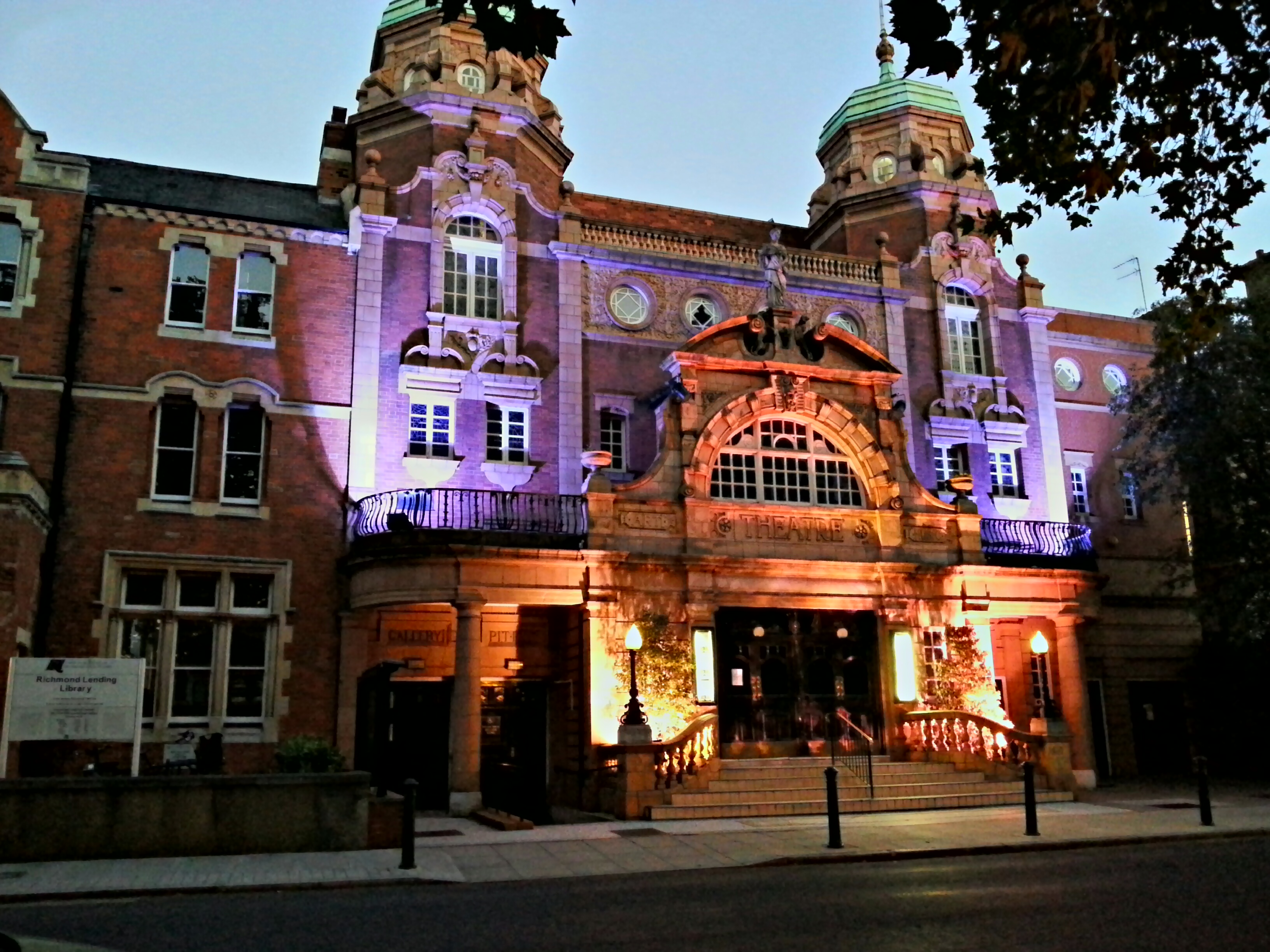
It is hard to imagine a more appropriate set that Adrian Linford’s rehearsal space, with rough cut scenery and busy props, fitting into a classic proscenium stage, which Frank Matcham’s Richmond Theatre jewel (there she is) perfectly frames in a nod to the play itself. Philip Franks’s direction makes everything perfectly clear, no mean challenge as you might surmise from the above.

By some margin my favourite Bennet play. Mind you next up Mark Gatiss and Adrian Scarborough in The Madness of George III. This is showing live at cinemas but I see there are more than a few tickets left at the Playhouse. So students of Nottingham University. amongst others, save your beer money and go see this instead.