

Alys, Always at the Bridge Theatre review ****

Books HD

Alys, Always

Bridge Theatre, 25th February 2019

Said it before and I’ll say it again. You have to be careful with adaptations of novels and/or films on stage. There may be enough in character and plot to justify the transfer but there may not always, (no pun intended), be enough in the form of drama, spectacle and movement to make it a resounding success. So it proved here. There is plenty to enjoy here, and Nicholas Hytner’s direction wrings as much colour as its possible out of the material, especially against the backdrop of a crisp design concept from Bob Crowley, and it is, no doubt, a good story, but as theatre, well not quite.

I don’t know the Harriet Lane novel from 2012 on which Lucinda Coxon, (whose work for stage and screen I have also contrived to miss bar The Crimson Petal and the White adaptation), has created the text. But I can see the temptation. It would make a terrific mini-series. As would, I suspect, Her, Ms Lane’s second novel from the sound of it. Harriet Lane began as a journalist herself, I remember her Guardian column, before becoming a novelist when her eyesight was unfortunately imperilled.

Frances Thorpe is a humble millennial sub-editor cum factotum for a Sunday supplement, the Questioner, who, by a twist of fate, finds her life and career catapulted into a new, gilded league. How she plays the circumstances is the nub of the tale. Gold-digging schemer or realistic opportunist? Becky S, Brideshead, Ripley (without the sociopathic tendencies), Eve Harrington, Holly Golightly, those who find, or position, themselves amongst their “betters” are a cultural staple and these are only the most interesting ones. And, as it happens, in one of those serendipitous coincidences which punctuate the life of the idle Cultur-tarian, the Tourist has subsequently seen two of these iconic parvenus in the guise of stage versions of The Talented Mr Ripley and All About Eve. (More to follow, informed, as these comments are, by the far greater literary intelligence of the SO, my carer for all these entertainments).

The tale of Frances is more subtle than many of these comparators, being more contemporary, set in the rarefied world of publishing, but there isn’t too much that will come as a surprise here. Psychological thriller? That is probably a bit of a stretch. Wry comedy of manners? In parts yes, there is plenty to laugh at, but this doesn’t go all out to skewer the manners, pretensions and behaviour of its characters. We need Frances to present a conundrum, difficult to pin down, but not a total blank, and we do need the dimensions of her character to be explored. Which, by and large, they are not.

Frances’s journey is sufficiently supple though to require a convincing lead performance and, in Joanne Froggatt, (made famous by Downton Abbey I gather), that is what it gets. Whilst the narrative of put upon mouse at work rising to the top and dumping on former colleagues along the way is a little cumbersome it is, in parts, a treat. The relationship that develops with Alys’s family and specifically her grieving husband, Laurence Kyte, (not giving much away here you can’t read elsewhere), also provides an opportunity for some sparkling dialogue. However Robert Glenister has to work awfully hard to bring the overweening, prize winning author to life and the knife-edge of Frances’s conflicted motives starts to blunt in the later two-hander scenes.

Leah Gayer as vacuous daughter Polly has a lot more fun. This is her stage debut. She’ll be back. Polly verges on “poor little rich girl” cliche but Ms Gayer somehow manages to elicit some sympathy for the position her character finds herself in. Her brother Teddy (Sam Woolf) is initially on to Frances but fizzles out thereafter. Sylvestra Le Touzel has a lot of fun with Mary, Frances’s long-serving, frayed boss, as does Simon Manyonda as her condescending, partying colleague, Oliver. The rest of the cast don’t get much opportunity to delve beneath the lines with the exception of Joanna David as Charlotte, the family friend who alone seems to penetrate Frances’s feelings and actions.

If directing is all about moving actors from A to B then there is n0-one better than Mr Hytner, who creates forward momentum and some suspense, from what are quite static scenes. The set, with its thrust stage, sliding room configuration and generous use of video (Luke Halls), is likewise silky smooth. As is sound (Gareth Fry) and lighting (Jon Clark). But the impeccable presentation is part of the problem. The play’s two acts clock in at just over two hours but it doesn’t outstay its welcome nor feel rushed. I was intrigued and entertained but never really challenged. Nor was Frances. Her progress is untroubled by doubt, from self, the other protagonists or audience. I remember only one knowing aside from Frances and one killer line from Charlotte.

I gather the book is altogether darker and Frances a far sharper piece of work, and less reliable narrator, than we see here. Translating that tone, that voice, to stage is always challenging. By taking the safe route Mr Hytner, in the first play he has directed written by a woman, will deservedly get bums on the superb Bridge seats, which is after all his purpose, but I hope his next outing, a new Dream will be something more memorable. Mind you it’s Shakespeare so he is off to a head start. After all when it comes to stage tales of self-advancers big Will served up the very best. Richard III. Now that’s how to do it.

Pinter at the Pinter 4 review ****

k

Pinter at the Pinter Four: Moonlight and Night School

Harold Pinter Theatre, 6th December 2018

The Tourist is a bit off the pace what with that the holiday celebrations to enjoy/get through (delete as appropriate). Still three more of the Pinter one act plays season to look forward too as well as the Betrayal with that nice Mr Tom Hiddleston playing the part of Robert (with the actors for Emma and Jerry yet too be announced).

Pinter 4 though brought together a couple of the master’s longer one-act efforts leaving no room for any of the add-ons that have characterised the prior outings. Moreover Jamie Lloyd stood aside here to leave the directorial duties to, respectively, Lyndsey Turner and Ed Stambollouian. Moonlight, from 1993, is concerned with the way memory is constructed, and comes from a similar place to Landscape and A Kind of Alaska, the plays that anchored Pinter 3, whilst Night School, from 1979, is a more “conventional” comedy matching many of the smaller scale comic works in the previous collection.

Now I see that many of the proper reviews were not altogether convinced by Moonlight. The Tourist however actually found it to be one of the most intriguing plays of the season so far, even accepting its recondite character. Civil servant Andy (a testy and crude Robert Glenister) is dying and confined to bed. His wife Bel, (the wonderful Brid Brennan who I had unaccountably never seen on stage until The Ferryman) is, with good grace at his ingratitude, getting on with the job of tending to him. Andy, perhaps whilst dreaming, and in bracing conversation with Bel, looks back on the highs, and lows, of his life, including, maybe, an affair with Maria (Janie Dee) and affection for an old friend, football referee Ralph (Peter Polycarpou). We cut alternately to his two sons, the affected Jake (Al Weaver) and more prosaic Fred (Dwayne Walcott), ostensibly in another flat, engaged in enigmatic, (and on occasion near-nonsensical), conversation and impersonation, which, it transpires, is partly their way of avoiding the death of their father. Their younger sister, Bridget (Isis Hainsworth), dressed in bright red duffel coat, also flits in and out: my guess is she might already have died. She certainly has the best lines at the end.

Lyndsey Turner, never one to make her life easy, lets all of her excellent cast do their stuff leaving Pinter’s words and our imagination do the working out. Which is exactly as it should be. Like I say this is a play about a family constructing and re-constructing their past and present. As we all do. There is no definitive “reality” when it comes to our own stories. We only mis-remember fragments of our lives. HP might not be alone in understanding this but he is pretty much the only playwright whose language can turn this into a stage drama where, whilst the old grey matter is whizzing and fizzing in its quest for meaning, we can still simultaneously care about how so and so and such and such can get from A to B.

In Night School, which started life out on the TV, the versatile Al Weaver (it would be good to see him tread the boards more often) is an ex-con, Walter, who returns home to find his room has been let to the enigmatic femme fatale Sally (Jessica Barden). She, we discover, leads a double life as PE teacher, night-school student and hostess in a night-club owned by the seedy Tully (Peter Polycarpou). Walter, when he is not being verbally prodded by retired East End gangster sort Solto (Robert Glenister thoroughly enjoying himself). or molly-coddling landlady spinster aunts Annie and Milly (Bird Brennan and Janie Dee, likewise), falls hook, line and sinker for Sally, bigging up his gang-land connections whilst falling well short with his chat-up lines.

It is actually quite shocking in its ordinariness. As if Pinter were writing a Pinter play with all the Pinter removed and replaced by Ealing comedy and a dash of Orton. It is East End boarding house in the early 1960s right down to the tea trolley and extravagant dropped aitches.

Pinter may have clicked through the gears in terms of power, class, politics, gender, absurdity and metaphysics across his writing career, becoming part of, whilst remaining critical of, the elite, but I reckon his affection for the early days spent in rep and doing odd-jobs never left him. Maybe that’s the reason for Night School’s relative lack of guile. Ed Stambollouian shakes it up a bit though by having Abbie Finn pounding out rhythms on an on-stage drum kit when she is not playing Mavis and having the prodigiously talented Jessica Barden play Sally with a rudimentary ordinariness. No-one here is special, no-one here is either particularly good or bad and no-one here is judged. I could imagine that in the hands of a less talented cast the humour in the characters could come across as very stilted but I loved it.

I have to assume that Soutra Gilmour had, unbeknownst to me, visited the SE London home of my grandad Sid and grandma Lil in the 1960s, in order to secure inspiration for yet another pitch perfect set. Though not the night-club scene in Night School obviously. Mind you it wouldn’t surprise me at all if there was more to Sid’s younger days than met the eye. All I remember is his bottles of Pale Ale, him telling us kids to “sod off” if we came anywhere near him or his newspaper, a bladder-damaging procession of tea courtesy of Lil, an outside privy, wash-basins and shockingly overt racism.

Moonlight was actually the longest play HP wrote in his last three decades and tends to be dismissed thanks to its awkward and uber-cryptic structure. I disagree and reckon Lyndsey Turner has made a case for more frequent revival. Hard to be as ardent about Night School but committed actors made me laugh and I am very grateful for the opportunity to add it to the Pinter tick list.

https://athomehefeelslikeatourist.blog/2018/12/05/pinter-at-pinter-3-review/

https://athomehefeelslikeatourist.blog/2018/10/27/pinter-at-the-pinter-one-review/

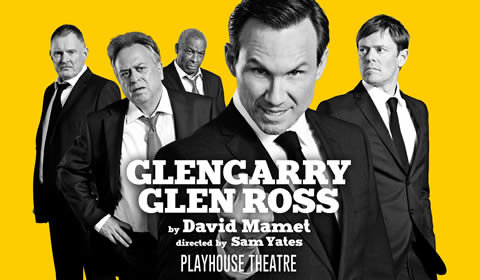
Glengarry Glen Ross at the Playhouse Theatre review ****

glengarry-new-ctt-480wx280h-1510060918

Glengarry Glen Ross

Playhouse Theatre, 25th January 2018

I am wary of West End productions that import a big American movie star to embellish a revival. And, like most ill thought out prejudice, this invariably turns out to be wrong. Still the only person harmed by this ignorance is me.

In this case though I was far more optimistic. This is, arguably, David Mamet’s finest play. A Pulitzer prize-winner no less. It was to be directed by the talented Sam Yates. The supporting cast, Robert Glenister, Kris Marshall, Daniel Ryan, Oliver Ryan, Stanley Townsend and Don Warrington was top drawer. And the Hollywood star in question was Christian Slater. Now I admit he may not be peak A list, he has been in such unutterable dross, I have never seen the West Wing, The Forgotten and Mr Robot, (I don’t have the patience for these TV series), and I can see he is a bit of a tit in real life. But when I have seen him he has munched his way through the scenery in that mini-Jack Nicholson way of his and I figured he was born to play Ricky Roma.

And so it proved. A dazzling performance. Cocksure, brash, manipulative, aggressive, dismissive but vain, hollow, deceiving himself as much as others. Ricky is about as good a character as modern drama has created but Mr Slater still delivers. The scene with Daniel Ryan’s cowed James Lingk, ably abetted by Stanley Townsend’s Shelley, was delicious, as good as I have seen on the West End stage. You could feel Ricky’s brain going through the gears so as not to lose the sale. Prodding, patting, probing, putting his arm around Lingk, not letting him get away. Superb.

Watching Stanley Townsend shift from desperation to euphoria, and then back again, as he pleaded for leads, pulled in a big sale and then realised he had been taken for a ride, was also exquisite. Kris Marshall’s portrayal of John Williamson, the office manager who eventually relishes the power he wields over the salesmen, was a revelation. Don Warrington played George Aaronow as a broken, lost figure, so easily manipulated and Robert Glenister was wonderful as Dave Moss, a man whose cunning is only matched by his belligerence.

This is as good an ensemble as you are going to see on any West End stage. Mind you I bet that is the reaction of anyone who sees it anywhere whenever it is revived. I first fell in love with GGR in, I think, 1985, the revival of Bill Bryden’s world premiere National Theatre production, staged at the Mermaid Theatre, (which is a lovely space and it is bloody criminal what has happened to it). The 2007 revival, with Jonathan Pryce and Aiden Gillen, directed by James MacDonald, near matched this. Not quite so sure about the film, what with the extra character and the softening of Jack Lemmon’s Shelley, but it should still be on your film bucket list for sure.

The salesman in the US is an iconic figure, even in a world of Amazon, internet disintermediation, telesales and the like. The skill of building a relationship with a customer or client, of identifying and fulfilling a need or want, (or manifestly not as is the case here), will always be with us. It is a potent subject for drama: the Tourist and LD remain addicted to the Apprentice, and America chose to elect an ersatz salesman as its leader. The attraction for playwrights lies in the insight the salesman offers into the human condition, particularly its uglier side, and the resonant metaphor it offers for society and economy. Hard to believe but the same subject gave us an even better play than this. In fact the greatest ever American play in the form of Death of a Salesman.

Of course the real beauty of the play is Mamet’s dialogue. And it is beautiful make no mistake. The boy Aristotle, who knew a thing or two, said drama needed heightened language, which you certainly get here, but also rhythm. a kind of music, to the interaction of the plot, characters, lines and the overall spectacle, and this is what Mamet delivers in spades. And he doesn’t hang around. Act 1, in the Chinese restaurant, is a little over half an hour here, (always fun watching the GGR virgins looking a bit nonplussed at the speed with which the interval arrives). Yet, in its three perfect scenes, we learn everything we need to know about Levene, Williamson, Moss, Aaronow, Roma and victim Lingk. In my book Roma’s soliloquy, masked as sales patter, is up there with the best ever written for the stage. And we see that pathetic combination of male aggression, false certainty and “firing from the hip” which infects modern political economy. Too often the plausible bully wins and rises to the top. And if he can’t win he throws a tantrum or cheats. It is always a he.

Chiara Stephenson’s set (and costume) design strove, as it should I think, for absolute realism, which meant a fair bit of carpentry in the interval to turn the atmospheric restaurant into the claustrophobic office where the overnight robbery barely upsets the chaos. And so on to the perfectly plotted second act. I guess the first performance I say was the best precisely because I didn’t know what was going to happen, but knowing the plot, as with all the best plays, leaves more headspace to relish the language and marvel at how Mamet captures this cocktail of virility and vulnerability without ever losing our connection with the characters. For ultimately our problem, surely, is we sort of admire Roma and we sort of pity Levene

Sam Yates as director lets the text sing and, unsurprisingly, leaves the cast to do their thing. So why not a perfect 5 stars. Well this reflects my now oft repeated aversion to West End theatres. To fund my theatrical habit means I can’t go splashing sixty quid plus, or even three figures, for the best seats in the house, willy-nilly,  so I went tight here and opted for the balcony (upper circle as they term it), having stupidly ignored the advice of simian experts. View and sound commensurate with price but the seats themselves up here in the Playhouse are ridiculous. I couldn’t fit in. Not I was a bit uncomfortable. I mean I couldn’t fit in. Moving to a smaller neighbour option and shuffling around helped in Act 2 but it was still about the worst I have ever experienced. Let’s hope they never put a Hamlet on here. I know there ain’t much they can do, and that ATG has to earn its corn, but a clear indication of just how tight legroom is would be appreciated, Anyway I found out the hard way.