
Richard III at the Alexandra Park Theatre review ***

Richard III

Headlong, Alexandra Park Theatre, 17th March 2019

Right. Let’s get the gripe out of the way. Maybe in the smaller venues where this production will tour it might creep up to a 4* but Alexandra Park Theatre, whilst an undeniably superb space after the refurbishment, is just a little too cavernous to accommodate the claustrophobic history/tragedy/comedy/thriller/psychodrama/vaudeville which is Dickie 3.

Chiara Stephenson’s Gothic, dark, old-school castle with a twist, namely the introduction of multiple full length, revolving mirrors, together with the lighting of Elliot Griggs, is a winner set-wise. But it utilises barely a third of the huge proscenium stage, and I would guess, since all is shielded in dark fabric, only a similar portion of the depth. To rectify this the actors, in addition to coming on and off through the glass revolves, enter from the auditorium to the side of the stage, and, for the London scene, pop up in the “slips” and bark back to the stage. It is the right look for John Haidar’s galvanic production and Tom Mothersdale scorpion delivery as Dickie but seems lost in all this volume. As do the lines. Not because of the delivery. In most cases this is sound as a pound but set against George Dennis’s throbbing, pounding, electronic sound the intensity is diluted, and occasionally, for the aurally challenged such as the Tourist, lost completely.

Now this being a Headlong production, (albeit in conjunction with Ally Pally, the Bristol Old Vic, Royal and Derngate and Oxford Playhouse, all of which it will travel to, as well as the Cambridge Arts Theatre and Home Manchester), there is still much to admire. With the Mother Courage, This House, Labour of Love, People, Places and Things, Junkyard, The Absence of War, American Psycho, 1984, Chimerica, The Effect, Medea and Enron, Headlong has been responsible for some of the best theatre the Tourist has seen in recent years. He even liked Common, John Haidar’s last outing, putting him in a minority of one. He would therefore never miss anything the company produces. All My Sons at the Old Vic and Hedda Tesman at Chichester already signed up with willing guests.

John Haidar has opted to sneak in a bit of Henry VI to provide context, (complete with first taste of murder before that “winter” even starts), juggles the standard text and cuts out superfluous characters, though doubling is kept to a minimum, and generally encourages a lively approach to the verse, (though nowhere near the gallop of Joe Hill-Gibbons’s Richard II at the Almeida recently) . This means each half barely ticks over into the hour. The focus then, as it should be, is on Tom Mothersdale’s Richard, and the “family” saga, if you will, a family from which Richard is permanently excluded, rather than the politics. Tom Kanji’s Clarence doesn’t take up too much time, the other assassinations are similarly rapidly dispatched, Stefan Adegbola’s smug Buckingham and Heledd Gywnn’s Hastings, (as arresting a presence as she was in the Tobacco Factory’s Henry V), take precedence in the jostling for power, and the scenes with the three women, Dickie’s, to say the least, disappointed, Mum, the Duchess of York (Eileen Nicholas), Edward IV’s Scottish widow Elizabeth (Derbhle Crotty) and sacrificial lamb Anne (Leila Mimmack), are given plenty of air time.

With Heledd Gwynn doubling up as Ratcliffe, Tom Kanji as Catesby and Leila Mimmack as Norfolk, the production achieves an admirable gender balance and also tips Richard’s murderous ascendancy into a joint enterprise, at least until he shafts his mates. The main cast is completed with John Sackville’s ghostly Henry VI, Michael Matus as Edward IV and then Stanley and Caleb Roberts as Richmond (and utility messenger). The stage then is literally set, what with the opening soliloquy and those mirrors, for Dickie to slay his way to the ghostly visitations. Each murder is marked by a red flash and a loud buzz just to make sure we get it.

Now the Tourist has seen young Mothersdale up close in the slightly disappointing Dealing with Clair at the OT recently, in the magnificent John by Annie Baker, as well as roles in Cleansed at the NT and Oil at the Almeida. He’s got it, no doubt. As he shows here. And, as he capers around the stage, in dark Burgundy suit and leather caliper, long-limbed, lank-locked, threatening, cajoling, pleading, squirming at Mummy’s rejection, he is certainly the “bottled spider” of Will’s description. But I am not sure he finds an angle. There is the caricature Richard of Thomas More Tudor myth, as Reformation Elizabethan England found its way in the world ordained by God. There is Richard as psycho executing to a plan, villainy as predestination. There is nudge, nudge, wink, wink comedy Richard who recruits us into the fun. Or there is poor, diddums, “nobody loves me so I’m going to show you” Richard who can’t stop once he gets started. And more. With multiple permutations.

Here we seem to get a bit of everything in this swift, safe production. Not the monomaniac man-child, (any resemblance to a current world leader is surely entirely deliberate), of the brilliant Hans Kesting in Kings of War, not the compulsive egotist of Lars Eidinger in the Schaubuhne production at the Barbican, not the amoral sociopath of Ralph Fiennes at the Almeida with that infamous rape scene, not the trad manipulator of Mark Rylance at the Globe. Of the other recent Dickie’s that the Tourist has enjoyed Tom Mothersdale comes closest to Greg Hicks’ take in the pint-sized, though still extremely effective production, under Mehmet Ergen at the Arcola in 2017. Except that Greg Hicks made every single word count and plumbed some very ugly depths in Richard’s misogynism and unquenchable grievance. And with chain permanently attaching arm to leg he offered a stark visual reminder of his “deformation”.

There are some fine moments, the “seductions”, the ghosts behind the mirrors, TM cringing at Mother’s curses and her recoiling from his touch, some meaningful gobbing, the writhing in the Bosworth mud at the end, and, like I say, this will probably work better at, say, Bristol or Oxford, but I would have preferred a more thoughtful, and yes, longer, interpretation. Still the one thing you know about Richard III’s, like Macbeth’s, Lear’s and Number 38’s, there will be another one along shortly.
Time Stands Still: Aurora Orchestra at Kings Place review ****

Aurora Principal Players, Iestyn Davies (countertenor), Sally Pryce (harp), John Reid (piano), Nico Muhly

Kings Place, 23rd November 2018

  • Satie – Gymnopédie No. 3
  • Thomas Adès – The Lover in Winter
  • Nico Muhly – Clear Music
  • Debussy – Danse Sacrée et Danse profane
  • Brahms – Gestillte Sehnsucht
  • Nico Muhly – Old Bones (world premiere of ensemble version),
  • Nico Muhly – Motion
  • Thomas Adès – The Four Quarters
  • Dowland (arr. Nico Muhly) – Time Stands Still (world premiere)

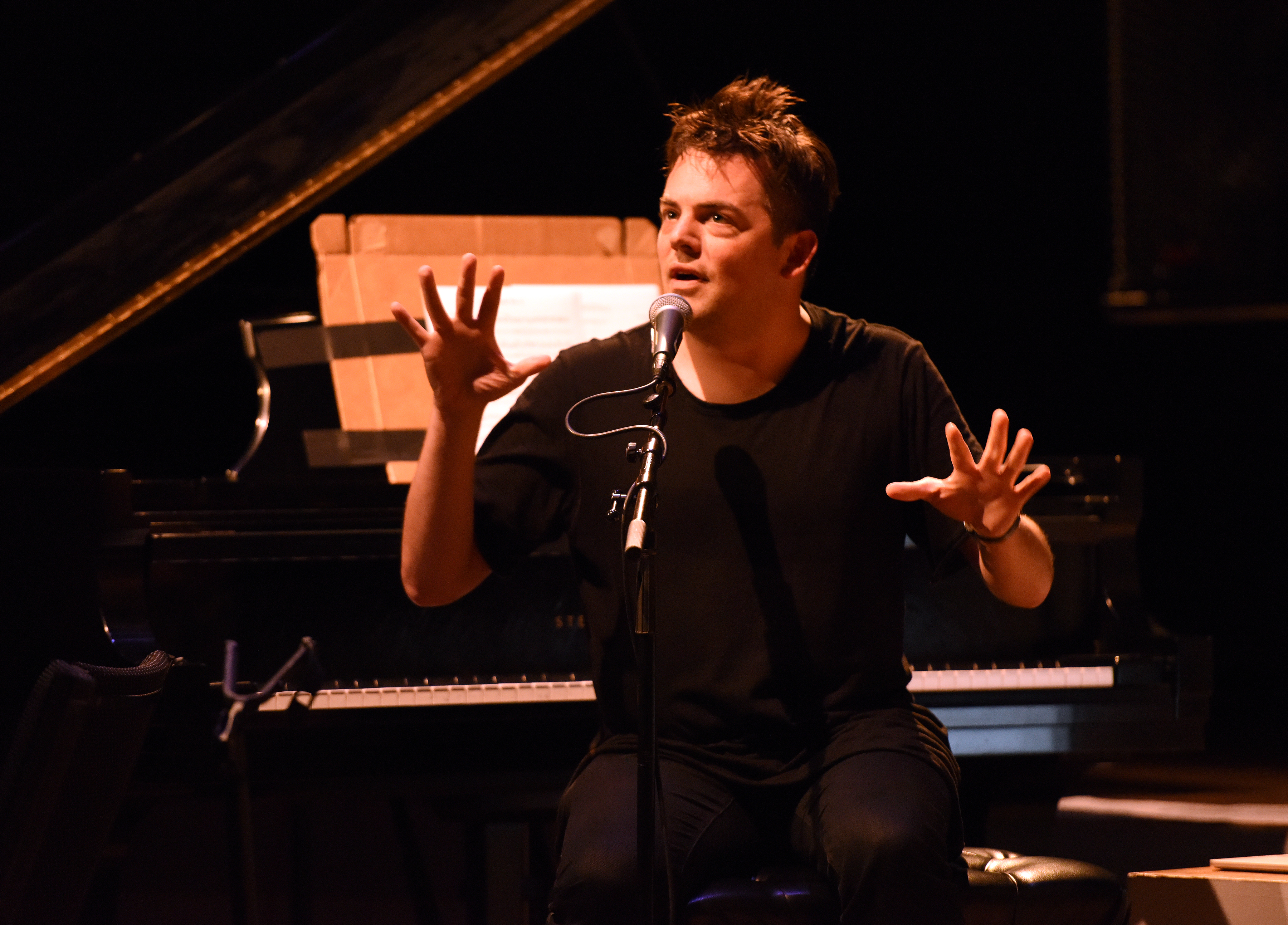
A full house, moreorless, for a diverse programme of chamber music and songs anchored by (relatively) well known works from Thomas Ades and Nico Muhly, whose effervescent presence also graced the evening as performer, conductor and even compere. Oh and did I mention he “curated” the event. The evening was part of the year long Kings Place Time Unwrapped season now coming to an end with the pieces ostensibly linked through their meditation on, er, time and music from an earlier age. 

The musical backbone was provided by the graceful pianism of John Reid, with strings and clarinet from Aurora principal players, Alex Wood, Jamie Campbell, Helene Clement, Sebastian van Kuijk and Peter Sparks. Against this a number of the pieces showcased the unusual harmonies of the harp (Sally Price whose playing was certainly not backward in coming forward), celesta (John Reid again) and the ethereal countertenor of Iestyn Davies

There was a world premiere of a new chamber version of Old Bones, a song cycle about the rediscovery of the body of Richard III in a Leicester car park in 2012, (an event which also formed the opening sequence for the Almeida Theatre production of Shakespeare’s play with Ralph Fiennes in the lead). The arioso of Iestyn Davies was originally accompanied only by a lute, which can be discerned in the fragments of poems about Sir Rhys ap Tomas, the alleged killer of the king, which follows the news commentary intro. The momentum builds into a processional as the text, from Philippa Langley of the Richard III society, eloquently connects the infamous monarch to today.  

Muhly’s Motion for string quartet, clarinet and piano takes as its starting point a verse anthem from Orlando Gibbons, See, see the Word, and applies his trademark post-minimalism energy to Gibbons’s complex vocal counterpoint .

In contrast Clear Music is based on just a fragment of a John Taverner motet. Mater Christi Sanctissima, and is scored for cello. harp and celesta with the latter gifted an inventive solo part for an instrument normally reserved for adding orchestral colour. The texture doesn’t change and the piece is locked in a pretty high register, even in the cello line, but, as usual with Mr Muhly, he creates an engaging piece that doesn’t come anywhere outstaying its welcome. 

Thomas Ades’s Four Quarters from 2010 is a string quartet which takes as it subject the ebb and flow of time, in common with the TS Eliot Four Quartets, poems from which it surely drew inspiration. As usual Ades serves up all sorts of striking  sounds, a wide dynamic range rhythmic complexity, beginning with the eerie babble of Nightfall, followed by Morning Dew evoked through pizzicato, the steady pulses of Days and the astounding harmonic complexity of the last movement, the Twenty Fifth Hour, which is measured in an unusual 25/16 time.

The evening’s outstanding piece of me though was The Lover in Winter, written when Ades was only 18. It is made up of 4 very short songs, in Latin drawn from an anonymous text. It has a bleak, brittle, chilly feel, just chiming piano chords and Iestyn Davies’s exquisite countertenor, though the last song fails up the passion. Melismatic with candid word-painting. 

Mr Davies was also superb in Time Stands Still, a Dowland song which Nico Muhly has re-arranged. The melody is defined by the singer, based on an anonymous love song, with the whole band coming together to provide complementary but recognisably contemporary harmonies. 

The programme kicked off with John Reid in Satie’s ubiquitous piano waltz  Gymnopedie 3, blink and you’d miss it, as well as a helping of (to me) an unremarkable Brahms song and Debussy’s showcase for the harp with its “medieval” first part and  bouncy Spanish inflected second “profane” part. At the end we were treated to Messrs Muhly and Davies presenting an aria from Marnie, which has just finished at the Met, and which I bloody loved at the ENO.

For someone who I gather lives in NYC, Nico Muhly seems to spend a lot of time in London. No surprise that to the Tourist. Indeed he will be back at Kings Place on New Years Eve with the Aurora Orchestra. I can think of worst places to be. Mind you I do have a better offer for once. 


Richard III at the Arcola Theatre review ****

tn-500_greghicksandsarapowellinrichardiiidirmehmetergencalexbrenner

Richard III

Arcola Theatre, 10th June 2017

I have had a surfeit of Dickie IIIs over the last few years. Mind you I am not complaining.

Mark Rylance on his return to the Globe found a vulnerable, despairing Richard who didn’t seem to care about his actions. Ralph Fiennes was a ruthlessly efficient c**t which left next to no room for audience complicity. Lars Erdinger was the narcissistic showman, even in the buff, in the Schaubuhne Berlin production at the Barbican. Benedict Cumberbatch, in the Hollow Crown II version (just get this on DVD if you “don’t like Shakespeare” and then change your mind), upped the comedy quotient which I enjoyed but was ingratiating for others. Robert Sheehan (the pretty boy off the telly’s Misfits) was one of the best things in Trevor Nunn’s marathon, “proper Shakespeare” War of the Roses at the Rose Kingston (yep all in one day for me) with his youth offering up a more bolshie Dickie. Best of all was Hans Kesting in Toneelgroep Amsterdam’s Kings of War. Like the War of the Roses this had the advantage of providing the back-story for Richard’s tale that the standalone productions don’t have, which ensures the other characters are in the flow of the action from the off. Kesting, with his tight fitting suit and birthmark but with no limp or withered arm, created a Richard with physical presence and superior intelligence who is able to bully all those around him. His actions almost seem reasonable such was his charisma making the final “I am a villain” monologue, when his loneliness is laid bare, here delivered to a mirror, even more disturbing.

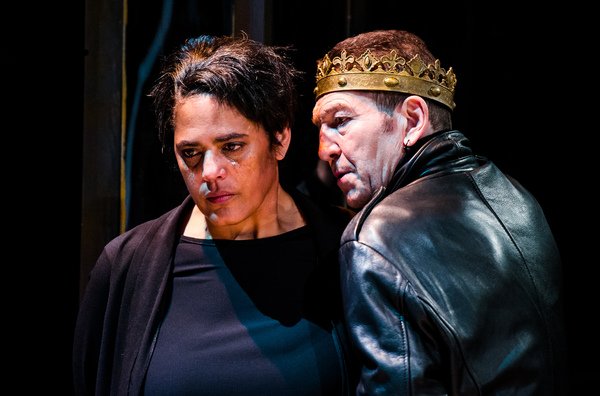
I have to say though that Greg Hicks, in this Arcola production directed by its inestimable head honcho Mehmet Ergen, tops the lot. This is because he captured all of the facets of what it is to be a Richard III in my view. Now remember this is a piece of Tudor propaganda as filtered through Will S’s imagination so no need to get too hung up on the “reality” of the body count or the misogyny. A bloody route to kingship was par for the English course through most of history. What matters is how the performance and production seeks to balance the contradiction between the audience’s repulsion and attraction to our leading man and the dialectic between the thirst for power and the self loathing that torments him. The best plays obviously feast on contradiction and big Will serves these up in spadefuls in this play.

Greg Hicks was not setting out to play the joker here, though the delivery of some of the classic asides to audience served that purpose. His crystal clear delivery of the lines, together with changes of tone and phrasing, and the masterful use of pauses, revealed intent in ways that had not been clear to me before, notably in the “group’ scenes with Rivers, Hastings and Stanley. His constant movement of face and body (with leg permanently chained to arm) and habit of getting right in the face of the other characters emphasised the desire to twist events to his advantage. This was a Richard in a hurry. The crown was the payback for the hate meted out to him in the past. The unhidden misogyny and careless manipulation was simply the means to this end. Not “pure evil”, not a charming pantomime villain, not solely motivated by self hate and a desire to avenge, self-aware but still consumed by the deception of rightful inheritance. This is when an intervention by a trained psychotherapist in childhood might had saved a whole lot of bother later on.

The compact Arcola space with its steepish seating, the sparse staging and costumes, sympathetic staging and lighting, all served to focus attention on the actors. The support from this medium sized cast (there was a bit of doubling) was admirable, particularly Paul Kemp as Clarence/Stanley, Sara Powell (so good in the recent The Plague on this very stage) as Elizabeth and Matthew Sim as a full-on psycho henchman Catesby, but matching Mr Hicks proved a big ask.

We know Greg Hicks is an outstanding Shakespearian actor having been and done it with the RSC and NT and I hope there are many more to come. But I would love to see him revisit some Pinter, create a hard-arsed Volpone or have the lead role in a future Martin McDonagh play.  For the moment though I have this performance to savour.