
Copenhagen at the Minerva Theatre Chichester review *****

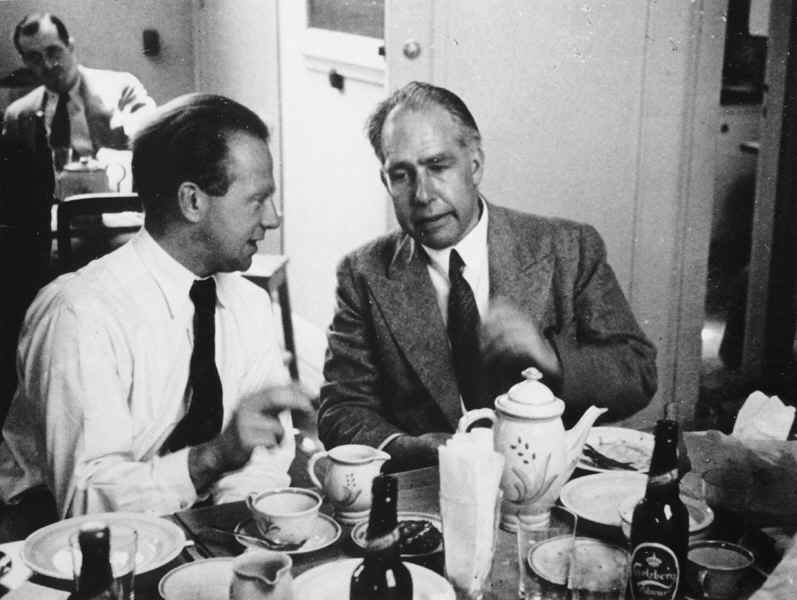
heisenbergbohr

Copenhagen

Minerva Theatre Chichester, 6th September 2018

Michael Frayn wrote the funniest stage comedy of all time. Noises Off. OK well maybe it is only is the funniest of those comedies that I have seen. And maybe the two productions that I have seen, the NT one from 2000/2001 directed by Jeremy Sams, and the 2011/2012 Old Vic revival directed by Lindsay Posner, show it off to best effect. And the fact that Mr Frayn has sharpened it up with re-writes since it first appeared in 1982 helps. It is a farce about a farce about a farce and is brilliantly constructed. For sure the belly aches come from the visual humour and slapstick but real comedy also emerges from the characters “on” snd “off” stage personas and their relationships. Everyone should see this once in their life, (but not the film version – the whole point of this is that it is a theatrical experience and the film is rubbish). LD remembers it as the funniest thing she has seen on stage and she was only 10 at the time.

We also have to thank Mr Frayn for his pitch perfect English adaptations of Chekhov. The magic of Chekhov can prove elusive but a text from MF gives a good chance for a production of walking the tightrope between pathos and comedy. There are his novels as well. I have though, until now, never seen either of his more recent dramatic triumphs, Democracy or Copenhagen.

So thanks to Chichester Festival Theatre for putting on this revival. And to recruiting a cast of the calibre of Charles Edwards, Patricia Hodge and Paul Jesson. And to persuading, if he needed persuading, Michael Blakemore, who directed the NT premiere in 1998 to wave his magic directorial wand over this revival.

Copenhagen is not quite a perfect play. But it is so close that it barely matters. Mr Frayn is a very, very clever man. So naturally he takes a very, very big subject for Copenhagen. The is the imagined conversation between Werner Heisenberg and Niels Bohr in Nazi occupied Copenhagen during WWII about whether eminent nuclear physicists could or should attempt to prevent the building of a nuclear bomb. The exact circumstances of the meeting in 1941 are unclear from their writings, though Bohr seemed to react angrily to whatever Heisenberg brought to him, and there has been much subsequent debate, in part fuelled by MF’s play, about exactly what happened. Out of this admittedly dramatic conceit MF constructs a play of intense philosophical enquiry, offers us both a science and a history lesson, shows the loving and fraught relationships between the eminent Bohr (then 55), his wife and amanuensis Margarethe and his one time student Heisenberg (39), and. as if that wasn’t enough, reminds us of the tension between the “objective” universe around us and our “subjective” view of that world that our consciousness constructs.

The memories of the meeting between the two physicists are played out in various ways, three times “another draft”. Time is not linear. We see several versions of events. The protagonists do not always occupy the same time and place. It is not always clear if they are talking to each other or to us the audience. This “plot” and the movement of the actors mirrors the behaviour of atomic particles in Peter J Davison’s monochromatic set. Did Heisenberg come to warn Bohr and, by implication, the allies about the Nazi nuclear programme? Or did he just want approval from his mentor? Or was he fishing for technical information on what was needed to trigger the required chain reaction? Did Bohr put him off the scent? How fervent was Heisenberg’s patriotism? Or his morality? Was he oblivious to what his country was doing? Did he help the half-Jewish Bohr and Margarethe escape from Denmark? How “guilty” did the scientists feel when looking back and are they trying to assuage that guilt – it was Bohr who ended up in Los Alamos after all?

MF cleverly uses anecdotes and the past history of the three protagonists to draw parallels with the scientific concepts they discuss. Skiing and table tennis act as metaphors to contrast the two men’s characters and approaches to scientific enquiry as well as a way in to Heisenberg’s uncertainty principle and Bohr’s complementarity principle. A pre-war train journey by Bohr shows how electron spin theory was disseminated across Europe and his movements mirror that of the particles he describes. A card game where Bohr bluffs by mistake points up the risk of nuclear proliferation. Toys and weapons are elided. The death by drowning of one of Bohr’s sons, Christian recurs as a motif for what might have happened if someone or something had intervened. (The video backdrop courtesy of Nina Dunn has a lot of waves, alluding to the drowning and presumably wave theory). There’s probably loads more I missed.

Even with these “simplifying” devices, (which, as the two scientists remind each other to revert to “plain” language for Margarethe’s sake, can sometimes patronise), this is dense stuff. But it doesn’t feel like it. Aside from one tiny slip, Paul Jesson as Bohr and, especially, Charles Edwards as Heisenberg, are utterly on top of the language, and Michael Blakemore’s direction ensures the delivery is perfectly placed. Patricia Hodge avoids smothering Margarethe with an overly haughty demeanour, protective of her husband and suspicious of Heisenberg, the nucleus revealing the human failings of both.

As I understand it, and I don’t, the Copenhagen Interpretation was proposed by Bohr and Heisenberg before the war as a way to reconcile different theories of quantum mechanics. Quantum mechanics can only predict the probabilities of what might happen in physical systems. The act of measurement affects the system to reduce to the one result that is observed. Like what MF is doing with the play. With us doing the measuring. Though we cannot be sure of the result.

Big ideas, and especially big scientific ideas, can often lead to big drama. But dramatists can often overreach themselves or retreat back into the human and not push us intellectually as hard as they should. Copenhagen, like Brecht’s Life of Galileo, doesn’t make that mistake. One of the best plays I have ever seen and, once fizzing, a near perfect production.
 

The Moderate Soprano at the Duke of York’s Theatre review ****

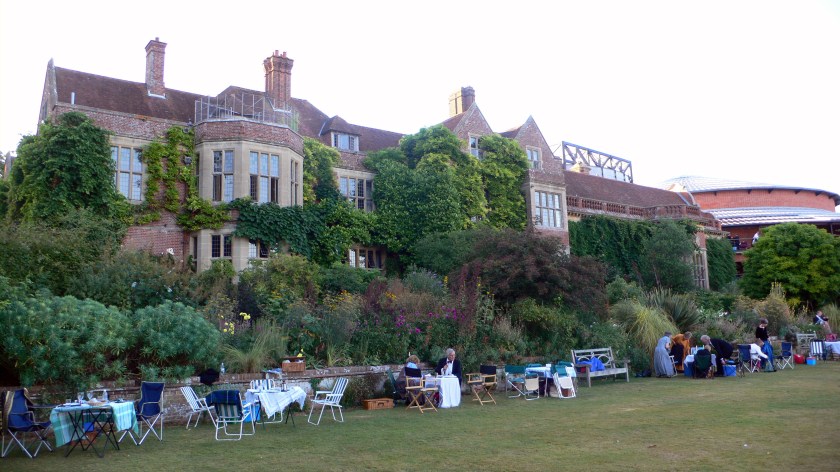
glyndebourne_1

The Moderate Soprano

Duke of York’s Theatre, 7th June 1018

There are a couple of weeks to go in the run of David Hare’s The Moderate Soprano at the Duke of York’s Theatre. There are plenty of (discounted) tickets left. You could do a lot worse than seeing this if you are after a bit of last minute theatre action. It charts the relationship of eccentric millionaire type John Christie and his singer wife Audrey Mildmay, (and the bunch of pre WWII emigres from Central Europe who helped them), as they set out to create the Glyndebourne Opera Festival in, essentially, their back garden. So if a gentle, though still involving, tale of toffs ill-advisedly pursuing their opera dream appeals don’t hesitate. If not I’d understand but you would be missing a treat from one of out greatest living playwrights.

Roger Allam, complete with convincing bald pate courtesy of make-up, and preposterously high-waisted linen trousers, plays Captain John Christie a textbook British oddball who inherited the Glyndebourne estate but didn’t then loaf around Brideshead style, instead leading his troops from the front in WWI, teaching science at Eton and then poking his nose into to matters of Efficiency in the matter of Government in WWII. He loved the opera, specifically Wagner, (I gather some people do though it beats me why), making regular pilgrimages to Bayreuth. He eventually finds love, late in life, and marries English soprano singer Audrey Mildmay played by Nancy Caroll, after much persistent wooing.

The Captain hatches a plan to build a small. 300 seater, opera house in the grounds of the estate, as you do. He recruits conductor Fritz Busch as Musical Director, (his brother was the founder of the legendary Busch Quartet), Professor Carl Ebert as Artistic Director and Rudolf Bing as Festival Director and overall marketing supremo. All three have escaped Nazi Germany, Bing, (whose extraordinary life is worthy of its own dramatisation), because he was a well-to-do Jew married to a Russian ballerina, Busch because his artistic freedom was curtailed (in savage fashion) by Nazi sympathisers, including his own orchestra at one point, and Ebert because of his voluble criticism of the regime. In a series of informal meetings between the five we learn, as does Christie who is initially sanguine about the changes in the Germany he admires, how the regime has attacked the culture it hates, how Christie’s arm is twisted such that Mozart, not Wagner, becomes the staple of the inaugural pre-war seasons for reasons of practicality and how Audrey becomes the glue that holds the whole project together (and gets to sing). Christie aim was to ring world class opera to Britain, previously accustomed to more amateurish fare, and to do this he turned to the best that Europe had to offer.

The most powerful scenes however, in large part thanks to the supreme skill of both Nancy Carroll and Roger Allam, are the flash forwards after the Christies have passed on the baton of running the Festival and as Audrey’s health progressively deteriorates. Audrey and their two kids were sent by Christie to the safety of Canada during the War but, unable to receive money from England, Audrey needed to sing to get by, which eventually led to a bust up with Busch when he refused to cast her in his Cosi at the Met, the shop where he, and Bing, had pitched up post Glyndebourne. They eventually made up and Busch returned to Sussex from 1950. It seems that Audrey was poorly throughout when she returned, often cancelling performances, but was still able to support Christie at Glyndebourne, help Bing set up the Edinburgh Festival, (yes that Edinburgh Festival), and sit on the Arts Council. What a trooper.

We see her near the end, having lost her sight despite surgery for high blood pressure, and the devotion and love between her and Christie pours out off the stage. I am a sucker for watching art portraying old people still plainly in love but I defy you not to be drawn in. Christie in turn is looked after, by faithful retainer Jane Smith (Jade Williams) after Nancy passes away. Lovely stuff.

I fear I may have given a bit too much of the story away but perhaps this means you can see why David Hare, who I assume loves the opera, was drawn to it. Now I have to admit that I would love to see Mr Hare rustle up one of those searing, state of the nation multi-character extravaganzas of old, much like his recent Collateral on the telly. On the other hand his more “domestic”, heir-to-Rattigan, ordinary-made-extraordinary dramas, of which this is a prime example, are just as satisfying. Jeremy Herrin, who has form with both writer and cast, directs with his usual flair, Bob Crowley’s new set opens up to reveal stunning interior and exterior representations of Glyndebourne itself, including Christie’s impressive organ, (no tittering at the back), ably assisted by Paule Constable’s lighting and Simon Baker’s sound designs.

Paul Jesson as Busch, Anthony Calf as Ebert and, especially, Jacob Fortune-Lloyd as Bing are all perfectly cast and tremendous foils for Mr Allam and Ms Carroll, who reprise their roles from the original Hampstead Theatre run. The comedy, which is wired in to Mr Hare’s text, is beautifully executed, to sweetly contrast with the pathos.

Now I ave never been, nor would I ever go, to Glyndebourne. For the same price as even a ticket upstairs at Glyndebourne I could get a couple of luxury visits to Covent Garden, and several years worth of fun from my normal high up perch, or three or four trips to the ENO. I don’t have an evening suit and would vehemently object to wearing one anyway. And I can’t be arsed to travel to Sussex with a bunch of braying toffs. Oh, and as I have said before, most of the classic canon in the world of opera, which is Glyndebourne’s meat and drink, is a dreadful bore. So I can assure you my enjoyment of this play has nothing to do with any great love of the institution despite the fact I am a shocking cutural snob. It is just a very pleasing presentation of a very interesting story, unafraid of its explicit Romanticism.

Coriolanus at the Barbican Theatre review *****

coriolanus-production-photos_-2017_2017_photo-by-helen-maybanks-700x455

Coriolanus

Barbican Theatre, 16th and 17th November 2017

This angry looking chap is Sope Dirisu and he is playing Caius Martius ,who you might know better as Coriolanus, in the RSC’s latest production of Shakespeare’s last proper “tragedy”. This will be followed from Stratford to London by the other plays in the Rome season, Julius Caesar, Antony and Cleopatra, and the gorefest Titus Andronicus, as part of the “Rome” season. You can read all the proper reviews from the Stratford run, but, if this is anything to go by, I reckon I am in for a treat with the rest, as this was better, in my view, than those reviews let on.

Now it helps that I happen to like this play. A lot. Maybe not as much as Othello, Macbeth and Hamlet, but, whisper it, more than Lear. It is sparse, he (Coriolanus) is a flawed character, and the writing is, by Shakespeare’s sublime standards, a little lacking in poetry and lyricism. This is exacerbated by a “prose driven” production – suits me but maybe not the  purists. Like Macbeth and, indeed Titus A, it tells of a hero, (or maybe anti-hero, that is why it is so clever), whose destiny is bound up with that of his country, in this case 5th century BCE Rome, the early days of the republic. Coriolanus is, like these other “warriors”, a complex and unique personality, whose vanity and inability to compromise leads to his downfall. He harbours powerful homo-erotic desires for his mortal enemy, Tullus Aufidius, and he has the mother of all mother complexes, as it were.

There is some humour, and some satire, though I get that it is a bit buried. The body count, by the standards of Shakespeare tragedy, is minimal, just one at the end. There is War though, unusually very early on, which allows fight scenes that this cast revelled in. Fight  director Terry King deserves a great deal of credit. The plot is straightforwardish, (WS once again pinched his story from Plutarch), and revolves entirely around the Big C himself. It is his connections with his family, his own people and the Volscian people of the enemy state Corioles, that defines the play and what makes it interesting for our, (and probably plenty of other), times. For the play brutally examines the exercise of political power, the relationship between classes, the limits of democracy and representation, the dangers of populism, the nature of patriotism, the business of compromise, the call of duty in both military and civil society, in addition to all the deep, Freudian, psychological stuff. Ancient Rome is fundamentally different to our world today but the issues it grapples with are uncannily similar.

Which is why, in its way, its the best “Brexit” play I have seen this year. People’s visceral reactions to what is “right” and what is “fair” and the way in which they are, or think they are, being treated by their leaders, is what lies at the heart of this play. The continuing tensions between the haves and the have-nots, the “leaders” and the “led”. As ever though, there is no black and white with big Will, as you oscillate between hating and maybe admiring Coriolanus’s actions and intentions, and you see the ways in which those around him react, Mum, wife, nemesis, tribunes, friends, soldier colleagues and substitute Father, all try to influence and manipulate him.

Now a twist of fate “permitted” me to watch the first half twice, up to Big C’s banishment. A technical issue on the first performance I saw meant a return the next day to see the rest. I confess I was so pumped up by the first half and by the cliff-hanger when Coriolanus tells Rome to go f*ck itself that I was bound to return. And the tightwad in me wasn’t going to miss a free hour and a half of this. Turns out the repeat viewing was an insight into how the interplay of text, action, acting and audience can create a very different experience. Same play, same production but different lines and words leapt out; I focussed on different characters at different times and thought about different aspects of plot and message as it evolved.

Sope Dirisu turned out to be a suitably virile military man and the camaraderie and mutual admiration between him, Charles Aitken’s ardent consul Cominius, and Ben Hall’s pragmatic general Titus Lartius, rang true. As did his hesitation with Hannah Morrish’s wispy wife Virgilia. The turning point scenes with mother Volumnia also stood out. Whether extolling the virtues of her son’s military achievements in full on patrician mode, or achingly pleading with him to curb his revenge even though she knows what this will lead to, Haydn Gwynne was magnificent in the role. Duty trumping family. The best performance of the evening. Mr Dirisu also shines in the scenes with Tullus Aufidius, but once again this as much reflects the skill of James Corrigan’s performance as the bested Volsci. It is tricky to convey the admiration, nay passion, that he feels for Coriolanus whilst still letting us know that he intends to play him to his country’s advantage when Big C turns treacherous.

It does take a bit of time for our Coriolanus to ramp up from haughty disdain to bilious disgust of the people, and the two tribunes, Sicinius Veletus and Junius Brutus, who orchestrate them. This though created a welcome ambivalence in our political sympathies. Should we side with the put-upon plebeians, hungry and overlooked by the out of touch Senate and the aristocratic Consuls, or with fearless Coriolanus, who may saved Rome from the enemy, but who sneers at the people and refuses even a pretence of the humility expected to secure their approval for his election as Consul?

Having two women play the tribunes, given Coriolanus’s conflicted relationship with the opposite sex, added an interesting dimension, and the contrast between Martina Laird’s more measured Junius and Jackie Morrison’s more provocative Sicinius was also well observed. Paul Jesson’s patient, though frustrated, Menenius, father, mentor and apologist for Coriolanus, was another fine performance.

Now as it happens Paul Jesson has a bit of form with Coriolanus having played Junius Brutus in Ralph Fiennes’ 2011 film version. This is an outstanding production, with a magnetic performance by Mr Fiennes, who also directed, a stunning cast and the uneasy backdrop of Serbia. Angus Jackson, with this modern dress production, has, perforce, created a somewhat different tone, but, I think, similarly makes the case for what I think, is a riveting play. It seems to me that there is a case for moderating Coriolanus’s “pride” and subsequent “fall” and for questioning the political “rights and wrongs” and, if that is true, Mr Jackson’s definitely direction succeeded here. A bully oozing utter contempt may lead to more powerful lead performances but can be overbearing. I liked the contrast of Mira Calix’s string and voice led score and Robert Innes Hopkins design (excepting the troublesome plinth) was coherent (it carries through the whole season).

Coriolanus a tricky, difficult, awkward play. Nonsense, as many recent productions have shown. Mind you I’ve never understood the difference between Shakespearean tragedies and comedies, so you can safely ignore me.