

The Remains of the Day
Yvonne Arnaud Theatre, Guildford, 13th April 2019
Right all you good citizens of Derby, Salisbury, Cambridge and Bristol. There is still time for you to book tickets to see this excellent adaptation of Kazuo Ishiguro’s celebrated novel The Remains of the Day. A very well crafted script by Barney Norris, (just the fellow to write pensive studies of “Englishness” based on his previous work), in an excellent production from one of our premier touring companies Out of Joint, thoughtfully directed by Christopher Haydon, (latterly of the Gate Theatre), with a pair of sparkling central performances from Stephen Boxer and Niamh Cusack.
Now the Tourist has never been much good at reading. Nothing ever seems to sink in without repeated exposure. Especially with fiction. And especially with fiction he read in his youth. A vague recollection of the big picture, a few specific episodes and a general “I like that author”. Not like the SO who can trot out plot, character, meaning, style, context, like an A* student even for things she read decades ago. Maybe this low level intimidation is what stops the Tourist picking up a book except when on hols. That and spending too much time at the theatre and writing this stupid f*cking blog.
Anyway you probably. like the Tourist. know this work more from the 1993 Merchant-Ivory film with Anthony Hopkins and Emma Thompson as Stevens and Kenton, both quietly upstaged by Peter Vaughan as Stevens Senior. Nominated for 8 Oscars, won none. Mind you that was the year the Academy rewarded Spielberg for Schindler’s List. Fair dos. I see that one Harold Pinter wrote an original screenplay for the film when Mike Nichols was slated to direct. Bits of Harold’s work made it to the end but he removed himself from the credits. Might have been a very different film with him and Mr Nichols in the driving seat.
Instead I remember the central, unrequited, relationship between the stiff Hopkins and the droll Thompson, the look and feel of the thing, (Merchant-Ivory being allowed to film in any toff’s house at the time such was their fame), and the almost elegiac take on the history under examination, the 1950’s and the 1930’s. Yes the politics were there but not as sharply delineated as in this play. Class, deference, knowing one’s place, belief in the wisdom of the elite, are common to both treatments but I was far more struck in this treatment by the desire of many in the aristocratic class in the 1930’s to broker a deal with Hitler, to appease, than I was in the film. And specifically the reasons why, the guilt at having inflicted so much economic misery on Germany post First World War, as well as the memory of the human carnage of that war, and, of course their anti-semitism, which motivated them to pursue this course.
It may just be that, like my reading of the book, I just don’t remember the film very well. Which is salient given that The Remains of the Day is a memory book/film/play. Or maybe more specifically a memory of a history, personal and political, book/film/play. To solve the “problem” of butler Stevens remembering the events at Darlington Hall in the run up to the Second World War, (as he undertakes the road trip in 1958 to pay the visit to the ex-housekeeper, Miss Kenton, prompted by her letter), the film makes generous use of flashbacks. And a cast of thousands.
Well maybe not quite but tons of extras and actors of the calibre of James Fox, Christopher Reeve, Hugh Grant, Michael Lonsdale and Tim Pigott-Smith to fill all the named characters, (trust me, a lot of people found their way to Darlington Hall). Even the minor parts are filled by the likes of Ben Chaplin, Patrick Godfrey, Peter Eyre, Pip Torrens and, the go-to actor for Germans in British films, Wolf Kahler. Blimey even a young Lena Headey, Cersei in you know what, gets a look in. Basically if you could do plummy or gor-blimey, and you weren’t engaged elsewhere, you got a part in the film.
No such technology of budget for Out of Joint and Messrs Haydon and Norris. So a fair bit of character pruning, some adroit exposition to incorporate those written out, and extensive doubling. But this is not just any old “exit Act 1, turn up as someone else in Act 2 with new costume and wig” stagecraft. This is seamlessly executed, on stage choreography, a hat, a coat, a pipe, to turn a cast the cast of 8 into the staff and guests of pre war Darlington Hall and the locals Stevens meets on his pint-sized odyssey of self-discovery. This means that the ghosts of the past are always present. Very clever and very easy to follow.
Stevens devotion to duty even in the face of the shocking demand by Lord Darlington to sack the two Jewish maids, Kenton teasing Stevens about his book, Stevens carrying on his duties even as his father dies and Mme Dupont, (a gender change to accommodate the casting pyrotechnics), whinges about her feet, Reginald’s increasing awareness of what his godfather is up to, Stevens disowning the past in his conversations with Dr Carlisle, the mocking Stevens is forced to undergo from “Sir David” the composite collaborator with Lord D, the radical conservatism, or conservative radicalism, espoused by everyman Morgan in the pub and, of course, the extraordinarily moving scenes between Kenton, or Mrs Benn later on, and Stevens, as the happiness they might might have had slips through their fingers. You flipping noodle Stevens.
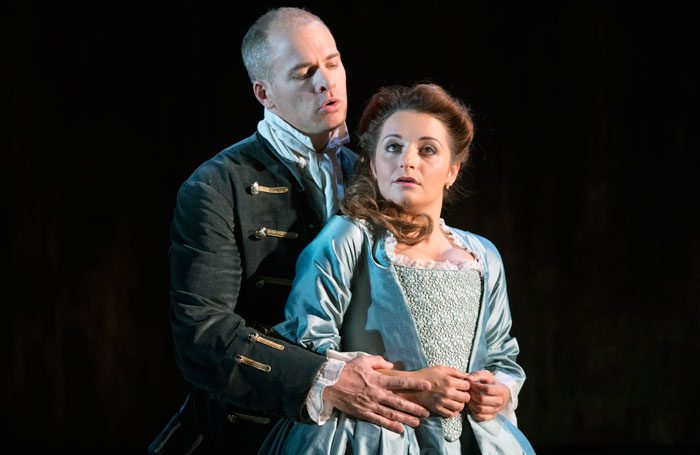
All of these scenes are memorable, providing plenty of minor key drama, but the best things about the play are the performances of Mr Boxer and Ms Cusack. I’ll stick my neck out here and say that for me, and remember this is based on my faulty memory, they capture the essence of Stevens and Kenton more that Hopkins and Thompson in the film. The ten year age gap between these actors seems more convincing than the 20 years of the film. Mr Boxer seems to me to bring out more of the interior life of Stevens, the way he buries the emotions that he plainly has in the cause of maintaining the dignified exterior he believes is required of him, the way he is puzzled by, but still craves, Miss Kenton’s attention. Ms Cusack seems more playful as Kenton, holding back the regret until the very end. the structure of the play lends more prominence to the conversations in the pub and the way this changes Stevens’s perspective.
The directness of the political dilemma, and its flawed morality, is far more pointed here than in the film. And the reliability of Steven’s recollection is more nuanced as in the book, (yes I took a quick peep again whilst writing this). In fact generally Mr Norris seems to capture the essence of the book in a, er, more reliable way that the period-drama aesthetic of the film does.
The rest of the cast step up. Miles Richardson captures the naivety, in life as well as politics, of Lord Darlington and the middle class bonhomie of Dr Carlisle. Sadie Shimmin offers us an uncomplicated pub host in Mrs Taylor alongside the hauteur of fascist sympathiser Mme Dupont. Edward Franklin warms to his task as the bespectacled, conscientious godson Reginald, (drawn from the film not the book), Patrick Toomey is the arrogant American politician Lewis (and, I think Farraday, Steven’s current employer) and Pip Donaghy marks out Stevens Senior decline. Top marks to Stephen Critchlow though as he he shifts from Morgan to the real “villain” of the piece the anti-semitic Sir David.
I see a lot of plays but this is one of the more satisfying I have seen so far this year. “Knowing” the content helps of course, and, from a personal geographical perspective a hop to Guildford, and the fine design and accumulated history of the Yvonne Arnaud Theatre, was no inconvenience. I get that Out of Joint rightly values its touring credentials and I am grateful to the Royal and Derngate, (on my list to visit), and the Oxford Playhouse for co-commissioning Barney Norris’s script. But I am stunned that this hasn’t secured, as far as I know, secured a berth in London.
The familiar story, the quality of the acting, the script and the production, (Lily Arnold’s set is another stand-out as is Elena Pena’s sound design), the themes it explores and their contemporary echoes – the dangers of passivity and nostalgia – all would suggest to me that this would pack them in in a mid sized West End venue. There is plenty for the customary theatre demographic to enjoy, (they certainly did on this Saturday afternoon), but, with the right tone, I reckon some younger folk could be persuaded. I know that Out of Joint’s last major production, Rita, Sue and Bob Too, had a false start, understandably, before eventually gathering plaudits as the Royal Court but most of the rest of their historical efforts have popped up in the capital. This, whilst still posing some thorny questions, looks to be a far more commercial proposition than many of those predecessors.
Barney Norris plainly says that “the play must be unlike the book or the film or it shouldn’t exist” in the programme. Fair dos. But, whilst its structure and perspective match his manifesto, there is more than enough of both earlier manifestations to justify your attendance should you know them.
Over to you nice people at ATG.
 At Home He Feels Like A Tourist