

Prom 15 – Bavarian Radio Symphony Orchestra, Yannick Nézet-Séguin (conductor)
Royal Albert Hall, 30th July 2019
- Beethoven – Symphony No 2
- Shostakovich – Symphony No 5
It always surprises just how few Proms concerts tick all the boxes for the Tourist. I can usually only manage 4 or 5 in the season. Partly this reflects holiday and other clashes, and this year I was a few hours late out of the block when booking opened, (so missing the Voces8 and English Concert gigs at Cadogan Hall and the first Vienna Phil Beethoven/Bruckner with Haitink conducting), but mostly it stems from the preponderance of Romantic repertoire and the relative absence of Early/Baroque/Classical in the programming. If you like the likes of Berlioz, Rachmaninov, Tchaikovsky, Mahler, Bruckner, Dvorak, Strauss and Sibelius you were, as usual, in your element this year. If this is not your cup of tea a more judicious approach is called for. Mind you. This suits me in a way as, (whisper it), the dear old Albert Hall isn’t my favourite gaff even if the sound is never quite as bad as you might fear up in the Raising Circle where the Tourist perches.
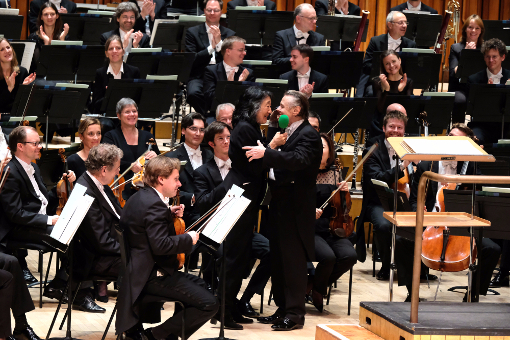
So for me this concert was the one stand-out in the season. Beethoven 2, Shostakovich’s 10th, with the BRSO, under the baton of Mariss Jansons, which runs close to being the best orchestra in the world right now. Hold up chum I hear you say. Mariss Jansons? Shos 10? That’s not what it says above. Well no. Mr Jansons was ordered to take time off over the summer by his docs though it looks like he will be back in the saddle in Munich for the new season, (and maybe he will keep his mouth shut about female representation in music in future). Fortunately for Prommers and those at the Salzburg festival Yannick Nezet-Seguin was able to step in at short notice and his facility with Shostakovich was sufficient to see the 5th replaced the 10th. Which was no great disappointment.
Especially in an interpretation as powerful as this. Now the Tourist has had to wait a few years to witness the conducting, (or indeed pianistic), prowess of French-Canadian YN-S. Never heard the Rotterdam Phil when he was head honcho and am not about to jet over to the Met in NYC or Philadelphia to hear his current troupes. Also never heard the Chamber Orchestra of Europe where he guest conducts and always missed him a few years ago when he still did the same for the LPO. And judging by his discography there aren’t too many orchestral works where our paths might cross. But Shostakovich is clearly one, and, based on this Beethoven 2, it is also clear to me that I need to find a way to hear him lead a Mozart opera.
I am not smart enough to understand why certain conductors and orchestras lift music to another level. But I think I know when I hear it. The BRSO under MJ massively persuaded me with a Prokofiev 5 at the Barbican a couple of years ago. Their playing is powerful, accurate and precise. This was clear in the leisurely reading of the Beethoven Second. Easy on the vibrato, HIP style, but still with a foot firmly planted in the Romantic, focussed on the individual building blocks of the symphony though not utterly convincing on the whole. No 2 can be, shall we say, forgettable compared to what can after, but, in the right hands, is still a work of genius, especially the opening and closing movements.
It took a little time for LvB to bring it to together, interrupted by commissions and by encroaching deafness, and was largely written at Heiligenstadt, but, as is often remarked, you wouldn’t know about LvB’s personal travails from listening to this. The first movement Adagio-Allegro can’t match the Eroica in scale but it does signpost LvB’s future direction of travel. The Allegro wanders off to B flat before wending its way back to the D major home key and the rising scale of the allegro couldn’t be simpler but sets the tone for the surprisingly jolly vibe which pervades the work. The Larghetto, also in sonata form similarly doesn’t spend too long in the darkness, though its woodwind burbling does slightly overstay its welcome, and the following Scherzo and Trio movement marks the first use of the “joke” in a major symphony. The Allegro finale starts off like a classic LvB rondo but then develops into something far more musically complex and is dominated by rapid string passages. Immediately appealing, but satisfyingly clever, like all the symphonies which were to follow.
So a solid start. But it was the Shostakovich which really showed what this band and conductor can do. Given his opera jobs I suspect it may have been a little while since YN-S last tackled the Fifth but it is a work he knows well. And the BRSO certainly does. The complete Shostakovich cycle recording on EMI conducted by MJ may not, individually be best in class, but the 2, 3, 4, 12, 13, 14 versions on this set made with BRSO come close, and, at 20 quid, the cycle is a steal. I confess I prefer Haitink overall when it comes to DSCH, but also have versions of some of the symphonies from Rozhdestvensky and the USSR Ministry of Culture SO and Petrenko and the Royal Liverpool PO (whose complete set is also a bargain). And I would snap up a set of Kondrashin recordings should this ever return based on what the experts say.
The point is that whilst super smooth Shostakovich should be avoided, the extreme of the hardcore Russian approach does take a bit of getting used to. Extremes of anger, aggression, pain and pathos, are what these works are all about, and it is right that interpretations test the patience of the listener, whether it be in the bleak never ending slow movements, the sardonic scherzos or the melodramatic, ambiguous, opening and closing movements.. Whatever you think about what DSCH was actually trying to say in his music it definitely needs an edge, even if you end up concluding that it is sub-Mahlerian, film-music bombast as many have done. I love it but it is undeniably music of edge, effect, emotion and image, mixing high and low brow, light years away from the musical maths of a Bach or Stravinsky.
What it does need to convince however is perfect playing. Forgive the thoughts of this musical dummy but f you have a lot of instruments playing the same thing, or single instruments soloing over a sparse backdrop, then you need the players to be exact. DSCH does not forgive imprecision. The BRSO, perhaps more than any other outfit, move as one. Which means that all the “effects”, the fear, brutality, solace, the bright lights, the shadows, were perfectly executed. DSCH symphonies all, at least from 5 to 13 (1,2,3 are the avant garde formal experiments, 14 and 15 defiantly personal), conjure up images of war and terror and the capacity of humankind to overcome even if, like the Fifth, they came before WWII. But to pull together the passages in the movements to simulate the march of history, and then to lay on top the ironic detachment that, I think, DSCH sought, the last movement of No 5 being archetypical, requires conducting and playing of real skill. That’s what we got here. The sheen was there, no doubt, as were the debts to Mahler and Stravinsky in the phrasing, but this was also properly aggressive and emotional when it needed to be.
The Fifth is, I would assume, the most oft-performed of DSCH’s symphonies meaning the dangers of over-familiarity loom even larger. How to capture the thrill and surprise of the music without getting lazy? How to balance the ostensible formal conservatism of the four movements in DSCH’s “Soviet artist’s response to justified criticism” with the probing, questioning and cynicism which seems, even if this is wishful thinking on our part, to lie beneath? YN-S and the BRSO did not avoid echoing the folk tunes, festive dances and grandiose anthems that punctuate the work to meet Soviet requirements nor did they try too hard to subvert the “uplifting” coda to the finale as it turns from D minor to major. Nor did they over-reach in the still, hovering episodes of the opening movement which punctuate the aggressive tutti climaxes, nor in the heart-rending third movement Largo chant, (with some ear-strainingly quiet pianissimos), nor in the perverted waltz of the Allegretto. They just let it speak for itself. Whether as classic symphonic journey, as testament to the struggle of the Soviet people to escape oppression or as satirical indictment of the dread inflicted by Stalin and his regime. Or just as music which, whilst maybe too obvious and precipitate, immediately connects. As was very clear from the eruption of applause when finally the timpani and bass drum sounded out their last, immense, booms.
A bit of Mussorgsky for an encore. Dawn on the Moscow River from Kovanshchina. Arranged by guess who. Shostakovich.
Like I said. There are surprisingly few Proms that do it for me. But, just like last year and the BPO’s Beethoven 7 under Kirill Petrenko, I reckon I heard the pick of the season. (BTW sounds like Mr Petrenko means business kicking off the BPO season with what sounded like a belting Choral Symphony and serving up a diet of, unsurprisingly, Beethoven and Mahler in the first half of next year. I get the BPO will be glad to see the back of Rattle’s excursions into Rameau and Bernstein. Anyway the Tourist feels a trip to Berlin coming on).
 At Home He Feels Like A Tourist