Peer Gynt at the National Theatre review ****

Peer Gynt

National Theatre Olivier, 1st October 2019

I know what I need. A bit more Ibsen. There are reasons why theatre-makers keep returning to the master and the slew of high profile productions in London this year alone is a reminder of why. I would probably plump for Ian Rickson’s Rosmersholm as the best of the bunch but there have been others that have captured the great playwright’s unique cocktail of thrilling drama, scathing political and moral critique and meticulous psychological insight.

Right now I crave a John Gabriel Borkman, a play that I have never seen and which I gather offers a challenge to directors in reconciling its melodramatic, symbolic final act to the realism of what has proceeded it. I don’t suppose I will have to wait too long though. In the meantime Peer Gynt, the romance, fantasy, epic, modernist mix of surrealism, poetry, naturalism and confessional, written in Danish verse over five acts, that has been challenging and delighting theatre makers and audiences since it first tore up the rule book in 1867. The last time I saw it was at the Arcola in Theatre an der Ruhr inventive two hander in German, (yep, I know what you are thinking). This could hardly be more different. The full resources of the Edinburgh Festival and National Theatre on the Olivier stage in a new, free adaptation by David Hare (with byline after Henrik Ibsen), directed by the venerable Jonathan Kent with sets and costumes from opera whizz Richard Hudson and with a cast of 25 led by James McArdle.

I confess I am still feeling my way into Peer Gynt and I recognise that David Hare here, whilst sticking closely to Ibsen’s plot, materially updated its content to satirise contemporary issues. I guess we should have expected nothing less from Mr Hare and his gift for the elegant, incisive and amusing turn of phrase remained undimmed. There are times when the exact target of Mr Hare’s ire became a little confused and/or indulgent but generally this is a text to savour.

Peer Gynt is a fantasist who creates his own narratives, his own view of his self, which, it turns out, is a long way from the reality even when he “succeeds”as well as when he “fails”. Pretty easy then to see why Mr Hare and Mr Kent would be attracted to this story of a life built on vacillation, invention and entitlement in our digital world of self-obsession and distortion at both the individual and societal level. As Ibsen trenchantly observed “if you lie, are you real?”. And the message of Peer, here Peter, Gynt is, if you are going to make stuff up and avoid knuckling down, go big. Who knows where you may end up. POTUS even? After all the play itself has generated its own reality with an annual festival, a sculpture park, a prize for best Norwegian thing of the year, numerous films, TV presentations, ballets, operas, musicals, Greig’s music and innumerable professional and amateur productions.

McArdle’s Gynt is a demobbed soldier returning to his Scottish village of Dunoon recounting tales of his bravery that bear and uncanny resemblance to seminal scenes from war movies. His Mum, Ann Louise Ross, puts up with his nonsense but the villagers, as we see at the wedding, are less forgiving. He kidnaps the bride, falls for Sabine (Anya Chalotra), a kind young immigrant woman, is banished, meets some line dancing cowgirls (Lauren Ellis-Steele, Hannah Visocchi, Dani Heron), gets shit-faced, bangs his head, dreams of a troll king (Jonathan Coy) and fathering a child with a his daughter (Tamsin Carroll), meets a gnomic chap called the Boyg (Nabil Shaban), wakes up, rejects a life with the faithful Sabine, movingly watches his Mum pass away, runs off, becomes an evil oligarch, a pilgrim, a fake guru and ends up chatting to the deranged inmates of an asylum. He heads for home, is shipwrecked, meets the aptly named Weird Passenger (Guy Henry) and finally has it out in the philosophical steakhouse with the Boyg and the learned Button-Moulder (Oliver Ford Davies), who teaches him the fundamental difference between self-absorption and self-realisation.

A revamped dream sequence, an inordinate amount of innovation from Richard Hudson, Mark Henderson (lighting), Christopher Shutt (sound), Polly Bennett (movement), Dick Straker (video), Paul Benzing (fight), Chris Fisher (illusions), and all their colleagues, original composition from Paul Englishby and musicians led by Kevin Amos, the discipline imposed by Mr Kent, a couple of intervals and a willing audience all pulled together to make this happen. Was it worth it? For me yes. I am not entirely sure if this Peer Gynt’s reach exceeds its grasp, (come to think of it that is sort of PG himself’s problem), but, thanks to largely to Mr Hare’s script and Mr McArdle’s brobdingnagian performance, (see what I have done there, referencing Swift’s Gulliver’s Travels, another genre-bending fantasy satire to which novelists still look today), I now know what Ibsen was trying to tell us. And, as importantly , I spent 3.5 hours immersed in a bloody good yarn.

Which I see is not an opinion shared by many of the critics who variously seem to have had it in for Mr Hare, the production, the play, the set and the direction. Oh well. It takes all sorts.

A German Life at the Bridge Theatre review ****

A German Life

Bridge Theatre, 15th April 2019

It is pretty easy when you spend as much time consuming theatre as the Tourist to go full on luvvie and get well carried away with the “genius” of playwrights, directors, creatives and, especially, actors. So you would probably be wise to ignore all of what follows and the gushing that generally ensues whenever acting royalty treads the boards. But, just for once, this was the real deal.

I see, for example, in today’s Guardian that there is a ranked list of Dame Judi Dench’s film roles. It’s pretty thin pickings, with the exception of some big screen Shakespeare, Iris, Philomena and, especially, Notes on a Scandal. This is not because Dame JD is a poor actress. Nonsense. It is because most films are rubbish. But when a proper text is given to her she is peerless. Which, for anyone who has ever seen her on stage, should be self-evident. I only know her from the recent collaborations with Kenneth Branagh and Michael Grandage, an RSC Mother Courage, Madame de Sade and the Midsummer Night’s Dream at the Rose. Too young and too stupid to have seen her in any major Shakespeare roles unfortunately.

Mind you I had never seen, until now, Dame Maggie Smith, on stage. Never saw The Lady in the Van at the NT or in the West End. Or earlier West End triumphs like Albee’s Three Tall Women and A Delicate Balance, or David Hare’s The Breath of Life. All in the fallow period for the Tourist’s theatre going. So it’s just the film and telly stuff. More often than not DMS stamps her mark on these screen roles so completely that you cannot imagine anyone else playing them. Sardonic, trenchant, caustic, acerbic, take your pick of adjectives, you know what I mean. Yet always something far more profound, revealing and empathetic beyond the natural comic timing.

So I wasn’t going to miss this. Whatever it was. Even if she had read out the telephone directory. As it happens a play based on the testimony of Brunhilde Pomsel, a personal secretary to Joseph Goebbels, the Reich Minister of Propaganda, was always going to be right up my street. Ms Pomsel died in 2017, aged 106, on Holocaust Remembrance Day, having given a series of interviews, aged 102, that formed the basis for a documentary film A German Life, produced and directed by Christian Krones, Olaf Muller, Roland Schrotthofer and Florian Weigensamer. This script in turn formed the basis for a subsequent biography and for Christopher’s Hampton’s translation and adaptation for the Bridge stage.

Ms Pomsel had a relatively unremarkable upbringing, despite the remarkable times, as a child in WWI and in 1920s Germany, and went to work as a stenographer in the late 1920’s for a Jewish lawyer and, soon after, simultaneously, for a right wing insurance broker. In 1933 she moved to a a job in the news department of the Third Reich’s broadcasting department, (having taken up Nazi Party membership), and eventually was posted in 1942 to the Reich Ministry of Public Enlightenment where she was a shorthand writer. Following the fall of Berlin in 1945, and Goebbels’s suicide, she was imprisoned by the Soviet NKVD for 5 years in various concentration camps, escaping to West Germany after her release and working for state broadcasters until her retirement, living in Munich.

Now it is pretty easy to see why the German documentary makers alighted on Brunhilde Pomsel. Yes, her proximity to Goebbels, but also the clarity and honesty of her recollection. Her apparent apolitical stance, she joined the party to get the job and couldn’t quite remember if she voted for the Nazis or the DNVP (the Nationalist party) in the early 1930s, but liked the colours and the meetings, and refusal, even in retrospect to utterly condemn the system she found herself at the heart of, made her a more authentic commentator on what happened to Germany than many others with more pointed conviction in their stories. Her testimony is not concerned with her own personal guilt or innocence and can therefore more credibly get to the heart of the question: what would you have done differently in the same situation?

I am not sure if Mr Hampton had Maggie Smith in mind when he began the process of translating and editing the material from the documentary, though I gather she had plenty of input to the final outcome. I assume that an unbroken monologue, in line with the film, was the only feasible option but I would guess again that Mr Hampton, and the creative team here, Jonathan Kent as director, Anna Fleischle (designer), Jon Clark (lighting), Paul Groothuis (sound), must have had some trepidation at presenting a talking head for near two hours. The set, a naturalistic representation of Ms Pomsel’s apartment, moves gradually towards the front of the thrust stage, Mr Clark’s lighting subtly rings changes and there are a handful of crucial sound interventions, (not least of which is subtle amplification – the Bridge is a brilliant space but not intimate), but otherwise it is just DMS sat in chair.

They shouldn’t have worried (in fact they probably didn’t). From the opening knowing aside “let’s see how this goes”, through Ms Pomsel’s strict childhood, her delight in Weimar Berlin society, the reckoning of Kristallnacht, the fear in Hitler’s bunker, disgust at the Soviets and the search for her Jewish friend post-war (she died in a camp in 1943), DMS is, and this is no exaggeration, spell-binding. You don’t hear and see a German centenarian on stage, it’s still DMS, but this is the vivid, animated story of a real person, conveyed in an entirely naturalistic way, with just hesitant voice, mobile hands and febrile face. Leaving you ample opportunity, as the details build, to reflect on the core question posed above. For it seems to me that any guilt than Ms Pomsel may have carried was actually more the guilt at not feeling guilt, despite all that had happened, and not the guilt of complicity, ignorance or indifference. The banality that lies behind Hannah Arendt’s banality of evil personified. The contradictions about what she did and didn’t know about the concentration camps, or more actually cared to remember about what she knew, especially when contrasted with her own experience in these same camps after the war, are the most pointed passages of testimony and play. “We didn’t want to know about them, we really didn’t”.

This I suppose is why this “evil” is a constant in human history. It’s not lack of resistance or evasive denial that lets this continue. Just “ordinary” people not understanding or caring enough to stop it. This story will never be irrelevant.

I would assume that this will proved to be Dame Maggie’s stage swan song. If so it is a remarkable demonstration of her skill. But beyond that this is a vital story. Powerfully told. It looks like Blackbox Film and Media, the documentary makers, have told, and are telling, other such vital stories. I need to find out more. Not least of which is to see the A German Life documentary. As should you perhaps given the play is sold out.

The Height of the Storm at Richmond Theatre review ****

Vincent_van_Gogh_-_Houses_at_Auvers_-_Google_Art_Project

The Height of the Storm

Richmond Theatre, 5th September 2018

I can’t deny that Florian Zeller is a gifted playwright. I am just not sure his work is for me. I saw The Father at this very house in 2016 with Kenneth Cranham in the lead role. Centering on an old fella with Alzheimers allowed Mr Zeller acres of space to deploy his trademark philosophical musings and play games with time and memory. Mr Cranham was great but all that deliberating about what you could and could not believe got a bit samey after a while.

Well he, and his translator Christopher Hampton, are at it again in The Height of the Storm. The nature of memory, the effects of ageing, the making of self, the cracks in a family, all are confronted again, but here set against a love story. Jonathan Pryce is Andre, a retired writer, who has been married to Madeleine, played by Eileen Atkins, for five decades. They live in a large country house in provincial France. Divorced daughter Annie (Amanda Drew) arrives for the weekend. It looks like she is pushing for the house to be sold. Later on younger daughter Elise (Anna Madeley) also pitches up with current estate agent boyfriend (James Hillier) in tow.  A bunch of flowers is delivered. A neighbour and apparent long-standing “friend” of Andre played by Lucy Cohu pops in. But it isn’t very long before we begin to wonder if Madeleine is really there or whether disorientated Andre just imagines her presence and whether the cosy conversations they are having are simply the memories of his now dead wife. Or maybe it is the other way round?

Mr Zeller quite rightly recognises that theatre is all about suspending rationality and playing games with “truth”. And Height of the Storm certainly messes with your head. He writes beautifully but presenting such uncertainty made me, well, uncertain about whether this was entirely satisfying. However the play certainly creates an atmosphere. The set design of Anthony Ward, the kitchen of the family home, is exquisite. The lighting and sound designs of Hugh Vanstone and Paul Groothuis respectively are equally ravishing. Obviously director Jonathan Kent is exemplary – this sort of drama is his meat and drink. And I could watch Jonathan Pryce and Eileen Atkins all day. Mr Pryce exactly shows us how Andre is lost without Madeleine and Ms Atkins in turn shows Madeleine’s fortitude. Florian Zeller was inspired to write the play when he saw an elderly couple cling together as they crossed a road from the window of a Paris hotel on the day of his own wedding. They had become “one being” and that is exactly what the play conjures up and these two masterly actors portray. The desolation of losing the one you love.

There is something powerful at work here and if you want to see two outstanding stage actors at the top of their game, (supported by excellent supporting performances), effortlessly directed then this is for you. At 90 minutes it doesn’t outstay its welcome. Just be prepared though for that “what was going on there then” feeling as you leave.


Slaves of Solitude at the Hampstead Theatre review ***

slaves-of-solitude-3

Slaves of Solitude

Hampstead Theatre, 8th November 2017

As this blog testifies I spend a lot of time in theatres, (too much I think), but the SO is far more circumspect in her choices. Occasionally, very occasionally, the SO’s desire to see a play, and her enjoyment thereof, outstrips mine. Slaves of Solitude was one such occasion, though we both agreed that this fell a little short of our expectations.

Patrick Hamilton (1904-1962) was a writer and playwright whose star is now very firmly in the ascendant after many years of neglect. His studies of working class London life between the wars, such as Hangover Square and the trilogy Twenty Thousand Streets Under the Sky, (adapted for TV a few years ago), bear comparison with Dickens. They are populated by recognisable characters and shot through with a sardonic wit. Early on he was an actor and his most famous plays, Gaslight and Rope, were both made into successful films (Gaslight twice in the UK and then the US – obviously the UK version is superior). If you know either of these films, especially Hitchcock’s version of Rope, then you will appreciate how skilled Mr Hamilton was at creating gripping thrillers, though these plays are somewhat removed from his novels.

He was not it seems, a happy chappie. Left scarred by a car accident in his twenties, disdainful of the culture around him and a committed Marxist, he sank into alcoholism and died at 58. Despite his heavy drinking he kept writing throughout although the tone of his work darkened through time. Slaves of Solitude is the only one of his novels set during WWII and is apparently a “lighter” work than some of his other novels.

The novel has been adapted for the stage by Nicholas Wright who is a dab hand at this sort of thing and is an admirer of Hamilton, along with master director Jonathan Kent, whose last major outing was the Chichester Young Chekhov Trilogy. The play is set in a genteel boarding house in Henley-on-Thames run by the brisk, but warm-hearted, Mrs Payne (Susan Porrett) and Irish assistant Sheila (a fine professional debut from Eimear O’Neill). It is December 1943. Residents include the redoubtable Mrs Barrett (Gwen Taylor) and the kindly spinster Miss Steele (Amanda Walker) and the bombastic, blazered Mr Thwaites (an authentic Clive Francis relishing the character’s preposterous turns of phrase). There is also the enigmatic Mr Prest (Richard Tate) who spends a lot of time up in London.

Our “heroine” is Miss Roach , a pitch perfect Fenella Woolgar with her prim exterior reserve concealing a more passionate, though buried interior. She works in publishing and has been forced to leave London to escape the Blitz. This is the stiff upper lip England of fading Empire, adapting to the war time privation of ration books, blackouts and the arrival of American troops. We see early on that the women are far more willing than the nasty, misogynistic, bullying Mr Thwaites to sympathise with the plight of individual “enemies” caught up in the war. This is put to the test after Miss Roach meets vivacious German emigre Vicky Kugelmann, (a magnetic performance by Lucy Cohu), who proceeds to move in to the boarding house.

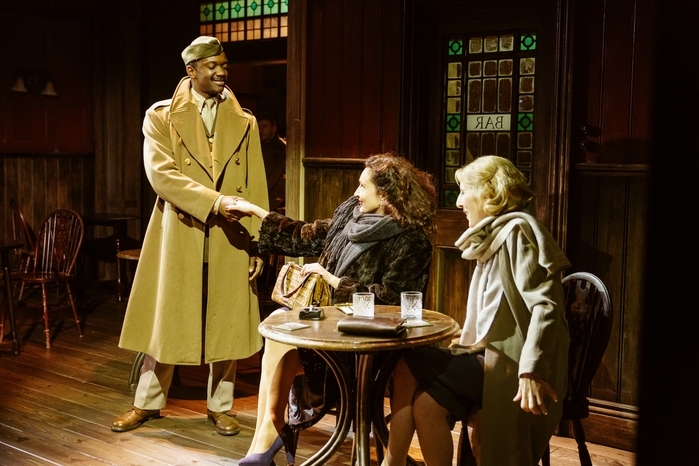
Miss Roach’s afternoons in the pub also contrive for her to meet Lieutenant Dayton Pike (Daon Broni), a friendly American GI, who begins to chat her up. Casting Pike as a black soldier, in contrast to the book, creates a heightened level of interest which Mr Wright’s adaption capably, if not forensically, explores. Roach and Pike’s subsequent affair is complicated by the presence of Vicky and by Pike’s own excessive drinking. An impromptu party at the boarding house gets out of hand with, inevitably, unfortunate consequences. Miss Roach escapes but Pike catches up with her for one final goodbye.

Now Patrick’s Hamilton gift for characterisation and creating atmosphere is splendid. The set and costume design (the Hampstead excels in this) from Tim Hatley is ingenious and puts us right inside the dining room of the boarding house and the saloon bar of the pub. These are emotionally stiff, but still sympathetic, people. The established social order has been thrown into turmoil by the war. Outsiders have arrived. Risks can be taken, particularly by women, leading to behaviour which would have been shunned before the war. Yet there are still consequences.

Unfortunately we see that this precarious world will be shattered via a flash forward at the opening which, for me, was unnecessary. The plot drifts along fairly predictably until a lurch into something more melodramatic in the second half, and the ending, which is intended to offer a modicum of solace is a little abrupt. These shortcomings were broadly compensated by the overall “feel” of the production however. Yet I was left with the nagging doubt that this was one of those subtle stories that might have been better left on the page and not taken to the stage. Whilst I do sometimes find his work annoying and frustrating I can’t help feeling that Terence Rattigan has cornered the market in theatrical British forlornness.