
The Rape of Lucretia at the Arcola Theatre review ****

rape_of_lucretia

The Rape of Lucretia

Grimeborn, Arcola Theatre, 1st August 2018

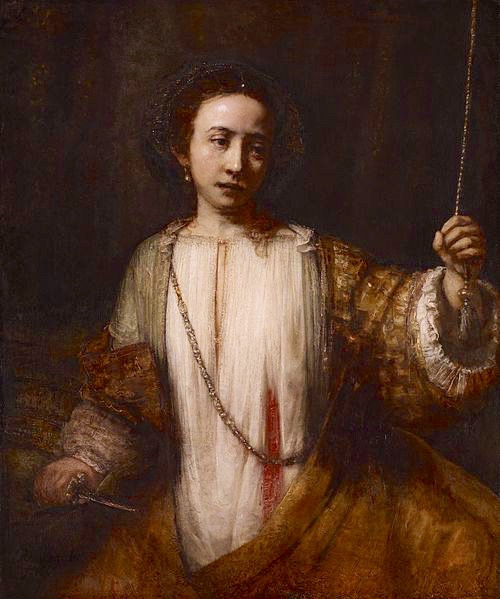
The Rape of Lucretia is a story with a long historical and artistic pedigree. It lies at the heart of the creation legend of the founding of the Roman Republic in the late 500s BCE, was documented by Livy and Ovid, then St Augustine, appears in Dante, Chaucer and Lydgate, was the subject of a poem by Shakespeare, (and Lucretia was referenced in some of his plays), and was a staple of much Renaissance and later art, notably works by Titian, Veronese, Rembrandt, Dürer, Raphael, Botticelli, old Cranach and Artemisia Gentileschi. The worst of these, depicting the rape, are violently voyeuristic, the best examine Lucretia’s subsequent suicide whilst avoiding gory titillation. Check out Rembrandt’s two takes on the latter, (see one above), Veronese’s and, best of all, Artemisia Gentileschi’s.

The story has undergone a few variations through the ages but, in the events of the Britten opera here, essentially runs like this. Tarquinius, the son of the last king of Rome Tarquinius Superbus, is sent on a military errand where he meets up with Collatinus and Junius. They have a few beers, (or the Roman equivalent),  and get to discussing the chastity of the women of Rome. Junius goads Tarquinius into testing the virtue of Collatinus’s faithful wife Lucretia. Tarquinius rides to Collatinus’s house that night and the servants are obliged to let him in. He rapes Lucretia and leaves. Collatinus returns. He comforts her but she cannot bear the shame and commits suicide. Junius tries to atone for his involvement by sparking a rebellion against the King.

As you can see there are multiple perspectives for the creatives who take on this ugly story, and specifically this opera, to alight on. Ronald Duncan’s libretto, which in turn is based on the French play Le Viol de Lucrece by Andre Obey, uses the device of a Male and Female Chorus to frame the action and, incongruously to me, to tack on a Christian message, notably in the Epilogue, to the “pagan” tale. He also uses some pretty high-falutin’ and fancy language for both chorus and in the dialogue. It is easy to grasp what is going on but the florid text does sometimes get in the way a bit.

Fortunately though the genius of Mr Benjamin Britten is at hand. The Rape of Lucretia, like Albert Herring and The Turn of the Screw which we recently saw in the superb production at the Open Air Theatre (The Turn of the Screw at the Open Air Theatre review *****), is a chamber opera scored for just thirteen instruments. As usual it took me 15 minutes or so to adjust to BB’s astounding mix of tonality, effect and experimentation but, once the ears were fully up and running, this music was as dazzling as I remembered. It has been a fair few years since the last performance I saw, (can’t actually remember where),  and I can’t say it is a turntable regular Chez Tourist, but, no matter, I was mesmerised. The Orpheus Sinfonia under Music Director Peter Selwyn, (who provided piano recitative accompaniment), were well up to the task and it was thrilling to hear the score in such an intimate space. The Sinfonia was founded to give an opportunity for talented young musicians to pursue a career that, trust me, they are doing for love not money. On this showing there are some fine talents here.

How then to deal today with what is plainly a deeply unsettling story? Britten was drawn to it as yet another “corruption of innocence” parable, the theme of so many of his operas. Yet I am not convinced that, as with those other operas, he fully thought through the perils of the material he was dealing with. Director Julia Burbach though made the most of the “universal” message that Duncan and Britten devised. The modern dress Male and Female Chorus, (here tenor Nick Pritchard and soprano Natasha Jouhl), open the opera by explaining how Rome under the Etruscan King Tarquinius Superbus is fighting off the Greeks and how the city has fallen into depravity. A Christian message for sure but as, subsequently, the two singers voice the thoughts of the male and female protagonists and move the story on, “out of time” as in classical Greek tragedy, a device to “explain” the motives and psychology of the characters and to involve us, the audience, in the action.

Fealty to Duncan’s libretto maybe means the production cannot resonant quite as volubly as it might have wanted to current MeToo awareness. Even so the drunken toxic masculinity, the fear that grips Lucretia and her two servants on Tarquinius’s arrival, the rape itself and Lucretia, broken, arranging flowers the next morning, are immensely powerful scenes reflecting the music, the acting and the movement of the characters and chorus under Julia Burbach’s direction. Having the Male and Female Chorus move through, and even at some points shape, the action was a smart move which offered insight.

I am not sure that any of this made the content of the story more palatable though and I can certainly understand why some may think this is an opera better left unstaged. I would suggest you see a production and decide for yourself though. This is not the only misogynistic opera: far from it. But when Lucretia, as here, is literally staring directly at you after the violence she suffers, it is impossible to ignore. And, when she dismisses Collatinus’s plea that Tarquinius’s action can be “forgotten”, the reason for her suicide is shifted from shame to anger.

The performances were uniformly excellent, particularly the two Chorus and contralto Bethan Langford as Lucretia. Bass Andrew Tipple was a deliberately vapid Collatinus, James Corrigan was a suitably odious Junius and a menacing Benjamin Lewis skilfully conveyed Tarquinius’s sickening importuning ahead of the rape. Claire Swale and Katherine Taylor-Jones both sang beautifully as Lucia and Bianca, Lucretia’s maid and nurse respectively. I am guessing that the performers had to take it down a notch or two in the Arcola space but what was lost in singing power was more than made up in clarity and immediacy.

The opera was staged as part of the Arcola’s Grimeborn festival which is not into its 11th year with 55 performances across 17 productions. For those of us who cannot face, or afford, the trip to Glyndebourne, where this opera was premiered in 1946, Grimeborn offers a bloody marvellous alternative. The small space means poncey C19 boring opera is off the agenda or the creative teams have to aggressively rethink it. New interpretations and new work abound. Chamber opera is in its element. Everything comes alive and acting, not vocal histrionics or regie-directorial setting, takes centre stage. All for around 20 quid a pop or less if you arm yourself with an Arcola Passport which is simply the second best gift to culture on the planet, after the Arcola AD Mehmet Ergen who should be knighted this minute.


Antony and Cleopatra at the Barbican Theatre review ***

antony-cleopatra-rsc-rst-119-700x455

Antony and Cleopatra

Barbican Theatre, 18th January 2018

The last instalment, for me, of the Rome season at the Barbican, and so late in the run that it has been and gone. Sorry. Anyway I have to say this was my least favourite of the four productions, though there was still much food for thought.

I think the reason for this is simple. I prefer the other three plays. Titus Andronicus for its over the top, knowing black comedy, Coriolanus for its astonishing insight into pride, the democratic ideal, the mother-son relationship and homo-eroticism and Julius Caesar for, well, everything you will ever need to know about the use and abuse of political power.

Titus Andronicus at the Barbican Theatre review ****

Coriolanus at the Barbican Theatre review *****

Julius Caesar at the Barbican Theatre review ****

The language in these three is flintier, more muscular, more direct. The drama is played out across a broader backdrop even if this is still measured across individual psychology and the relationships between friends, enemies and family. In A&C the language is way more florid, despite the similar source material as JC (Plutarch via Thomas North), and the focus is firmly on the mature lovers. High Baroque not Early Renaissance if you will.

There is a curious ironic, detached quality to our observation of A&C. I am not saying I identify with unhinged sadist and novelty pie maker Titus A, by way of example, but I can sort of see where he is coming from. Elsewhere in Shakespeare the thrill of recognition is never exhausted, no matter how many viewings, but with A&C I can’t escape the performance, the spectacle. That may well be the whole point. There are times where the pompous grandiosity of these two entitled mid-lifers sets me spluttering, internally and, embarrassingly, externally. Certainly Will S has the right words and right scenes to skewer them. But all the poetry  and “look at me” gets a smidge wearying. I know that complaining that Shakespeare sometimes has too many words is like saying Mozart has too many notes but the platitude applies.

Of course it could just be that I haven’t come across the right A&C yet. I see the NT is set to stage a production with Simon Godwin at the helm, (who sucked all the meat off the bones of Twelfth Night and Man and Superman at the NT), with Ralph Fiennes and Sophie Okonedo. If those two get fired up sparks can fly. Let’s hope so.

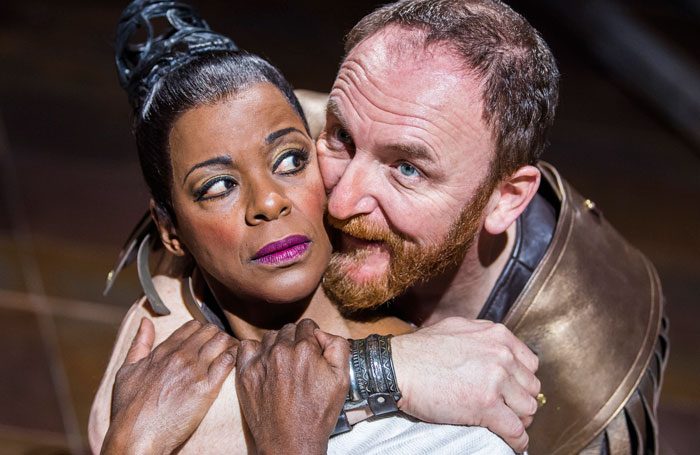
Designer Robert Innes Hopkins here chooses to go with a look straight out of Cecil B DeMille. Josette Simon as Cleo has more frock changes than I have underpants, including, at one point, sporting her birthday suit. Costume supervisor Sian Harris, and all the unsung heroes who cut and stitch, must have thought Christmas came early, just in greaves alone (google it). There is a big black cat. natch, and I hear Southall high street is now short of kohl. There are even some steamy Roman baths and an impromptu harbourside bar on display. I bet they only ruled out the incense sticks at the first rehearsal. Mind you I get it is tricky to take A&C out of its historical context.

Ms Simon captures Cleo’s unpredictability, grace and caprice but maybe not the extremes of cruelty and vulnerability. Some of her vocal delivery, to use football commentator parlance, “takes the wrong option”. She does have stage presence though, even when brooding on the sidelines. Workaholic Antony Byrne, who knows his way about the Shakespearean stage, has a cursive way of delivering lines and character and a grizzled, martial look about him. Yet, at times, he felt a bit mechanical and MA’s intense fear of shame was not fully realised.

I was never entirely persuaded of the couple’s passion or plotting.  There was none of the seemingly spontaneous physicality that Hans Kesting and Chris Nietvelt brought to the parts in the TA Roman Tragedies. That really stank of sex, with Marieke Heebink’s Charmian the …. well I better stop there as I am getting hot and bothered. Alexandria never looked so decadent, and the cropping of action and lines, as well as the translation process, seemed to help me overcome my objections to the play.

I am not sure if Ben Allen’s Octavius here was intended to be quite so limp, and the contrast with David Burnett’s roister-doister Pompey, quite so sharp. Andrew Woodall swapped Caesar for Enobarbus, taking world-weary to a previously untested level. When it comes to ironic commentary on what is going on around him, Enorbarbus has some of the best lines in the play and these were delivered with relish by Mr Woodall, though he does have an uncanny resemblance to my brother-in-law. I am much taken with James Corrigan here playing Agrippa as upright conciliator. Amber James as Charmain and Kristin Atherton as Iras provide sterling support as ego-masseurs-in-waiting to Queen Cleo.

Director Iqbal Khan offers a straightforward account of the play, in line with the staging, and somewhat of a contrast to his previous Shakespeare, where he has mixed it up a bit. That means that each line is pretty clear but the overall rhythm a little baggier than Angus Jackson’s Julius Caesar. There comes a point in many a Shakespeare history play, when the to-ing and fro-ing between locations, and the long line of messengers bearing news, can distract. A&C, nominally a tragedy, can fall into the trap. If your head is filled with contemplation of motive or poetry you won’t see the joins. Here, once or twice, I did.

So there you have it. It seems I was far more taken with Angus Jackson’s Coriolanus and Julius Caesar in this season than consensus, reckon Blanche McIntyre fully got to grips with the uncertain tone of Titus Andronicus and agreed with most that this Antony and Cleopatra was more stately than seductive.


Julius Caesar at the Barbican Theatre review ****

screen-shot-2017-04-07-at-10-31-13

Julius Caesar

Royal Shakespeare Company, Barbican Theatre, 11th January 2018

The third instalment, (for me), of the RSC “Rome” season at the Barbican which originally aired at Stratford. And, as is so often the case with this idiotic blog, it is about to end and is sold out anyway. Et tu numbnut.

Now JC (1599) was written a fair few years before its sequel, Antony and Cleopatra (1606), but both draw heavily on Plutarch, (via Sir Thomas North’s translation), for the guts of the story. Yet they could not be more different in tone. JC is austere in its construction of architecture and language, dripping with rhetoric. A&C is loose-limbed and florid as we watch the saucy couple get it on, often funny, and certainly over the top. All will be revealed when I see A&C as the last part of the RSC quartet shortly. (I note this attracted the most glowing reviews of the four).

I have to say that, generally, JC is my favourite of the two. Here we have four chaps, (unfortunately this is a terrible play for female roles even if the sensible trend to cast Cassius as a woman is followed, though it is not here), whose actions and relationships can be interpreted in an infinite variety of shades. In this production we have an unyieldingly peremptory Julius Caesar courtesy of Andrew Woodall, (nailing all that third person humblebragging), an overly smug and somewhat vain Brutus from Alex Waldmann, a Mark Antony who is more devious than he at first appears from James Corrigan and a vituperative, beguiling Cassius from Martin Hutson. I have to say this latter performance brought out facets of Cassius that I had not observed before, and, as with his Saturninus in the RSC Titus Andronicus, Mr Hutson near stole the show. Alex Waldmann is the go-too if you want a character “plagued by doubts”, (last seen by me as a brilliant Henry VI in the Rose Kingston’s War of the Roses), but the way Martin Hutson works off of his uncertain Brutus is just mesmerising.

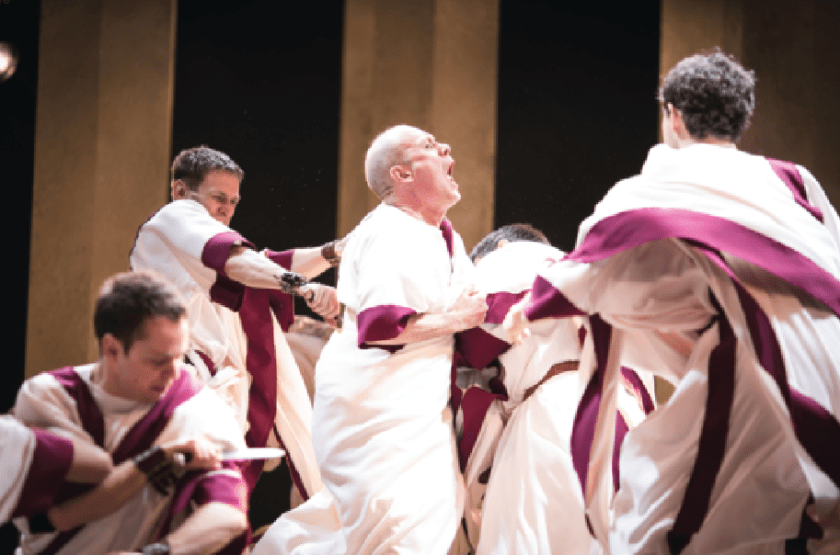
Will S’s brilliant innovation in JC is to telescope all of the action up to the big man’s brutal knifing by the conspirators into what seems like just a couple of days. This means the reasons for the conspiracy, to take down Caesar who has got way too high and mighty in an echo of the Roman kings of pre-Republic days, come flying out of the blocks thick and fast. This resolutely includes the personal as well as the political.

Angus Jackson’s direction allows the momentum to build whilst still clearly laying the arguments around the use and abuse of power, the morality of rebellion against oppression and the legitimacy of political assassination. It is not what Caesar has done, but what he might do. On whose behalf are the conspirators acting, the people or themselves and their own class? The hoi-polloi is never happier than when they have a “strong” leader remember. The uncertainty around what would happen after QE1 died, in the context of the struggle between Protestant and Catholic, would have been clear to Will S’s contemporary audience. The impact of uncertainty is just as clear now.

But big Will didn’t stop there. Oh no. The carnage “unleashed” in the aftermath of JC’s death as Mark A and Octavius put the plotters to the sword, whose own resolve is shattered, is just as effective and thought-provoking. That is the problem with regime change. It usually goes t*ts up because none of these blokes thinks about what happens next. All summed up in two minutes with the horrific murder of Cinna by the confused mob.

Because we never learn Will S can keep on teaching us. Clever huh.

And, in this production, with complete clarity in the delivery of the lines, it was very easy to see that the main players were as much victims, as shapers, of events. The conspirators were uncertain, their tone and movement revealing the dissension between them. Caesar has got all imperious in part because no-one stopped him. Mark A’s sycophancy reflected an eye to the main chance: his famous rhetorical speech to the crowd, cynical, a man realising he could seize control. Watch him build up, then tear up, Caesar’s will. Cassius egging on Brutus, not prepared to take the lead. Brutus and Cassius falling out big time in the tent but always knowing they had to make up since they only, ultimately, had each other. Kidding themselves they really were “honourable” even to the end by getting some poor sap to administer the “coup de grace”. Honour in our appallingly individualistic society may look like an anachronistic concept, but the effect on the audience of its study in this play suggests it still has a place in our hearts and minds.

No need for modern dress. Togas are fine. Would sir like Doric or Corinthian columns. No need for video of an orange Donny spouting hate or rioting millenials. No need to ham up the famous lines or cut out Will’s words. Frankly no need for an interval if it were my choice. One of the best ways to see and hear JC is still Mankiewicz’s 1953 film with Gielgud. Mason and Brando. Not to be confused with Stuart Burge’s 1970 film with Gielgud effortlessly shifting from Cassius to Caesar, but with execrable performances from Charlton Heston as MA and, worse still, Jason Robards as Brutus who appears to have wandered out of an old folks’ home.

Now I am not saying that JC cannot benefit from a little bit of tidying up and reshaping. I think Phyllida Lloyd’s all-female outing at the Donmar was the best of her trilogy last year, (and was a top ten production for me), and Hans Kesting’s speech to the crowd in Toneelgroep Amsterdam’s Roman Tragedies might just be the best 10 minutes of theatre I have ever seen. It’s just that the play can be as, if not more, powerful as a whole, without needing the full directorial vajazzle. I see that many of the proper reviews felt this production was all a bit old-skool, declamatory. I disagree. It is about the power of language to change the direction of political action. Praxis if you will. So emphasising that language should not be seen as embarrassing.

The good news is that we have another chance to see JC in the very near future, (from 20th Jan), as Nick Hytner and team at the Bridge Theatre have a crack. With Ben Wishaw as Brutus, Michelle Fairley as Cassius, David Morrissey as Mark Antony and David Calder as Caesar. How about that for casting. Can’t wait.


Coriolanus at the Barbican Theatre review *****

coriolanus-production-photos_-2017_2017_photo-by-helen-maybanks-700x455

Coriolanus

Barbican Theatre, 16th and 17th November 2017

This angry looking chap is Sope Dirisu and he is playing Caius Martius ,who you might know better as Coriolanus, in the RSC’s latest production of Shakespeare’s last proper “tragedy”. This will be followed from Stratford to London by the other plays in the Rome season, Julius Caesar, Antony and Cleopatra, and the gorefest Titus Andronicus, as part of the “Rome” season. You can read all the proper reviews from the Stratford run, but, if this is anything to go by, I reckon I am in for a treat with the rest, as this was better, in my view, than those reviews let on.

Now it helps that I happen to like this play. A lot. Maybe not as much as Othello, Macbeth and Hamlet, but, whisper it, more than Lear. It is sparse, he (Coriolanus) is a flawed character, and the writing is, by Shakespeare’s sublime standards, a little lacking in poetry and lyricism. This is exacerbated by a “prose driven” production – suits me but maybe not the  purists. Like Macbeth and, indeed Titus A, it tells of a hero, (or maybe anti-hero, that is why it is so clever), whose destiny is bound up with that of his country, in this case 5th century BCE Rome, the early days of the republic. Coriolanus is, like these other “warriors”, a complex and unique personality, whose vanity and inability to compromise leads to his downfall. He harbours powerful homo-erotic desires for his mortal enemy, Tullus Aufidius, and he has the mother of all mother complexes, as it were.

There is some humour, and some satire, though I get that it is a bit buried. The body count, by the standards of Shakespeare tragedy, is minimal, just one at the end. There is War though, unusually very early on, which allows fight scenes that this cast revelled in. Fight  director Terry King deserves a great deal of credit. The plot is straightforwardish, (WS once again pinched his story from Plutarch), and revolves entirely around the Big C himself. It is his connections with his family, his own people and the Volscian people of the enemy state Corioles, that defines the play and what makes it interesting for our, (and probably plenty of other), times. For the play brutally examines the exercise of political power, the relationship between classes, the limits of democracy and representation, the dangers of populism, the nature of patriotism, the business of compromise, the call of duty in both military and civil society, in addition to all the deep, Freudian, psychological stuff. Ancient Rome is fundamentally different to our world today but the issues it grapples with are uncannily similar.

Which is why, in its way, its the best “Brexit” play I have seen this year. People’s visceral reactions to what is “right” and what is “fair” and the way in which they are, or think they are, being treated by their leaders, is what lies at the heart of this play. The continuing tensions between the haves and the have-nots, the “leaders” and the “led”. As ever though, there is no black and white with big Will, as you oscillate between hating and maybe admiring Coriolanus’s actions and intentions, and you see the ways in which those around him react, Mum, wife, nemesis, tribunes, friends, soldier colleagues and substitute Father, all try to influence and manipulate him.

Now a twist of fate “permitted” me to watch the first half twice, up to Big C’s banishment. A technical issue on the first performance I saw meant a return the next day to see the rest. I confess I was so pumped up by the first half and by the cliff-hanger when Coriolanus tells Rome to go f*ck itself that I was bound to return. And the tightwad in me wasn’t going to miss a free hour and a half of this. Turns out the repeat viewing was an insight into how the interplay of text, action, acting and audience can create a very different experience. Same play, same production but different lines and words leapt out; I focussed on different characters at different times and thought about different aspects of plot and message as it evolved.

Sope Dirisu turned out to be a suitably virile military man and the camaraderie and mutual admiration between him, Charles Aitken’s ardent consul Cominius, and Ben Hall’s pragmatic general Titus Lartius, rang true. As did his hesitation with Hannah Morrish’s wispy wife Virgilia. The turning point scenes with mother Volumnia also stood out. Whether extolling the virtues of her son’s military achievements in full on patrician mode, or achingly pleading with him to curb his revenge even though she knows what this will lead to, Haydn Gwynne was magnificent in the role. Duty trumping family. The best performance of the evening. Mr Dirisu also shines in the scenes with Tullus Aufidius, but once again this as much reflects the skill of James Corrigan’s performance as the bested Volsci. It is tricky to convey the admiration, nay passion, that he feels for Coriolanus whilst still letting us know that he intends to play him to his country’s advantage when Big C turns treacherous.

It does take a bit of time for our Coriolanus to ramp up from haughty disdain to bilious disgust of the people, and the two tribunes, Sicinius Veletus and Junius Brutus, who orchestrate them. This though created a welcome ambivalence in our political sympathies. Should we side with the put-upon plebeians, hungry and overlooked by the out of touch Senate and the aristocratic Consuls, or with fearless Coriolanus, who may saved Rome from the enemy, but who sneers at the people and refuses even a pretence of the humility expected to secure their approval for his election as Consul?

Having two women play the tribunes, given Coriolanus’s conflicted relationship with the opposite sex, added an interesting dimension, and the contrast between Martina Laird’s more measured Junius and Jackie Morrison’s more provocative Sicinius was also well observed. Paul Jesson’s patient, though frustrated, Menenius, father, mentor and apologist for Coriolanus, was another fine performance.

Now as it happens Paul Jesson has a bit of form with Coriolanus having played Junius Brutus in Ralph Fiennes’ 2011 film version. This is an outstanding production, with a magnetic performance by Mr Fiennes, who also directed, a stunning cast and the uneasy backdrop of Serbia. Angus Jackson, with this modern dress production, has, perforce, created a somewhat different tone, but, I think, similarly makes the case for what I think, is a riveting play. It seems to me that there is a case for moderating Coriolanus’s “pride” and subsequent “fall” and for questioning the political “rights and wrongs” and, if that is true, Mr Jackson’s definitely direction succeeded here. A bully oozing utter contempt may lead to more powerful lead performances but can be overbearing. I liked the contrast of Mira Calix’s string and voice led score and Robert Innes Hopkins design (excepting the troublesome plinth) was coherent (it carries through the whole season).

Coriolanus a tricky, difficult, awkward play. Nonsense, as many recent productions have shown. Mind you I’ve never understood the difference between Shakespearean tragedies and comedies, so you can safely ignore me.