
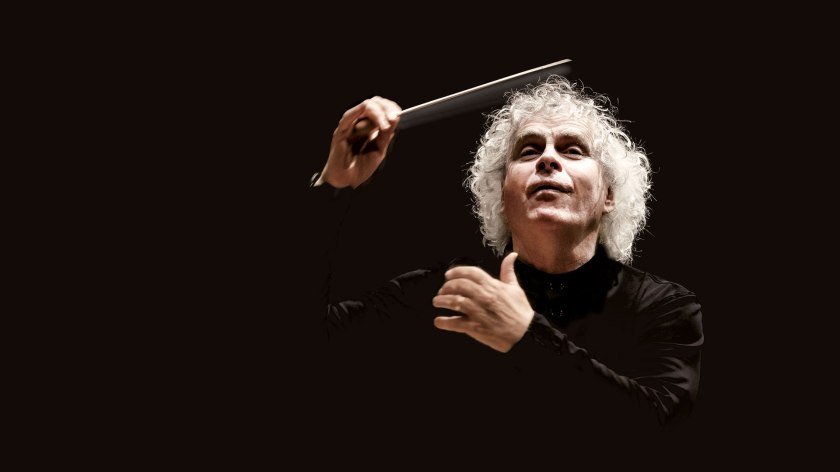
Stravinsky from Rattle and the LSO at the Barbican review *****

orig_59ae8c22d00135-63398832

London Symphony Orchestra, Sir Simon Rattle

Barbican Hall, 24th September 2017

  • Igor Stravinsky – The Firebird (original ballet)
  • Igor Stravinsky – Petrushka (1947 version)
  • Igor Stravinsky – The Rite of Spring

So here is is. The second coming. Sir Simon Rattle kicks off his tenure at the helm of the LSO. I missed the opening concert of British composers (annoying) and the Damnation of Faust (no interest) but this was always going to be a must see so I booked as soon as it opened.

Now it has been perfectly possible to see Sir Simon in London with the LSO, (for example, a Mahler 6 and the Ligeti Grande Macabre earlier this year), and other bands, (a Haydn Seasons and the late Mozart symphonies both with the OAE stick in the memory), but this was the first opportunity to gauge what will be possible for orchestra and conductor to achieve now they have quality together.

So it was an expectant mood in the hall as the Scouse Gandalf took to the podium (no need for scores – it is all in his head), after a few words with a clearly pleased as punch Lord Mayor. And then all hell broke loose. This was simply breathtaking. For long periods I was sitting stock still (and I am a terrible fidgeter) either open-mouthed in astonishment or grinning to myself like the proverbial cat from Cheshire.

Now I like the boy Stravinsky. And the more I get to grips with his compositions the more pleasure (and intellectual stimulation) I get. But it is hard to beat these three ballet scores.

Sir Simon chose to deliver the complete Firebird ballet. This means there is more of the still late Romantic colouration and chromaticism before we get to the Kashchei mad disco bits which presage The Rite of Spring. This means the debt to mentor Rimsky-Korsakov and the stench of Imperial Russia (give ’em fairy tales instead of food) hangs heavy in the air. Tchaikovsky and the rest of the Five are also on show. As usual Sir Simon was not interested in galloping through the first half of the exotic first tableau, to make sure every ounce of orchestral magic was received and understood by the audience. Which meant that by the time we got to the stunning apotheosis we were begging for release. Oooh. You just knew Igor, after this first lucky break, was going to take this to the next level.

Which is what he did. For Petrushka we got the 1947 streamlining though this is the standard nowadays. Here we start to get the big repeated rhythms and motifs which are what took the world of Western classical music by the scruff of the neck and turned it into a new direction. The late C19 structure is sort of still visible but in a kind of ironic way. The thrust towards Modernism and the age of machines is starting to take over though with rapid changes of direction, repetitions, major keys piled up and loads of banging tunes. And at the centre was the LSO’s own pianist master, Philip Moore.

A well earned break and we got to Sir Simon’s Rite of Spring. What a racket. In a brilliant way. The orchestra throughout was using every available inch of the Barbican stage with 60 odd strings on show and more brass than Yorkshire. And in the giant rhythmic climaxes they all got a look in. My ears were pounding and I was at the back of the circle. Heaven knows what it must have been like for the captives at the front of the stage. I have heard some marvellous Rite of Springs, (in my view, I cannot vouch for the ear of the professional), but this topped the lot. You can see why everyone got so enervated at the first performance in 1913. I was tempted to jump out of my seat at the end of Dance of the Earth and yell “go on my son”.

Now the LSO is top notch. We know that. Best in the world. Maybe. Best in my world. Definitely. But I have never heard them sound like this. Under Valery Gergiev, sometimes with interpretations that seem to be dialled in a couple of hours before a concert, they looked, and sounded, frustrated. Not here. They were having a blast. I have never seen an orchestra looking so happy. Every single section sounded faultless to me bar a couple of overly-enthusiastic brass fanfares. Yet is was the woodwind which stood out. And when the strings where belting out as one, like some giant single instrument, or capturing a pianissimo so quiet time was suspended, it just felt good to be alive.

So all in all a genuinely memorable evening. I cannot wait for the next from this marriage made in musical heaven. Unfortunately a fair slice of Sir Simon’s standard repertoire is not entirely to my taste but there should be enough from the C20 and contemporary commissions and from Classical masters. Indeed in January he will take the LSO back to the Baroque in part (Handel and Rameau) alongside Mahler’s Ruckert Lieder (with the lady wife singing – his, not mine) and Schubert’s Unfinished Symphony. There is also a very attractive C20 programme with Janacek, Carter, Berg’s Violin Concerto, with the marvellous Isabelle Faust, and Bartok’s Concerto for Orchestra. And there is plenty of Mahler, as well as Tippet, Bernstein and Strauss for those attuned to that sort of thing. Bring it on.

London Philharmonic Orchestra at the Royal Albert Hall review ****

dmitri-shostakovich-1233767711-editorial-long-form-0

London Philharmonic Orchestra, Vladimir Jurowski, Alina Ibragimova (violin)

Prom 71, Royal Albert Hall, 6th September 2017

  • Igor Stravinsky – Funeral Song,
  • Igor Stravinsky – Song of the Volga Boatmen,
  • Sergei Prokofiev – Violin Concert No 1 in D Major
  • Benjamin Britten – Russian Funeral
  • Dmitri Shostakovich – Symphony No 11 in G Minor “the Year 1905”

What with one thing and another, but mostly my stupidity at missing the booking opening, I only made it to one RAH Prom this year and missed out on two or three that I really wanted to hear/see. Never mind BBC Radio 3 came to the rescue with their recordings. BTW I WILL PERSONALLY KICK SHIT OUT OF ANY POLITICIAN WHO HAS THE TEMERITY TO FUCK ABOUT WITH THE BBC. I can’t move quickly but I am a big lad so you don’t want to get in my way. Understood. Just joking. I think.

Moving swiftly on. The main reason for picking this Prom was the opportunity to hear the LPO with personal favourites Vladimir Jurowski (a man who seems to conduct with his shoulders and head as much as his hands and eyes, riveting from my choir perch), and the meticulous violinist Alina Ibragimova, having a crack at some hardcore C20 Russian repertoire. And specifically Shostakovich 11 which gets an outing now and then but not regularly enough to miss. Having said that I still can’t decide how much I like it.

Before the main event we had some early works from clever clogs Stravinsky. The score for Funeral Song, Op 5, was only recently rediscovered and is a memorial to teacher and mentor Rimsky-Korsakov. The latter’s influences are fairly clear, (we must thank N R-K for Stravinsky’s mastery of orchestral colours), but, for me,, the louder voice was Wagner, not a good thing to my ears. This was followed by Stravinsky’s arrangement of the Song of the Volga Boatmen, which is a rousing, if very short, ditty which served as the original Russian anthem post 1917 Revolution.

I don’t know if I will ever “get” Prokofiev. I have heard some convincing performances of his works recently, the Quintet and Martha Argerich playing the Piano Concerto No 3 (mind you I reckon Martha could leave you open mouthed in admiration playing Happy Birthday on the spoons). And the piano sonatas I remember seeing performed have been interesting. But there may be too many ideas in the music for me. My ears and brain crave repetition and structure. There is enough rhythm in Prokofiev but there is a lot of flitting about. So I may not be up to it. Still I will keep trying. This Violin Concerto created the same confusion for me. Ms Ibragimova puts line and detail into her performances and really convinces. There were passages of real interest, even when it all got a bit too lyrical, and there were such clever twists and one blinding fast passage, but once again it was just too “bitty”. Sorry. Moreover, whilst I was close enough to hear the violin clearly even with my ropey ears, I suspect the gallery punters might have been working a bit harder.

In contrast to Prokofiev Britten is dead easy for me to understand. Russian Funeral is the only piece he wrote for brass band and it is an open, Mahlerian march bookending a disquieting scherzo. The march is taken from a Russian funeral song (which appears again in the DSCH symphony), hence the title, and the whole thing reflects Britten’s anti-war stance. I loved it.

Now the main event. It is a heck of a slab. An unbroken hour, four movements, slow, faster, slow, fastish. It is based on four revolutionary songs and takes the events of the failed 1905 uprising. The programme is pretty clear, The Palace Square in winter as the revolutionaries march to petition the Tsar. The fighting starts, the Imperial Guard opens fire and the assembly is brutally quashed. We then mourn the thousand dead and finally look forward to when the proletariat will succeed in throwing off the yoke of their oppressors. Now there are some absolutely belting tunes in all of this, but it is a long, drawn out affair. This is one of the DSCH symphonies that drifts towards the cinematic which is fine except we have no pictures for the eyes so the ears get a bit of an overload. And the contrast between the icy despairing chords of the Adagios and the martial drumming of the Allegro movements is a bit overwrought. As ever with DSCH you can sometimes have too much of a good thing.

Having said that it certainly clears out the passages and conjures up an epic vision of the struggle. There isn’t very much of the sardonic or sarcastic audible here, or if there is, it is well hidden, so I can see why this went down a treat with the big boys in the Party when it was served up in 1957 as part of the 40 year celebrations. DSCH did make a few veiled comments pointing to what wad happened in 1956 in Hungary but it didn’t leap out. But then the old chap never did give much away. From the perspective of the centenary of the Revolution though it does feel a bit odd especially when you know what DSCH delvers when he nails it. Can’t fault the playing though and Mr Jurowski wisely gave as much room as was needed to the expansive phrases. No point rushing this edifice as it isn’t going to make much of a difference. And when needed he and the band turned it up to 11, indeed right at the end when the bells come in, we were treated to a 12 on the Tufnel scale.

When all is said and done, and despite the shortcomings, No 11 is still an extraordinary wall of sound and the LPO nailed it. Thanks lads and lasses.