
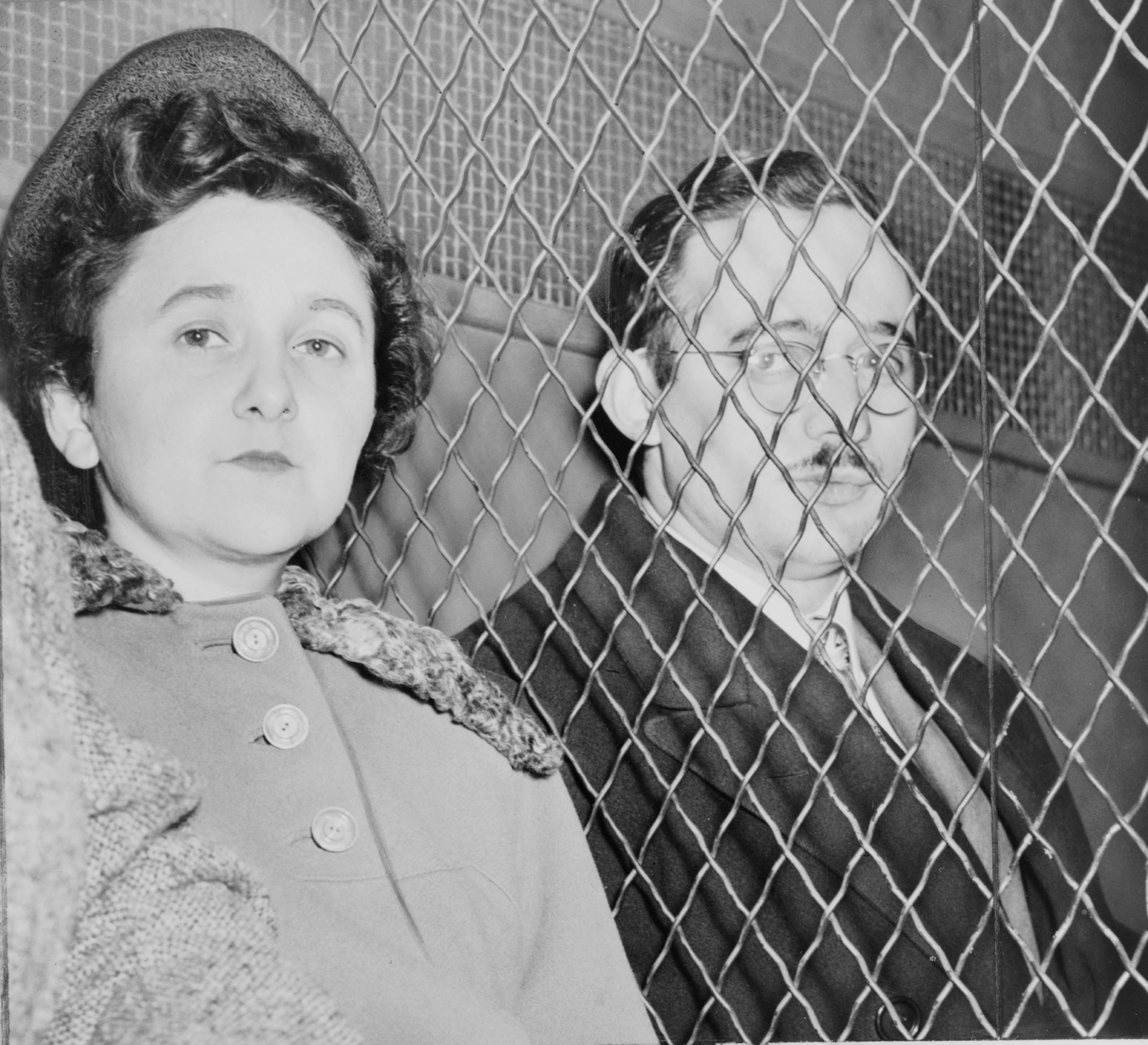
The Rubinstein Kiss
Southwark Playhouse, 9th April 2019
I liked this. A lot. Certainly more than I might have expected given the string of lukewarm reviews. I liked the way the important story was told, the structure, a later generation revisits and is shaped by its shared history, the three believable relationships that lie at the heart of the play, the way director Joe Harmston and designer Sean Cavanagh, (and a punchy contribution on sound from Matthew Bugg), made very effective use of the SP’s larger space, in transverse, to convey changes in time and place and, especially, I liked the committed performances from the cast of seven.
James Phillips’s play is based on the life and, still contested, crimes of Julius and Ethel Rosenberg. The Rosenbergs were convicted and executed in 1953, at the height of the Cold War, after spying for the Soviet Union, allegedly having passed secrets about nuclear weapon design secured by Ethel’s brother, David Greenglass. The play disregards the trial itself, focussing instead on the early lives of the Rosenberg’s and Greenglass’s, the interrogation of Julius Rosenberg and, in a constructive framing device, the attempts in later decades to clear their names after the executions.
Katie Eldred (a splendid stage debut performance) plays history teacher Anna Levi who meets lawyer Matthew Rubenstein (a similarly persuasive, if occasionally overly clamorous, Dario Coates) at an exhibition in 1970s NYC where he is staring at an iconic picture. It turns out that this is his parents kissing, (there is a similar image of the actual Rosenbergs, though the above is the most reproduced). I don’t think it is giving too much away to say that Anna and Matthew have a connection beyond the sexual relationship that follows, namely that he is the son of the Rubensteins and that she is the daughter of David Girshfeld (Sean Rigby) and Rachel Liebermann (Eva-Jane Willis). We go back in time to the small apartment where the earnest Jakob Rubenstein (Henry Proffit) and his spirited wife Esther (Ruby Rentall), who gave up a promising singing career, first set up home and bring up Matthew. Having left the army, where he worked in the nuclear bomb testing facilities in Nevada, (at a time when only the US had this technology), David is invited by Jakob to join his electricals business, allowing David and Rachel to also have a child, Anna. We see how Jakob and Esther’s upbringing, a child of the Great Depression, education and Jewish heritage inform their Communist idealism and sympathy for Soviet Russia (as did so many of their class and background did at the time). We also discover how Jakob was fired from his job as an engineer at a New Jersey facility which carried out research on missile systems for the army because of his CP membership.
In a series of flash-forwards, sometimes acted out in parallel, we also see how Jakob refused to renounce those ideals and confess to his crimes of espionage even when facing trial and under interrogation from FBI agent Stephen Cranmer, a man of considerably more complexity than you might expect, required an appropriately nuanced performance from Stephen Billington. And we see how and why David turns against Jakob and Esther, confesses his own involvement and implicates Jakob as the head of a Soviet spy ring. We also return to Anna and Matthew whose relationship is transformed by the revelation of their shared parental history and by Matthew’s involvement in the campaign to clear his parent’s names.
All this seems to follow much of the actual Rosenberg case, though we don’r really get to understand what exactly the Rubensteins, and David, did, nor, convincingly, why. Nor the events that have unfolded in the last couple of decades which point to the guilt of the Rosenbergs and have changed the way in which the cause celebre is viewed, now focussed on whether the punishment was appropriate to the crime. This is more about the relationships at the heart of the events, embellished and re-imagined, and all the better for it. There may well be another play located in the arrest, indictment, (the way the Greenglass’s changed their evidence is much simplified in TRK), trial, conviction and execution but it might not work effectively as drama and would be pretty thorny to grasp. There have certainly been other dramatic treatments of the people behind the facts on stage as well as film, though I can’t vouch for any of them. As an aside Roy Cohn, who later went on to play a leading role in the McCarthy trials and act for the Trump family, was involved in the Rosenberg prosecution case. And, as all good students of theatre will know, his particular brand of amoral, wanker-ism was spectacularly aired in Tony Kushner’s epic Angels in America.
So James Phillips has packed a lot into his award winning play which by and large works. This is its first revival following its premiere in 2006 and it is easy to see why Joe Harmston and the Devil You Know company alighted on it. I am happy to forgive Mr Harmston for his hyperbolic comments about its relevance to the “end of days apocalypse of division” we now face. Threats to the enlightened consensus are permanent and democracy always fallible. And, from what I read, there is much to debate around the “rights and wrongs” of the Rosenberg case. But, as drama, this really worked for me. When I fill in one of those stock surveys the major theatres send out to us regular attendees I always tick the “I want to be educated” and “I want to be entertained” boxes. Job done here. On both counts.

 At Home He Feels Like A Tourist