
The Beauty Queen of Leenane at Queens Theatre Hornchurch review ****

The Beauty Queen of Leenane

Queens Theatre, Hornchurch, 14th November 2019

From one side of London to the other. All on track until the very last gasp, so snuck in a few minutes late to this. A big thanks to the very helpful ushers at this friendly house. TBQOL isn’t starved of revivals but this was my first live viewing of Martin McDonagh’s first play, though somewhat nominally since the next two in the Leenane Trilogy, A Skull in Connemara and The Lonesome West, as well as the first two of the Aran Islands trilogy, followed hot on its heels in the mid 90s. Hence my completist determination to see it.

And the fact that it had attracted some decent reviews at the run at Hull Truck, the co-producer. Whose veracity I can testify to. Designer Sara Perks has delivered a Connemara farmhouse, shared by Mag Folan (Maureen McCarthy) and daughter Maureen (Siobhan O’Kelly), required for all these plays, but with a twist. The walls are half-built, foretasting Maureen’s escape, though beyond the walls all is dark, in Jess Addinall’s moody lighting design. (There is an interview with young Ms Addinall, who started as a temporary technician at Hull Truck, which shines a light !! on her work and ambitions).

At its heart this is a simple story. 70 year old Mag is suffocating the 40 year old Maureen, who, after her two sisters married off, grudgingly tends to her every whim, tea, porridge, lumpy Complan. When she meets old schoolfriend Pato Dooley (Nicholas Boulton) at the farewell party of a visiting American uncle the chance to escape beckons, despite Mag’s interventions. The only other character is messenger Ray (Laurence Pybus), Pato’s younger brother, default setting bewildered, distracted by casual violence. This being MM the course of true love doesn’t run smoothly and things don’t end well.

It is brilliantly written, with exquisite dialogue, by turns comic and tragic, (my favourite, the crucial fire poker is casually described by Mag as “of sentimental value”), and a sturdy plot. That’s why it won a ton of awards when it first appeared in 1996, in Galway itself, before the Royal Court run and then transferring to Broadway in 1998. It is also, intertwined with the bitterness and regret, of all three characters, brimful of pathos, perhaps more so than the other Irish plays. Maggie McCarthy, slumped in her chair, allows us to see Mag’s vulnerability even as she passively-aggressively plots to keep Maureen in her place. Nicholas Boulton shows us the deep sadness at the core of Pato, happy neither in London, where he goes to work, and home in Leenane, and the excitement with which he imagines a new life with Maureen in Boston. And Siobhan O’Kelly is mesmerising as Maureen, whose past, and isolation, explains her awkward, exaggerated behaviours. Daughters turn into their mothers. Who’d have known.

Just a shame some berk in the audience seemed incapable of turning their phone off, twice, much to the chagrin of Ms O’Kelly. If you don’t know how your phone works (which I surmise was the issue here), ask someone younger (yep it was an early boomer), or, better sill, don’t bring it to the theatre. Whatever it is can wait. You are not that important.

My guess is that Hull Truck AD Mark Babych is a big fan of McDonagh’s. Mind you who isn’t. The SO and I still rate Hangmen as the best play we have seen in recent years, LD’s favourite was the Michael Grandage revival of The Lieutenant of Inishmore with Aidan Turner, and everyone I know who saw A Very, Very, Very Dark Matter, despite its flaws, hasn’t forgotten it in a hurry. Mr Babych has plainly lavished a great deal of care on this production and I am a little surprised that it hasn’t toured. Still, London audiences will have another chance to see the play at the Lyric Hammersmith later next year, in a production directed by LH AD Rachel O’Riordan (she kicked off her inaugural season with the superb version of A Doll’s House written by Tanika Gupta).

The Tourist recently saw another play centred on a dysfunctional mother-child relationship, Eugene O’Hare’s misfiring Sydney and the Old Girl at the Park. Chalk and cheese, This is how it should be done.
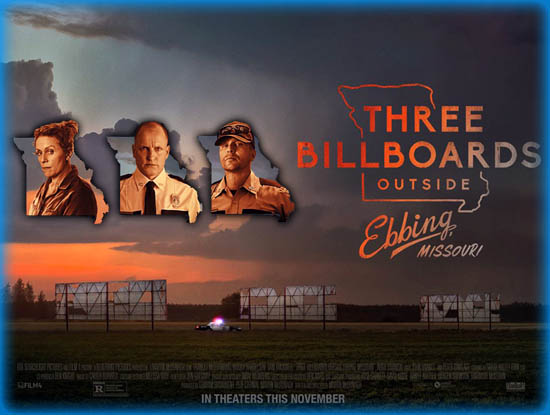
Three Billboards Outside Ebbing, Missouri film review *****

threebillboards

Three Billboards Outside Ebbing Missouri, 16th January 2018

Best film of 2018.

Settle down Tourist. We are only three weeks in. Well I am confident that nothing will come along to match this so I stand by my sensationalist claim. You see I spent all of 2016 waiting for a better play than Hangmen, also penned by Martin McDonagh, to come along and it never did. In Bruges is a top 10 ever film for me and The Pillowman is another favourite play. I have not seen all of the five “Galway” plays that Mr McDonagh tossed out in the space of a year in 1994, in the absence of a proper job, but I have read them. I love theatre but trust me, I don’t read many texts, that would be a step too far. But these cried out to be read. Heavens I even think Seven Psychopaths could do with more meta references.

So, as you can see I have a (un)healthy admiration for Martin McDonagh. And now, to cap it all, I read that he is courting the prodigiously talented Phoebe Waller-Bridge.

Even by his high standards though, Three Billboards is a terrific achievement. I believe he has argued in the past that film is a better artistic medium than theatre, (he is transparently wrong in this regard), but the simple fact is, the reason he is such a brilliant film-maker is precisely because he is such a brilliant playwright.

He can tell a story. And he does it in a classically Aristotelian way. Perfect plotting. Take a character, or in this case three characters in the form of Mildred Hayes, the transcendent Frances McDormand, Bill Willoughby, played by a pitch-perfect Woody Harrelson, and Jason Dixon, entrusted to another McDonagh regular, the Sam Rockwell, and present them with problems to solve, or not.

The bitter, careworn Mildred wants justice for her daughter, Angela, who was brutally raped and murdered. The target for her fury is police chief Willoughby, who, we soon learn, is dying of cancer. And one of his officers, Dixon, is a violent racist whose redemption is prompted by Willoughby’s intervention. These major characters, and those supporting the story, could not be more vivid.

Justice, rage and revenge, as we know from other contemporary film directors, (there are echoes of Tarantino and Asian masters here), and playwrights down the ages, are themes that are guaranteed to grip any audience. I think those who have got hooked up on race, the state of America, sexual violence or a host of other themes they think this film should be addressing have missed the point.

Language: well I have no idea how the good and bad people, of Missouri speak, but I know there is poetry here. And you never know what anyone will say next. There is so much small detail to relish in the dialogue. There is spectacle aplenty with a string of WTF scenes and some stunning cinematography. The multiplicity of tone, and “ordinariness” of location, constantly left me searching for cinematic references.

The jerky rhythm that is created from the interplay of plot, character, language and spectacle carries us along breathlessly. What just happened? What is about to happen? Do I like them? Do I hate them? Why did they do that? These are questions you need to keep asking to make a drama come alive. Three Billboards delivers this. Again and again and again. The wonderful score and intelligently curated musical excerpts only add to the story.

McDonagh’s writing is economic and fearless as is his directing. There are multiple occasions where he rushes in where others fear to tread, but he is no fool. Bait and switch followed by bait and switch, but never really stretching credulity, (which is an overrated requirement in naturalist drama anyway). Suffused with violence sure, but also with humanity. And plenty of characters whose primary mode of expression is “f*ck you” which, as well know, is as naturalistic as it comes.

This then is a tragedy full of comedy. Or a comedy full of tragedy. There was another playwright who mastered that art and was unafraid of going straight for the audience’s jugular. Big Will didn’t deal in stereotypes either and the good, the bad and the ugly could crop up on the same page in the same character. And he was wowing them 400 years ago. Further back there were 3 Greek fellows who nailed drama – so good they defined it. All good people to emulate.

Once you strip out the fantasies, the horrors, the rom-coms, the puerile, the childish, the introspective, the experimental, the “real life” dramas, the biopics, the historical, the spys, the super-heroes ….. and so on and so on, there just aren’t that many films that want to take a human story, and make it mythic. I appreciate that those who prefer their entertainment where the violence is frequent, unremarkable and bloodless and the comedy broad, or those who want drama that scrupulously adheres to their world-view of what is just, (best steer clear of Othello then), but, for those of you who prefer your meat a little rarer, (or your tofu a little spicier), then DO NOT MISS THIS.

Predictably I have got carried away. I just think this is an amazing film by an amazing writer. So I’ll stop now. For those of us Londoners who love this man’s work we are in for a couple more treats this year with a revival of The Lieutenant of Inishmore from end June at the Noel Coward Theatre directed by Michael Grandage, (who successfully revived The Cripple of Inishmaan in 2013), with that sex-bomb Aidan Turner playing Mad Paidrac, and with his new play A Very, Very, Very Dark Matter opening at the gorgeous Bridge Theatre in October. This sounds like it will revisit the dark and twisted territory of The Pillowman. I’ve booked it to replace the usual family panto trip.