I’ll tell you what. That Annie Baker backs herself. Here is another long play, near 2 hours straight through, where, visually, nothing much happens, bar a properly weird interlude, and dense with word. And this time it is a story about stories, Yep that’s right. The meta of meta. Six assorted punters (five men and just one woman) are ranged around a glass, conference style table telling each other stories in an attempt to create a story. Mediated by their distracted passive aggressive boss Sandy (the ever wonderful Conleth Hill), with occasional interruptions from his chipper assistant Sarah (Imogen Doel) to take food orders, excuse Sandy’s absences and chivvy the crew, and the voice of mogul “Max” (Andrew Woodall) who is bankrolling the enterprise. And with a note taker, Brian (Bill Milner), who eventually, memorably, gets stuck in.
It looks and feels like a scriptwriter’s meeting but its real purpose is never fully revealed and the rules of engagement are vague. Just see what happens seems to be Sandy’s instruction and from this all sorts of stuff pours out, from personal disclosures and confessionals, jokes, classical myth and allusion, gods, monsters, religious dualism, stories about stories, right through to various creation myths. It is affecting, thoughtful, funny, intriguing. Chloe Lamford’s set, complete with Perrier overload, Natasha Chiver’s garish lighting, Tom Gibbons’s sound, Sasha Milavic Davies’s movement (much use of swivel chairs), all echo the hyper-reality, or do I mean hyper-banality, of Annie Baker’s text, which gradually shifts the apparently mundane into the realms of the extraordinary. No surprise that Ms Lamford and Ms Baker co-direct.
It doesn’t quite scale the heights of profundity that it sets out to achieve, or the genuine grace of predecessor John, and it probably stole 20 minutes of my life more than it should have, but you still couldn’t fault its ambition and verve. In trying our patience, and venturing into the Freudian “uncanny”, it gets right under your skin even if it doesn’t shed too much fresh light on the creation of collective, and self, narrative. But it does cover all the bases, maybe too many, as concept overwhelms even this committed execution. Though with actors of this quality, Fisayo Akinade, Matt Bardock, Arthur Darvill, Hadley Fraser, Stuart McQuarrie and Sinead Matthews as the writers), individual character emerges out of the ensemble.
I guess the point was that whilst the urge to share our truth and humanity, and bring meaning to pointless existence, through stories remains undimmed, our capacity to do so might be fading, (especially as chaos in the outside world seeped into the ill-judged ending). Or maybe not. The vagueness of purpose is all part of the attraction in Annie Baker’s practice, so best just to go with the intractable flow and don’t pull too hard on the individual, intellectual, threads. It won’t be one of my top 10 2019 theatrical events but was still a story that could not be missed.
The Tourist, as this blog shows, is a nice bloke given to giving creatives the benefit of the doubt. Hence the string of positive reviews on these pages. He likes to think that he is wise in his choice of entertainment. The reality is that he just wants to be liked, even when it manifestly doesn’t matter.
Even so he admits to toddling off to the Almeida to see Shipwreck with some trepidation. Reviews were mixed but rarely overwhelming. The SO, BD and LD had all bailed out in advance, for good reasons, though Dad’s sales pitch was about as convincing as that of The Apprentice candidate, (a clever Trump reference there people), who is fired in week one. The Tourist and BD had abandoned Anne Washburn’s Mr Burns one act in, though this was in part due to “cold-induced fatigue”/teenage hangover, and the SO had to abandon The Twilight Zone, now playing at the Ambassadors Theatre, due to a domestic crisis. A poor familial showing all round. Would lightning strike thrice then?
Certainly not. I bloody loved this. As usual that is of no use to you if you fancy seeing it since it is now all over but it really shows why Rupert Gould and the Almeida have such faith in Ms Washburn’s abilities. There may be some dramatic shortfalls, largely born of excess ambition, but boy can she turn a phrase. Now I don’t know when, or if, this will make its way to the other side of the pond but if it does, assuming you are a member of the very echo chamber it purports to excavate, then you should definitely see it. (I think I can safely assume that the Trumpian side of the cultural divide will have no interest in watching their “opposition” introspect, though they would get apoplectically wound up).
Shipwreck is a meticulous unpicking of liberal America’s current paralysis in the face of angry populism. It may be very time and place specific but its messages are universal. Populist politics, which can and will turn ugly, cannot be dismissed, mocked, pandered to or ignored. It has to be confronted and unpicked, piece by piece, through argument, mobilisation and democratic will. Hand wringing and virtue signalling won’t cut it.
By bringing together seven privileged, articulate, white bar-one, liberal American progressives in a snowbound, holiday farmhouse in upstate New York, and then letting then slug out the arguments one by one, with a useful, if not unsurprising twist, AW is able to rehearse all the arguments in forensic detail. The dialogue is actually centred on June 2017 after the ex head of the FBI, James Comey, offered up his damning testimony before the Senate Intelligence Committee. Comey, you will recall, or maybe you won’t for that is one of the points the play forcibly makes, was the bloke who was fired by Trump, ostensibly on the recommendation of the attorney general Jeff Sessions and deputy attorney general Rod Rosenstein because the FBI rank and file had allegedly lost confidence in their director, but, in reality, because Trump feared the net closing in the the strands of collusion with Russia in the election, taken up subsequently in the Mueller enquiry. Comey, you may also remember, was the chap who rashly indicated that he was re-opening an investigation into the so-called Hilary Clinton e-mails just before the election having previously said there was no case to answer. Confused? I am and that is the point. Keeping up with the truth is tough enough. Unpicking truth, lies and fantasy when narrative and ideology conflict and when there are multiple “reporting” platforms makes it near impossible even for those with the time, inclination and critical faculty to care.
One of the pivotal moments in the debate between the Shipwreck crew comes when, I think, Adam James’s lawyer Andrew reminds then of the time when Trump, in a Republican primary event, claimed the GOP bigwigs had pleaded with him to cool his opposition to the Iraq War. He had not publicly declared any such opposition. He just made it up. And kept repeating it. Then this kind of breathtaking audacity was a surprise. Now many have have become inured to it, just accept it or positively embrace it. Truth has always been a slippery fellow, manipulated by teller and beholder, and more so as time passes, but deliberate, outright fabrication is plainly dangerous to the body politic. But pitifully easy it seems.
The other key moment comes when Andrew’s partner, banker Yusuf, (Khalid Abdalla), admits he voted for the comb-over bogeyman in the election. With the age old excuse of “wanting to shake things up”. Justine Mitchell plays Allie, the sarky, Facebook-ing keyboard warrior “activist”, who criticises the complacency of others but whose logic can send her liberalism way off-beam. The hosts Jools (Raquel Cassidy) and Jim (Elliot Cowan) are more concerned with day-to day accommodation of the changed environment, expecting a reversion to their comfortable mean, whilst Tara Fitzgerald as Teresa and Risteard Cooper as Lawrence are the hippyish slackers, who bang on about the natural birth they have just come from and who see their green-tinged, near-socialism as adequate inoculation. And so all the strands of liberal call and response are represented.
Now I would have been happy with a couple of hours of this fascinating, pointed, if admittedly wordy, to and fro, but, AW being AW, she clearly felt we needed more. So we are introduced to Mark, an orphan of Kenyan descent, who has ended up in the foster care of a traditional, Christian, Trump-voting, rural couple Richard and Laurie, doubled by Risteard Cooper and Tara Fitzgerald. The connection is the farmhouse which Jools and Jim bought from them. Mark then becomes the mouthpiece for racial politics and identity. It is a clunky device but all is forgiven pretty much as soon as Fisayo Akinade as Mark opens his mouth. Now for those that don’t know Mr Akinade, he was the comic turn as Eros in the NT Antony and Cleopatra where he near stole the show from under Ralph Fiennes and Sophie Okonedo. He also starred in Barber Shop Chronicles which, for my sins, I haven’t seen, and in the Donmar’s Way of the World, St Joan and The Vote, as well as the Caryl Churchill short Pigs and Dogs, all of which I have. Here, in a series of monologues, in total contrast to the structure and mood of the group scenes, he charts the subtle, and not so subtle, racial dilemmas in his upbringing, imaging what it would be like to be a slave and describing his difficulties in describing the American racial divide to his own child. It is powerful stuff, sharp, funny and rhetorical, made more so by a very fine performance.
And there’s more. As if enough ideas haven’t been explored, AW then goes on to subvert the dramatic form in a very Churchillian (Caryl not Winnie) way and thereby offer up multiple theatrical opportunities for Mr Goold and, especially, the lighting and sound of veterans Jack Knowles and Paul Arditti. Firstly by having Fisayo Akinade playing a sheepish George HW Bush who is rounded on by the besuited, megalomaniac Trump about the Iraq War. And secondly, and this is where the fun really starts, going all out fantasy as Elliot Cowan (I think), bravely, morphs into a gold-painted, Caesar-esque unhinged tyrant, complete with bird-hooded priests, (yep you read that right), berating a nervous James Comey (Khalid Abdella again) during the infamous one-on-one meeting with Trump in the Oval Office where the POTUS allegedly tried to influence the investigation and demanded his loyalty. Mythic.
As in her previous plays AW shows she doesn’t seem to have an edit function, so even within the tripartite form she crams in so much more. References to Greek tragedy, the nature of art, politics and theatre (“art needs time, space and reflection” as Jools says – not here, AW just gets stuck in), class, incessant social media chatter and mock outrage, the lack of food and drink and their practical shortcomings, disparities in wealth between the couples. But always returning to the uncomfortable idea that the rise of Trump is a retaliation to the pious entitlement and performative shortcomings of white liberalism. And that what these people are most afraid of is losing their economic and cultural dominance to the unenlightened.
No plot, occasionally bonkers, no apologies speechifying, three hours plus, repetition and circularity. Shipwreck is so obviously flawed. But I don’t care because AW, even when she goes too far, can still slum-dunk ideas, message and theatrical thrills which the uniformly excellent cast and Rupert Goold, (and the rest of the creative team, including Miriam Buether symbolic, circular design and Luke Halls, who else, with his striking political and religious iconographic video,) greedily feast upon. It is complex, over-stuffed, baggy, ill-disciplined but in going beyond the usual incredulity at how the Orange One gets away with it, it is brilliant and telling.
Simon Godwin is a director who has shown he has a bit of a way with the sprawling masterpieces in the dramatic canon in recent years. Especially from the Bard. His recently opened Timon of Athens at the RSC, albeit with the force of nature that is Kathryn Hunter in the lead, seems to have gone down well with the criterati. Previously at the National his Twelfth Night, (OK so that’s not really sprawling but it is stuffed to the gills with characters all wanting time to shine), was a belter, his excellent African inspired RSC Hamlet announced Papa Essiedu to the world, and further back the Tourist can bear witness to the success of his interpretations of Farquhar’s The Beaux Stratagem, Shaw’s Man and Superman and O’Neill’s Strange Interlude, none of which falls into the snappy, straightforward category.
He doesn’t go in for the flashy, but neither is he by any means “conservative”, here being resolutely modern-dress. What I think he does do is think carefully about every single character’s attributes and motivations, and how they fit together, and ensures they have enough “space” to show those attributes and motivations. So even the most far fetched plot seems eminently reasonable. He is at it again with Antony and Cleopatra. You can see that from the string of 4* reviews and the gongs already handed out to the incomparable Sophie Okonedo (who has also I see now bagged a CBE from Her Maj) and the redoubtable Ralph Nathaniel Twisleton-Wykeham-Fiennes (who I believe has never been so honoured though he is, as you might expect with that moniker, a distant relative of our beloved Royals).
So you probably don’t need me to tell you this is probably about as good an interpretation of the still flawed A&C as you are ever likely to see. (And you can still see it if you are crafty, and lucky, with the returns that invariably pop up a day or so ahead). Still, redundancy, and/or sluggishness, have not prevented me venturing an opinion in the past so here goes.
The problem with A&C, which was readily apparent in the last, somewhat unconvincing, RSC offering, lies in the flamboyance of the language, the articulation between the “great events” which provide its context and the domestic “at home with the … ” drama of our ageing lovebirds, and the potentially wearing effect of seeing the celeb couple always “showing off” to real, and imagined, audiences. Simon Godwin however has chosen to take these challenges head on.
First up he takes his time. At near 3.5 hours with the interval, across 42 scenes, this does mean there are one or two moments where audience concentration will waver but, with little in the way of cuts (though I am not expert enough to be sure), it means that the historical big picture is unclouded and that all the characters, and not just the power couple, get the chance to show themselves fully. Moreover the lines themselves are given air to breathe and the detail of the domestic exchanges has been rigorously thought out, especially the comic and ironic inflections. Interestingly only the final suicide scenes feel a little rushed with the snake being a bit of an indulgence. We had come this far so I would have been happy to see a more measured take on Tony’s botching and Cleo’s scrupulous choreographing of her own demise.
Obviously it helps that the acting is so strong. And not just from our Sophie and our Ralph. Tim McMullan as Enobarbus, especially shaven-headed for the part, is as wonderful as everyone says he is. It helps that Enobarbus is gifted with some of the best lines in the play but even so he brilliantly walks the tightrope of truth and cynicism (central to the whole play) in his capacity as detached observer and explainer of events and as the embodiment of corrupted honour. And he does all of this whilst barely appearing to try. Now I am pretty sure that Mr McMuillan doesn’t want for work, so good an actor is he, but I would like, no I demand, a Richard II and an Iago from him in the relatively near future. And a lead role in a new play at the NT.
The other standout was Fisayo Akinade as Eros, given full rein to ramp up the comedy but also squeezing a ton of emotion out of a character that normally is just a bit part. The smart money already knows this young man is going places. Re-gendering Agrippa definitely worked, especially with Katy Stephens stepping up, I really enjoyed the performances of Gloria Obianyo and Georgia Landers as Chairman and Iras, more put upon bessies than intimidated hand-maidens, joining Eros and Enobarbus as the conflicted confidantes required to soothe and distract their nominal bosses.
Hannah Morrish did her steely, vulnerability thing again as Octavia. Nicholas Le Provost did his Nicholas Le Provost voice to perfection as a slightly feeble Lepidus, though Tim McMullan’s impersonation might actually improve on the real thing, and Sargon Yelda was an adept Pompey. In fact the only slightly jarring performance came from Tunji Kasim (who is a fine actor make no mistake) whose Octavius seemed overly stilted compared to the naturalistic verse and prose delivery on show elsewhere.
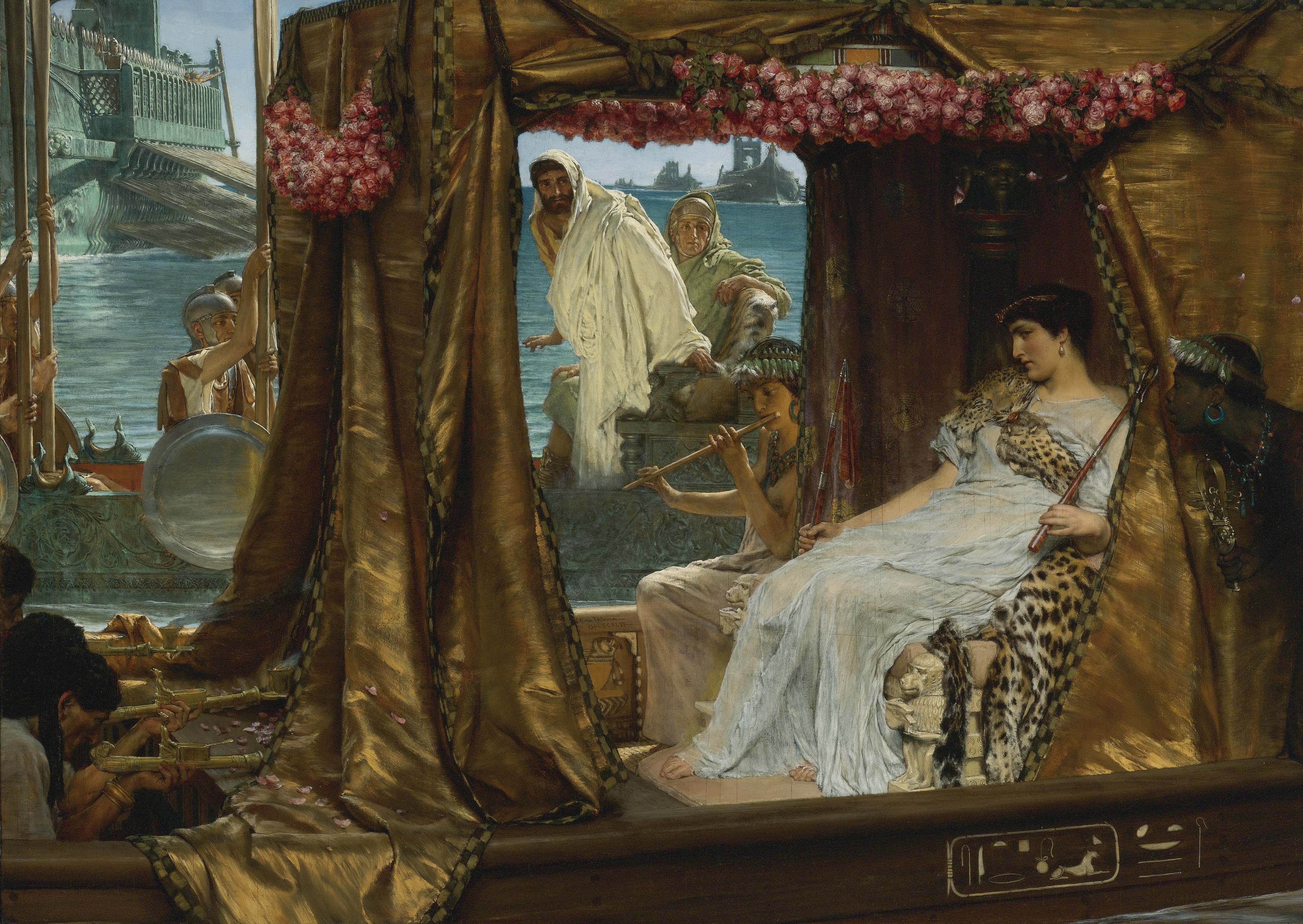
This delivery and the afore-mentioned deliberate pacing also meant that the “performances” of A&C were foregrounded. A&C were the hammed-up actors in their own blockbuster, not just in terms of the ludicrously over the top way they voice their love but also in the way they inject this passion, this risk-taking, into their behaviour in the political arena. Whilst also knowing they are a bit too old and tired for all this display and that it is unlikely to end well. But there egos can’t help themselves. This is also perhaps what has made the story, and especially the “idea” of Cleopatra, so alluring to subsequent generations. (Though as the preposterous flummery of Dutch/British Victorian artist above shows most of these generations preferred their Cleo to look like she had come from Surrey).
Making sense of the “epic” in the tale whilst still permitting us to make a personal, emotional, connection is Mr Godwin’s, and his casts’, smartest achievement here. Hildegard Bechtler’s revolving set (note to designers: always use the revolve on the Olivier to avoid the “acres of space” illusion) is sumptuously minimal, or minimally sumptuous, making the delineation between efficient Rome (modern war room with split screen conflict footage), sultry Egypt (Alexandrian palace with complete with pool – only slightly Vegas) and all places in between, including a submarine, clear without being fussy. Once again it does slow down proceedings but, like I say, that gives time to process what we learn from each of the sometimes rapid-fire scenes.
I’ve no doubt that Anthony Hopkins and Judi Dench did it better but this was the first time the play properly worked for me. Sophie Okonedo, dolled up in slinky ballgowns (Evie Gurney and the costume team can certainly tailor), breezes through Cleo’s caprice, wit, quick temper, self-obsession, but still manages to make her exposed, needing her soldier-boy especially when he is not there. The bickering is patently borne of adoration and mutual dependence, as well as their individual self-regard.
Ralph Fiennes brings a little of the faded rock star from A Bigger Splash as he dons baggy salvars when relaxing with his lady love. Yet he also, as you might expect, nails military bearing when required. Throughout he does seem troubled, burdened if you will, shoulders hunched, as if he knows how the picture will end. As do we particularly given Simon Godwin’s decision to show us the end at the beginning (and the end, obvs). I had forgotten how many wonderful lines Shakespeare gives Antony to grapple with his failure, his fading from view. Loved it.
Eternity was in our lips and eyes …. ‘fraid not Cleo as this excellent production shows. It will never be the Tourist’s favourite Shakespeare but finally I see the attraction.



 At Home He Feels Like A Tourist