
Translations at the National Theatre review ****

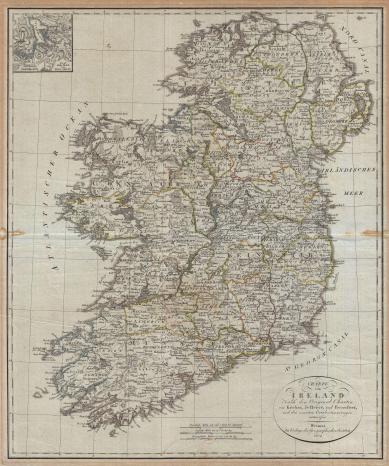
1804_jeffreys_and_kitchin_map_of_ireland_-_geographicus_-_ireland-weimar-1804

Translations

National Theatre Olivier, 6th June 2018

At the end of the day it is all about the words. That’s theatre. The power of language. Which is exactly what Brian Friel’s play is all about. A modern classic, first seen in 1980, in Derry (with Stephen Rea, Liam Neeson and Ray McAnally no less in the cast), to set alongside Philadelphia Here I Come, Aristocrats, Faith Healer, Dancing at Lughnasa and The Home Place, as masterpieces from his hand. All set in the fictional town of Baie Beag (Ballybeg). All exploring the particularities of Irish history, society and culture but all offering up universal insight. The Irish Chekhov as some would, with very good reason, have it.

So I wasn’t going to pass this up and I was going to insist the SO attend. I have no truck with those currently giving Rufus Norris and the NT a kicking. There have been some absolute belters over the last couple of years which more than compensate for a couple of missteps, so you haters can STFU. Anyway this is a marvellous productions. Rae Smith has conjured up another evocative, organic, set, the “hedge” school in which the play is set is foregrounded, leaving the rest of the Oliver stage as moorland which stretches to a backdrop of rolling mist and clouds. It is 1833 in Ballybeg and embittered Manus, (superbly played by Seamus O”Hara), lame in one leg, is setting up the school run by his father Hugh. He is joined by the voluble Jimmy Jack Cassie whose shambling manner and fondness for a tipple belies his classical education. He and Hugh are equally at home in Latin and Greek as their native Gaelic. Dermot Crowley and Ciaran Hinds offer up a par of towering performances. The hedge schools which were the source of their learning are about to be replaced by a free national school system. Sarah movingly played by Michelle Fox, whose speech is impaired, is joined by Maire (Judith Roddy who was also marvellous in the recent Donmar Knives in Hens), Doalty (Lawrence Kinlan) and Bridget (Aoife Duffin) in the school.

Through their interchanges we quickly become immersed in their domestic worlds, lives that may lack material plenty but are rich in many other ways. The Great Famine is still a decade away but the threat from potato blight is addressed. Translations is not an overtly political play, Brian Friel determined to avoid that commenting  that “the play has to do with language and only language … and if it becomes overwhelmed by that political element, it is lost”. However when Hugh’s other, prodigal, son, Owen, returns after a several year absence, the clash of culture between British coloniser and Irish colonised, is revealed. Owen (Colin Morgan, TV’s Merlin) has returned with two English soldiers, the ruthless and patronising cartographer Captain Lancey (accurately represented by Rufus Wright) and the more sympathetic orthographer Lieutenant Yolland (Adetomiwa Edun). Owen is a translator: the soldiers have been tasked with renaming the Irish place names into English. This was initially it seems a virtuous undertaking but the metaphor is clear and, eventually, as you might guess, the army seeks retribution when one of their number goes missing.

Now Mr Friel’s brilliant central conceit is to have both the English and Irish characters speaking in English. The two English officers speak no Gaelic, though Yolland as he falls in love with both country and Maire, tries to learn. Owen, initially misnamed Roland by the officers, picks his way carefully through his translations. And, it transpires, that a number of the Irish contingent know a great deal more English that they are letting on.

Hopefully my brief description should persuade you just how elegantly, and cleverly, constructed Mr Friel’s play is. But it doesn’t stop there. In scene after scene and line after line, he patiently, but insistently, drives his points home. Even so these characters are no mere ciphers; there is plenty of emotion too. The love scene, ostensibly in two different languages, between Maire and Yolland, is very affecting, Sarah’s yearning for Manus which echoes it, Manus’s flight when he realises there is nothing left for him in Ballybeg,, Hugh’s demons fuelled by drink, Owen’s cultural ambivalence; everyone has a story to tell, and not just in words.

Ian Rickson is as sure-footed in his direction of the marvellous cast as you could wish for though there are moments of over-deliberation. Neil Austin’s lighting, Ian Dickinson’s sound design and the music of Stephen Warbeck all stand out,  and a big hurrah for the voice work of Charmian Hoare and Jeanette Nelson and to dialect coach Majella Hurley, this being a play about language.


Girl From the North Country review ****

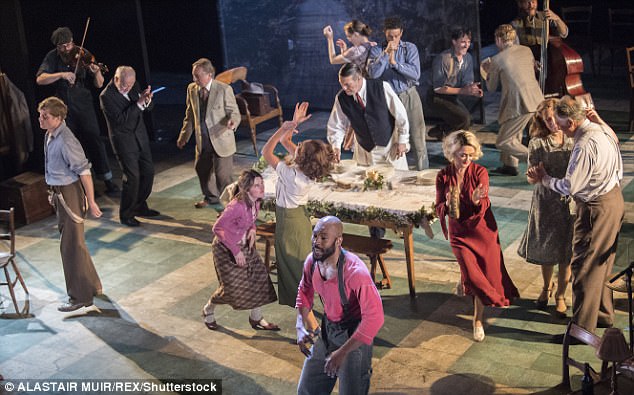
42c1b7d200000578-4738018-image-m-25_1501202623766

Girl From the North Country

The Old Vic, 20th September 2017

(Girl From the North Country is transferring to the Noel Coward Theatre from 29th Dec 2017 through to 24th Mar 2018)

I am afraid there is a bit of a rant coming. If the Old Vic is going to fill matinee performances with teenage schoolkids can it please find a way to get them to shut up during the performance. I can just about deal with the Old Vic’s kettle-ing of the audience into the tiny foyer, the toilet squeezes (and I am a bloke – the ladies queue looks worse), the sometimes loose productions let down by under-rehearsal, the leg-room in parts of the Lilian Baylis Circle, the sound quality in parts of the stalls and the occasionally grasping approach to interval scheduling. Why? Because it is the Old Vic, a commercial theatre with no subsidy that does its level best to bring together the best creatives with classic plays and important new works. And it is a big space to fill. And, to be fair, they are doing something about the layout.

Now pitching up at matinees here and at the Young Vic is going to mean schoolkids. And by and large that is a brilliant thing. Watching some young-uns relax into the Joe Hill-Gibbons’s Midsummer Night Dream earlier in the year was a joy to behold. A bit of cacophony before the curtain rise, some fidgeting, the odd screen flicker, maybe even one or two whispers is normally a fair exchange for the audible gasps or whoops when something really exciting happens on stage. But what I could not stomach here was a trio of show-offs pointedly stage-whispering throughout. Too loud and frequent to ignore. Couldn’t find a teacher/TA to gently vent fury so ended up seething.

And thus my journey to grumpy old man is complete.

Anyway it meant that my enjoyment of Girl From the North Country was compromised. Which is a shame. Because as the remaining full houses and official and audience reviews suggest, it is very very good. I went with the SO as a replacement for BUD, who I had attempted to rope in, knowing full well that he would be enmeshed instead in a world of finance. Now the SO is famed in our house for her dislike of “musical theatre” and for eschewing any information in advance about what she will be seeing in the theatre. So having failed to gauge any reaction during the first half from her usual Sphinx-like gaze (and having myself been focused on the stage itself whilst trying to zone out the offending youths) I waited with bated breath for her verdict. “It is good – I am enjoying it”. I was tempted to insert the word “really” before “good” or “enjoying” in the previous sentence but that would imply a level of rapture that the SO rarely attains. in fact in the last 5 years of theatre going only The Ferryman, Andrew Scott’s Hamlet and Hytner’s NT Othello claimed a “really” good accolade.

Anyway the point is that this play with music really works. It is no surprise that writer Conor McPherson’s text is a delight. This is the man who delights in story-telling from a theatrical culture that does likewise. The setting, a guest house in Duluth, Minnesota (the birth-place of Bob Dylan) in 1934 as the US is emerging from the Great Depression, lends itself perfectly to this tableau of interweaving narratives. The characters are one rung up from the completely dispossessed, and the Crash and the ensuing credit collapse and failed harvests are swinging into the rear view mirror, but these characters still have next to nothing and are scraping around for the means to live.

Sorry another aside. If you ever get a chance read the novel Duluth by Gore Vidal which uses the city as a starting point for a brilliantly structured flight of fancy with layers of meaning and sharp satire. As usual Mr Vidal was decades ahead of the zeitgeist. And now I see there is a revival of his play, The Best Man, about to tour. I hope the production does it justice as the text (and film adaptation with Henry Fonda in the lead) shows a play with real relevance to US politics today, (though at the time of writing Vidal’s acerbic wit was aimed at Nixon, the Kennedys and McCarthy). That nice Martin Shaw will take the lead role and Simon Evans will direct (a wise choice given his recent Arturo Ui at the Donmar). I would definitely gives this a viewing.

Anyway back to the matter in hand. Now there is a big Bob Dylan shaped whole in my life. I have tried half-heartedly to fill it but have never really been persuaded. Seeing and hearing this might have changed my mind, but if it eventually doesn’t that is no judgement on the 20 songs here. For in the context of the production the music and lyrics were a perfect fit. There is no particular attempt to make lyrics echo plot or vice versa. This is a play with songs (some partial, some reprised and most realised with standing microphones) and not a musical. No jazz hands, fisting clenching or “woe is me” ballads. Just a procession of interludes where one or more of the characters plunder Mr Dylan’s back catalogue (across the decades so not just the obvious early folk-y/bluegrass-y stuff) accompanied by a band playing only instruments of the Depression years period. (Hats off to musicians, Alan Berry, Charlie Brown, Pete Callard and Don Richardson). The arrangements from Simon Hale are very satisfying, the lyrics are self-evidently beautiful and the performances pitch perfect (emotionally I mean – obviously some of the cast are better singers than others). Particular favourites for me were Slow Train, Jokerman, Hurricane, You Ain’t Going Nowhere and Make You Feel My Love. And the diminutive Shirley Henderson belting out Like a Rolling Stone.

Mr McPherson, who directs here as well, an eminently sensible decision given the structure of the work, lets the characters emerge with a sparse but emotionally affecting text. The whole play is only just over a couple of hours. Strip out the music and maybe there is 90 minutes of drama. Yet there are 13 named characters. We get to know all of them and their stories though. That alone is a remarkable achievement.

Ciaran Hinds plays the owner of the guesthouse Nick Laine. A big man whose dreams were crushed a long time ago. Last time we saw Mr Hinds he was a curiously lifeless Claudius in the Cumberbatch Hamlet. Here though he is what he should be. Wife Elizabeth has long since retreated into her own world but her delusions do not stop her seeing the essence of what is going on around her. Shirley Henderson (whom I adore) is maybe a tiny bit over the top but her unravelled self works as metaphor for America in these years. Son Gene, played by telly star, Sam Reid yearns to write but likes the whisky a bit much. Again a stock character, true, but not a stereotype. Adopted daughter Marianne, played by Sheila Atim, is black and hugs the guest-house for fear of attack. Nick would like to marry her off to elderly shop-owner Mr Perry (Jim Norton) but she resists, fearing a life of unhappiness and frustration. Katherine Draper (the excellent Claudia Jolly) is passing through and has hopes of an inheritance which will let her set up a business with Nick with whom she is having an affair. Yet Nick will never leave Elizabeth and, anyway, Katherine’s financial salvation vanishes into thin air.

A couple of cons then crash the guesthouse, Joe Scott (Arinze Kene who I need to keep tabs on) a good man, an ex-boxer, who woos Marianne, and “Reverend” Meadows, (a suitably sly Michael Schaeffer), a self-styled preacher and bible seller, who is up to no good. We are also joined by the bankrupt and broken Burke family (moving performances from Stanley Townsend and Bronagh Gallagher) whose son Elias (Jack Shalloo) has an intellectual disability. And to top it off we have the mighty Ron Cook as Dr Walker, who acts as narrator to add context, Mrs Nielsen (Debbie Kurup) and a fine ensemble (Kirsty Malpass, Tome Peters, Karl Queensborough) to add depth to the chorus. Overall all then a busy stage but the scene changes were deftly handled.

Now if I had a small misgiving, (aside from the babbling youth), it would be that the structure and length of the play constrains any real plot development. As I say we get to “know” these characters and understand their dreams and frustrations but, all up, only a few things actually happen. No matter given the sublime spell that the dialogue, music and lyrics help to create, but I think this could actually have done with being a little longer (a rare request from the Tourist) to expand the stories of the Laine and Burke families in particular, and maybe heighten the drama. I also think that when this is revived, (the rest of the run is sold out I think), as it surely will be, an outdoor setting, on a summer’s evening, might turn it into magic.

Anyway,whilst maybe not quite up there with Mr McPherson’s The Weir on the theatrical bucket list, this is a play with music that should be seen. Even, or maybe especially, if you are not a Dylan devotee. Remember it was the recalcitrant Nobel Prize winner who approached Mr McPherson and attached no strings to the project. Clearly he knew that justice would be done to his poetry (though it seems the old curmudgeon hasn’t seen it yet).