Edward II
Greenwich Theatre, 24th January 2018
Right then, This is what theatre is all about. Take a cast-iron classic history play from Jacobean bad-boy Kit Marlowe, hack out thematic repetition, wordiness and some characters, pare back set, costumes, sound and lighting, and let a young, hungry cast do its thing. This is not the first time that Edward II has been given this treatment, (there are echoes of Joe Hill-Gibbons divisive NT production a few years ago), and it won’t be the last given the plays themes. Marlowe often proves just too juicy for directors who feel compelled to make their artistic mark. The risible Faustus from Jamie Lloyd a couple of years ago shows just a mess some have made of this opportunity. We walked out at the interval leaving it to those whooping at Kit Harington’s bum and munching on McDonalds (I kid you not).
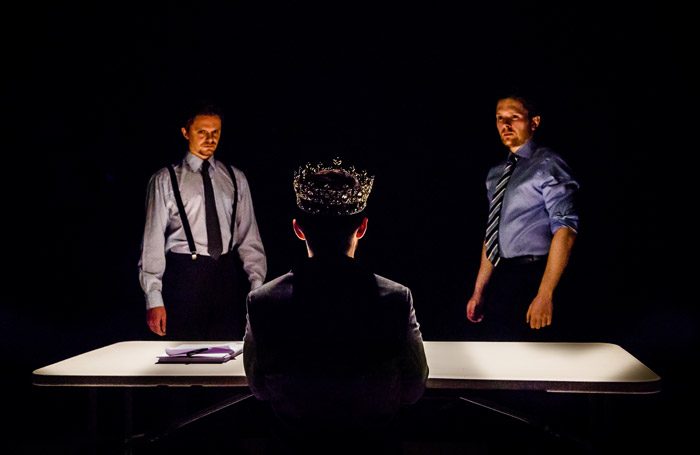
On the other hand if you let the “actors” get too actorly, and treat every word of Marlowe’s text with solemnity, then it can turn into an impenetrable slog. It shouldn’t. This is a salacious shocker but it also draws out its themes, of homophobia for sure, but also, and more importantly, class division and religious hypocrisy, with brutal clarity. Ricky Dukes as adaptor and director, and his team at Lazarus Theatre, have performed a minor miracle in getting this down to 90 minutes whilst still highlighting these themes, drawing out the characters and their motives and preserving the flavour of Marlowe’s delicious verse. And it is properly thrilling as well. The Spensers and Sir John of Hainault, together with various toffs and hangers-on, are dispensed with. The scenes pre and post the unpleasantness with the poker are all collapsed into one tableaux, replete with scary clown masks, a lot of fake blood, polythene sheets, (practical as well as visually impressive), and, given the Greenwich Theatre air-con is pretty fierce, I should imagine a cold, naked Eddy II. The play ends with tween Eddy III admonishing all over the phone. It is a stunning last 20 minutes.
This cut means that the focus is on Eddy II and Gaveston’s relationship and the early manoeuvrings of the nobles, here just Kent, Mortimers pere et fils, Warwick, Lancaster and Canterbury, for and against them. It also gives more focus on Queen Isabella’s stratagems. The staging from designer Socha Corcoran is utilitarian. Cristiano Casimiro costume design sees the men in rolled up shirts and suit trousers looking like they have have been standing outside a City (or Wharf) bar for a few hours on a summer’s evening. (And what with the shouting and arguing they also sound like they might have downed a few). Edward II gets a sparkling, heavyweight crown and a robe, Queen Isabella a simple blue gown. Costumes and props remain on stage as do the entire cast with Eddy II and Gaveston standing on chairs when not involved as the nobles plot against them. Ben Jacobs’s lighting is harsh and Neil McKeown’s sound is aggressive and dramatic. Ricky Dukes and the team have learnt from the best that contemporary theatre direction can offer, (hello Katie Mitchell), but have avoided going over the top, so that the modern dress and stark set serve the play, not overwhelm it.
Best of all the young cast, even when down to the undies at the end, deliver Marlowe’s concrete verse crisply and clearly and ensure that the questions posed by Marlowe, albeit with deliberate ambiguity, are to the fore. Edward II was, by reputation a vain, immature man-child who presided over a period of weak government and fiscal chaos. Just as well son Eddy III came to the rescue and make England great (again?). Timothy Blore captures Edward Ii’s apparent callow sense of entitlement and his supposed infatuation with Oseloka Obi’s more knowing Galveston. The pair show real tenderness in the “love” scenes but Mr Obi makes sure we are uncertain as to Gaveston’s true motives and his manipulative nature. Jamie O’Neill delivers an excellent Mortimer as he orchestrates the others into first banishing Galveston, and later conspiring to see Edward murdered. Getting rid of, replacing or curtailing the powers of flawed kings, (here the Ordinances of 1311), has, after all, been an occupational requirement for the nobility/elite of this country across the centuries. Kings and queens after all are simply symbols to support the fiction of nationhood and underpin the theft of property. But too often they thought they could do what the liked, because, in essence they could.
Alex Zur as the protective Kent, David Clayton as the vengeful Canterbury, Stephen Smith as the Elder Mortimer, Stephen Emery as Lancaster and John Slade as Warwick are, to a man, superb. Topping them however is Alicia Charles as Isabella whose wounded pride cannot get in the way of her own, and eventually her son’s, destiny.
As I understand it homosexuality was tolerated in medieval and early modern society. The act of sodomy was theoretically punishable however, up to, and including, death. This reflects the influence of the church, always obsessed with the mechanics of sex. Such was the context in which Marlowe, regularly accused of blasphemy, (amongst other things), penned the play. He examined homosexual relationships in other plays and poems, notably in the opening of Dido, Queen of Carthage, and in his descriptions of Leander.
Whatever Marlowe’s own sexuality, and whether or not he was avowedly atheist, he presents his themes with provocative equivocation (to use the Jacobean buzzword). Was he tempting his contemporary audience to celebrate, condone or be moved by the central relationship? How critical is he of the social order which sees Gaveston’s real crime as his anonymous upbringing, a “minion”? How playful is Ed and Gaveston’s mocking of Canterbury, (who stands in for the Bishop of Coventry in this condensed production)? How true are Ed II’s emotions, after all he accedes to Gaveston’s banishment and execution? Is Gaveston driven by passion or the pursuit of power and wealth? What is the true relationship between Isabella and Mortimer and how does this influence their actions? Their lust for power doesn’t end well remember. War, pestilence, famine, the Scots and the French sticking their noses in, seizure of lands and possessions, trials, executions. All this followed from this struggle between king and his toffs. On the other hand some good came out of all this as it hastened in the beginning of Parliament as we know it.
There is so, so much more to Marlowe’s play than a some gay clinches, a poker and an arse and Lazarus’s production is an excellent contemporary attempt to capture this richness. This is a play that looks back to the defining philosophies of its setting, but also goaded and asked questions of its contemporary Elizabethan audience, and, because Marlowe’s writing is so wise and we are essentially the same then as now, (bar the technology), it can make us think today.
Short, sharp, brutish it is. Very short given the cut and paste Mr Dukes has taken to the text and action. But sweet too. I can see that other reviews of this productions are mixed to say the least. There are a fair few that seem not to know quite what had hit them. Not saying I did but I was persuaded and will be back to see Lazarus’s take on Golding’s Lord of the Flies. Thanks very much Lazarus.

 At Home He Feels Like A Tourist