
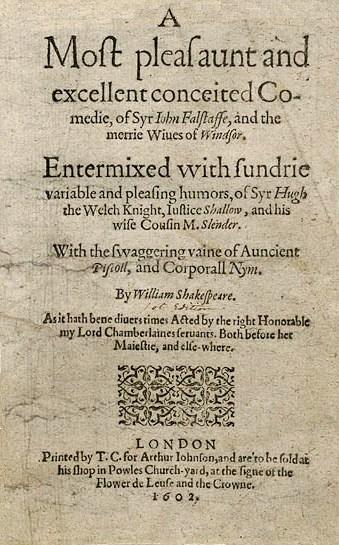
The Merry Wives of Windsor
RSC, Barbican Theatre, 13th December 2018
Confession. This was the first time I had ever seen a production of The Merry Wives of Windsor. The Tourist can’t remember there being an opportunity, RSC or otherwise, in those few periods of his intensive theatre-going in the past, and I don’t think there was a production of sufficient quality over the more fallow years to drag him away from the reality of life, work, kids, drink and the like.
Also, I have to admit, TMWOW has always sounded a bit limp, with the Shakespeare industry being a bit sniffy about its worth, dubbing it “the first sit-com”, compared to the other comedies, Twelfth Night, Dream, Much Ado, As You Like It, Errors, Shrew ….. in fact only The Two Noble Kinsmen of the “pure” comedies seems to get a worse rap. (Well maybe The Taming of the Shrew with its impossible to mitigate misogyny without some dubious directorial device). The other criticism seems to centre on the disappointment of taking one of WS’s most “rounded” characters, analytically as well as literally, out of the history plays and plonking him into a class-based farce as the butt of the comedy.
Well just as Barrie Rutter made a case, albeit not entirely convincing, for WS’s (with John Fletcher) last contractural obligation with his Two Noble Kinsmen at the Globe, so director Fiona Laird has served up a peach for the RSC, (though it is just about to end its run at the Barbican). All I can say is that if TMWOW is normally this funny then all those naysayers who are supposed to know their onions when it comes to the Bard need their heads examined.
If it isn’t normally this funny then Ms Laird is to be further congratulated for making it so to a contemporary audience. Shakespeare’s humour comes from plot – usually will they/won’t they romances and unlikely assignations, from – word-play – badinage, punning and bawdiness – and from physical comedy – which, obviously, is not something made explicit in a text. To make a modern audience laugh it usually makes sense to trust Will and let the plot do what it will, play down the anachronistic, and not always easy to follow, wordery and massively ramp up the caricature, mannerism and visual gags. Which is exactly what this production does. With plenty of new interpolations.
If the audience reaction at the performance the Tourist attended was anything to go by, and it seems this has been supported by critics, professional and amateur alike, this definitively worked. I laughed. A lot. In fact as much as I can ever remember for a Shakespeare comedy. It is not as all round satisfying as the best Much Ado or Twelfth Night production but it was still a revelation.
The plot is contrived. And daft. No question. One theory alleges that Will only had 14 days to come up with it after the Queen requested an entertainment for the Order of the Garter festival in 1597 to feature her favourite of his comic creations, Sir John Falstaff. Now, as I sure you all know, Falstaff is way more than just a comic buffoon, as we see in Henry IV Parts I and II, and as Mistress Quickly explains in her eulogy in Henry V. He may be vain, boastful, corrupt, cowardly, a drunk and petty criminal, but he is charismatic and he embraces life and we, and Prince Hal, therefore love him despite his faults. And he is, of course, fat and as everyone knows us fat people, with our seeming inability to control our appetites, and our apparent physical limitations, are just funny.
Humour invariably validates superiority. It takes what the group or society has deemed as unsettling, threatening or just different and turns it into something safe and tolerable. Falstaff, because the genius Shakespeare created him, is doubly funny because he is both the object of our laughter and also, because of his wit and intelligence, the source. Tricky business humour. I am sure that there are plenty of people who would be happy to make a joke at my expense because I am fat. In the same way it would probably make me happy to make a joke at their expense because they are stupid. Like I say tricky business.
Anyway I suspect big Will didn’t waste too much time mulling over the psychology of humour and just got on with the task, knowing which way the Elizabethan bread of patronage was buttered. Which explains the oft observed “lack of subtlety” in the plot and character. Yet, as all students of the situation-comedy know, the best characters in the genre have one, or more, personality traits amply exaggerated. And the best sit-com plots begin with a plausible set-up that gets incrementally ever more ridiculous. Which, give or take, is what happens in TMWOFW.
Falstaff is on his uppers. He pitches up in Windsor, or, in this production a place that feels suspiciously like Chigwell. He resolves to woo a couple of wealthy married women, Mistress Alice Ford and Mistress Margaret Page. He commands his servants, Pistol and Nym, to deliver the ladies identical love letters. They refuse and tell the ladies’s husbands. Page (Paul Dodds) isn’t too bothered but Ford is the jealous type, and he is introduced to Falstaff by the Host(ess) of the Garter Inn masquerading as a Master Brook in order to unveil Falstaff’s plans. Meanwhile, (yep there is always a meanwhile or two in these plots), three other chaps are trying to woo the Ford’s daughter, Anne; absurd French doctor Caius, asinine youth Master Abraham Slender, cousin (here nephew) to Justice Robert Shallow and young Fenton (Luke Newberry), a gentleman now bereft of his fortune.
Cue confusions, set-ups and comic revenges. By the three suitors on the Host(ess), by the two Mistresses on Falstaff, by “Brook” on Falstaff, by Ford on his wife, by everyone on Falstaff, and by Page and his wife on Slender and Caius, and by Anne and Fenton on the parents. It all ends happily though.
These farcical set pieces, replete with disguise and concealment, offer plenty of opportunity for clowning, which the cast, directed by Spymonkey specialist Toby Park, relish and have perfected over the run in Stratford and now London. David Troughton is a brilliant Falstaff, decked out in “fat suit” and priapic codpiece, and booming out his perfectly timed lines. Rebecca Lacey and Beth Cordingley are sensational as the conspiratorial and true friends, Mistresses Page and Ford, with exaggerated TOWIE accents and hamming up their humiliations of Falstaff, both in the laundry basket scene, here a wheelie-bin, and in the Woman of (now) Brentwood scene. Vince Leigh, who I remember pulled off a similar trick in Propellor’s all -male Taming of a Shrew as Sly/Petruchio, manages to make Ford’s jealousy palpable, and not a little pungent, but still amusing, and even gracious, when his suspicions prove unfounded. It is possible to believe that he and Beth Cordingley could be a couple who care beneath the mutual scorn.
Tim Samuels and Tom Padley make a fine double act as Shallow and Slender. All the servants, Ishia Bennison as Mistress Quickly, here housekeeper to Caius, Steve Basaula as his man Rugby, Nima Taleghani as Falstaff’s pageboy and John Macaulay as Simple, offer wry indulgence to the whims of their “betters”. Charlotte Josephine, Afolabi Alil and Josh Finan are also able to inject at least some of the personalities of Bardolph, Pistol and Nym, though these are more developed in the history plays. TMWOW is, at its heart, a satire on the pretensions and affectations of the “middling” class, their preoccupations with wealth, marriage prospects and position in society. Aristocracy is conspicuous by its absence, other than Falstaff and his young doppelgänger the spendthrift Fenton, though Shakespeare chucks in enough references which gently mock his Court audience, and the servants are generally enablers rather than protagonists. This then is obviously immediately recognisable territory for the modern audience, “we are all middle class now”, made more so here by the Essex milieu.
The comedy also takes a swipe at that staple of “English” comedy, foreigners, and specifically their funny accents. No obviously progressive way to do this so best wade right in. David Acton does exactly that with loquacious Welsh parson Sir Hugh Evans, another from the Shakespeare school of Welsh windbags, but Jonathan Cullen goes even further with Dr Caius, offering a Gallic strangling of the English language which goes well beyond the simply Clouseau-esque. A couple of deft retouches create some priceless, and filthy, moments, one of which I fear I might have made up in my own dirty mind as no-one else seemed to laugh. I particularly enjoyed the addition of the East Europeans who come to remove the wheelie-bin, who are snootily looked down on by the assembled throng whilst they, it transpires, are chatting about the scene’s resemblance to Proust.
The final theme of TMWOW seems to me to lie in the power executed by the women. By casting Katy Brittain as the Hostess of the Garter pub she too, along with the Mistresses, Anne, (another fine performance from Karen Fishwick to set alongside her Juliet in this season), and Mistress Quickly, run rings around the lads. They get their own way, and get revenge on the sexual predators, not through compromise, simpering or abasement but through their own agency, and they have a right laugh in the process. Switching the denouement to the town square, rather than Windsor Great Park, with Elizabeth’s statue towering over it, may slightly invalidate Falstaff’s Herne the Hunter garb, though Epping Forest isn’t too far away I’ll warrant, but it does, finally, leave the women on top. I wonder if Liz I herself would might been pleased with this ending.
Lez Brotherston’s set, turning seamlessly to reveal the skeletal interiors and exteriors of the half-timbered houses, is as ingenious as his hybridised costumes, which mix modern and Elizabethan fashions. There is plenty of blingey accessories on show, particular favourites for the Tourist were the blow-up flamingos, Mistress Page’s all in one cerise pink throne and foot-bath, Anne’s fluffy pooch, the f*ck-off massive gas barbecue, the remote-control golf cart and the white leather bar stools. Caroline Burrell has recreated Tim Mitchell’s lighting design particularly effective when the houses turn neon. Gregory Clarke’s sound design didn’t intrude and Fiona Laird’s own composition completed the jolly mood.
OK so there are a couple of occasions when my snob-o-meter vibrated. The Bread of Heaven chorus and the Dick Emery reference might have been steps too far but that is my problem not Ms Laird’s and the RSC’s. Overall this is a cracker of a show, very funny, easily digested and with a few points to prove. Carry On.
https://athomehefeelslikeatourist.blog/2018/06/27/the-two-noble-kinsman-at-the-globe-theatre-review/
 At Home He Feels Like A Tourist