I’ll tell you what. That Annie Baker backs herself. Here is another long play, near 2 hours straight through, where, visually, nothing much happens, bar a properly weird interlude, and dense with word. And this time it is a story about stories, Yep that’s right. The meta of meta. Six assorted punters (five men and just one woman) are ranged around a glass, conference style table telling each other stories in an attempt to create a story. Mediated by their distracted passive aggressive boss Sandy (the ever wonderful Conleth Hill), with occasional interruptions from his chipper assistant Sarah (Imogen Doel) to take food orders, excuse Sandy’s absences and chivvy the crew, and the voice of mogul “Max” (Andrew Woodall) who is bankrolling the enterprise. And with a note taker, Brian (Bill Milner), who eventually, memorably, gets stuck in.
It looks and feels like a scriptwriter’s meeting but its real purpose is never fully revealed and the rules of engagement are vague. Just see what happens seems to be Sandy’s instruction and from this all sorts of stuff pours out, from personal disclosures and confessionals, jokes, classical myth and allusion, gods, monsters, religious dualism, stories about stories, right through to various creation myths. It is affecting, thoughtful, funny, intriguing. Chloe Lamford’s set, complete with Perrier overload, Natasha Chiver’s garish lighting, Tom Gibbons’s sound, Sasha Milavic Davies’s movement (much use of swivel chairs), all echo the hyper-reality, or do I mean hyper-banality, of Annie Baker’s text, which gradually shifts the apparently mundane into the realms of the extraordinary. No surprise that Ms Lamford and Ms Baker co-direct.
It doesn’t quite scale the heights of profundity that it sets out to achieve, or the genuine grace of predecessor John, and it probably stole 20 minutes of my life more than it should have, but you still couldn’t fault its ambition and verve. In trying our patience, and venturing into the Freudian “uncanny”, it gets right under your skin even if it doesn’t shed too much fresh light on the creation of collective, and self, narrative. But it does cover all the bases, maybe too many, as concept overwhelms even this committed execution. Though with actors of this quality, Fisayo Akinade, Matt Bardock, Arthur Darvill, Hadley Fraser, Stuart McQuarrie and Sinead Matthews as the writers), individual character emerges out of the ensemble.
I guess the point was that whilst the urge to share our truth and humanity, and bring meaning to pointless existence, through stories remains undimmed, our capacity to do so might be fading, (especially as chaos in the outside world seeped into the ill-judged ending). Or maybe not. The vagueness of purpose is all part of the attraction in Annie Baker’s practice, so best just to go with the intractable flow and don’t pull too hard on the individual, intellectual, threads. It won’t be one of my top 10 2019 theatrical events but was still a story that could not be missed.
Sweat, Shipwreck and now Downstate. Some of the best new plays I have seen this year have come from established US playwrights. Whilst Brits can usually be relied upon to come up with more innovative theatre in terms of subject and form, (well maybe Shipwreck fits that bill), if you want talky, gritty, politicised, soundly structured drama then the American heavyweights fit the bill. I guess it reflects their history, we are currently being treated to a Miller-fest in London, one of the greats, and, socially, culturally and political, the US theatre community has much to comment on right now.
We have more to look forward to later in the year with the world premiere of David Mamet’s latest play Bitter Wheat, a “farce” inspired by the Weinstein scandal, Appropriate, Branden Jacobs-Jenkins’s take on the classic American family drama at the Donmar, Fairview at the Young Vic, the Pulitzer Prize winner from Jackie Sibblies Drury and The Starry Messenger from Kenneth Lonergan. Judging from the reviews in the US, (they do go on a bit those Broadway critics – mind you, pot, kettle, black), they are all well worth seeing. And maybe later in the year, or next year, we have Antipodes from the mighty Annie Baker to look forward to at the NT.
Now Bruce Norris is most renowned for his play Clybourne Park from 2010, a kind of sequel to Lorraine Hansberry’s classic A Raisin in the Sun from 1959, and The Low Road from 2013, which is pretty much at the top of my “you f*ckwit, how did you manage to miss that” list since its premiere at the Royal Court with a cast to die for. Property, race, the contradictions of capitalism, the marginalised. These are the beefy concerns of Mr Norris and many of his peers. And Mr Norris has an advantage in that his work is usually brought to life by the world famous, (well in certain circles), Steppenwolf Theatre Company in Chicago.
Downstate premiered at Steppenwolf’s Upstairs Theatre last year but, having been jointly commissioned by the NT, the company, including our own Cecilia Noble and Aimee Lou Wood, has been preserved for the London premiere. And it shows. This is ensemble acting at its best, and, I assume, the weeks of performance have polished up Mr Norris’s already sparkling dialogue to the jewel we see here. Downstate is not an easy subject to dramatise. Four paedophiles, released from prison but restricted in terms of movement (electronic tags and restriction zones), money, jobs and access to technology by state laws, are sharing a house in downstate Illinois overseen by weary police probation officer Ivy (Cecilia Noble). The elderly Fred (Francis Guinan) is wheelchair bound and the play starts with him listening to the testimony of one of his two victims, Andy (Tim Hopper) accompanied by his wife Em, (Matilda Ziegler). Andy, fresh from a survivors group, is plainly damaged and angry and determined to hear Fred acknowledge the abuse. Fred, who in all respects appears a kindly, almost naive old man, admits the crime but more as a matter of fact than remorse.
Fred is cared for by Dee (K Todd Freeman), a witty, intelligent and acerbic gay man, who still loves the young man, pointedly a Lost Boy in a production of Peter Pan, who was his evident victim. Gio (Glen Davies) is a garrulous younger man who refuses to accept he committed an offence, having had sex with young woman who “lied” about her age and, in breach of the conditions which govern his freedom, has befriended his young co-worker, bolshie Effie (Aimee Lou Wood) . The quartet is completed by Hispanic American Felix (Eddie Torres), who is barred from any contact with his family having abused one of his daughters. Like Gio, he has turned to religion, to atone and deflect.
Bruce Norris has thus created a realistic situation, (the programme offers some vital insights into the way sex offenders are treated in the US after they have nominally served their sentences), and four believable characters who cover the spectrum in terms of offences and the way in which they accept and acknowledge their actions. The play highlights the way in which society seeks to punish and secure revenge for these crimes as well as the debilitating impact on these men of the need to secure “protection” for any future potential recidivism. Punishing offenders for crimes that they have yet to commit is what makes sex offenders a special category of criminal. Which apparently doesn’t work anyway.
The brilliance of Mr Norris’s writing is that, without in any way lessening the impact of the suffering of the victims, Andy continues to play a central, if ambiguous, role throughout, we are asked to see them as sympathetic individuals, not monsters, and to listen to their accounts of what they did and who they are. They all see themselves in some way as victims. The uneasy fact is we start to understand, if never accept, why they would believe this and persist with the self-pity. Some of the bait and switches, and the speechifying, is a little mechanical, and I have still to make up my mind about the ending, but this is forgivable given the drama and dimensionality that it creates. It is not a comfortable watch but it grips from start to finish, and, if ultimately the task of a great playwright is to make you grapple with complex moral issues, without providing definitive answers, whilst still telling a story, then Mr Norris has delivered. It pokes and provokes, with no little humour, and even manages to generate audible audience gasps. That makes it a great play.
Todd Rosenthal’s set, Clint Ramos’s costumes, Adam Silverman’s lighting and Carolyn Downing’s sound, are note perfect. We are in the house with the characters. Pam McKinnon, who is the AD of the American Conservatory Theatre in San Francisco, is a long time collaborator with Bruce Norris. It shows. The rhythm here is well nigh perfect. And the cast is, as I said, superb. Normally when I say this it actually means one or two members didn’t quite bring the A game that most of their colleagues did. Not here though. Even so, if I had to pick out one performance, it would be K Todd Freeman’s Dee. It is he who has to say most of the unsayable.
I would be surprised if, like Clybourne Park, this doesn’t quickly become a staple, and, whilst I find it hard to believe a future production could match this, it is a play you must see. If only to reflect on how easy it would be to fail when dramatising these issues, (Lucy Prebble has fortunately gone on to bigger and better things since her debut The Sugar Syndrome which addressed a similar subject). Mr Norris is a brave writer, like many of the peers mentioned above. I look forward to seeing more of his work.
Who is the greatest living playwright (in the English language). Caryl Churchill. Obviously. Who is, in the opinion of the Tourist, probably the most talented playwright under 40 in Britain today. Ella Hickson. What was the best original play the Tourist saw last year. John by Annie Baker. And the best play so far this year. Sweat by Lynn Nottage.
So far this year the Tourist has seen 19 plays (well 18 and a half to be exact of which more in a future post. Actually it is quite a bit more than that but I have condensed the Pinter at Pinter season ). Too many. Certainly but such is the life of the friendless, privileged layabout.
Only 4 by women though. Not good enough. Either by me or the industry. Last year, (I shall refrain from the total number – it is embarrassing), just 25% of the plays of the plays I saw were by women. If I take just new plays (not classics or revivals) the ratio edges towards 40%. Not great but getting better.
Before I get started I note that Sweat is transferring to the Gielgud Theatre from 7th June for 6 weeks or so. If you haven’t seen it don’t hesitate.
Sweat is set largely in a bar in a de-industrialising town in the rust belt of the American North East. Lynn Nottage and her team spent over two years interviewing residents of Reading, Pennsylvania in preparation for writing the play. Now, as I know from having seen another Pulitzer Prize winning entertainment, Julia Wolfe’s oratorio Anthracite Fields, Reading was, in its heyday through the second half of the C19 and first few decades of the C20, a powerhouse of US industry built on iron and then steel, its proximity to coalfields and on the railway. Its fall was precipitous however and it became, by the time of the 2011 census, one of the poorest cities in the entire country, though it is now being reinvented as a centre for cycling nationally.
Ms Nottage’s play is set in 2000, though it begins in 2008, with the release of Jason (Patrick Gibson) from prison into the hands of probation officer Evan (Sule Rimi who has, thankfully, popped up on numerous occasions for my viewing pleasure). Jason is “reunited” with once friend Chris (Osy Ikhile). Neither is in a good place. We then flash back to see how we got to that place. Jason’s mum Cynthia (Claire Perkins), Chris’s mum Tracey (Martha Plimpton) and Jessie (Leanne Best) are celebrating in the bar managed by Stan (Stuart McQuarrie) and where Hispanic-American Oscar (Sebastian Viveros) is employed. Cynthia is estranged from husband Brucie (Wil Johnson) who has spiralled downwards after being shut out from the factory during a strike some years ago. All three, tough, women are also employed at the local steel-works, as are the boys, (though Chris wants another life), and as was Stan until an industrial accident, and it is against this back-drop that the story unfolds.
Now you might be thinking, uh-oh, this is going to be one of those terribly worthy political plays where a finger-pointing, hand-wringing lesson about economic and social injustice sucks the life out of the drama and leaves you with conscience enhanced but ever so slightly bored. Well nothing could be further from the truth. The relationships between the characters, and the extraordinary, often moving, dialogue, that describes them is perfectly pitched. The play is flawlessly plotted, structured and executed. The fact that Lynn Nottage is able to locate this within a broader economic and social context (blimey, she even nails the mixed blessings of NAFTA), to conjure up time and place (and history) and to explore fault-lines along racial, class and gender divides, without getting in the way of the personal drama, is what makes this such a complete work of theatre. This is fiction, with no trace of verbatim, but the process of its creation, the people that Ms Nottage talked too, make it very real.
There is nothing redemptive or uplifting here but that is the reality of the damage that the economic dislocation and industrial change has brought to the region and by implication, those left behind in the US and across the Western world. The play opened in New York in 2016 just before Trump’s election. It could not be more relevant. The shattering of the American Dream is hardly a novel subject for drama but Sweat brings home the causes and consequences of the shift away from heavy industry and manufacturing, from managed capitalism, through financial capitalism into the information age. Ms Nottage has said that “we are a nation that has lost our narrative”, which sums up the disillusionment, rage and frustration which is now being vented by those that have lost out and, for whom, the dignity of labour has been upended and faith shattered in a system which was supposed to protect them. Setting the play in an all-American bar, rather than the workplace itself, is a masterstroke, for this is an arena in which the tensions can truly erupt.
Even a play this perfect still needs cast and creatives to deliver. Indeed any flaw in delivery would probably be more visible. Fortunately we are in the secure hands of director Lynette Linton, assistant at the Donmar and now in the hot seat at the Bush. Frankie Bradshaw’s set is wonderful as the bar descends, altar-like, inside a framework of steel girders, supported by Oliver Fenwick’s lighting design and George Dennis’s sound. The cast is uniformly exemplary, another triumph for dialect coach Charmian Hoare, (though this Brit is no expert), with Claire Perkins particularly excellent as the striving Cynthia and Martha Plimpton just, and for once the vernacular is justified, awesome.
Best of all Lynn Nottage didn’t just helicopter in to extract her story and then move on (as it happens now to a work around the life of Michael Jackson – crikey!). No, she and the team, went back to show the play and to engage in many ways with the community across multiple projects. Drama matters. The Greeks knew that. Hard to see how it could matter more than with Sweat.
I would be very wary of playwright Annie Baker if I were you. She will bewitch you. Magical powers. That is the only way to explain John. Nothing really dramatic happens, the setting doesn’t change and the words, initially at least, seem quite ordinary. Yet the longer it goes on, (it clocks in at near 3 hours even stripping out a couple of intervals), the more mesmerised the audience becomes. It is “pregnant with possibilities” you see and turns out to be anything but ordinary. Extraordinary in fact. John goes beyond the exaggerated naturalism of Annie Baker’s previous plays into, well, a theatrical place that I have never quite experienced before.
How she wrote it is beyond me. Conjuring up these voices, and then just letting them speak in the moment, reveals a writer of utter confidence who knows exactly what she is about. If she can see and hear the whole thing before putting pen to paper I am in awe. If she makes it up as she goes along, (I know, she almost certainly didn’t), then frankly I am gobsmacked.
Haunting is the word I have seen elsewhere to encapsulate John and it is a good word both to describe the meanings that Ms Baker seeks to explore, the effects she creates and the memories she delivers beyond initial viewing. The very best plays/productions leave you with a series of pictures in your head that can be recalled long afterwards, (doh – that’s how memory works you numbnut), and it is not always the ones that you might immediately expect. John vividly falls into this category.
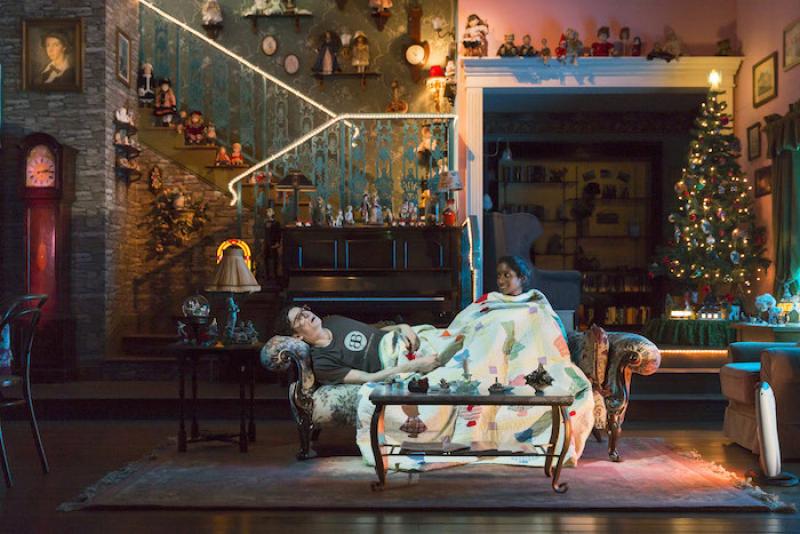
It is the week after Thanksgiving. Jenny (Anneika Rose) and Elias (Tom Mothersdale) arrive at a bed and breakfast in Gettysburg, Pennsylvania run by Mertis (Marylouise Burke). All that follows takes place in the lounge/dining area of the B&B. Chloe Lamford’s set is a thing of wonder and a character in itself. A vintage radio cum juke box seems to be permanently set to Bach. A self-playing piano alarmingly springs to life. The furniture is exactly as you would imagine in a fading but homely B&B. Think dusty chintz. The staircase leads to a handful of unseen bedrooms, (to which Jenny and Elias retreat on occasion), which seem never to be heated. The dining area is, optimistically, named “Paris”. There are knick-knacks a plenty but what is most disturbing are the dolls lining a high shelf. Jenny even recognises one of them as the doll which unsettled her as a child. Peter Mumford’s superb lighting complements the set. The atmosphere which is created is ever so slightly off-kilter from the expected cosy, but still a long way from full-blown, Gothic supernatural.
It was Elias’s idea to come to Gettysburg for a couple of nights after seeing Jenny’s family: she was less sure. (Gettysburg remains the single biggest day, well three days, of slaughter in American history and was the turning point in the Civil War. One for students of semiotics there methinks). Elias is a musician, Jenny writes questions for a TV quiz show. They are three years into their relationship but cracks are appearing. Innocent comments, or texts, can prompt gentle bickering. Moody Elias is always looking to take offence: Jenny predictably counters with textbook passive-aggressiveness. There are silences – Ms Baker really, really understands the importance of silences. Then, just as naturally, they cuddle up on the sofa, (too cold upstairs), with Elias trying to make up “ghost” stories. So, a portrait of an entirely recognisable modern couple, played to perfection by Anneika Rose and Tom Mothersdale.
And so to Mertis, aka Kitty. Marylouise Burke is a veteran of the US stage and this is a remarkable performance. Mertis throughout is sweet, dithery, eccentric, but no cliche. She runs the B&B with second husband George, who is apparently ill and remains unseen. Her blind friend Genevieve, another perfectly pitched performance from June Watson, comes to visit, and, over a few glasses she and Mertis engage Jenny in meaningful conversation, Jenny having stayed behind suffering from menstrual cramps as martyr Elias went off alone to visit the battlefields. Genevieve is a more forthright character than Mertis but both believe they have been accompanied by “watchers” in their lives. This culminates in the idea of love as a haunting, literally in Genevieve case by her ex called, you guessed it, John. Jenny feels something of the same as does Elias when subsequently cornered by Mertis.
This then is what I took to be the central concern of the play. The idea that the uncertainty, loneliness and disappointment of life is what drives the urge to believe in, take comfort from, or be disturbed by, something beyond the immediate and rational. The uncanny stories, (in Act 3 Mertis reads some Lovecraft to Genevieve who then remains in the shadows through Elias and Jenny’s “final” argument), conversations, signs and symbols that abound in the play, as well as the precise naturalism of the lines, are, I think, what Annie Baker has alighted on to force us to think about how this “need” articulates with our interior monologues and our sense of external reality. Alternatively maybe I am just a pseud who thinks too much.
Theatre, at its best, is a shared experience in a way that other art forms cannot replicate. The connection between text and actor, character and actor, audience and actor for sure. But also the connection between members of the audience as text and performance unfold. That was definitely in the air for John. It is subtle but entirely engrossing. It is crammed with detail, and that is just what registered, there was probably loads more that I missed. Oh and did I say it is funny. Because, at times, it really is.
It is no surprise that James Macdonald is the director here. Is there a director working on the UK stage who is more sympathetic to playwrights? I don’t think so. I am pretty sure this will end up being in my top ten plays this year and I will do my level best to see more of Annie Baker’s plays. (I see Circle, Mirror, Transformation is being revived at Home, Manchester shortly).
If you are one of those bellends who feels the need to constantly check your phone then this probably isn’t for you. But if you are at all interested in the possibilities of theatre then you should snap up one of the tickets for the remaining performances, snuggle into a seat at the Dorfman, (not always that easy), and let this evocative play bleed into you.




 At Home He Feels Like A Tourist