
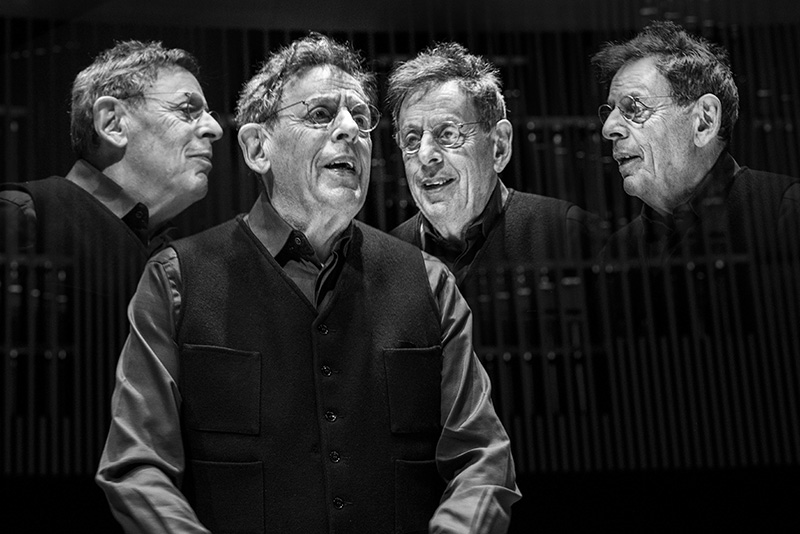
The Philip Glass Ensemble
Barbican Hall, 30th October 2019
Philip Glass – Music With Changing Parts
Of course it was a disappointment that PG himself wasn’t up to appearing but the old boy is coming up to 83 years old and was poorly. Hopefully he is better now. Anyway this was still a proper occasion, involving many of his long term collaborators, in a performance of this pivotal work from 1970. PG didn’t hand over performance of his large scale compositions until the 1970s. Prior to that he wasn’t sure other outfits were up to the task. So it was his own eponymous band that premiered this, Music in Fifths, Music in Similar Motion and Music in Contrary Motion, (all from 1969) and Music in Twelve Parts, composed through 1971 to 1974, and the only work comparable to this.
MWCP has had a few outings since then, though not here, but had fallen out of the PGE’s regular repertoire. However, after hearing other recent performances PG decided to revisit the score and enlarge it with brass and a vocal ensemble. The new version premiered in NYC and SF in 2018 and this was its first airing in Europe.
The “new” MWCP is near 90 minutes long, unbroken, and is built on shifting keyboard and woodwind melodies, which are, towards the end, semi-improvisatory, though don’t panic, the PGE knew exactly where they were going, The addition of the brass, courtesy of the London Contemporary Orchestra, and the choir, here drawn from the boys and girls of the Tiffin Chorus, (which extends beyond the eponymous schools into Kingston and surrounding areas), doesn’t detract from the hypnotic vibe, but it does provide far more texture than the original which is proper psychedelic, hippy-dippy. Harmonies emerge, expand, enlarge and retreat and there are contrapuntal contrasts but not to the extent of the breakthrough Music in Twelve Parts, last heard in these parts in 2017. But MWCP has the distinct advantage of not going on for 5 hours plus.
It isn’t possible to hear all of these PG classic pieces. You will drift off, to the mundane, (I composed my admittedly short Xmas list), as well as the memorable, that is part of the experience. But there will also be times when the sound just takes over. The keyboards of Mick Rossi and Nelson Padgett basically churn out repeated semi-quavers throughout leaving the woodwind to generate the shifting ostinati and the voices, delivered with military precision under choral conductor, Valerie Saint-Agathe, the complexity. This is hard work for such young voices, rapidly repeating same note patterns, sometimes in unison and sometimes divided, which vary in length and intensity, The brass, when it got going, did rather drown out the rest, and the Barbican’s acoustic, even with the tinkering from Dan Bora and Ryan Kelly, PGE’s sound designer and audio engineer, wasn’t helpful. Though maybe the reverberation was the effect they were aiming for.
The absence of PG wasn’t too much of a handicap musically as PGE’s director Michael Riesman stepped in to conduct from the piano. He, and Lisa Bielowa on keyboards (though she normally sings), have been in the PGE for ages, and helped create the new orchestration of MWCP with PG. There is no doubt that all these extra layers have created a work much closer to PG’s recent work than the “classical” minimalism of his youth. Whether this is a good or bad thing, not having heard the original version, I couldn’t tell you. Though as a fan of the more ascetic I guess not. Still, like I say, you have to grab these opportunities when they arise and I, and the whole audience based on the genuine ovation, am pleased I did.
Apparently the last time MWCP played in London, 48 years ago, there were a couple of groovy cats in the audience by the name of Bowie and Eno. They went on to highlight PG’s influence on the Berlin trilogy and, as all you PG fans will now, he went on to compose, eventually with Lodger earlier this year, symphonies based on those three classic albums. That alone justifies the existence of MWCP.
 At Home He Feels Like A Tourist