Ligeti Immersion Day, Guildhall Musicians, BBC Singers, BBC Symphony Orchestra, Sakari Oramo (conductor), Sofi Jeaninn (conductor), Augustin Hadelich (violin), Nicolas Hodges (piano)
Milton Court Concert Hall, St Giles’ Cripplegate, Barbican Hall, 2nd March 2019
Not obligatory to illustrate the world of Gyorgy Ligeti with a “universe” picture. But given the associations of, particularly, his micropolyphonic and choral music, with such themes, (via, amongst others, its use by Stanley Kubrick in 2001 A Space Odyssey), I figured, why not? And this image. courtesy of the Hubble telescope is a beauty no? Just like Ligeti’s music.
From a relatively recent standing start I have immersed myself in Ligeti’s music, of which there are essentially three periods, the Bartokian, “secret” early music, the micropolyphonic phase, and the final polymodal, polyrhythmic works after the four year hiatus around 1980. All his work though incorporates pulse, process and humour and a fascination with pitch, texture and harmony. His music is intriguing but there is usually some immediate appeal. Its structures, often deliberately, hold back emotion, or show it in an exaggerated or comic way, perhaps a reflection of his extraordinary life story. Yet beneath the surface scepticism it worms its way in to your head and heart. Well it does me. It is easy to see why he is now probably the most popular modernist composer.
At the top pf his game he is up there with Bach and Beethoven. So you can imagine how excited I was by this Immersion Day, which followed a similar, though smaller scale celebration at QEH last year under the direction of Pierre-Laurent Aimard. This day kicked off with the documentary film All Clouds Are Clocks, then to Milton Court for a selection of chamber works from students at the Guildhall, a chat by Ligeti expert Tim Rutherford-Johnson, a survey of unaccompanied choral works at St Giles’ Cripplegate by the BBC Singers and finally some of the key orchestral works with the BBC SO under the baton of Sakari Oramo including the two late concertos for violin and piano. Here’s the complete list.
Musica ricerata
10 Pieces for Wind Quintet
Horn Trio
Síppal, dobbal, nádihegedüvel
Éjszaka – Reggel
Zwei Kanons
Dri Phantasien
Idegen földön
Húsvét
Betlehemi királyok
Lux Aeterna
Magány
Nonsense Madrigals
Clocks and Clouds
Violin Concerto
Piano Concerto
Atmosphères
San Francisco Polyphony
I’ll spare you a great long regurgitation of the programme notes. Hardly seems worth it for the two readers who might stumble across this. Highlights then? The Horn Trio, Ligeti’s first statement of his mature style from 1982, which looks backwards in some ways to the Romantics but also contains astonishing new sounds and rhythms. A shout out to Karen Starkman’s horn playing, which was equally effective alongside the varied miniatures of the 10 Pieces for Wind Quintet. Best though was Síppal, dobbal, nádihegedüvel, (with pipes, drums, fiddle) from 2000, which sets four poems by Ligeti’s Hungarian mate Sandor Weores for mezzo-soprano, to a background of bonkers tuned and untuned percussion. Pure imagination. I particularly enjoyed the short, folk based, early choral pieces but star billing went to Lux Aeterna, the piece which Kubrick purloined, and which is the very definition of other worldly. Perfection from the BBC Singers. And in the evening, well all amazing but particularly Nicolas Hodges’s direct take on the metrical patters of the Piano Concerto from 1988 and, best of all, the closing San Francisco Polyphony, an eleven minute concerto for large orchestra which represents just about every idea GL ever had. Just immense.
Philharmonia Orchestra, Peter Eötvös (conductor), Iveta Apkalna (organ), László Fassang (Hammond organ)
Royal Festival Hall, 7th February 2019
Arnold Schoenberg – Accompaniment to an Imaginary Film Scene, Op. 34
Bela Bartok – Dance Suite
Igor Stravinsky – Symphony in Three Movements
Peter Eotvos – Multiversum
A sort of panic purchase this. It is a bit of a faff to use credit for returned tickets at the South Bank. Forgot that a chunk of said credit was about to expire and had already booked most of the concerts I was keen to see. So a bit of fat finger fact finding on the phone ahead of a booked concert and this was the result. Which I promptly forgot about until it popped up in the diary. Still you can’t go wrong with a bit of Bartok and Stravinsky right, and the Eotvos piece (a UK premiere) look like a lark.
Well up to a point. As it turns out Multiversum was a thing to behold but the rest of the programme was less convincing.
What with his Blue Reiter and Expressionist mates, his own daubing and his atmospheric, serialist diddling, Schoenberg was a shoe-in for a film score commission but when it came in 1929, purist that he was, he turned it down and itself wrote this, for an “imaginary” film. It is made up of three moods, Threatening Danger, Fear and Catastrophe and is as dull as everything else I have heard by Schoenberg, whether it be late Romantic gushing, atonal, tonal, or twelve tone. Maybe one day I’ll get it but not so far.
I’ve said before that Bartok’s music is equally fascinating and baffling for me. The Dance Suite manages to be both at the same time. He was commissioned by the Budapest municipality to come up with something which could restore some pride in a Hungary battered by the WWI peace settlement. It’s six movements work as a kind of musical memento mori for the Hungary of history with folk dance music with distinct Hungarian, Romanian and Arabic characters. Like all of Bartok he doesn’t hang around ideas wise so just when you have got your head around one melody he is on to the next one. There are some punchy passages notably in the second Allegro molto (which seems to end with “The Hills Are Alive” !!), the proceeding Allegro vivace and the short, spooky Comodo. The Finale is a suite all by itself. Played the right way, as in the recording I have by the Chicago SO under Solti it is up there with the best of the Stravinsky ballets and Ravel’s most atmospheric works. Here it felt a bit underwhelming.
Things perked up with the Stravinsky, which I have always felt has an air of Shostakovich about it, despite the fact that IS thought DSCH was an appalling hack. The Symphony in Three Movements is really just three, admittedly brilliant and imaginative, movements, written at different times, which IS cobbled together. The Overture: Allegro is as exciting as anything he ever wrote with its motoric string march proceeded by a woodwind and piano scamper. IS was at the height of his fame in New York at the end of WWII and his ballet music was even sampled by Disney. This movement could have fallen straight out of The Rite of Spring albeit with a neo-classical lilt. The Andante: Interlude, L’istesso tempo is led by the harp and was originally intended for a film, The Song of Bernadette. It too has a balletic feel. The finale, Con Moto, was tacked on ahead of the 1945 premiere and comprises a lolloping march, woodwind burble and more keyboard accompaniment. I have heard more urgent and involving performances but Mr Eotvos drove the Philharmonia a little harder than in the prior two pieces to good effect.
Now the composer says the Multiversum was written to channel his interest in “string theory, gravitational waves and the relationships between multiple universes”. Uh oh. I have nothing about contemporary composers describing what prompted and inspired them, and programmatic music has a long history, but sometimes …….. Anyway there are certainly passages in Multiversum where Mr Eotvos goes a little bit B movie, sci-fi on our collective arses, (though thankfully no ondes martenot or electronica), but, cumulatively, across its 35 minutes it does leave a monumental impression. This is largely down to the innovative combination of pipe organ and Hammond organ and the way the orchestra, which is not vast, is placed and combined.
The 20 strong string section was positioned to the audience left, woodwinds to the right, with brass and percussion scattered through the back of the stage. The Hammond organ allows for various pulse-y, lengthened effects, while the main pipe organ, in step-wise motion, generates the throb that sits behind the soundscapes. Together they do say “cosmos” even if at times it was more film score than the mind being stuff of, say, Ligeti or Xenakis.
There are three movements, Expansion, Multiversum and Time and Space, with a kind of Bach-ian construction – Prelude, Toccata, Chorale- though I couldn’t work out much in the way of themes or ideas. There were though some undeniably impressive passages, with inventive harmonies and waves of repetition, and I would happily listen to the piece again, but the influences of Mr Eotvos’s Hungarian heritage, and years spent with Stockhausen and Boulez, were not immediately apparent. He seemed to be having a lot of fun though as did the two soloists and the PO. Iveta Apkalna, dressed in a long, Gothic frock coat, certainly added drama on the RFH’s mighty organ, (her own baby is the brand spanking new Klais organ in the Elbphilharmonie), and Laszlo Fassang showed why he has the market in “classical” Hammond organ sewn up.
Hungaria, Milton Court Concert Hall, and 3rd February 2019
Gyorgy Kurtag
Six moments musicaux Op 44
Jatekok excerpts
Bela Bartok
14 Bagatelles Op 6
String Quartet No 3
Three Burlesques Op 8c
Gyorgy Ligeti
Etudes excerpts
Musica ricercata VI-XI
String Quartet No 1 Metamorphoses nocturnes
One day. Three concerts. Showcasing the chamber music of the three most renowned Hungarian composers of the C20 (OK, well maybe that is a little harsh on Zoltan Kodaly). In fact, outside of some chap by the name of Franz Lizst, probably the three most famous Hungarian composers of all time. Except that European history being what it is all three of them were actually born in Romania, in its various incarnations. But their shared musical heritage, rooted to various degrees in folk music, is defiantly and definitely Hungarian. To perform the music, a Spanish quartet, albeit one with great affinity with the repertoire, and a Serbian pianist, though again one with proven expertise in all three composers.
A confession. I missed the first concert. Late-ish flight back the previous evening (Bologna since you ask – not humble-bragging but the Tourist highly recommends La Dotta/Grassa/Rossa, as well as nearby Ferrara and Ravenna. Be thankful he hasn’t the energy to start blogging on these trips or the vanity to Instagram). Anyway a bit tired to get to the Barbican by 11am so the first 5 parts of Ligeti’s Musica ricercata were missed, as were various excerpts from Kurtag’s Jatekok piano works, his 12 Microludes and Bartok’s String Quartet no 1. Most annoying (to miss) in retrospect were the Microludes, 12 tiny string quartet pieces in homage to Kurtag’s mate Mihaly Andras. Still, no worries, as, on the strength of Six moments musicaux, which was Kurtag’s fourth string quartet, I have a CD of his entire output for the form winging its way to me.
For I was very taken with Six moments musicaux, a title lifted from Schubert (and Rachmaninov). Written in 2005 the, er, six short pieces differ in character both between, and within, themselves. All are, as is characteristic with GK, very short. The first, Invocatio has loud, hard rhythms, an announcement, encasing a pianissimo melody and a chorale. Footfalls is a slow, broken waltz, the title taken from a late Beckett play. Then a Capriccio, a duel with obstinate lines and then a memoriam, a sort of passacaglia dedicated to Hungarian pianist George Sebak. This, like the finale, was based on two of the Jatekok piano pieces. The finale, titled Les Adieux, tilts at Beethoven but is subtitled in the manner of Janacek and is a lament of sorts. The penultimate is a “study in harmonics” based on birdsong a la Messaien.
George Kurtag was notoriously slow to get in to his compositional stride, writing just 9 small-scale works in the 1960s and early 1970s. In 1973 though he was commissioned to write some children’s piano pieces, which became the first 4 volumes of Jatokek (“Games”), and since then he hasn’t stopped, and there are now several hundred of these piano pieces alongside all his other work. All tiny, for solo or duo piano, their titles range across ideas, emotions, images, dedications, gestures, and together these fragments encompass the range of his musical imagination. If I am honest, even with the love and care lavished on them by Tamara Stefanovich, the combined effect was a bit stupefying, not in a bad way, just that, in the absence of titles or breaks, it was tricky to keep up. I will need to revisit.
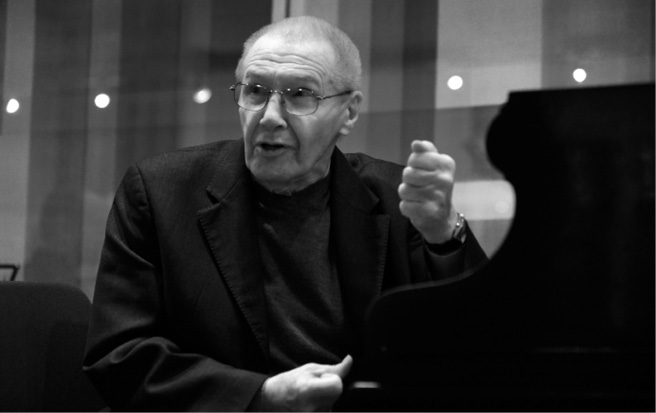
Indeed I will need to explore all of GK’s oeuvre. The idea of reducing music to fragments appeals (Flowers We Are, Mere Flowers, from the eighth volume of Jatokek, is just 7 notes long), but, based on these pieces, this is music with emotional heft despite its brevity, and not just an academic exercise. GK (pictured above) is an expert teacher, especially in chamber music, and the echoes of his own favourites, Bach, Beethoven, Schubert, Schumann, Webern and, of course, Bartok are easy to pick out. Of course it helps that GK adores the music of his friend and mentor Gyorgy Ligeti, who similarly, though I would contend, at a somewhat more elevated level, was to take the language and structure of music and turn it into something truly astounding. GK is still with us, now 93, though he was a little frail to attend the premiere of his opera, Fin de partie at La Scala last November, which is based on Beckett’s Endgame (which Ligeti first introduced him to).
In these two concerts we were treated to Tamara Stefanovich’s rendition of a handful of the Etudes (2, 8, 11, 3, 5, 15 and 10) and the second half of the Musica ricercata. The Etudes proved a fertile laboratory for Ligeti’s genius, mixing his early affinity for Hungarian folk sounds, (following in the footsteps of Bartok), his love of Debussy’s re-invention of piano music and purpose, his experiments with fractal patterns, his investigation of non-Western tonality and his fascination with Conlon Nancarrow’s complex cross-rhythms. Most of the etudes involve some, albeit very different variation on each hand playing at different speeds. If you have never heard, or claim never to want to hear, any “modern” classic music listen to the Etudes. You will change your mind. Guaranteed.
TS is a powerful advocate for the work, maybe not quite as powerful as her friend and collaborator, Pierre-Laurent Aimard, who performed the Etudes in their entirety last year at the QEH Ligeti weekender, but brings more Debussyian grace. Musica ricercata is more rule-based composition, not serialist, but a suite intended to progress from just two notes to a full-blown High Baroque fugue. It was written in the early 1950’s in Budapest, where it could not be played given the Soviet musical mindset, and, when GL moved to the West he saw it as too simple, until 1969 when the adventure of Boulez and Stockhausen was no longer de rigeur. I am still listening and learning, (some helpful programme notes here courtesy of Paul Griffiths), so can’t explain the music musically as it were, but, like the Etudes I know I like it. A few more years and I might even understand these works.
The highlight of the day though was Ligeti’s First String Quartet however, “Metamorphoses nocturnes”. The Ligeti quartets are putting ever more frequent appearances in the quartet repertoire and the Casals turned in an excellent rendition, near matching the Arditti recording I have. GL took this early piece with him when he left Hungary in 1956 after the Soviet crackdown, and it was premiered in Vienna in 1958. However, like the Musica ricercata, it was deemed a little too “prehistoric” in Ligeti’s words, to warrant dispersion, until its first recording in the 1970s. By then the world was ripe for the interplay of the folk rhythms and trademark Ligetian polyphony, colours and enquiry. The eight sections generate a variety of moods, atmospheric, macabre, dance, humour, with a motif, G-A-G sharp-A sharp, threaded throughout. It is brilliant.
What to do with Bela Bartok? It seems that every time I hear a performance of Bartok’s work, whether orchestral, chamber or solo, (or choral as with Cantata profana performed recently by the LSO, alongside Ligeti’s Lontano), that gets the juices flowing, it is immediately followed by a performance that perplexes. Here the String Quartet No 3, which to be fair I have heard a few times before courtesy of the Emerson recording, challenged and fascinated, whereas the piano pieces, the 14 Bagatelles and Three Burlesques just confused me. Oh well, I guess I just keep trying.
Now sometimes these “immersive” days can feel a bit cobbled together. Not here though as creative director Gerard McBurney introduced each piece with appropriate extracts from the writings of the composers themselves, reinforcing the links between them and their homeland, and the words of contemporary poets, such as Endre Ady and Attila Joszef, in Hungarian as well as translated. Moreover the video backdrop created by Amelia Kosminsky, a mature final year student at the Guildhall, was stunning. She had discovered a treasure trove of amateur monochrome photographs from Hungary throughout the C20, the Fortepan archive, which she combined superbly to match music and text. If I am honest sometimes these designs can just be bloody distracting. Not here though.



 At Home He Feels Like A Tourist